Festival · Nine evenings of wild flowers for Gauri, given back to the water
Bathukamma
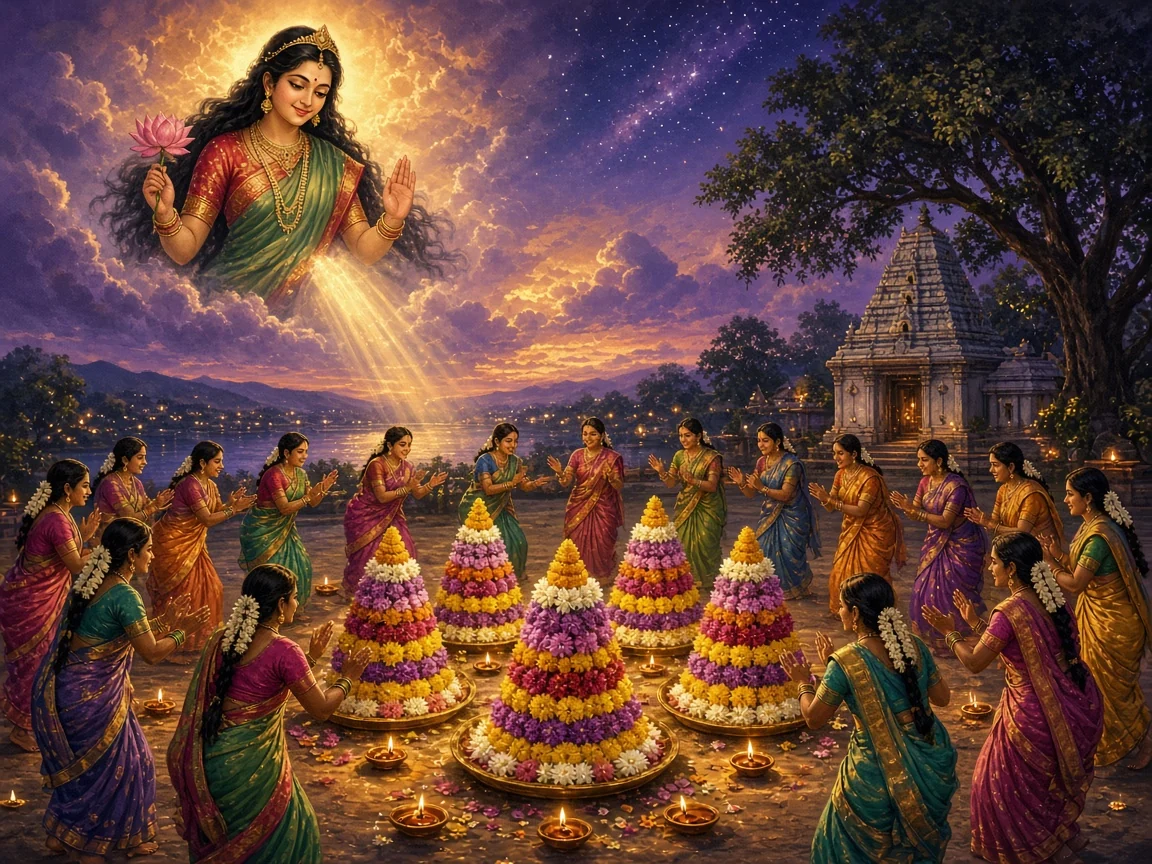
Bathukamma is the flower festival of the women of Telangana, kept for nine days from Mahalaya Amavasya to Durgashtami in Ashvin, at the end of the monsoon. Each day they build a cone of seasonal flowers in rings on a brass plate, crown it with Gauramma, a little Gauri of turmeric, and in the evening sing and clap round it in a circle before floating it on a pond or tank. The last day, Saddula Bathukamma, has the tallest flowers and five kinds of flavoured rice. It has been Telangana's state festival since 2014.
When is Bathukamma in 2027? Saddula Bathukamma, the last and greatest day, is Thursday 7 October 2027; it runs 29 September to 7 October 2027. In 2028: Tuesday 26 September 2028. Nine days from Mahalaya Amavasya, the new moon at the end of Bhadrapada, to Durgashtami, the eighth day of the bright half of Ashvin, in late September or October.
Also calledBathukamma PandugaBatukammaEngili Pula BathukammaSaddula BathukammaPedda Bathukammathe flower festival of Telangana
In short
What is Bathukamma?
The flower festival of the women of Telangana, kept for nine days in Ashvin at the end of the monsoon. Each day they build a cone of wild flowers, sing and clap round it in a circle, and float it on a pond or tank.
When is Bathukamma in 2027?
From Engili Pula Bathukamma on Mahalaya Amavasya, Wednesday 29 September 2027, to Saddula Bathukamma on Durgashtami, Thursday 7 October 2027, by the almanac; the state announces the days each year.
What does the word Bathukamma mean?
Bathuku is life and amma is mother, so it is read as "mother, come alive" or "live long, mother". The legends give it as the sages' blessing on Lakshmi born to a Chola king, or as the women's call to Sati to come back to life.
What is Gauramma?
A small cone of turmeric shaped as Gauri, Parvati, and set on top of the flowers. It is taken back before the flowers go into the water, and married women touch the turmeric to their mangalsutras.
What is Saddula Bathukamma?
The ninth and greatest day, on Durgashtami, with the tallest bathukammas and five flavoured rices, the saddulu, of curd, tamarind, lemon, coconut and sesame. Hyderabad keeps it on Tank Bund.
Next, in 2027Thursday 7 October 2027
29 September to 7 October 2027
Prime godGauri, as Gauramma of turmeric
with 3 more
WhereTelangana above all, from the villages to Hyderabad's Tank Bund; parts of Andhra Pradesh; and Telangana people in Mumbai, the United States, Britain, the Gulf and Australia
How longNine days, Engili Pula Bathukamma to Saddula Bathukamma
Nine days from Mahalaya Amavasya, the new moon at the end of Bhadrapada, to Durgashtami, the eighth day of the bright half of Ashvin, in late September or October
Why it is kept
Bathukamma is the festival of flowers that the women of Telangana build. At the end of the monsoon, when the dry upland turns green and the tanks are full, the fields and bunds fill with yellow tangedu and the white plumes of gunuka. For nine evenings the women stack those flowers in rings on a brass plate into a tower, crown it with a little Gauri of turmeric, stand round it clapping and singing, and give it to the water.
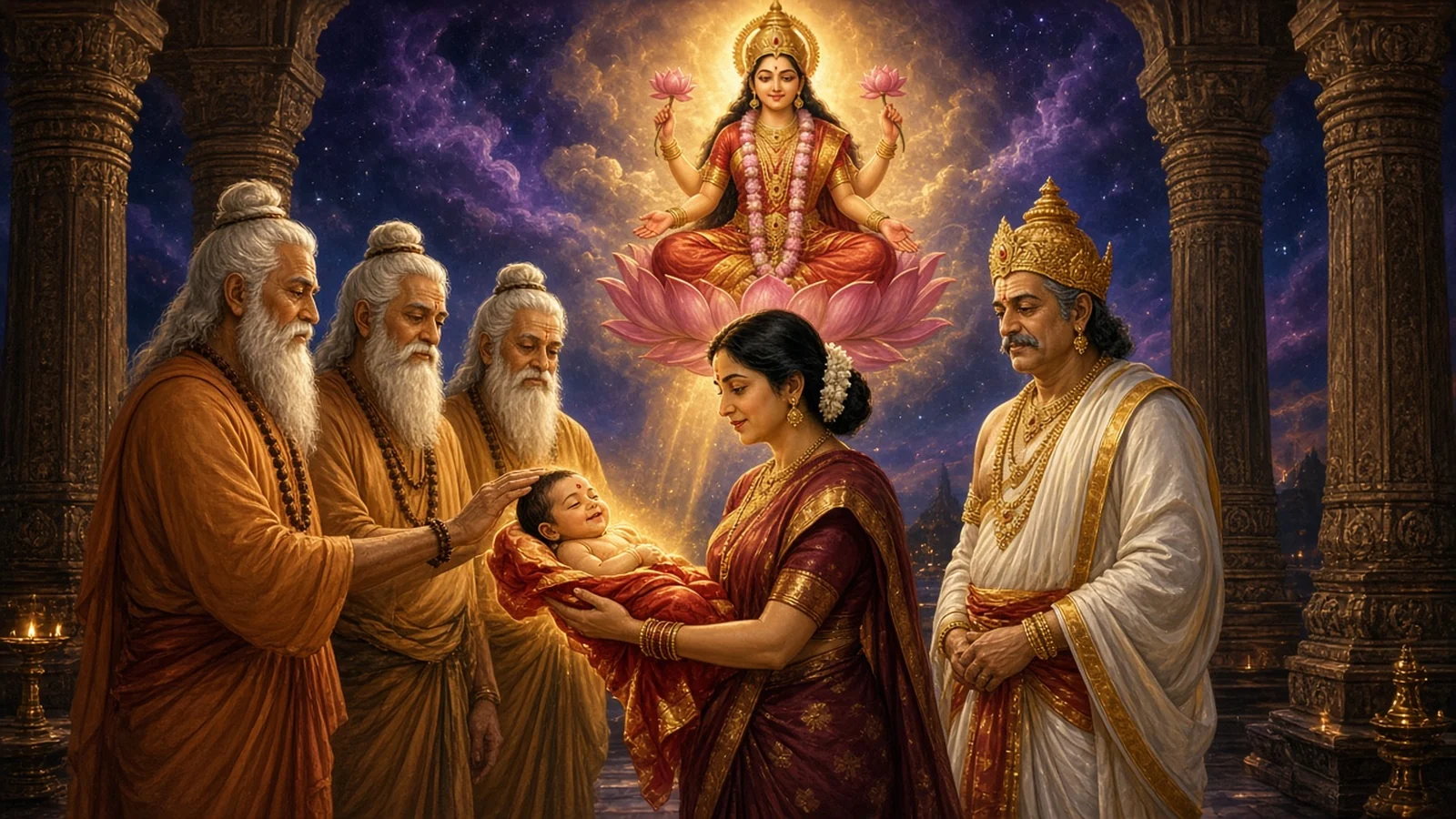
The name is a wish: bathuku, live, and amma, mother. The best known legend gives it to a girl. A Chola king, Dharmangada, and his queen Satyavati lost all hundred of their sons in war and prayed to Lakshmi for a daughter, and the goddess was born to them herself. The sages blessed the child with the name, live long, and she came through every danger of her childhood; the girls of the kingdom began to sing to her. Others tell it of Sati, who died in her father Daksha's fire, and say the women are calling her back to life, as she came back as Parvati. The temple town of Vemulawada has its own telling, of Parvati left grieving when her lord went away, and of women who made flowers in his shape to console her. All of these are in The Girl They Called to Live.
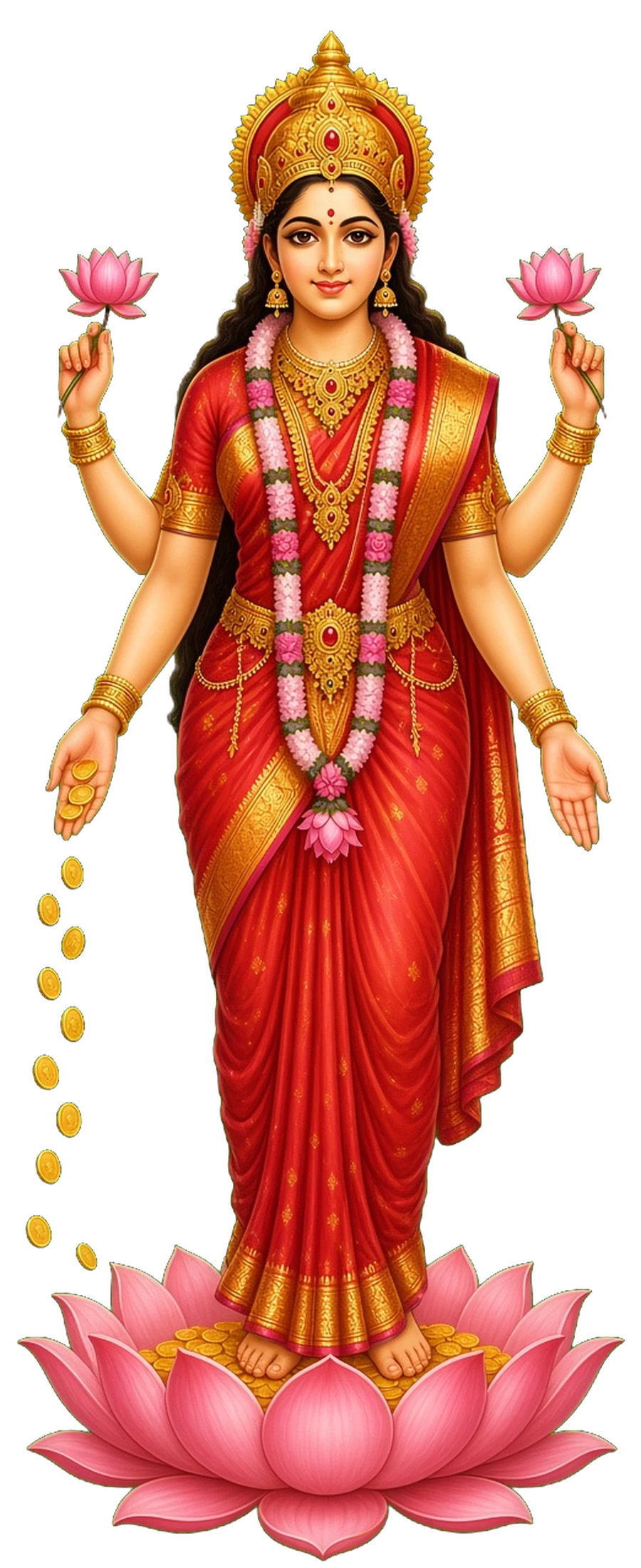
The Chola king and queen receive their baby daughter, Lakshmi born to them in a golden glow
So the goddess of the festival is Gauri, sitting on top of the flowers as Gauramma, and the flowers are Bathukamma herself. Environmental writers add a reason of the land's own: the wild flowers are many of them medicinal, and are said to cleanse the ponds and tanks they are floated in after the rains.
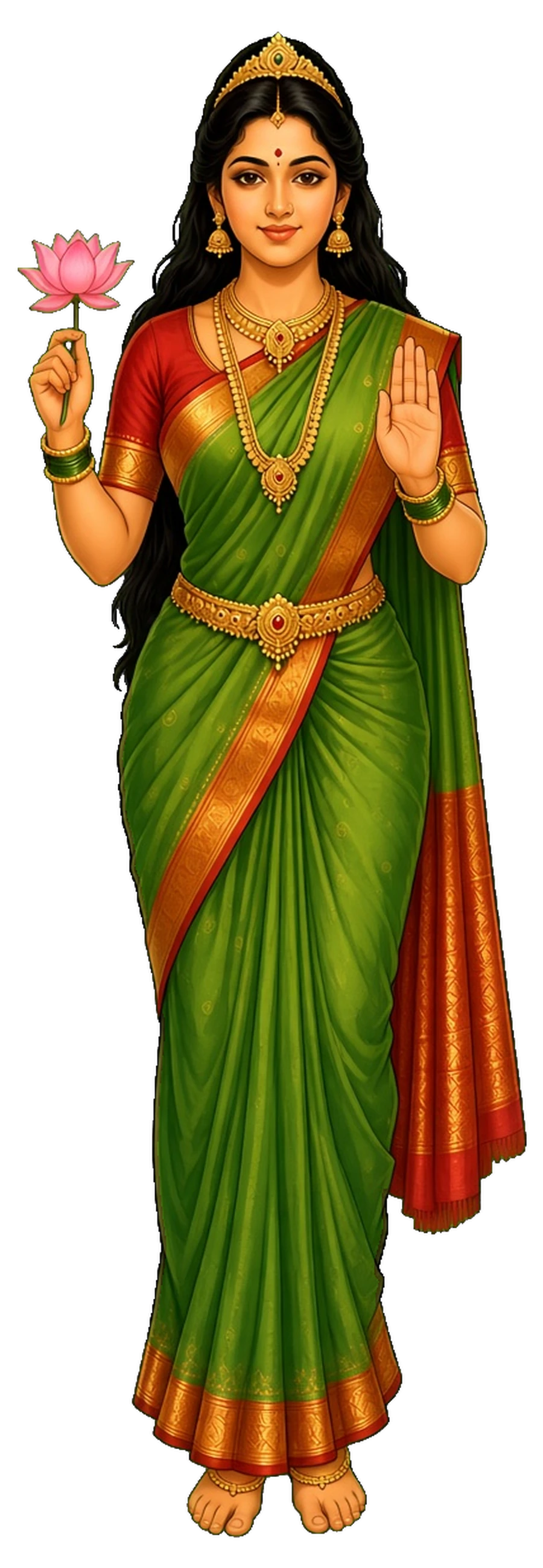
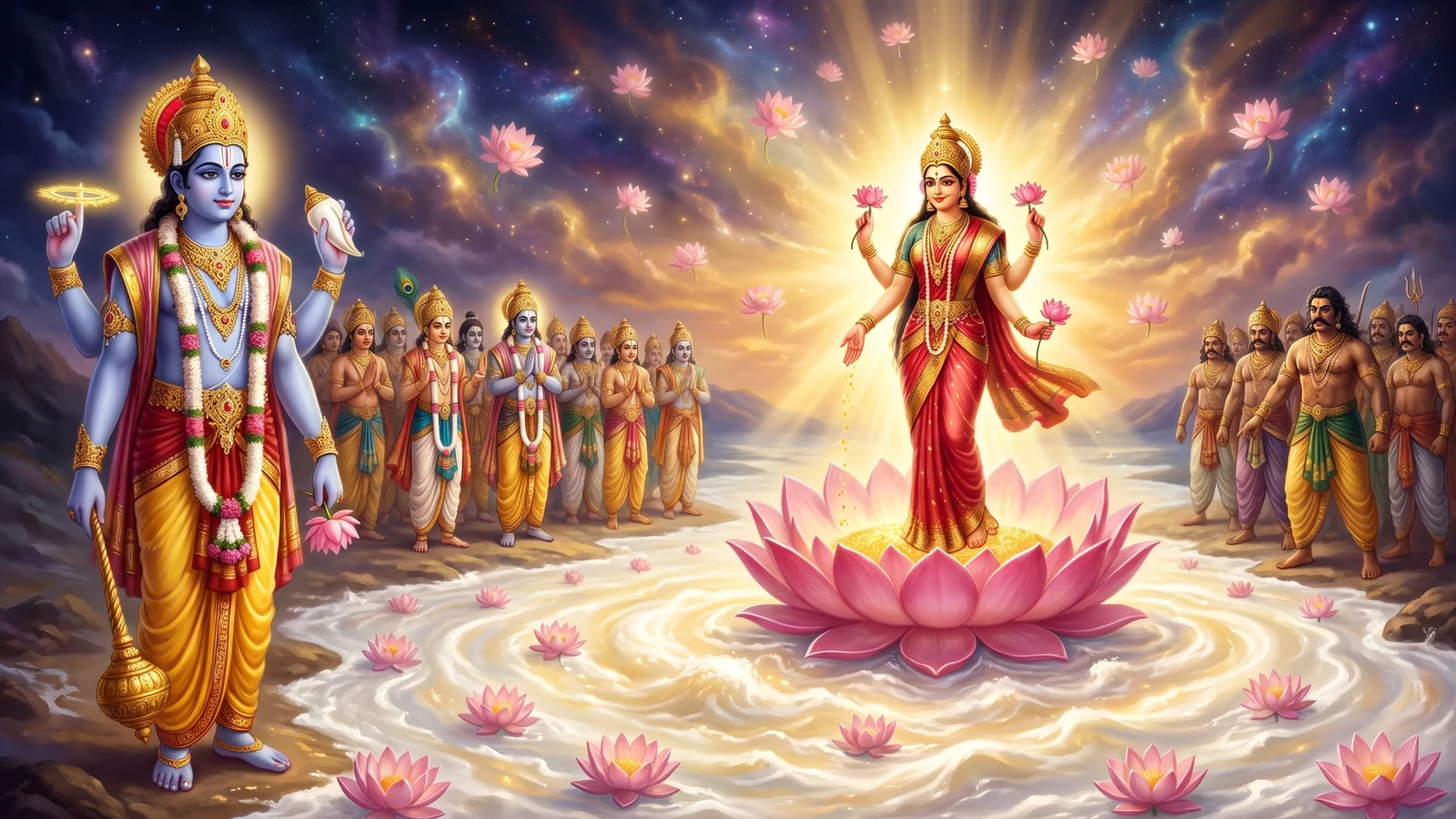
Gauramma, a little Gauri of turmeric, sits on top of the flowers as the goddess wakes in gold
The goddess on top of every bathukamma, a small cone of turmeric set on the flowers each day and taken back before they go into the water, when married women touch the turmeric to their mangalsutras. Many tell the festival as the women calling Sati back to life, and she came back as Parvati.
B
Bathukamma
The goddess of the flowers, whose name means "mother, come alive". The cone of flowers itself is worshipped as her, built new every day for nine days and sent down on the water.
In the best known legend she is born as the daughter of the Chola king Dharmangada and his queen Satyavati after they lose a hundred sons in war, and the sages name her Bathukamma, live long.
Her eighth day of the nine nights, Durgashtami, is the last day of Bathukamma, and the festival runs through the same days as Navratri.
Nine days of flowers
1
Engili Pula Bathukamma
Mahalaya Amavasya, the new moon at the end of Bhadrapada · Wednesday 29 September 2027
Engili Puvvula BathukammaPethara Amavasya
The men and boys go out early to the fields and bunds for tangedu, gunuka, marigolds and pumpkin flowers, and the first bathukamma of the year is built and taken out in the evening. The day's offering is sesame with rice flour, or coarsely pounded wet rice. In 2026 it fell on Saturday 10 October.
Engili Pula Bathukamma: men and boys bring tangedu and gunuka in from the field bunds at dawn
The first day of the bright half of Ashvin · Thursday 30 September 2027
The offering is atukulu, flattened rice, with boiled lentils and jaggery.
Atukula Bathukamma: flattened rice with lentils and jaggery offered before the day's flowers
3
Muddapappu Bathukamma
The second day · Friday 1 October 2027
Soft-boiled lentils with milk and jaggery are offered.
4
Nanabiyyam Bathukamma
The third day · Saturday 2 October 2027
The offering is rice soaked in water, with milk and jaggery.
5
Atla Bathukamma
The fourth day · Sunday 3 October 2027
Small pancakes of wheat flour, or dosas, are offered.
Atla Bathukamma: small wheat pancakes on a brass plate beside the day's flowers
6
Aligina Bathukamma
The fifth day · Monday 4 October 2027
Alaka Bathukamma
The one day of the nine with no offering at all. The flowers are built and the songs are sung as on any other evening.
Aligina Bathukamma: no offering today, only the flowers, the circle and the songs
7
Vepakayala Bathukamma
The sixth day · Tuesday 5 October 2027
Rice flour is shaped like the fruit of the neem tree, vepakaya, and fried. At Vemulawada this, the seventh evening, is the last.
Vepakayala Bathukamma: rice-flour neem fruits, and at Vemulawada the flowers go to the water
8
Vennamuddala Bathukamma
The seventh day · Wednesday 6 October 2027
Vennela Bathukamma
Sesame, butter or ghee and jaggery are offered.
9
Saddula Bathukamma
The eighth day of the bright half of Ashvin, Durgashtami · Thursday 7 October 2027
Pedda BathukammaDurgashtami
The greatest day, when every woman takes part and the biggest bathukammas are built. Five saddulu, flavoured rices, are cooked: curd rice, tamarind rice, lemon rice, coconut rice and sesame rice, with maleeda, a sweet of bread and jaggery. Gauramma is taken back before the flowers go into the water to drums, and the food is shared on the bank. In 2026 the state kept it on Sunday 18 October.
Saddula Bathukamma on Tank Bund: the tallest flowers go into Hussain Sagar to drums
The state's own Saddula Bathukamma is held on Tank Bund along Hussain Sagar. On 18 October 2026 about a thousand bathukammas came in procession from the Martyrs' Memorial with some seven hundred Perini, Gussadi, Oggu and Dappu artists, and the evening ended in a laser show and fireworks over the lake. The Bhagya Lakshmi temple at the foot of the Charminar keeps the festival too, and the city tells of a Nizam who floated a bathukamma on the flooded Musi.
Warangal and HanamkondaThe Kakatiya capital
The women of the old Kakatiya capital gather at the Thousand Pillar temple and the other temples and grounds of the tri-city, and once a year lakhs come to float their flowers in the pond at the foot of the Padmakshi hill. At Seethampeta near Hanamkonda the weavers keep a three-day Bathukamma of their own at Diwali, with oxen of black pond clay.
Vemulawada and KarimnagarThe seventh-day Saddula
Vemulawada, the temple town of Rajarajeshwara, ends its festival on the seventh day for the seven mothers, with Vepakayala Bathukamma as its Saddula, and floats its flowers at the Bathukamma Teppa near the Moolavagu stream. Its local tradition makes it the place where the festival began, about 1010.
Andhra Pradesh
Parts of Andhra Pradesh keep Bathukamma too, and Andhra women join Telangana's celebrations abroad.
Mumbai and abroadThe Telangana diaspora
Telangana associations hold it in Mumbai, Dallas, London and beyond. In 2016 the Telangana People's Association of Dallas began with a Boddemma puja in a park in Irving and held its great evening in a Frisco arena, and in 2019 the Telangana Jagruthi held celebrations in twelve places abroad, among them the United States, Britain, Australia, Qatar and Oman.
The women of TelanganaA festival of every caste
Women and girls of every caste, class and age sing in the same circles, and it has long been the festival of the producing castes and the Backward Classes. Dalit women were once made to keep it apart in some villages; some now set Ambedkar's portrait among their flowers, and the singer Vimalakka has led Bahujana Bathukamma celebrations across the state.
The men of the houseThe flower-gatherers
The men and boys go out at dawn for the long-stemmed wild flowers and bring them to their mothers and sisters, and fathers and brothers fetch the married daughters home from their husbands' villages for the nine days.
The state of TelanganaThe state festival
In the movement for a separate Telangana, Bathukamma, Bonalu and the Medaram Jatara became the marks of its own culture, and since the state was formed in 2014 Bathukamma has been its state festival. The figure of Telangana Talli holds a bathukamma in one hand, and from 2017 the government gave about a crore of poor women a Bathukamma saree each year.
How it is kept
The day begins with the men and boys going out for flowers. In the afternoon the women lay pumpkin leaves on the taambalam and build the rings, gunuka and tangedu, marigold, chamanti and the pumpkin's own yellow flowers, some of the gunuka dyed pink or green, narrowing to a peak, and set Gauramma on top. Married daughters come home from their husbands' villages for these days, and the house does their work.
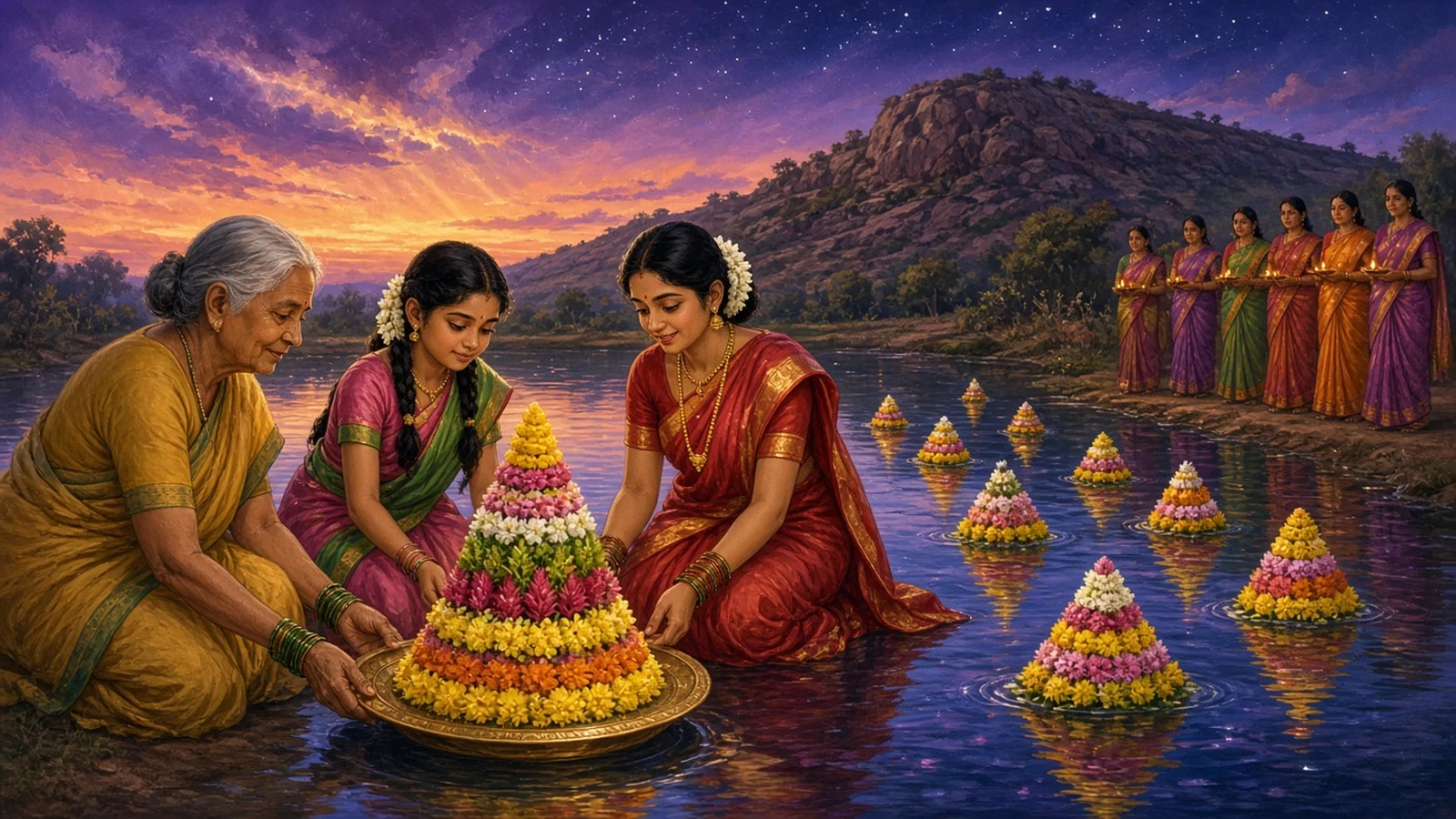
Building the bathukamma: rings of gunuka, tangedu and marigold on pumpkin leaves on a brass plate
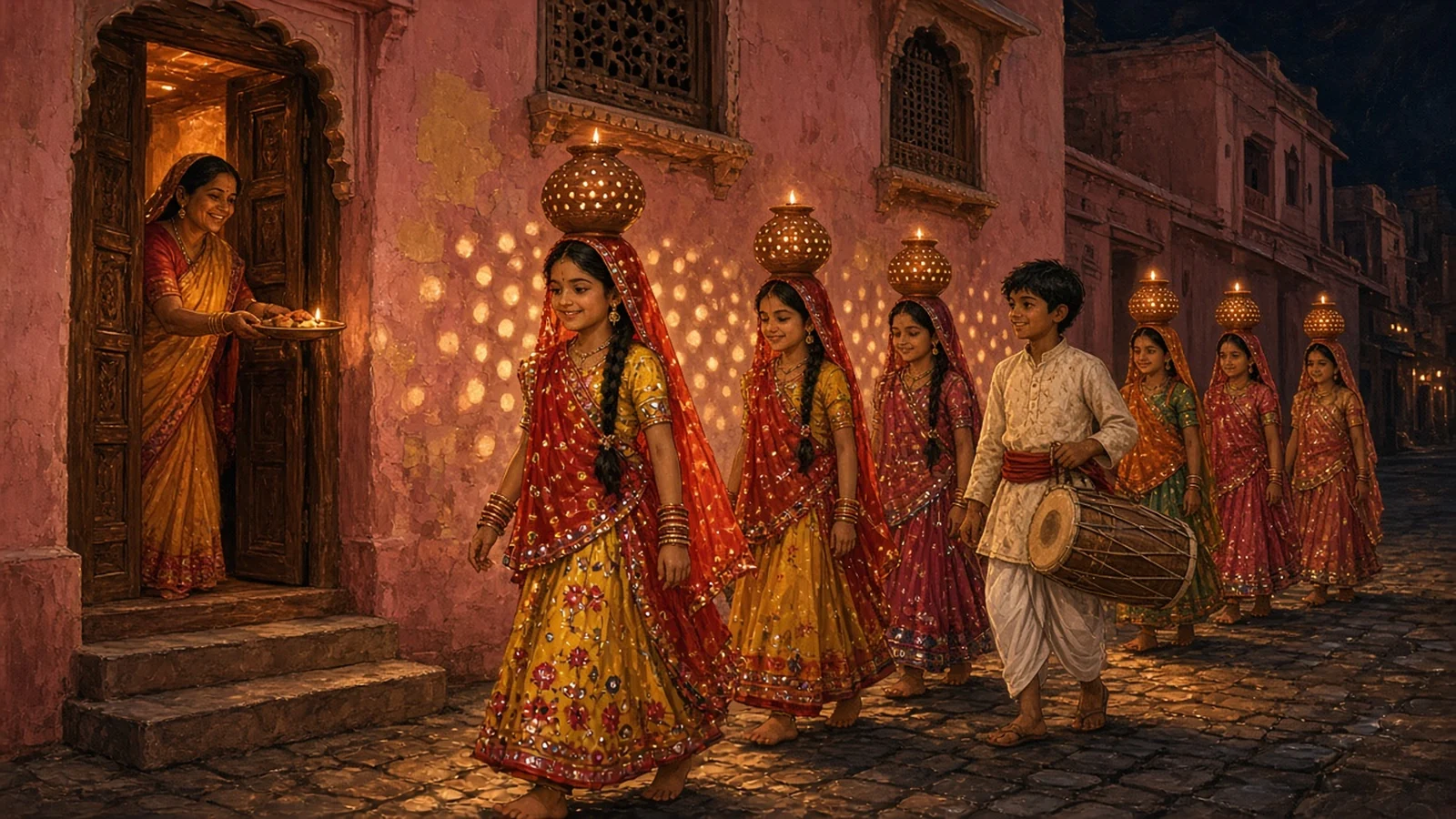
In the evening the women and girls carry the bathukammas on their heads to a lane, a crossroads or a temple ground, set them in the middle and make a ring round them. They move sideways, bending and clapping, elbow to elbow, singing the Uyyala patalu and answering each line with the refrain. Then they walk to the pond, float the flowers, and share the day's offering. Each day is named for that offering, flattened rice, lentils, soaked rice, pancakes, and on the sixth day nothing at all. On the ninth, Saddula Bathukamma, the towers are tallest, five rices are cooked, Gauramma is taken back for the mangalsutra, and the flowers go into the water to drums. The nine days as one family keeps them, and the state's last evening on Tank Bund, are told in The Flowers on the Water.
Some families keep Boddemma as well, a clay Gauri made and floated in a pond over the week that joins the festival; the accounts differ on whether that week comes before Bathukamma or after it. The same nine days are Navratri, which has its own page.
In the old texts
Bathukamma has no scripture. Its text is its songs, made by women, sung in the circle and handed down by mouth, each generation adding what happened in its own time, so that the songs are also a record of their age. Some of them say the festival began under the Kakatiya kings of Warangal. The historian Satyanarayana Dyavanapalli's book of the songs, released in October 2026, calls them the oral history and shared memory of Telangana's women.
The legends are folk tradition, recorded in the Telugu press, the state's celebrations and the writers on the festival, and none of them is in a Purana. Daksha's sacrifice and Sati's death, which the Gauri telling builds on, are Puranic; the Chola princess, the snakes round the tree and the Vemulawada consolation belong to Telangana.
Where this page comes from. Written by Devalok from the Bathukamma legends and customs as Telangana keeps them and as Wikipedia, The News Minute, the Deccan Chronicle, Sakshi Post, Swarajya, eSamskriti, News on AIR, Telangana Today, UNI, the C.P.R. Environmental Education Centre and the Hindu Blog record them, the songs as the historian Satyanarayana Dyavanapalli describes them, and Drik Panchang's almanac for the dates, as recorded in the Devalok Lore. Our own words throughout.