As one family keeps it
Telangana · Hanamkonda, from Engili Pula to Saddula Bathukamma · 3 min read
Swathi's brothers came back from the fields at noon on the new moon, the Pethara Amavasya, with their arms full. Yellow tangedu, the tanner's cassia that grows wild along every bund after the rains. White plumes of gunuka. Marigolds, pumpkin flowers, and the broad pumpkin leaves.
"Is that enough?" said Ravi, dropping it all on the verandah.
"For today," said their grandmother. "Tomorrow you go again. Nine days, nine times."
Swathi's mother dipped half the gunuka in pink and green dye and laid it out to dry. Her aunt Lalitha had come home the night before, fetched from her husband's village by Swathi's father, the way the brothers of the house bring the married daughters back for these days. Nobody let her lift a pot.
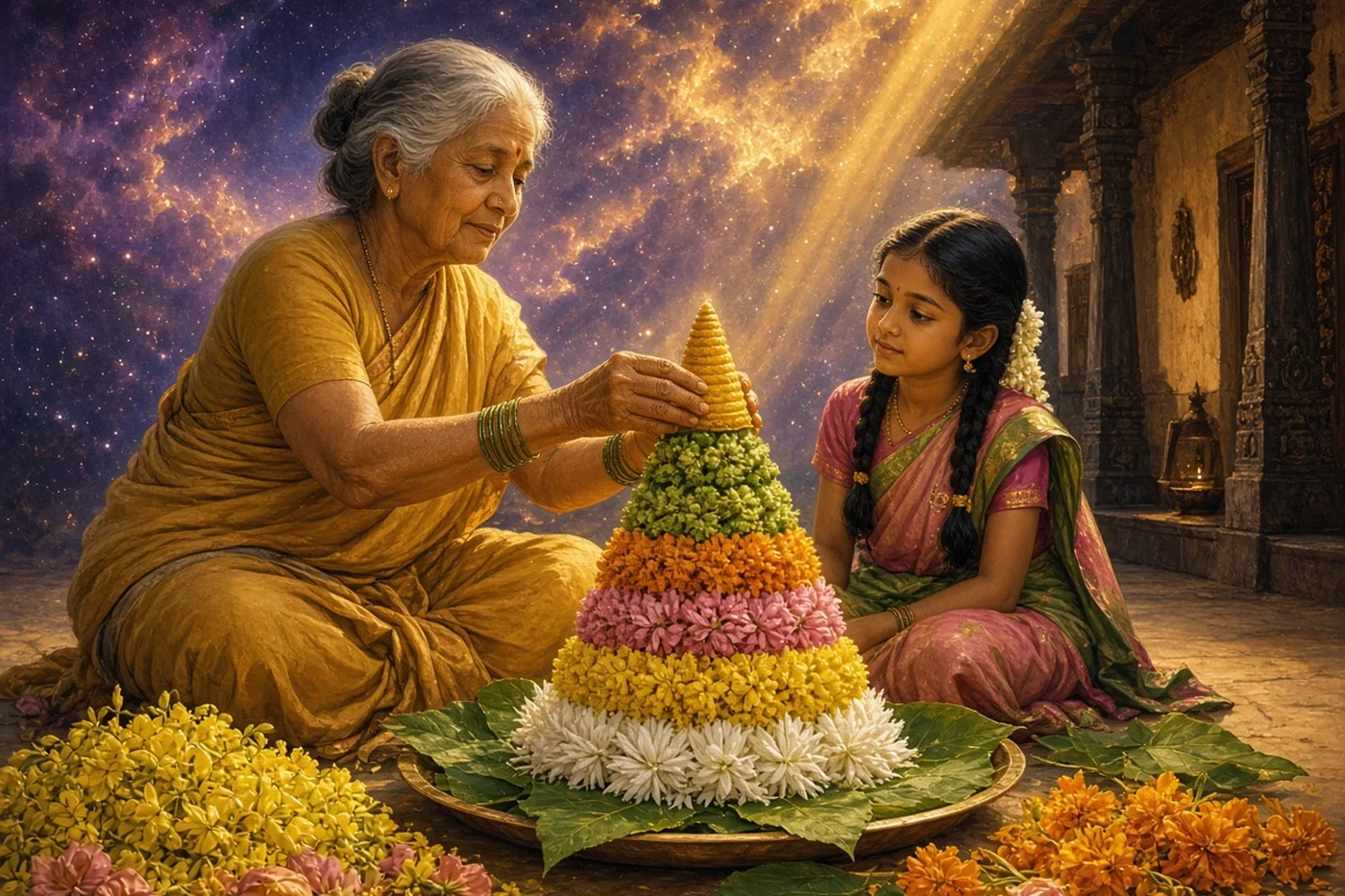
In the afternoon the grandmother sat down with the brass plate, the taambalam, and covered it with pumpkin leaves. Then she began the rings. Gunuka round the edge, cut short and packed tight. A ring of tangedu inside it. Pink gunuka, then marigold, then green, each ring a little narrower than the last, until the flowers rose from the plate like a temple tower.
"Now Gauramma," she said, and rubbed wet turmeric between her palms into a small cone and set it on the very top.
"Why turmeric?" Swathi asked.
"Because she is Gauri, the golden one," said her grandmother. "These nine days she comes home to us, like Lalitha."
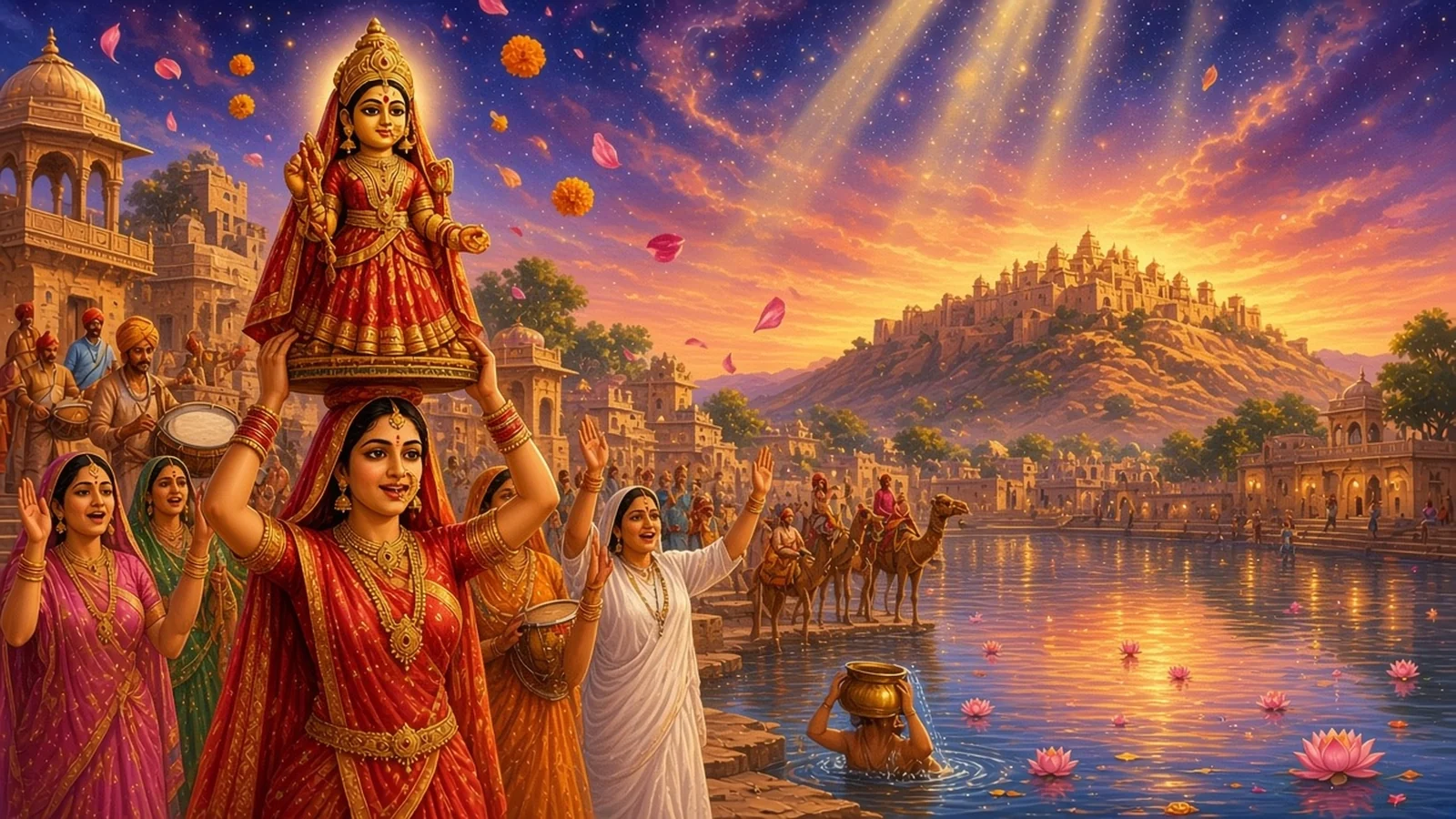
At dusk the women of the lane carried their plates on their heads to the Thousand Pillar temple and set them down together in the middle, a field of small towers. Then they made a ring round them, shoulder to shoulder, and began to move sideways, bending, clapping, each woman's elbow touching the next so that the rhythm passed along the circle without a word.
Lalitha started the first song. The women answered her at the end of every line with the old refrain, "Bathukamma, Bathukamma, uyyalo," and the ring turned.
"Who made the songs?" Swathi asked when they stopped for breath.
"Women," said her grandmother. "Nobody wrote them down. Every grandmother added what happened in her own time. Add something of yours, one day."
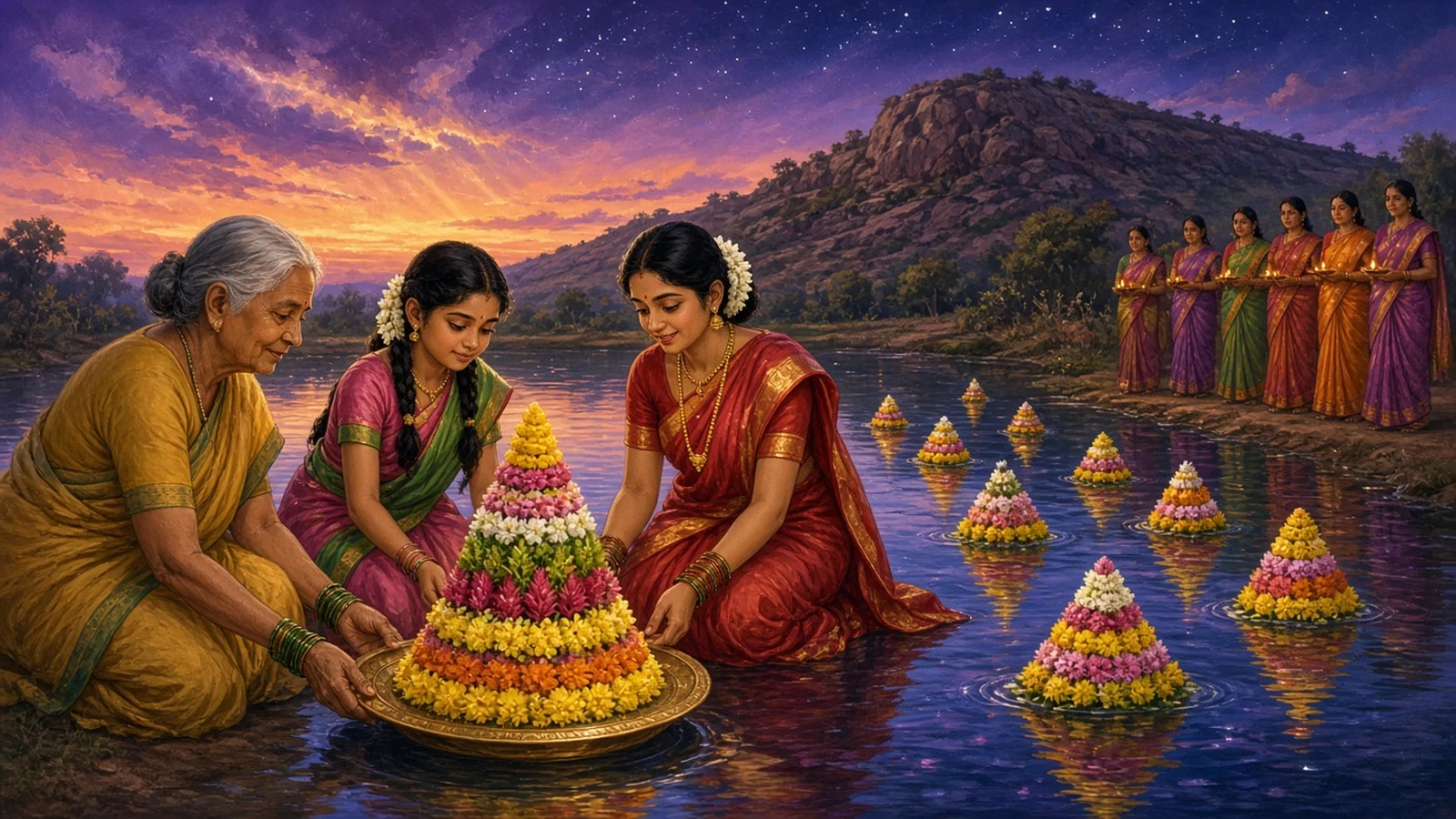
When the singing was done they lifted their plates again and walked to the pond at the foot of the Padmakshi hill, and one by one they set the flowers on the water and watched them float away. Then the grandmother handed round the day's offering, sesame pounded with rice flour, a pinch in every palm.
So it went. Flattened rice with jaggery on the second evening, soft lentils with milk on the third, soaked rice on the fourth, little pancakes on the fifth. On the sixth, Aligina, nothing was offered at all. Fried rice-flour shapes like neem fruits on the seventh, butter and sesame on the eighth.
On the ninth, Saddula Bathukamma, the grandmother built the tallest tower of all, and the kitchen cooked five rices: curd, tamarind, lemon, coconut and sesame. At the water, before the flowers went in, she lifted Gauramma off the top, and the married women touched the turmeric to their mangalsutras.
"Why do we give the flowers to the pond?" Swathi asked.
"The old people say these flowers clean the water after the rains," said her grandmother. "And Gauri came with the flowers. We send her back the way she came."
The tower went out on the dark water with the others, and the women opened their tiffin boxes and shared the five rices, and Lalitha packed for her husband's village.
As the state keeps it
Hyderabad · Saddula Bathukamma on Tank Bund, 18 October 2026 · 2 min read
In Hyderabad the last evening belongs to the whole state. On Sunday 18 October 2026 the procession set out at four in the afternoon from the Martyrs' Memorial and came down to Tank Bund, the old embankment along Hussain Sagar, carrying, by one report, about a thousand bathukammas, and the flower towers stood all along the waterfront.
About seven hundred folk artists came with it. There were Perini and Gussadi dancers, Oggu drummers and Dappu players, and women in their best sarees with their daughters. The Governor, Shiv Pratap Shukla, came with his wife, and so did the tourism minister, Jupally Krishna Rao, the panchayat raj minister, Seethakka, and two film stars. The women sang round the flowers as they would in any village lane. Then the city added a laser show over the lake and fireworks.
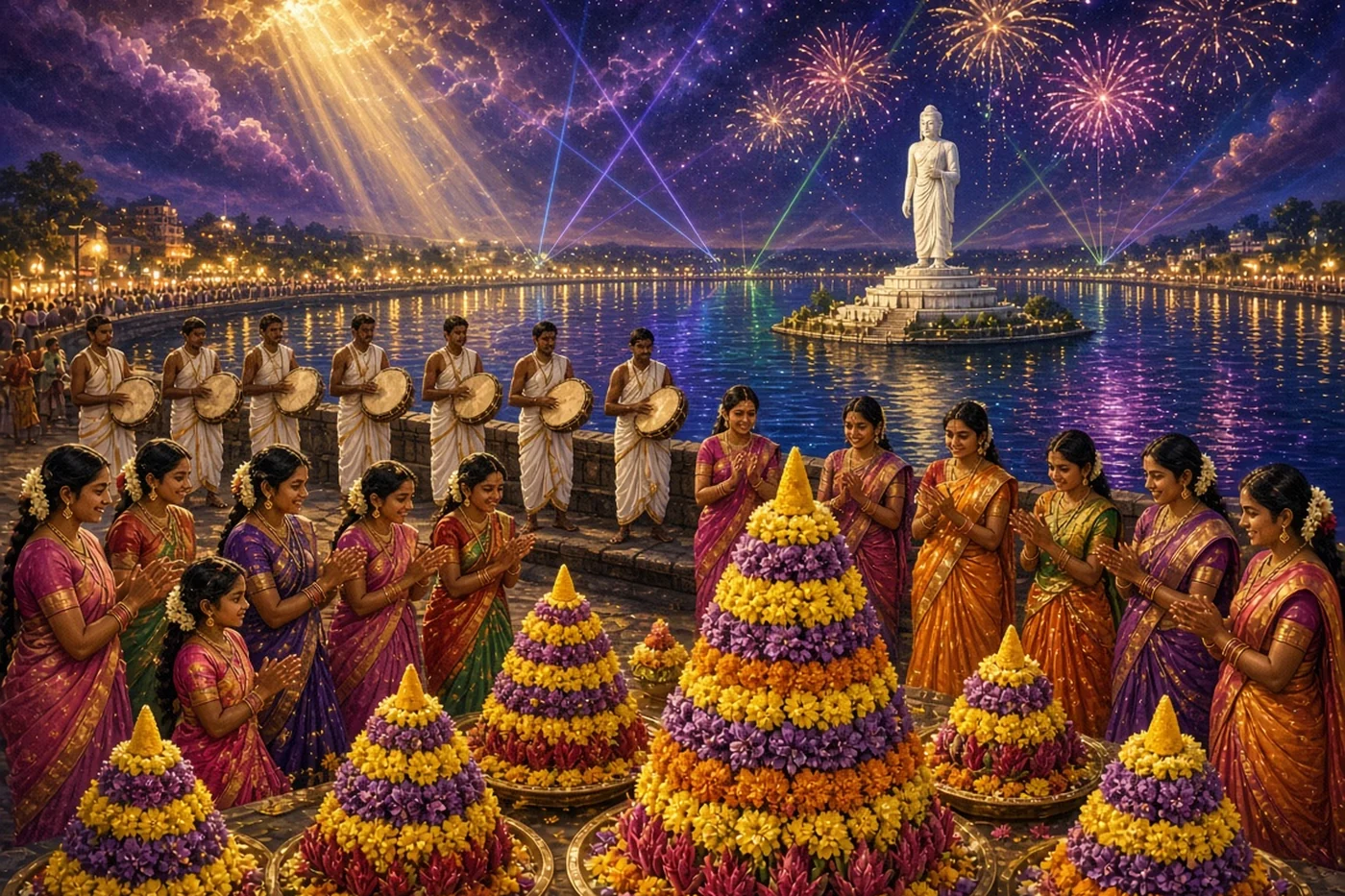
The state has kept Bathukamma as its own festival since Telangana was formed in 2014. In the years of the movement for a separate state, Bathukamma, Bonalu and the Medaram Jatara became the signs of a culture that was Telangana's and not Andhra's, and the state's own figure of Telangana Talli, the mother of Telangana, holds a bathukamma in one hand. In the years from 2017 the government gave a free saree to about a crore of poor women every Bathukamma, woven on the state's own power looms.
Hyderabad's festival was older than the state. The Bhagya Lakshmi temple at the foot of the Charminar keeps it still, and the city tells of a Nizam who, when the Musi flooded, prayed to the goddess and floated a bathukamma on the river himself.
The state measures its festival now. On 29 September 2025 its celebration set two Guinness records, one for a flower arrangement about seven tonnes in weight and more than sixty-three feet high, and one for 1,354 women dancing together.