Festival · The fishing on Uruka, the night in the straw hut, and the meji burnt at dawn
Magh Bihu
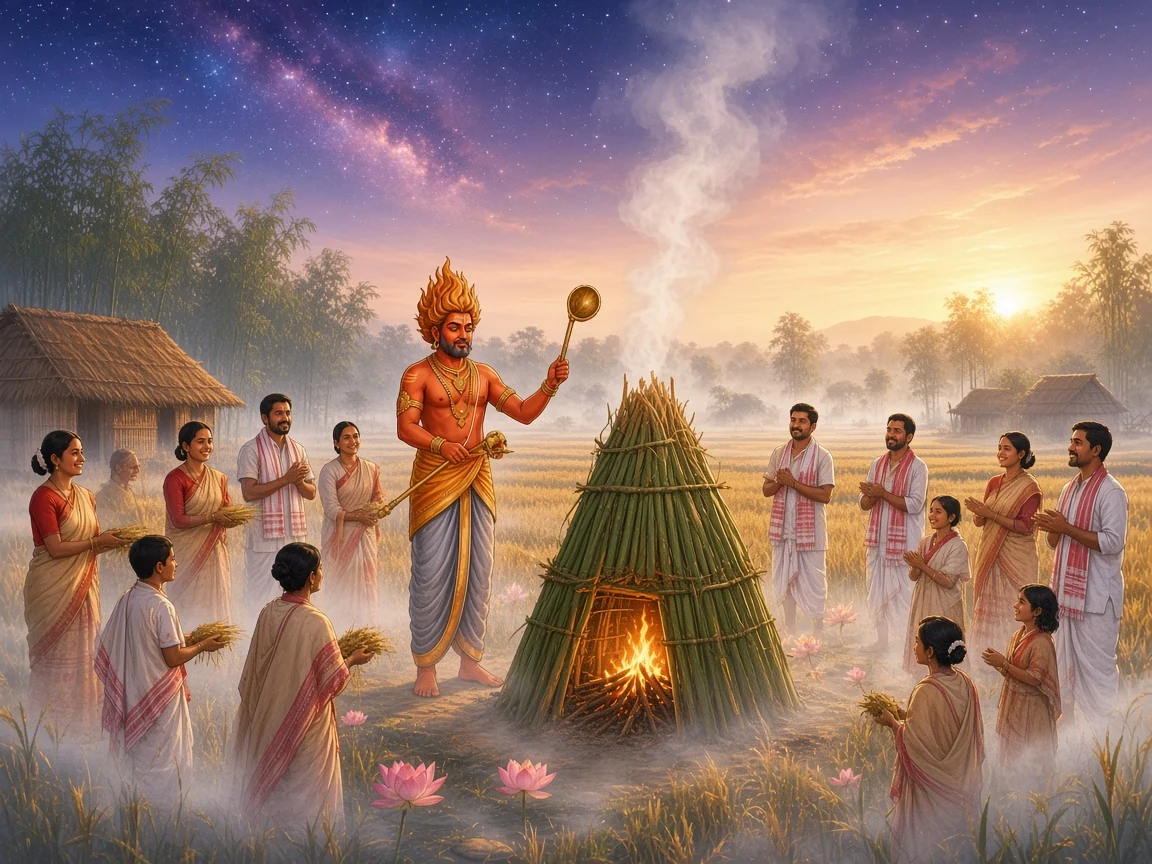
Magh Bihu, also called Bhogali Bihu, is Assam's harvest festival, kept in mid January as the month of Puh ends and Magh begins, once the winter rice is in the granary. Its eve, Uruka, is a day of community fishing and a night of feasting in the bhelaghar, a straw hut in the stubble. At dawn on the first of Magh the meji, a tower of bamboo, wood and straw, is burnt in honour of Agni, and pitha, betel nut and sesame go into the flames. The day ends with egg fights, pot-breaking and, where they are still held, the buffalo fights.
When is Magh Bihu in 2027? Magh Bihu, the meji lit at dawn, is Friday 15 January 2027; it runs 14 to 15 January 2027. In 2028: Sunday 16 January 2028. The last day of Puh, Uruka, and the first day of Magh, at the sun's entry into Makara in mid January.
Also calledBhogali BihuMaghar Domahithe Bihu of feastingMagw Domasi among the BodosPoy Me-Ji among the Tai AhomsMaghyo Bihu among the Deoris
In short
What is Magh Bihu?
Assam's harvest festival, also called Bhogali Bihu, the Bihu of feasting, kept in mid January when Puh ends and Magh begins and the winter rice is home.
When is Magh Bihu in 2027?
Uruka, the eve, is Thursday 14 January 2027 and Magh Bihu, when the meji is burnt, is Friday 15 January. In 2028 Uruka is Saturday 15 January and Magh Bihu Sunday 16 January.
What is a meji?
A tall structure of bamboo, wood, straw and dried banana leaves built in the harvested field and burnt at dawn on Magh Bihu in honour of Agni, the fire.
What is Uruka?
The eve of Magh Bihu, a day of community fishing and a night of feasting in the bhelaghar, the straw hut beside the meji.
Are the buffalo fights still held?
The Gauhati High Court struck down the state's permission for buffalo and bulbul fights in December 2024. In November 2025 Assam's Assembly passed a bill to exempt the buffalo fights from the animal cruelty law; in January 2026 it was still awaiting the President's assent, and no official fight was held that Magh Bihu.
Next, in 2027Friday 15 January 2027
14 to 15 January 2027
Prime godAgni, the fire of the meji
with 3 more
WhereAssam, from Sivasagar, Jorhat and Dibrugarh in the east through Nagaon and Morigaon to Guwahati, Nalbari and the Bodo country in the west, with the Tiwa fair at Jonbeel and the temple town of Hajo
How longTwo days at its heart, Uruka and Magh Bihu; the pitha is made for days before, and the fairs and visits run through the first week of Magh
The last day of Puh, Uruka, and the first day of Magh, at the sun's entry into Makara in mid January
Why it is kept
Magh Bihu is the Bihu of the full granary. By the time Puh ends the winter rice has been cut and threshed, and Assam spends the last day of the month fishing, cooking and feasting, and the first morning of Magh around a bonfire in the bare fields.
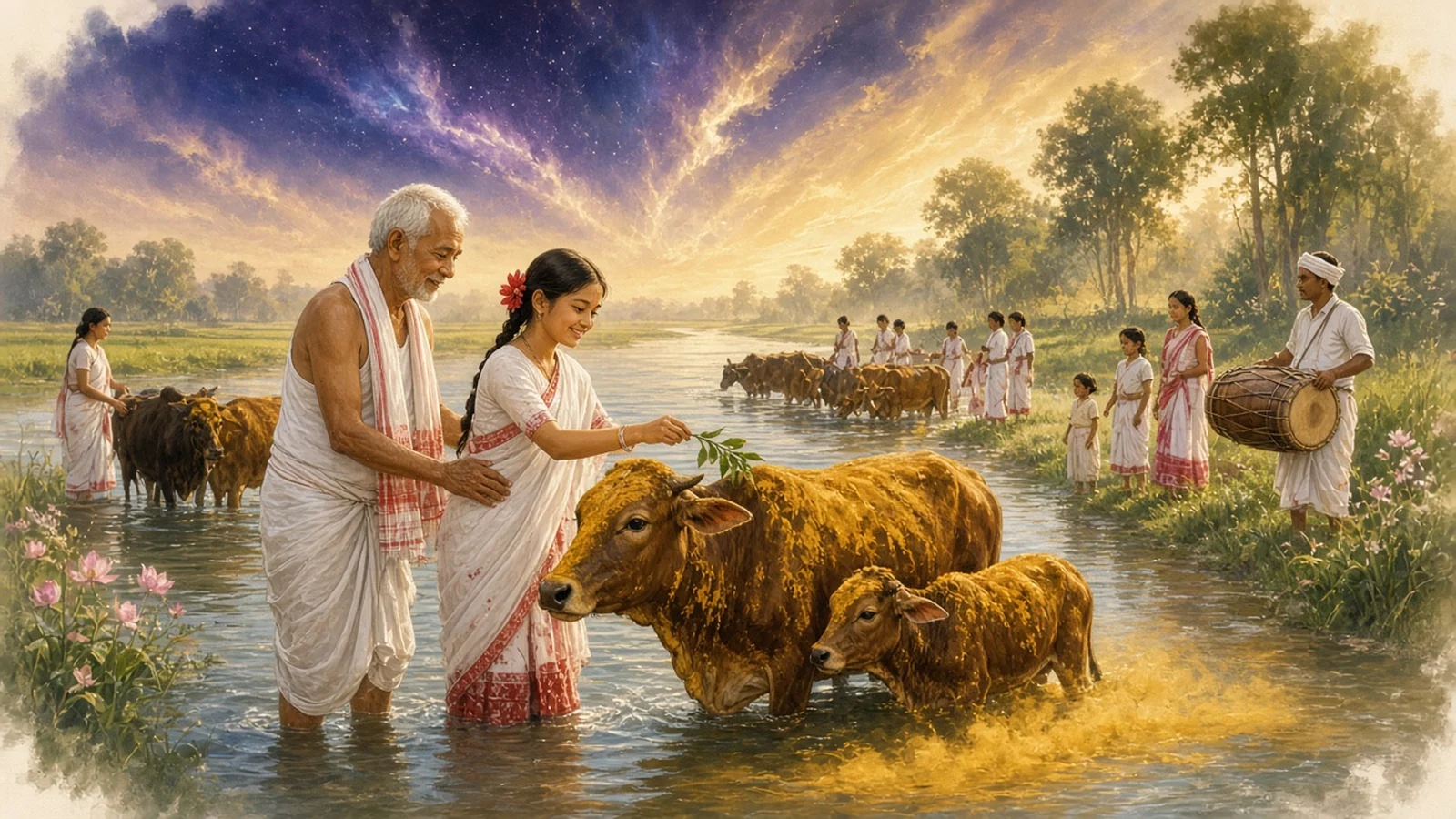
Of Assam's three Bihus this is the one of plenty. The spring Bihu comes before the sowing and the autumn one, Kati Bihu, while the rice is still growing in the fields; Magh Bihu comes after the harvest, when there is food to spare, which is why it is also called Bhogali, the Bihu of enjoyment. The spring festival and its cattle bath have their own page, Rongali Bihu, told in The Cattle at the River.
After the harvest: the granary full of winter rice and the fields cut to golden stubble
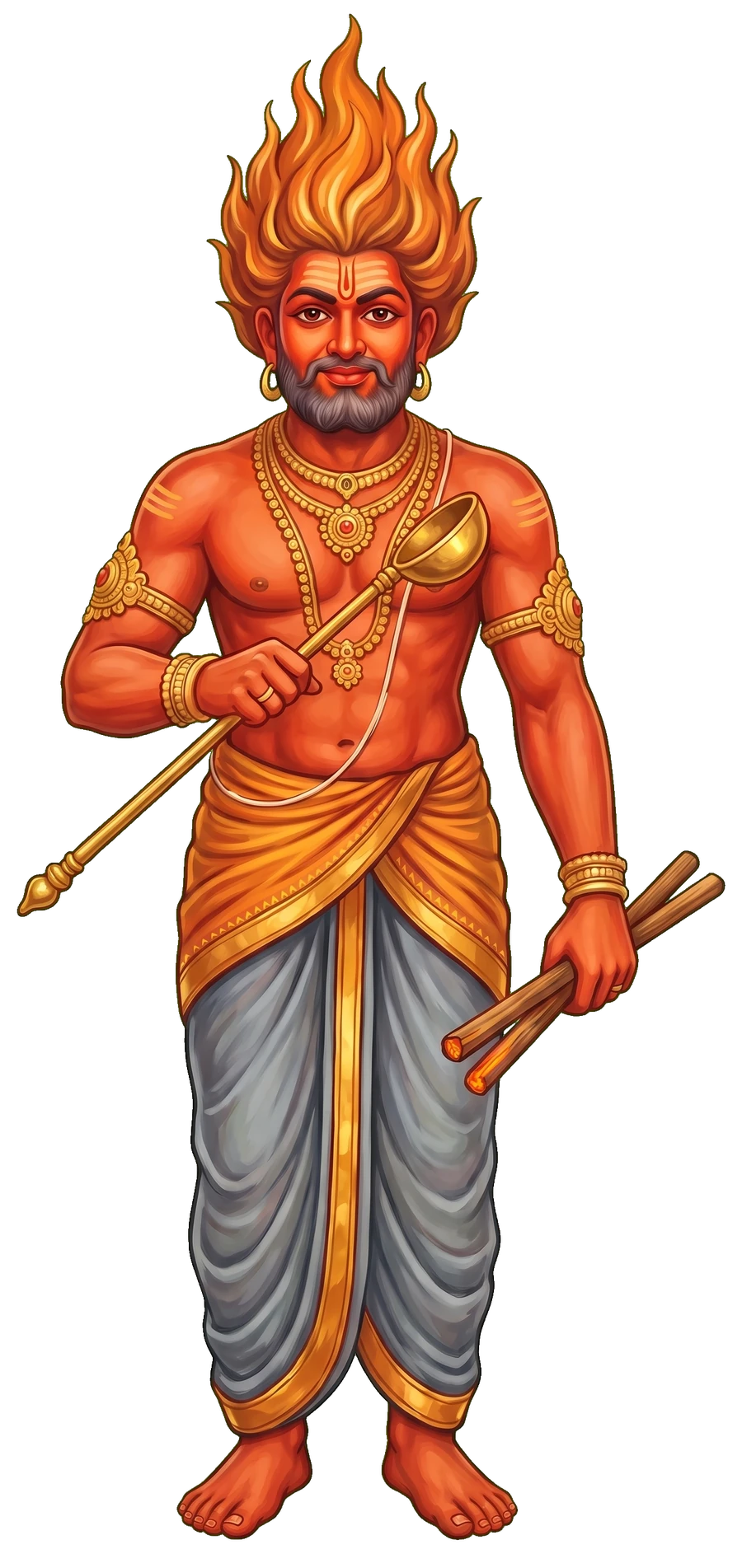
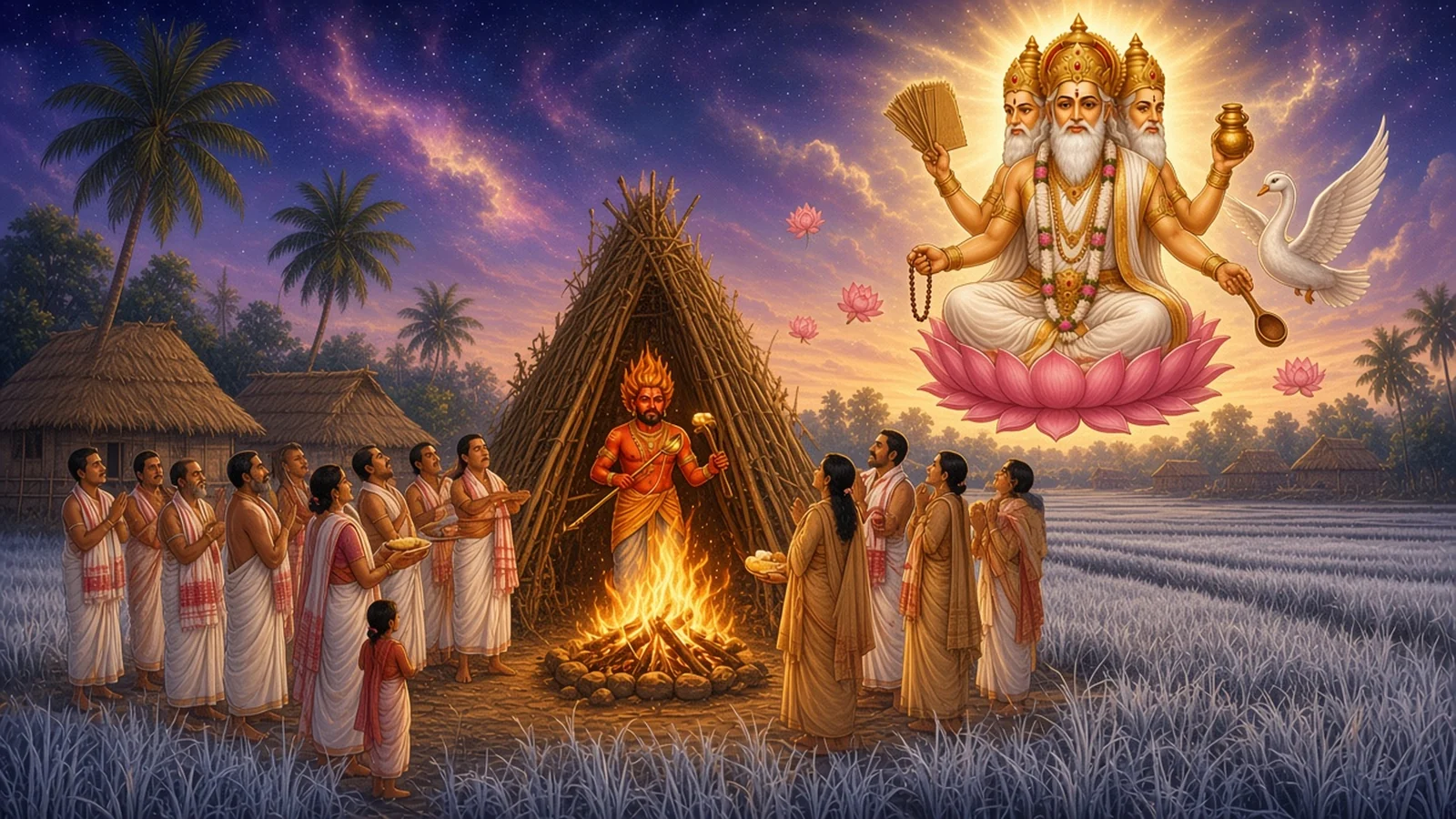
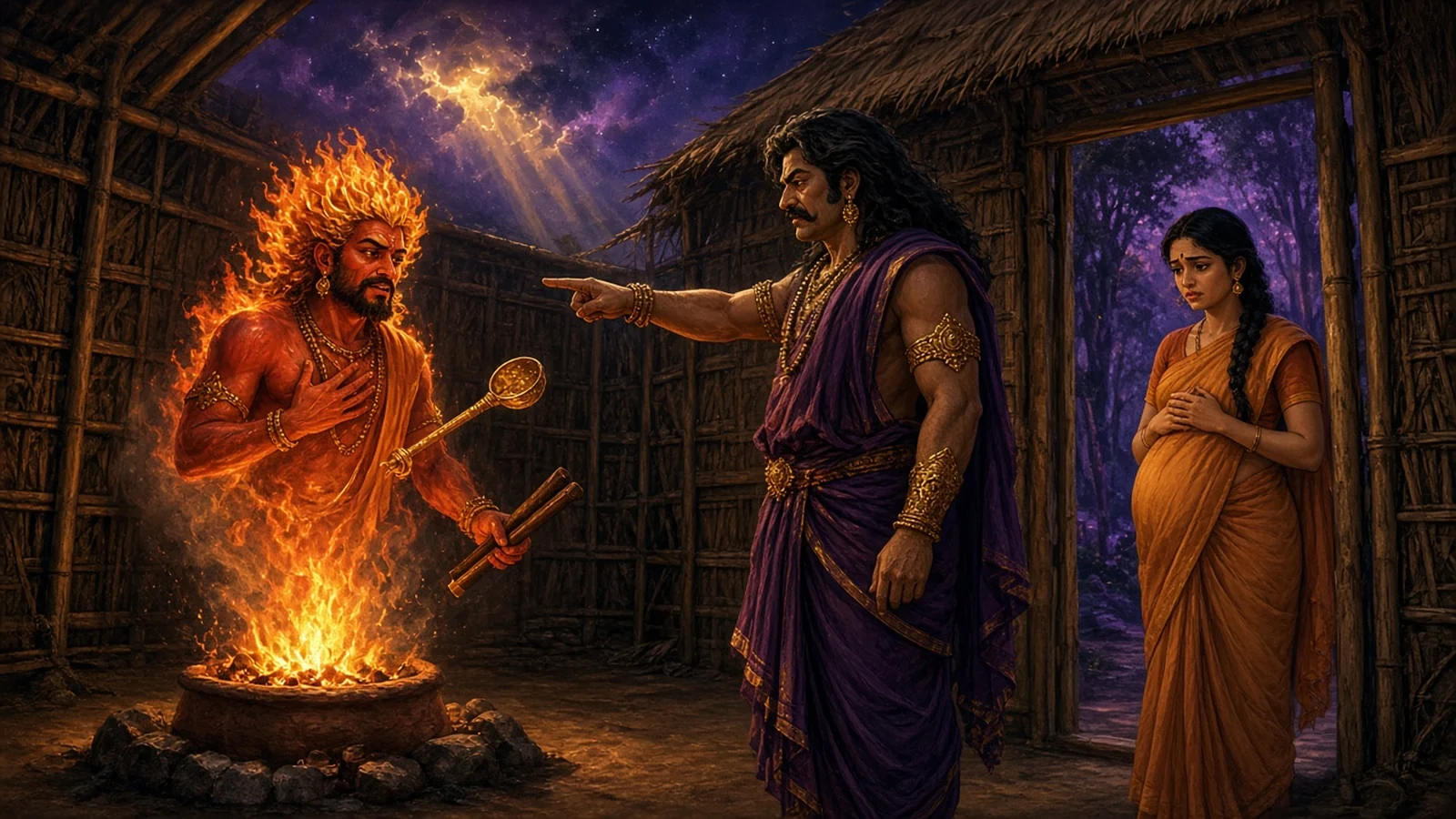
The fire is the centre of it. In the Assamese villages the meji is burnt as reverence to Agni, the fire god, with the first rice and the new sesame thrown in, and its ash goes back to the trees and the fields. The Sonowal Kacharis tell how the fire came to be worshipped at all: Brahma came down to the earth, and the people took him for Agni. That tale, and the Kacharis' older memory of a fire lit when the boys came home from guarding the crop, is The God in the Meji. Agni's own story, of the curse that made him eat everything and the blessing that made him pure, is The Fire That Could Not Lie.
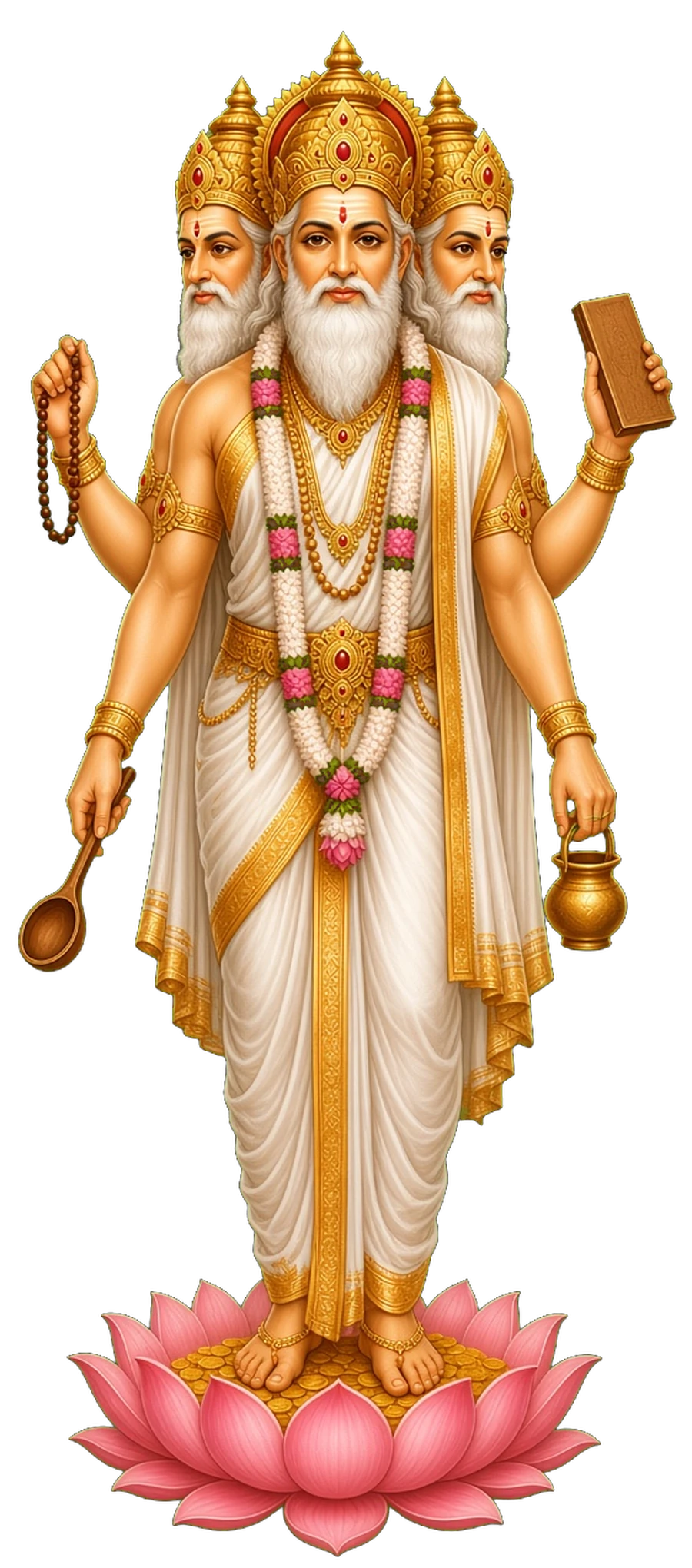
Brahma comes down to an Assamese village, and the Sonowal Kacharis bow to him as Agni
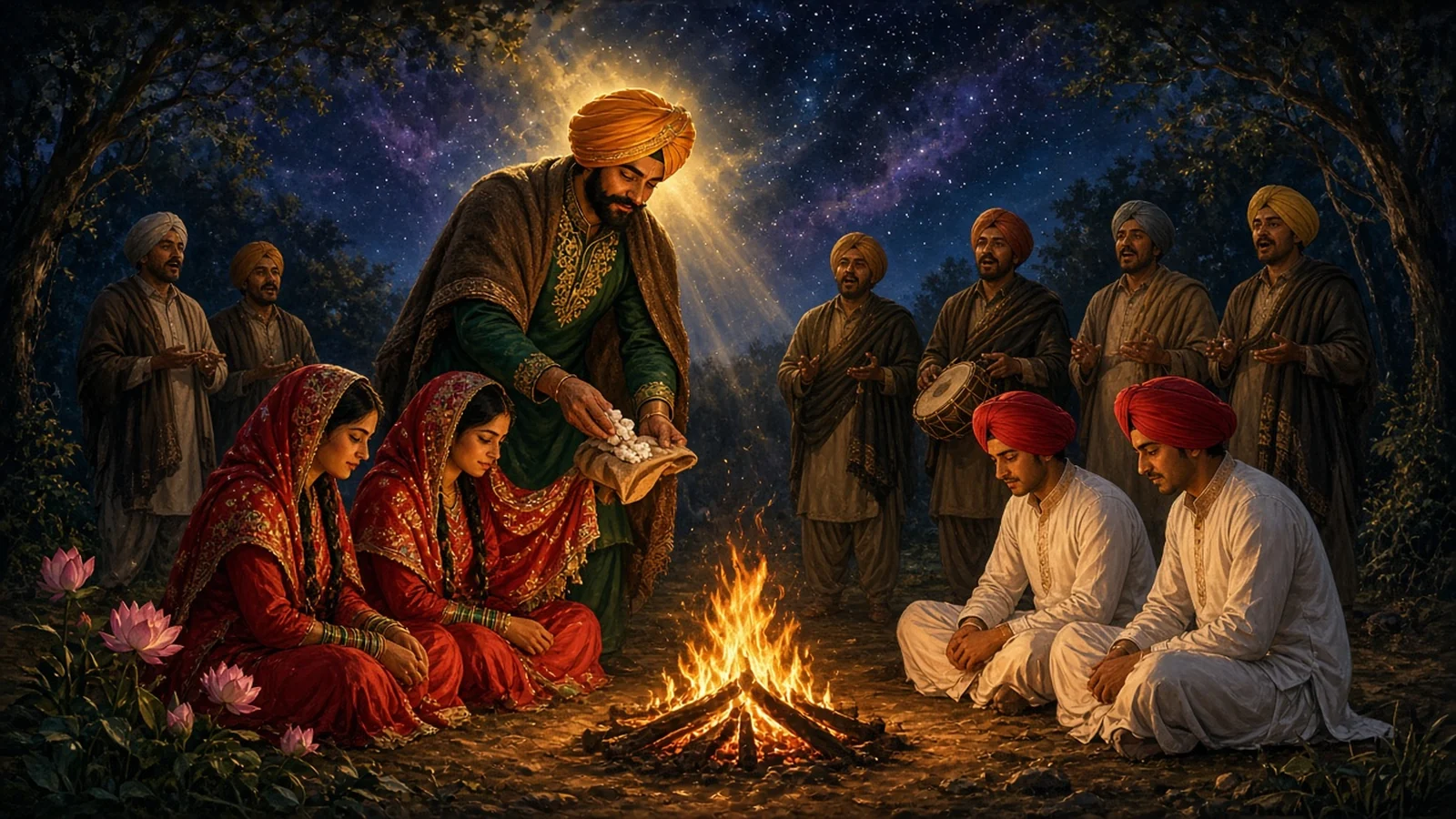
The festival falls at the sun's turn into Makara, kept across India on the same days; the turning itself is on the Makar Sankranti page. Punjab's fire on the same night is Lohri, with its own story in The Songs for Dulla Bhatti.
Magh Bihu is a harvest festival, and its one god is the fire. The meji is lit at dawn as an act of reverence to Agni, and the household throws in pitha, betel nut, sesame and rice and bows before it. The Sonowal Kacharis call their larger meji the Agni meji, the Misings build theirs for the fire god, and the Tiwa king opens the Jonbeel fair with an offering to him.
The Sonowal Kacharis say Brahma once came down to the earth and the people mistook him for Agni, and that is why they worship the fire at Magh Bihu and bind their trees on Uruka.
B
Bathou
Bathou Bwrai, the high god of Bodo households, is worshipped in the courtyard on Magw Domasi, the Bodo Magh Bihu, before the ancestors are fed.
T
The ancestors
Tai Ahom families offer rice beer to their forebears at the meji, the Thengal Kacharis worship them on the evening of Magh Bihu, and Bodo families lay out food and cloth for them at the south of the courtyard.
Uruka night and the morning fire
1
The bhelaghar built
The last days of Puh, before Uruka · Wednesday 13 January 2027
the days of the dhekithe meji raised
In the days before the festival the women gather to pound soaked rice in the dheki, the foot-driven husker, and make pitha, laru, chira and curd by the hundred. The young men cut green bamboo, straw and dried banana leaves and raise the meji in the harvested field, with the bhelaghar, a makeshift hut, beside it. Among the Bodos the cowherds build their belagur and its hut near the river a week or two ahead.
Women pound rice in the dheki while young men raise the meji and a straw hut in the stubble
From early morning the villages fish their beels and rivers together, at Deepor Beel near Guwahati, at Sonapur and around Nalbari, till the afternoon. At night comes the great feast of fish and meat, eaten by the fire in the bhelaghar, where the young men keep watch until morning, and a little licensed thieving of firewood and vegetables is part of the fun. Many families tie straw cords round their fruit trees and the granary. Thursday 14 January 2027 is the last day of Puh in the Assamese almanac.
Uruka morning: a whole village wades into the beel with bamboo polo and jakoi traps and nets
The first day of Magh, the day after the sankranti · Friday 15 January 2027
Magh BihuBhogali BihuMagh 1meji jwaluwa
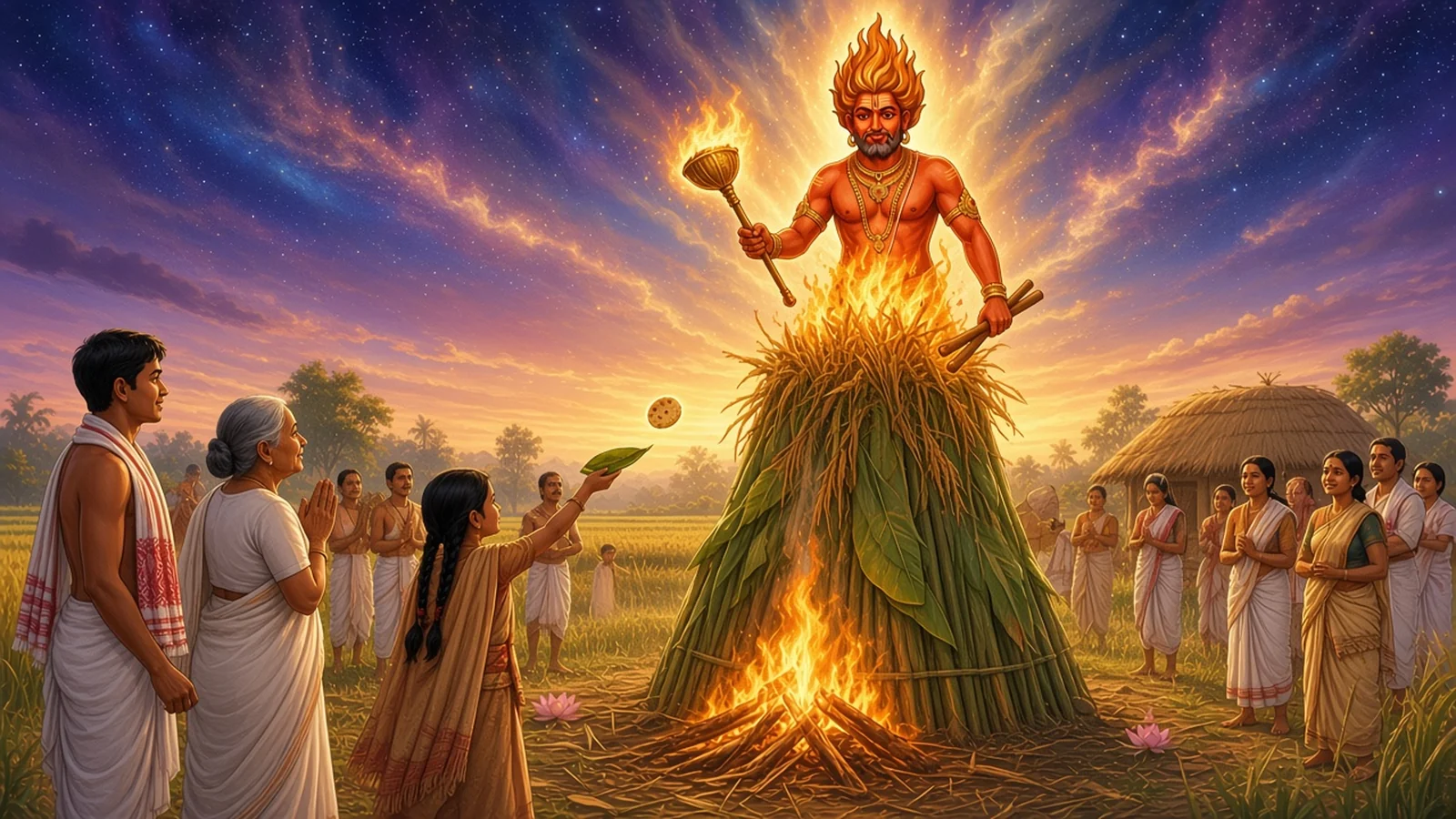
Everyone bathes before sunrise and goes out to the field. The meji is set alight in reverence to Agni; pitha, betel nut, sesame and rice go into the fire, and the bursting green bamboo is said to drive evil spirits away. The ash and the half-burnt bamboo are carried home to the fruit trees and the fields, and in many houses the stove is not lit and the night's food is eaten. Friday 15 January 2027.
A family tosses pitha, sesame and rice into the burning meji at dawn, with joined hands
The first day of Magh and the days after · Friday 15 January 2027
koni jujtekeli bhongamoh-jujbulbul fights
After the fire come the games: koni juj, the egg fight in which one player taps the other's egg until a shell breaks; tekeli bhonga, a blindfolded player swinging a stick at a hanging pot of puffed rice and jaggery; and in Morigaon, Nagaon and upper Assam the buffalo fights, best known at Ahotguri. The bulbul fights at Hajo belong to the same morning.
The games after the fire: boys tap eggs in koni juj and a blindfolded girl swings at a hanging pot
The pitha goes on being eaten and carried to relations for days. The Tiwa fair at Jonbeel near Jagiroad begins on the first Thursday of Magh, Thursday 21 January 2027 by that rule, and there the plains still trade their pitha and dried fish for ginger, turmeric and bay leaves from the hills without money changing hands.
The Jonbeel fair: plains families trade pitha for ginger, turmeric and bay leaves from the hills
The Tai Ahoms keep Poy Me-Ji with rice beer for their ancestors at the fire. The Sonowal Kacharis build two mejis, the smaller Gorokhiya meji and the Agni meji, and mark their cattle with straw ash; the Thengal Kacharis burn theirs in the courtyard and worship the ancestors that evening. The Misings build a meji for the fire god.
Lower Assam and GuwahatiThe beels and the town feasts
Uruka is a fishing day across lower Assam, at Nalbari, Sonapur and Deepor Beel on Guwahati's edge, and the city's papers print pictures of the biggest catch. Guwahati households still pound rice in the dheki for their pitha where they can.
Nagaon and MorigaonAhotguri and Jonbeel
Ahotguri in Morigaon is the best known ground for the moh-juj, the buffalo fights, which drew 33 pairs there on Magh Bihu 2026 though no official fight was held. Close by at Dayang Belguri the Tiwa hold the three-day Jonbeel Mela from the first Thursday of Magh, opened by their king's offering to the fire god.
The Bodo countryMagw Domasi
The Bodos keep Magw, or Domasi, with rice beer and their own cakes, the cowherds' belagur fired by the river at dawn, the granary sealed with lines of cow dung, and offerings to Bathou and the ancestors.
HajoThe bulbul fights
The Hayagriva Madhava temple at Hajo, across the Brahmaputra from Guwahati, holds bulbul fights on Magh Bihu, which its priest calls a sport bound up with religion; the same report calls them seven centuries old and also dates them to the Ahom king Pramatta Singha. They were stopped from 2015, held in 2024 and not held in 2025.
The Assamese villagesThe fire and the namghar
The meji is a fire offering without a priest; the household lights it and bows before it. After it many go to the namghar, the Vaishnava prayer hall, for the day's hymns.
The Kacharis, Misings and DeorisTheir own harvest fires
Each community names the fire in its own way. The Sonowals tell how Brahma was taken for Agni, the Thengals and Misings bow to the fire god, and the Deoris keep the same days as Maghyo Bihu.
The Tiwa, Karbi, Khasi and JaintiaThe Jonbeel barter
At Jonbeel the hill peoples and the plains meet once a year to exchange goods without money, ginger and pepper and bay leaves for pitha and dried fish, a custom the fair is said to have kept for five hundred years.
The BodosBathou and the ancestors
Domasi turns to Bathou Bwrai, the god of the Bodo courtyard, and to the dead, who are given food, a dokhona and a gamsa.
How it is kept
The work starts days ahead. Rice is soaked and pounded in the dheki, and the flour goes into til pitha, rolled round sesame and jaggery on a dry pan, narikol pitha with coconut, and ghila pitha fried in oil, along with laru, chira and curd. The young men gather bamboo, straw and banana leaves for the meji and the bhelaghar.
Til pitha rolled on a dry pan, with narikol pitha, laru, chira and curd laid out in brass
Uruka is the day of the beel. Whole villages wade in with nets and traps, and the catch goes into the night's feast, with duck, chicken and mutton, eaten round the fire in the bhelaghar. At dawn the family ties straw round the fruit trees, bathes, and goes to the field, where the meji is lit and the offerings thrown in. The Night of Uruka follows one lower Assam family through these days, and a Bodo household through its Magw Domasi.
Uruka night: the village feasts by the fire in the straw bhelaghar, the tall meji waiting outside
The rest of the day is for games and visits: egg fights, the blindfolded pot-breaking, and the buffalo fights of Ahotguri, which have spent a decade in and out of the courts. In December 2024 the Gauhati High Court quashed the state's permission for them, holding it contrary to the Supreme Court's 2014 judgment against animal fights; the Assembly answered in November 2025 with an amendment to exempt them, still awaiting assent when the next Magh Bihu came. At Hajo, whose other shrine story is The Stone on the Hill of Jewels, the temple's bulbul fights have been caught by the same rulings.
In the old texts
Magh Bihu has no scripture and no Sanskrit rite. The Ahom chronicles, the Buranjis, are court histories, and the one we searched, the Ahom Buranji in Golap Chandra Barua's translation, names Bihu only in the spring, in the years of the Moamoria rising. The Rang Ghar at Rangpur, from which the Ahom kings watched buffalo fights, is its nearest royal monument.
The record is the folklorists'. Sidney Endle described the Darrang Kacharis' Bihu huts and bonfire in 1911 and called the feast a harvest home. Birinchi Kumar Barua saw in the bhelaghar a memory of the young men's dormitory. Later scholars have recorded the Sonowal, Thengal and Bodo customs village by village, and argued over the word meji itself, which some take from a Deori-Chutia phrase and others from Sanskrit. The Bihu songs of Magh, sung round the fire, are the rest of the text.
Where this page comes from. Written by Devalok from the Magh Bihu customs as Wikipedia, Bhupali Kashyap's Tezpur University thesis, the Sentinel, the Assam Tribune, the Assam Times, The Federal, ETV Bharat, The Hindu, ThePrint and the Times of India record them, the studies of Suravi Gohain Duwarah and Simani Boro, Sidney Endle's The Kacharis, Bodoland Tourism, and Drik Panchang and an Assamese panjika for the dates, as recorded in the Devalok Lore. Our own words throughout.