As an upper Assam village keeps it: the river, the gamosa and the Husori
Upper Assam · a village near Jorhat on the last day of Chot and the first of Bohag · 3 min read
Mridu's mother had ground the black gram and the turmeric the night before, and in the grey before sunrise the paste sat in a brass bowl by the cowshed door, yellow and cold.
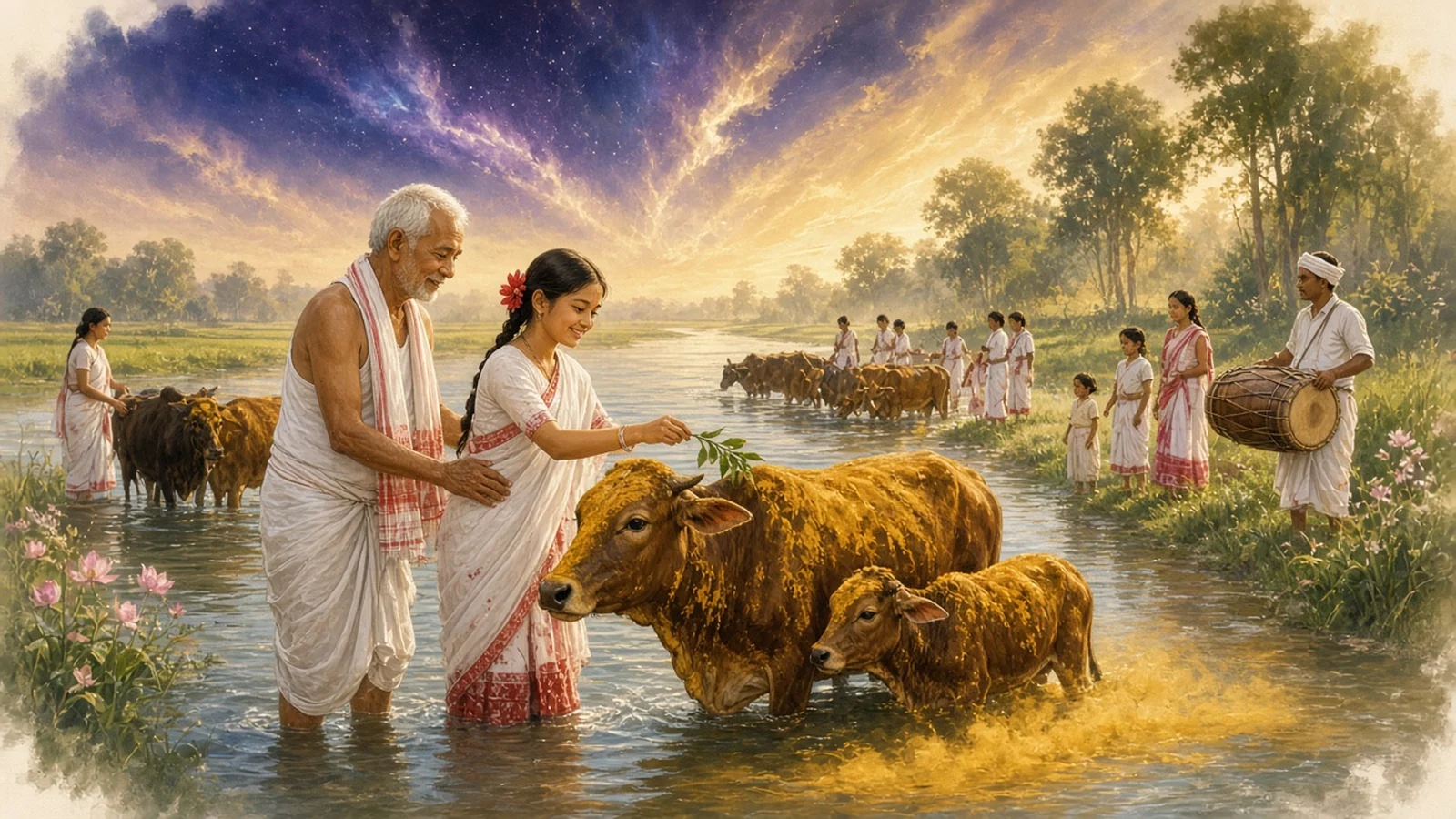
"Hands first," said Koka. He dipped his fingers in the mustard oil and rubbed it into the horns and the hooves of the old cow, Lakhimi, and Mridu did the same for the calf. Then they smeared them with the paste, neck and flanks and the soft fold under the jaw, until both animals shone like brass.
The whole village was going down to the river. The cattle walked in a slow brown line with children beside them and the dhol going somewhere at the back. Mridu carried a bundle of dighloti and makhiyati sprigs, and her cousin carried a string of sliced gourd and brinjal.
At the water the men led the animals in up to their bellies and scrubbed them, and the paste came off in yellow clouds downstream. Koka handed Mridu a sprig.
"Not hard," he said. "You are not beating her. You are wishing her a year."
So she touched Lakhimi on the back with the leaves, and threw her a piece of brinjal, and sang with the others: "Lau kha, bengena kha." The rest of the rhyme went on about growing bigger year by year, bigger than your mother and your father, and the calf, who was already nearly as big as its mother, looked at her as if it had heard.
Koka cut the old rope from Lakhimi's neck and passed it back between her legs into the river. "Today she goes where she likes," he said, and she did, wandering off along the bank with the calf behind her.
They washed themselves with what was left of the paste, so that their skin would stay clean all year, and sat on the bank in wet clothes eating pitha and chira with curd and jaggery while the cattle grazed.
At dusk the animals came home on their own. Koka had twisted a new rope of tora fibre that afternoon, and he tied it gently. Mridu's mother burnt rice husk in the shed so the smoke would drive off the flies, and Mridu held out a pitha on her palm for Lakhimi's grey lips.
In the morning it was Bohag, the year's first day. Everyone bathed again, Mridu put on the new mekhela her aunt had sent, and her mother lit the lamp in the corner where the household gods were kept.
Then Mridu took the gamosa she had bought with her own money, white with a red border, folded it, laid a betel leaf and a nut on it, and bent to touch Koka's feet.
He put the cloth round his neck. "Live long," he said. "Learn well. Grow taller than me, like the calf."
That night they heard the drum before they saw the lamps. The Husori had sung first at the namghar, and now they stopped at the gate and struck the dhol until Koka went out to call them in. They filed into the courtyard and stood in a ring, and before any dancing at all the oldest of them led a slow verse of praise, naming Gobin, Krishna, Rama, Narayana, the others answering.
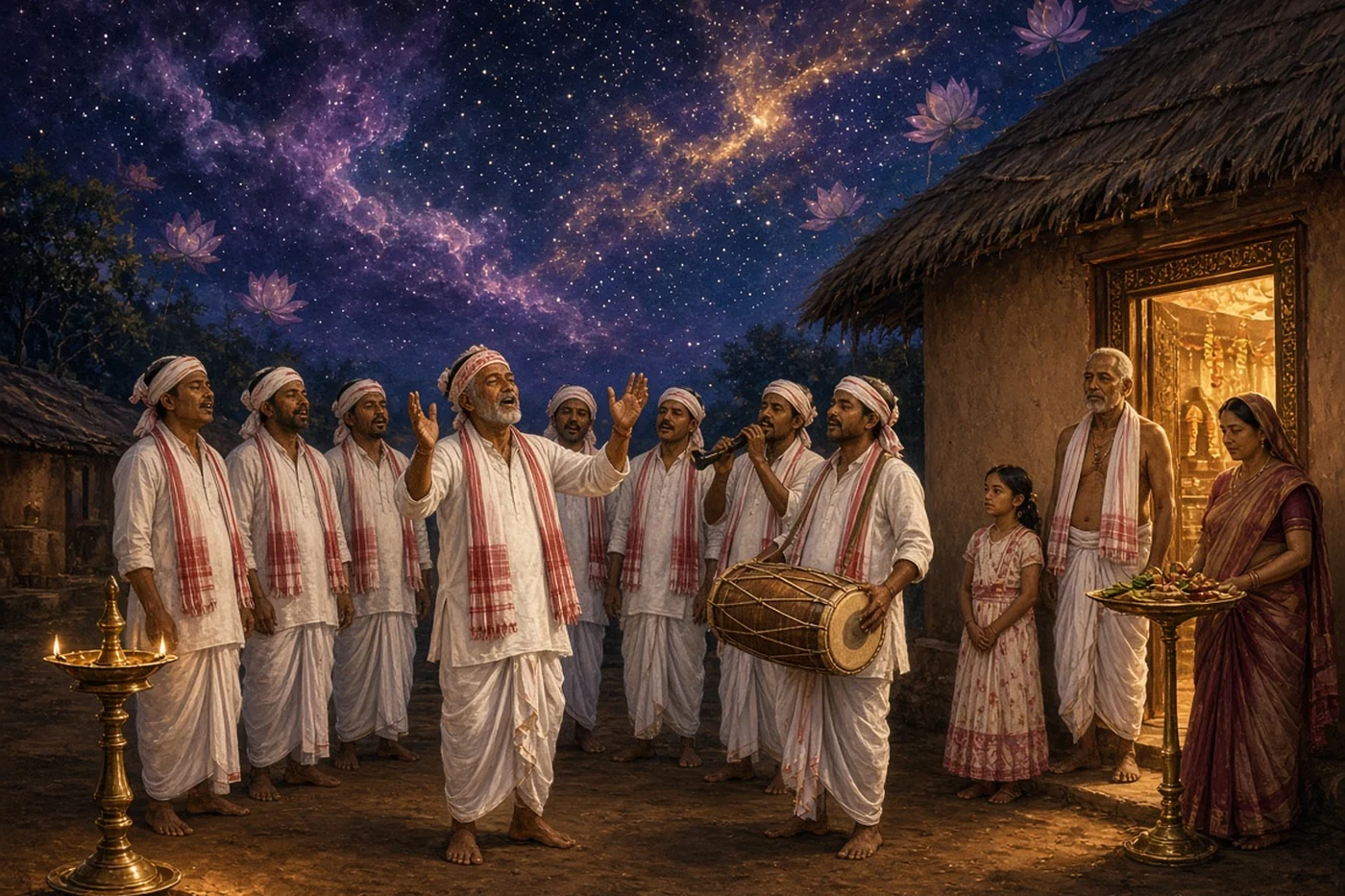
Then the pepa cried out, the drums doubled, and the young men turned in their ring, gamosas flying.
Mridu's mother brought out the xorai with betel, nut and a coin on it. The leader took it, lifted his hand over the house and blessed it for the year, the cattle and the granary and the children in it. Mridu asked where the money went.
"To the namghar," the leader said, already turning for the next gate.
As Guwahati keeps it: from the ghats to the Latasil stage
Guwahati · the Brahmaputra ghats, Machkhowa and Latasil field · 2 min read
An old man in Uzanbazar remembers when the city was hardly a city. Every family had its granary, its cowshed and its loom, and Bihu was kept at home.
On the cattle's day the boys drove the animals down to the Brahmaputra, or to the nearest pond, and scrubbed them in the shallows. At home there was a new rope ready, the shed was filled with the sweet smoke of dhuna resin, and someone stood by with a new hand fan to keep the flies off the wet backs. On the next days men came round singing husori from house to house, and they kept coming until the late 1940s.
Then, in 1947 and again in 1948, the city did something new. On the first of Bohag a procession set out from the Latasil playground with an elephant in front, decked in cloth, and walked all the way to the mosque at Machkhowa and back along the river road. At the tail came a lorry carrying a husori troupe, led by the singer Mukul Barua, and over it all flew an embroidered gamosa for a flag. The organisers were Hindu, Muslim and Marwari together; two of them, Talebuddin Ahmed and Mahiuddin Ahmed, lived in Machkhowa itself.
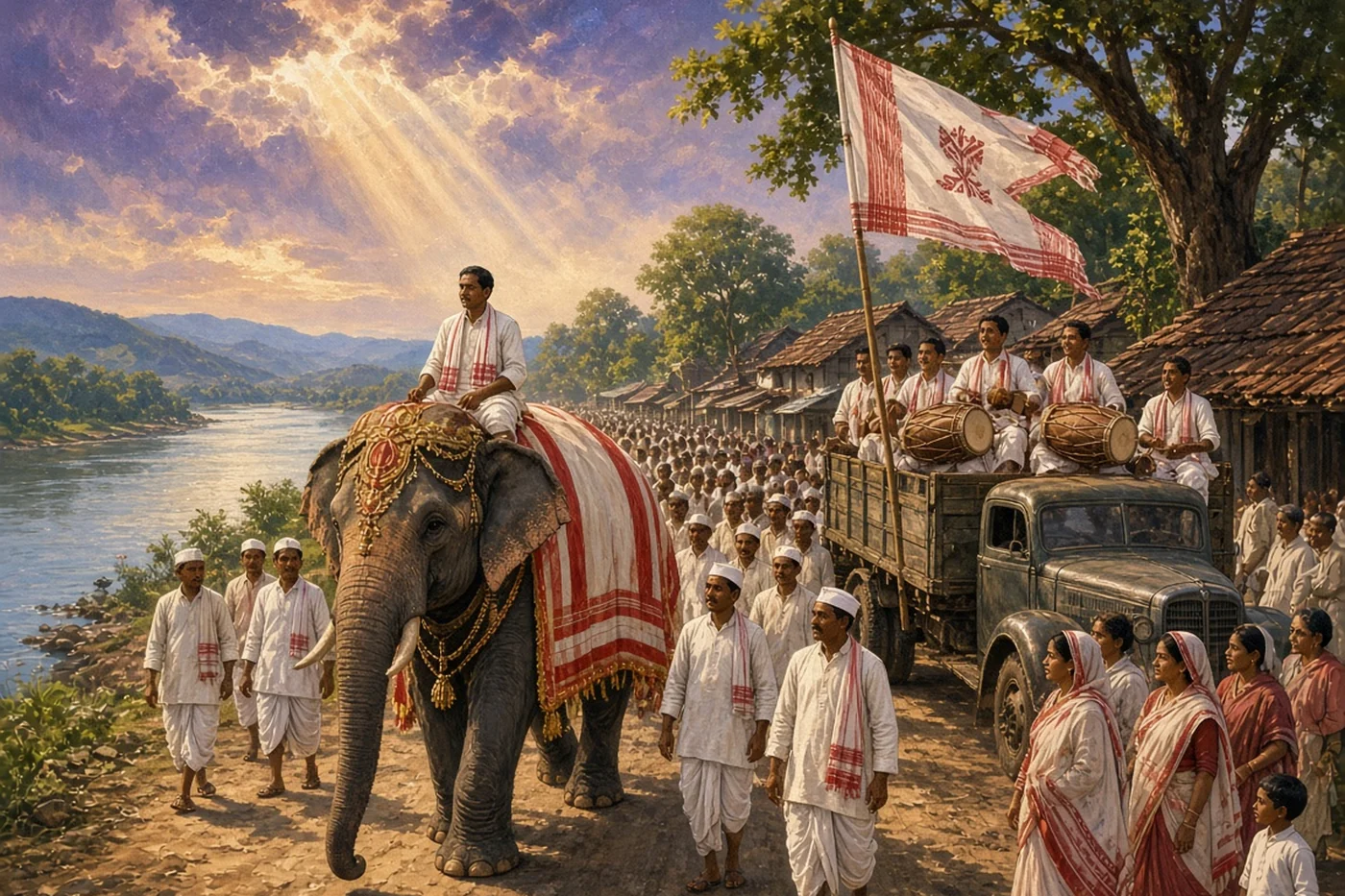
"We did not know we were starting anything," the old man says. "We only wanted the city to see Bihu."
In 1952 some of the same people formed the Guwahati Bihu Sanmilani and built a stage on Latasil field, and that night the dancers climbed up onto it for the first time. Other towns had held public Bihus before, Golaghat first of all, but Guwahati's stage became the mother of the Bihutolis. Stages went up in every neighbourhood after it, and then in every town.
"Now the children learn the dance for the competition," he says. "Very good dancers. But nobody comes to my gate."