As the mathas tell it
Udupi, from Madhva to Vadiraja · 2 min read
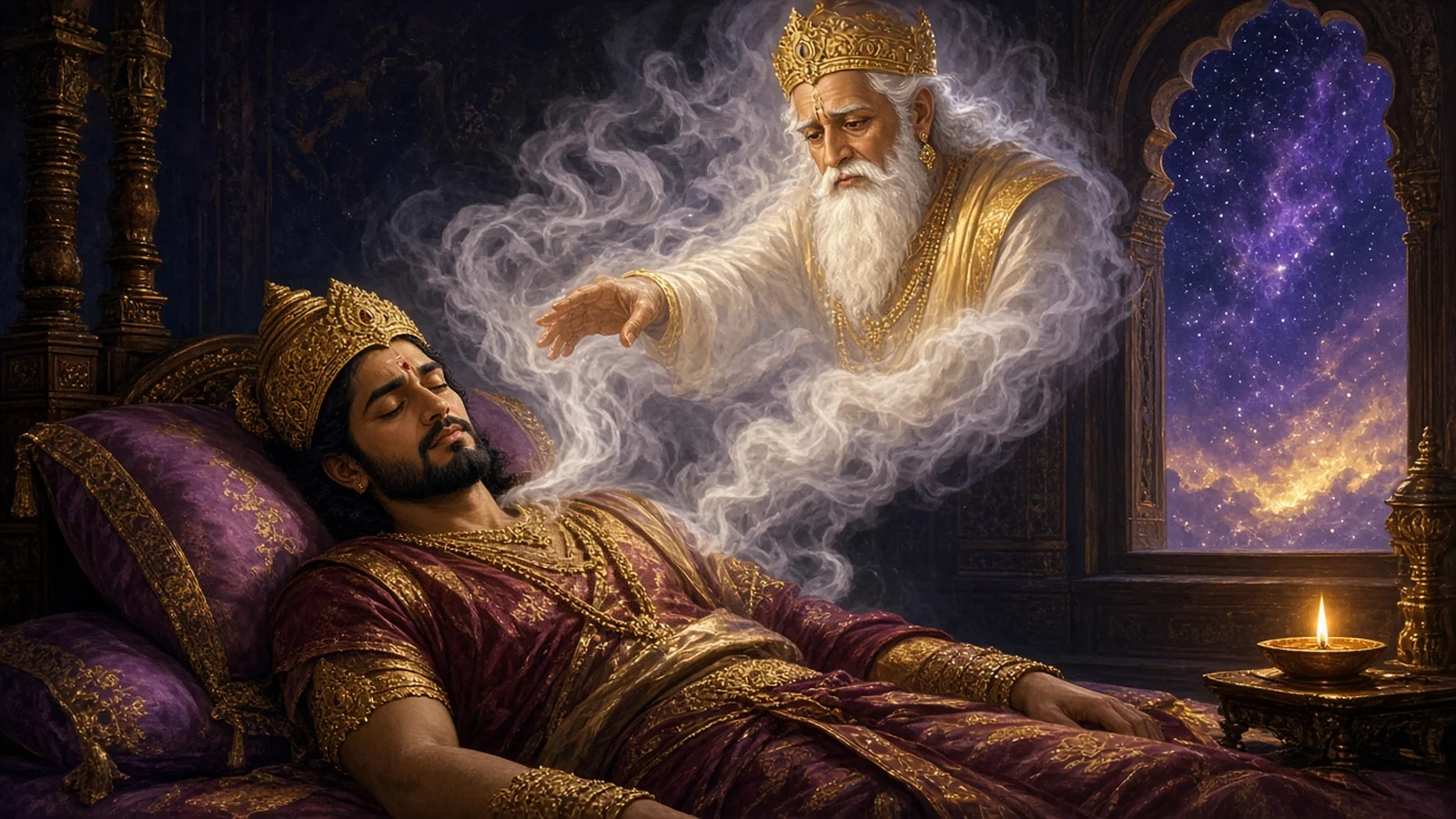
When Madhva had set up the child Krishna at Udupi, he served him himself, and he had laid down what was to be done at every hour of the day. But he would not always be there, and the child would need someone to wake him, bathe him, dress him and feed him every day after he had gone.
So he made eight young men of the Tulu country into monks. One of them was his own younger brother, who took the name Vishnu Tirtha. The others were Hrishikesha, Narasimha, Janardana, Upendra, Vamana, Rama and Adhokshaja, each a Tirtha too.
"The worship of Krishna is yours now," he told them. "Each of you in turn, two months at a time."
"And if one of us falls ill in his turn?" one of them asked.
"Then his partner takes the worship for him."
So they were paired, two and two, and given their order, with Hrishikesha first and Adhokshaja last.
Madhva left them something else, the mathas say: a vessel and a ladle for the kitchen, with a blessing on them.
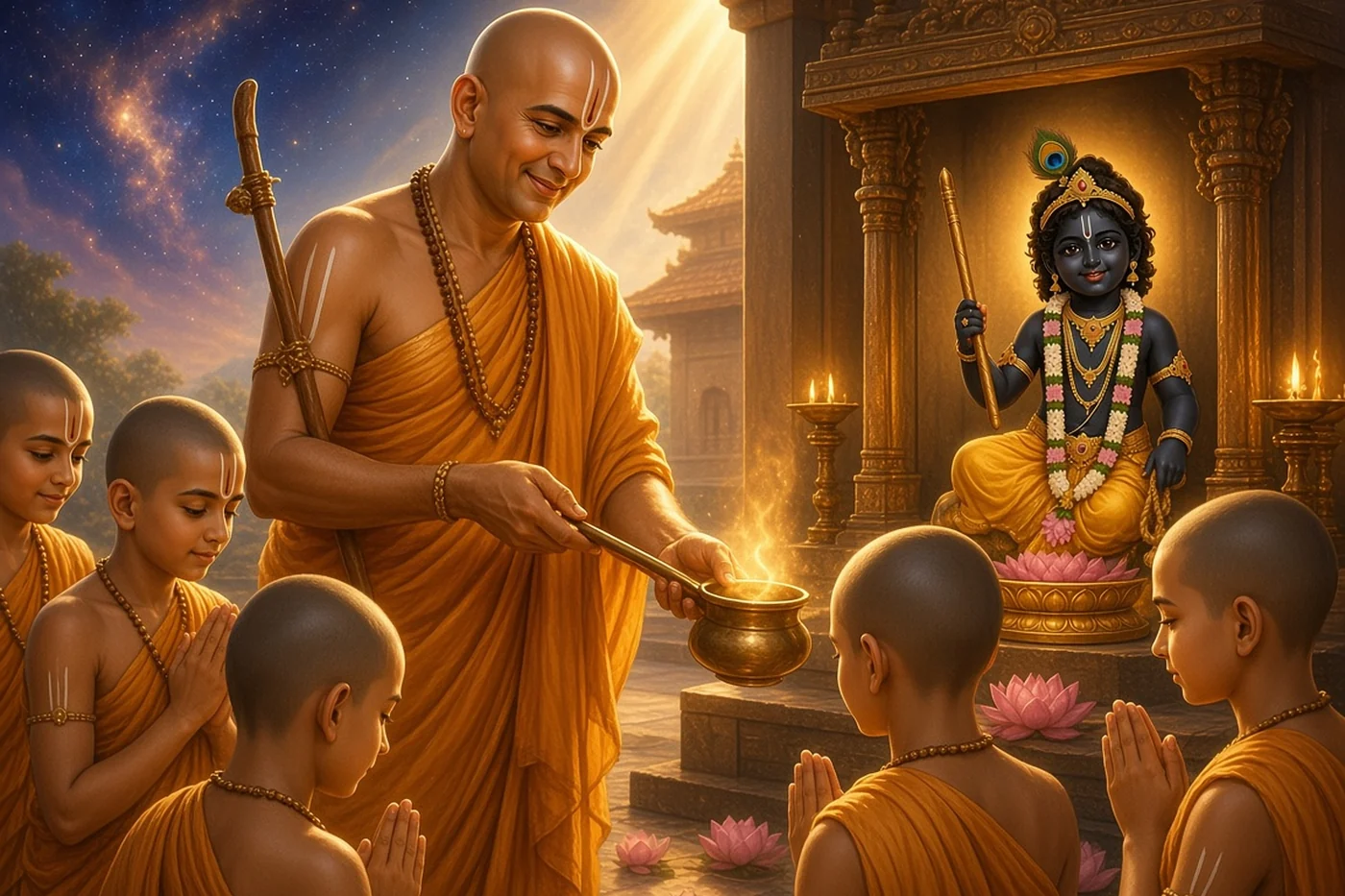
"As long as these are handed on," he said, "the feeding here will never stop."
Then he went away north to Badari, and Udupi did not see him again.
It went on that way for about two hundred years. Every two months the worship changed hands. The eight monks lived in eight rooms inside the matha, and each began a line of monks after him, and each line came to be named for a village: Palimaru and Adamaru, Krishnapura and Puttige, Shiroor and Sode, Kaniyooru and Pejavara.
Then, in the sixteenth century, the head of the Sode matha was Vadiraja Tirtha, a poet and a great traveller, who had spent twenty years walking the holy places of India and writing about them. He looked at the two months and saw what they cost.
"A swami has hardly settled in before he has to pack up again," he said. "Every change costs money. And fourteen months off in sixteen is not long enough to go anywhere far and teach."
So he made the turn two years. A full round of the eight now took sixteen years, and each swami had fourteen of them to travel, preach and gather what his next two years would need.
He did more. He rebuilt the shrine and the tank of Madhva Sarovara, and he built each of the eight swamis a matha of his own around the square in front of the temple, the square that is Car Street now. The eight lines, which had lived as one household, became eight houses.
The change is dated to about 1522, and the turn of two years has gone round ever since, five hundred years and more. It is called the Paryaya, the turn, and the swami who holds it is the Paryaya swami.
As Udupi keeps the night
the Paryaya festival · the morning of 18 January, every other year · 2 min read
A Paryaya begins a year before it happens. The swami whose turn is coming plants banana and tulsi for the god's worship and for the leaves the crowds will eat from. Then he stores rice in bundles of straw, then stacks firewood in the shape of a temple car, then lays in paddy, each on a lucky day, with offerings to Chandramouleeshwara, Anantheshwara and Krishna.
Then he travels for months, and a fortnight before the day he enters Udupi in state.
On the night itself, at about three in the morning, he goes to Dandatirtha, a pond some ten kilometres south that Madhva is said to have made with his staff, and bathes. The other swamis wait for him at Jodukatte on the edge of town. A procession forms with the swamis in decorated palanquins, his own matha's image in a golden one, all of them in new silk for this one morning, and it winds into Udupi with music and tableaux to Car Street.
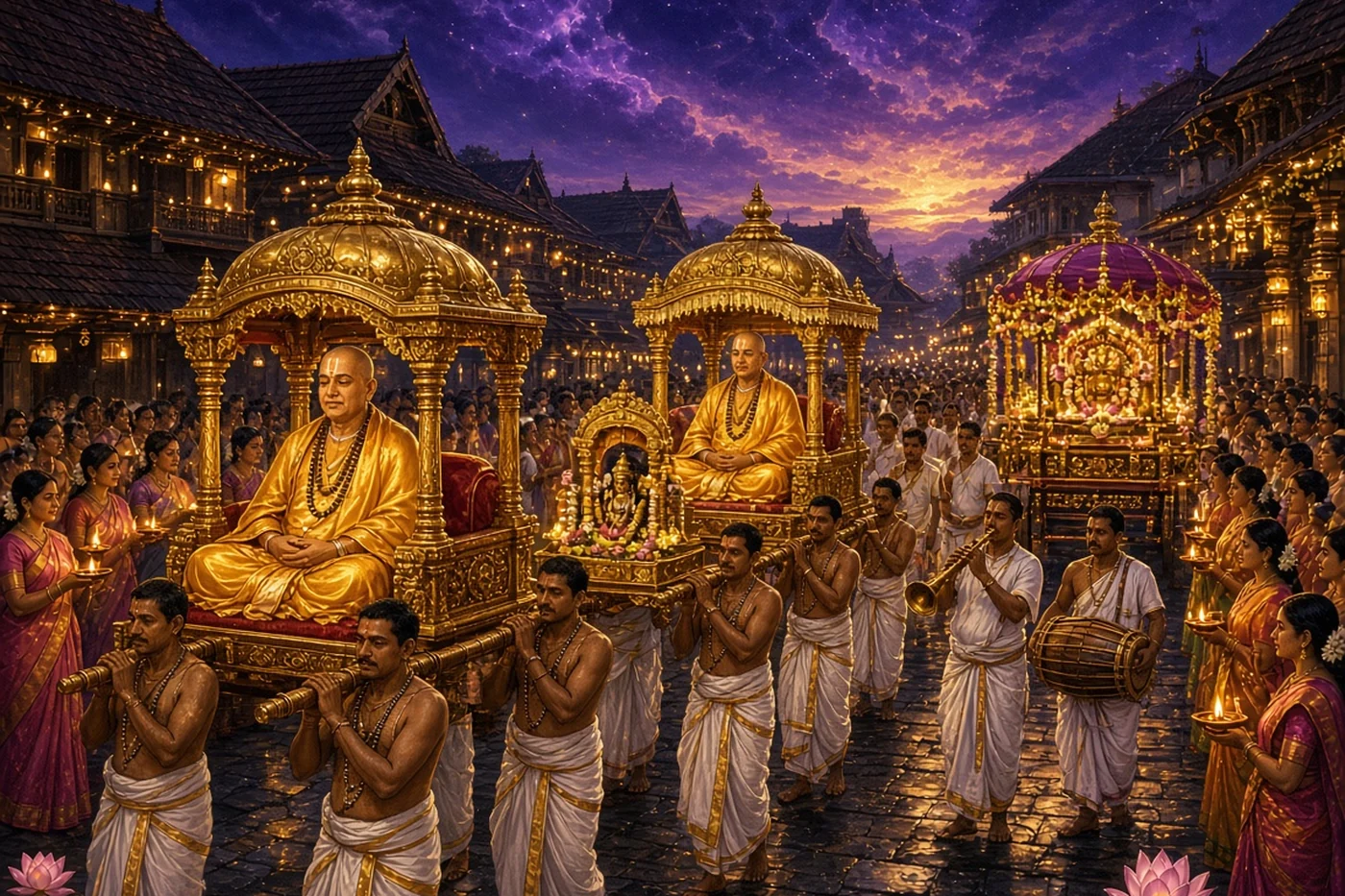
The new swami does not go in by the door. He goes first to the back of the temple and looks at Krishna through the Kanakana Kindi, the window where Kanakadasa sang, then visits the two old temples, Anantheshwara and Chandramouleeshwara.
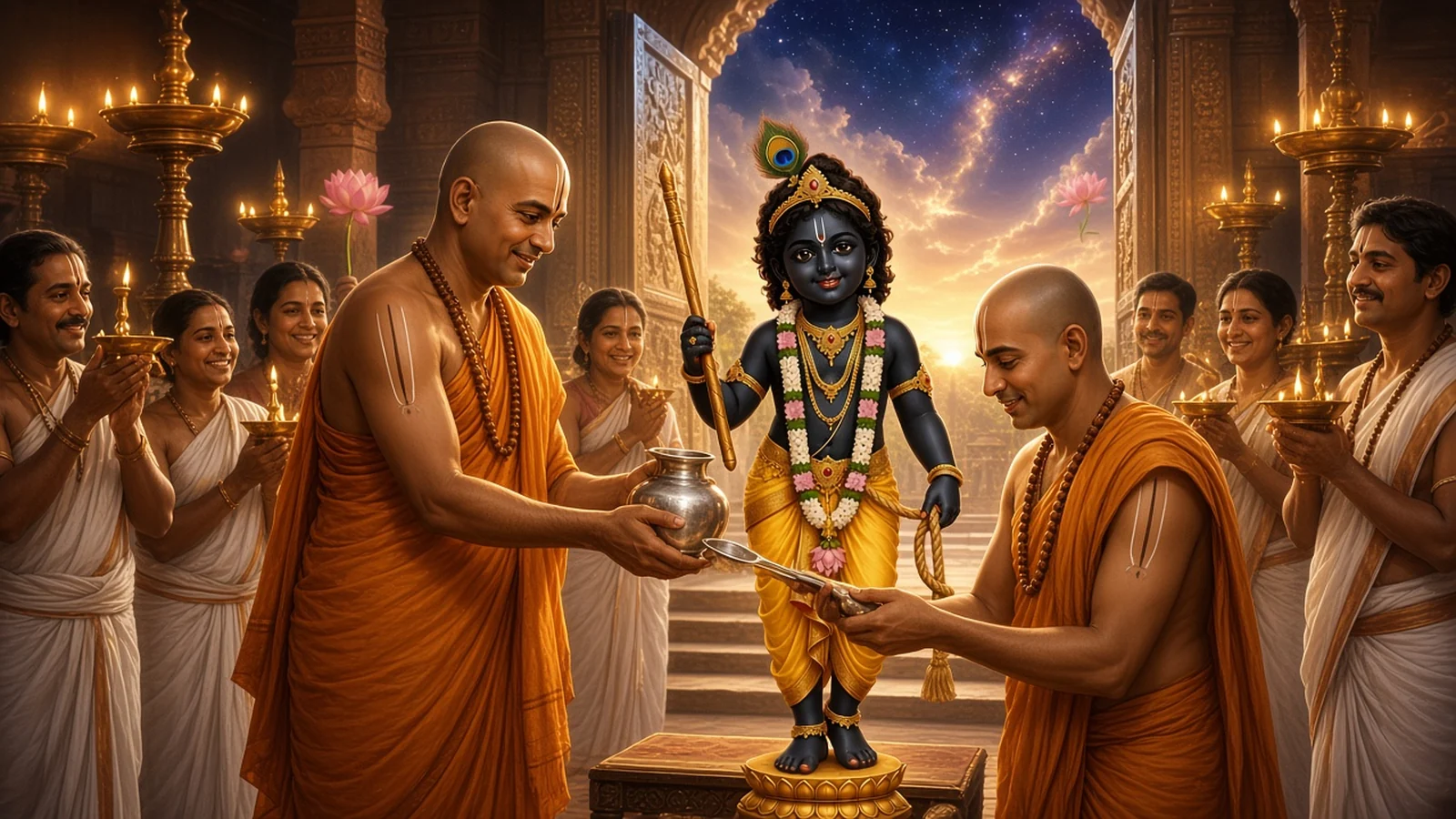
The outgoing swami meets him at the entrance. They wash at Madhva Sarovara, go in together and stand before the child. Then, in the hall of the throne, the outgoing swami rises from Madhva's seat, the Sarvajna Peetha, and the new one sits down in it. He is handed the Akshaya Patra, the vessel that never empties, the ladle and the keys of the shrine.
By seven there is a public assembly in the Rajangana, and by afternoon nearly a hundred thousand people have been fed. The new swami will not leave Udupi again for two years.