As an Ahmedabad pol keeps it: the two days on the roof
The walled city of Ahmedabad · the eve, Uttarayan and Vasi Uttarayan · 3 min read
On the eve of Uttarayan the old city did not sleep. Meera walked behind her grandfather through the Patang Bazaar near Raipur Gate. It was past ten at night and the lanes were as full as at noon, with bundles of kites hanging from every awning like bright laundry.
They had already been to Jamalpur that afternoon, to the house where Rukhsana ben and her daughters had been making kites since November. The front room was a workshop now. Paper was stacked against the wall and bows of split bamboo lay drying on the floor. Rukhsana ben counted out a hundred kites for them and put in five more for luck.
"Every year she puts in five more," Dada said on the way home. "Her mother did the same for my father."
String was the last thing. Dada stopped at a stall where a man from Lucknow was winding thread onto a reel.
"Plain cotton," Dada said. "No glass this year."
"No glass anywhere this year," the man said. "The police have been through twice."
Dada told Meera about the old manja on the walk back. In his time it was made by the road. Glass bottles were pounded to powder and mixed with rice paste and colour, and the string was run through the paste and dried in the sun. It could cut a kite's line in one pass, and a finger too.
That night he sat under the bulb in the courtyard and tied the kinya, the bridle knots, on kite after kite. Nobody else in the house was allowed to touch them.
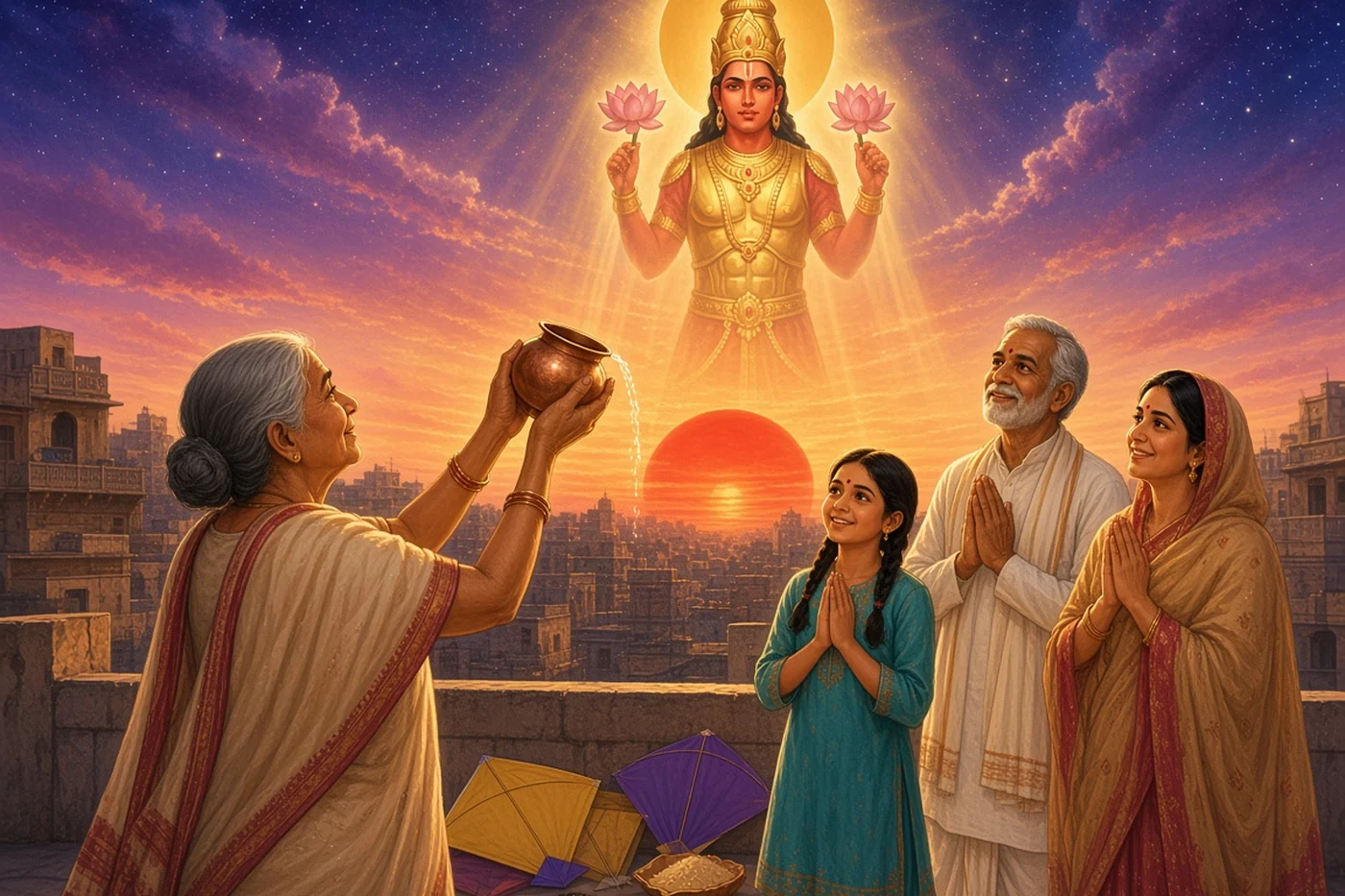
Ba woke them all before five. They bathed in the dark and climbed the stairs to the terrace with the cold still in the stone. When the sun came up red over the roofs of the pol, Ba poured water from a copper pot towards it and folded her hands. Then she put til and jaggery into a cloth bundle for the women who came to the door, and sent Meera's father down with green grass for the cow at the corner.
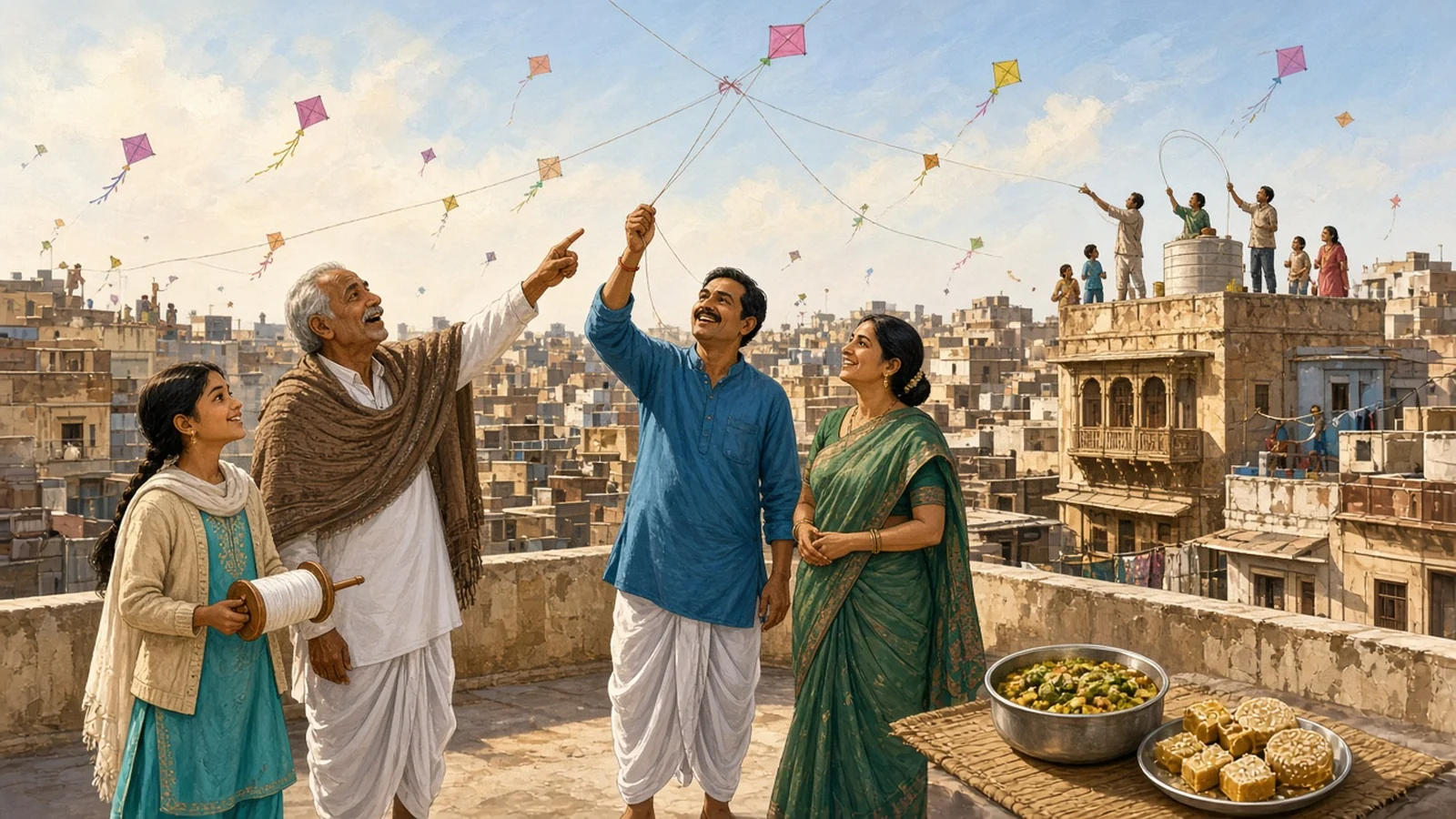
By seven the sky was full. In the pol every house shared a wall with the next, so every terrace touched another, and the whole lane flew together as one long roof.
Meera's father hooked the neighbour's kite from below. Two strings crossed and pulled, and then the other kite went drifting away over the water tank.
"Kapyo chhe!" the whole terrace shouted.
"Lapet, lapet!" Dada called, and Meera wound the loose line onto the reel as fast as her hands could go.
At noon her mother brought up undhiyu in a steel pot and jalebi wrapped in newspaper. They ate standing up, with their eyes still on the sky. After dark Dada sent up white kites, and from their strings hung the tukkal, small paper lanterns that glowed as they climbed until the sky over the old city was dotted with lights.
The next morning was Vasi Uttarayan, and the kites went up again.
Meera found the pigeon behind the water tank. A loose length of string was wound around its wing, and the wing hung wrong.
"Don't pull it," Ba said sharply. "Get a towel."
They covered the bird and put it in a shoebox with holes punched in the lid, and Meera's father phoned the helpline. The nearest Karuna Abhiyan camp was a tent outside the municipal school, with a vet in a blue apron and a row of boxes on a table.
Meera carried the shoebox the whole way, holding it level with both hands.
As the Riverfront keeps it: the International Kite Festival
Sabarmati Riverfront, Ahmedabad · the week before Uttarayan · 1 min read
A week before the roofs fill up, the kites come out in public on the long paved bank of the Sabarmati.
This is the International Kite Festival, run by Gujarat Tourism. Flyers arrive from all over India and from Japan, Italy, Britain, Canada, Brazil, Indonesia and other countries. They do not bring small paper fighters. They bring big show kites in every shape their makers can imagine, and long trains of small kites flying on a single line. The crowd along the river walks underneath them with its heads tipped back.
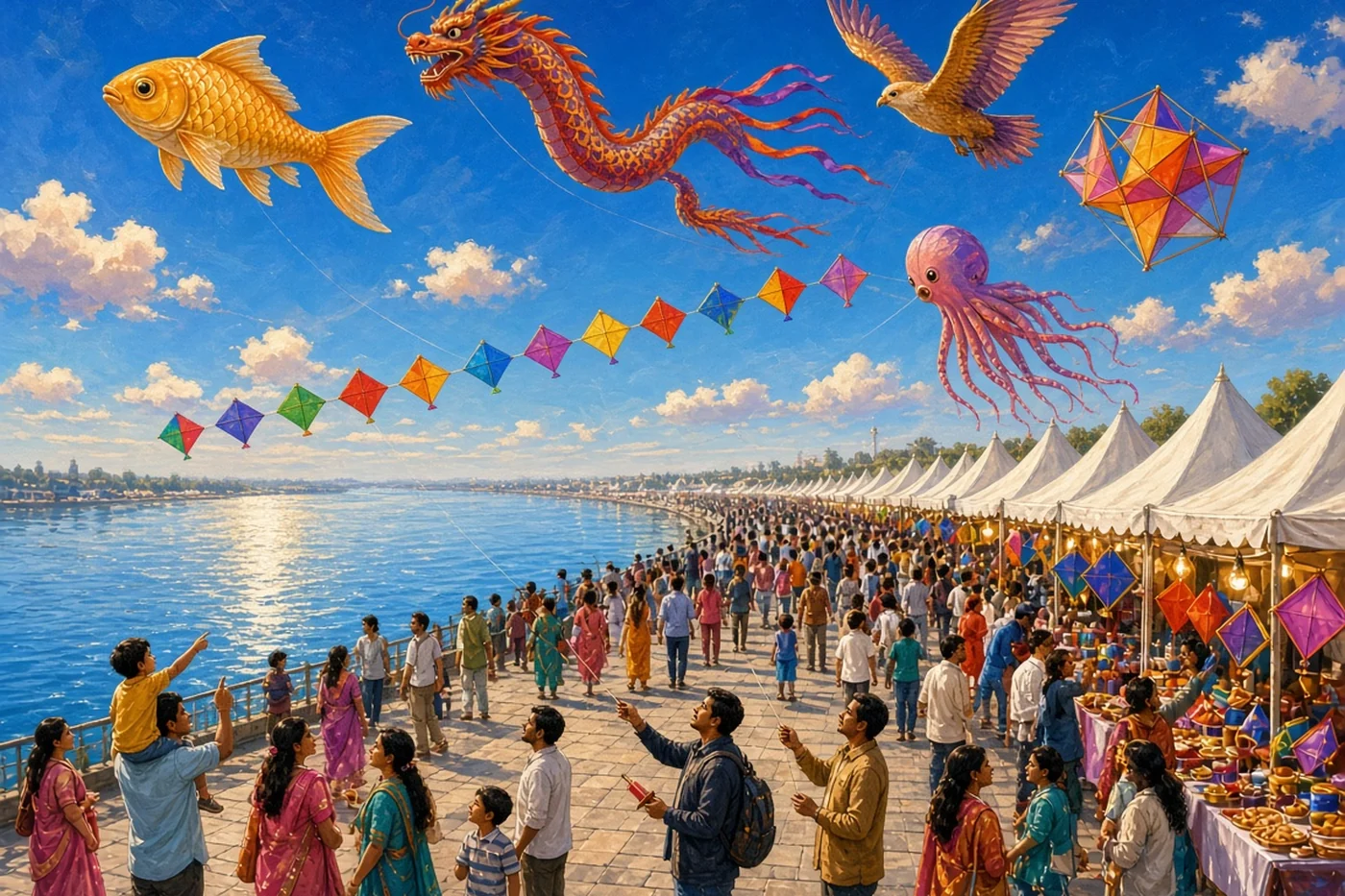
Behind the flying ground there are stalls of kites, string and food, a craft market and a pavilion with the year's theme. Events have also spread to Surat, Vadodara, Rajkot and other towns.
The festival began in January 1989. The first one was held at the police stadium in Shahibaug, with Edmund Hillary as the chief guest. Bhanu Shah, a collector of kites, worked on it with the kite makers Rasul and Naushad. Rasul's family had come from Mathura and Naushad's from Rampur. Rasul's kites now hang in the city's kite museum at Sanskar Kendra.
In January 2026 the flying began on the tenth in Rajkot, in Surat and out at Dholavira, the old Harappan city in the Rann of Kutch. On the twelfth the festival opened on the Riverfront, where the Prime Minister of India and the German Chancellor flew the first kites together, and it ran until the seventeenth.
The fighters do not compete here. That happens on the roofs, two days later, in every neighbourhood of the city at once.