As two friends walk it
Western Uttar Pradesh · Har ki Pauri to Pura Mahadev, the fortnight before Shravan Shivratri · 3 min read
Mohit and Satbir had been talking about it since the wheat was cut. Every Shravana the young men of their village near Sardhana went to Haridwar for water, and every Shravana the two of them had been told they were too young. This year Mohit's father only said, "Buy good kanwars. And come back."
They took the bus north with six others and reached Haridwar in the dark. The town was saffron from end to end. Before dawn they went down the steps at Har ki Pauri, where the river comes out of the hills fast and cold, and held their brass pots under until the water ran over their wrists.
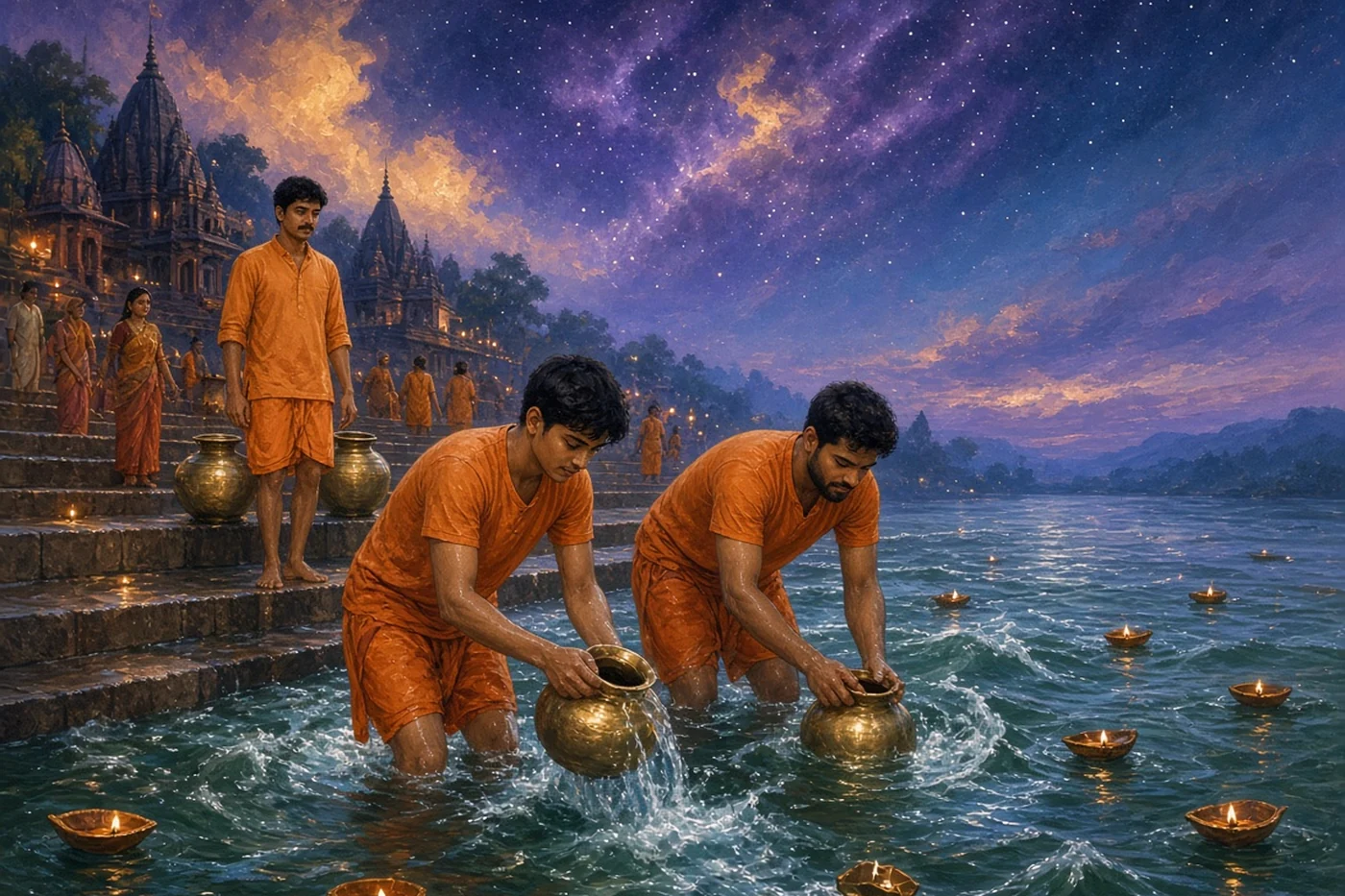
"Seal them properly," said Rajbir, who had walked eleven times. A man on the steps sold wet clay for it. "From now on that water is not yours. It is his. It does not touch the ground until it touches the linga."
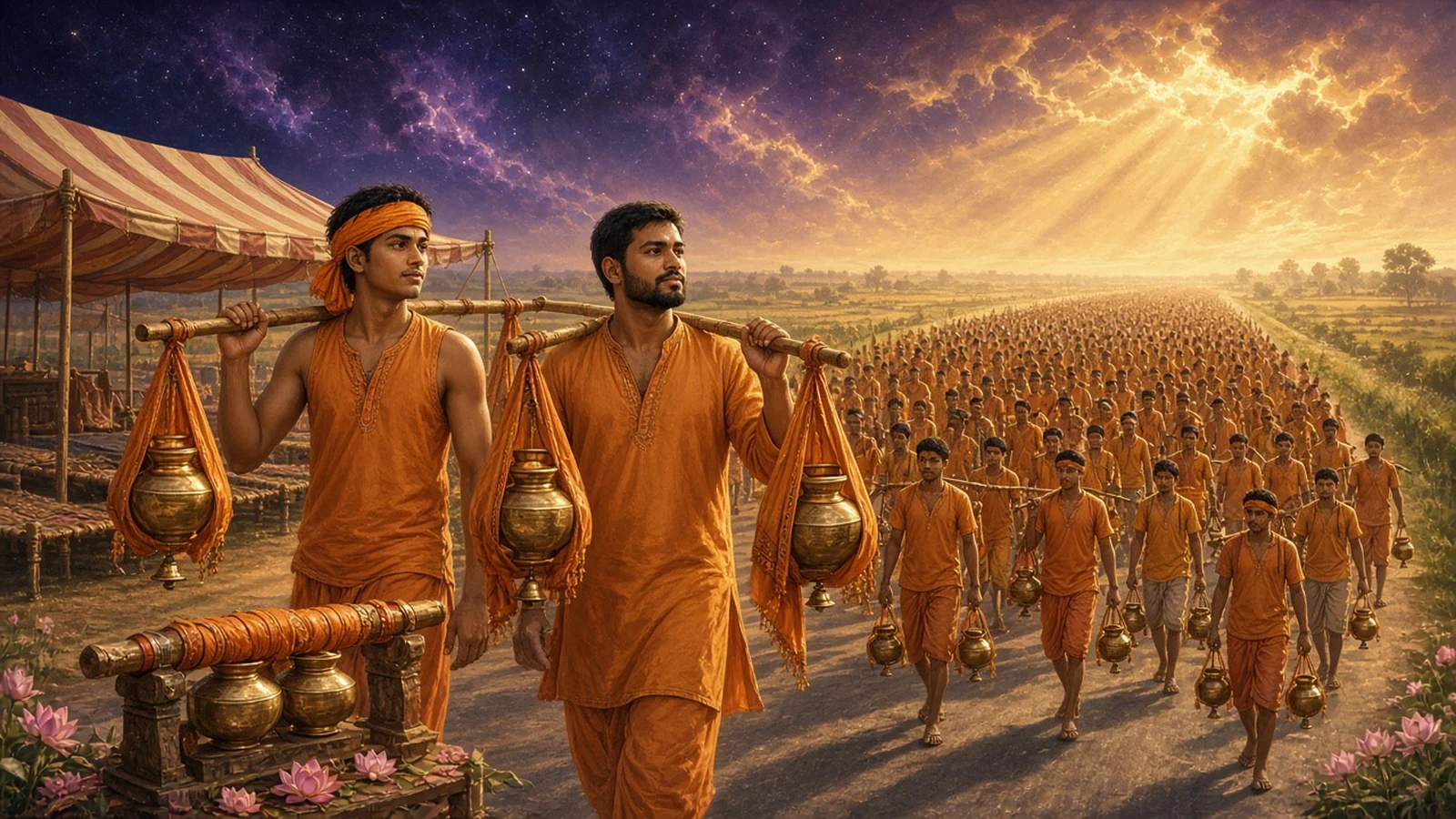
The kanwar was a bamboo pole with a pot hung from each end, wound in saffron cloth, with a bell on it and a small picture of Shiva. Satbir lifted his onto his shoulder and felt the river pull at both ends.
"Bol Bam," said Rajbir.
"Har Har Mahadev," the boys answered, and they walked.
The first days were easy, because everything was new. The highway south was closed to trucks and the kanwariyas had it, thousands upon thousands, in saffron shorts and vests, barefoot or in cloth slippers, nobody wearing leather. Every few kilometres there was a camp under a striped awning, put up by a kanwar committee or a shopkeepers' association or a village, with bhajans on the loudspeakers, cots in rows, water and puris, a man with bandages and painkillers, a boy offering to press tired legs. Nobody paid for anything.
At every camp stood a wooden stand, waist high, where a kanwar could rest without touching the earth. "If you sit, it goes on the stand," Rajbir said. "If it ever touches the ground, you hold your ears and do your squats and say sorry to him. Mine never rests at all. Mine is a khari kanwar. When I stop, one of you holds it upright for me."
By the fourth day Mohit had blisters on his blisters, and they began to walk in the evenings, when the road was cooler. That was when they first saw the dak kanwariyas.
They heard them before they saw them: a horn, a shout, the slap of bare feet. A runner in saffron came past at full speed with a kanwar held out in front of him, and behind him a truck full of his team, its lights blazing and its music loud. Two hundred metres on another boy jumped down from the truck, took the pole from the runner's hands without breaking stride, and was gone into the dark.
"Dak kanwar," said Rajbir. "They fill at Haridwar and pour at home inside a day and a night. The water never stops moving. They fast the whole way."
"Next year," said Satbir.
"Walk this year first," said Rajbir.
They passed Muzaffarnagar, and a week after they had set out they came down into Meerut district, where rose petals fell on the road from a helicopter and the boys looked up with their mouths open. On the night of Shravan Shivratri they stood in the queue at Pura Mahadev, in the village of Pura near the Hindon, with three kilometres of saffron in front of them in the dark. A little before four the bells began.
When Mohit reached the linga at last, he broke the clay with his thumb and tipped the pot, and the water of Har ki Pauri, carried all that way on two shoulders without once touching the ground, ran over the stone and away.
"Is that all?" he said.
"That is all," said Satbir, and found that he was crying, and did not know why.
As the Shravani Mela walks it
Bihar and Jharkhand · Sultanganj to Baidyanath at Deoghar · 2 min read
At Sultanganj, in Bihar, the Ganga turns and flows north for a stretch, and that is where the east fills its pots. On a rock in the river stands the temple of Ajgaibinath, and the pilgrims bow to it before they lift the kanwar. Then the walk begins: about a hundred and five kilometres south, out of Bihar and into the hills of Jharkhand, to Baidyanath at Deoghar, the linga that Ravana set down and could not lift again.
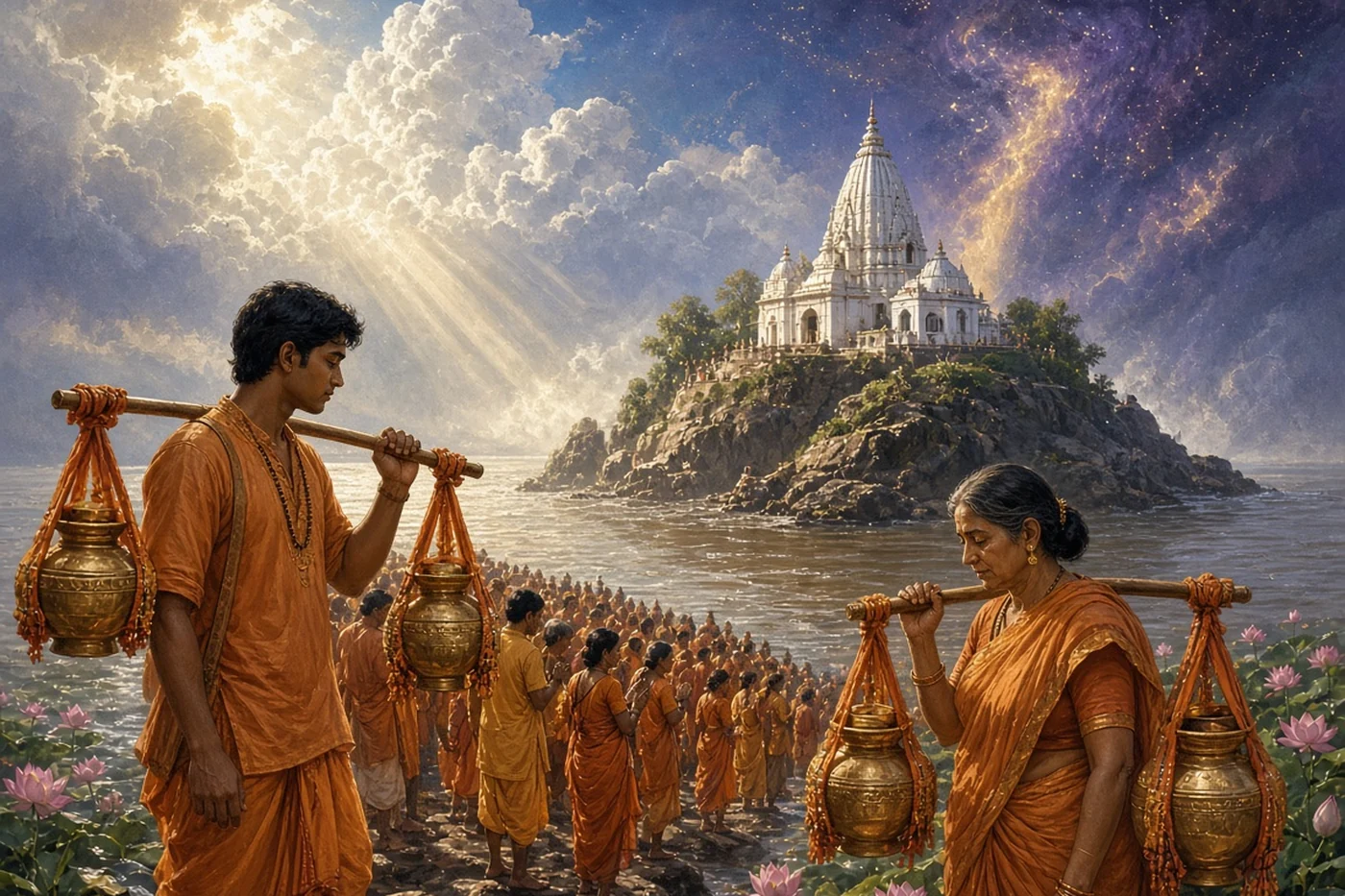
On this road everyone is a bam. The pilgrims call each other bam ji, every shout of "Bol Bam" is answered with another, and for the whole month of Shravana the road is one saffron line. Most take four or five days, twenty or twenty-five kilometres a day, through Asarganj and Tarapur, Kumarsar and Jalebiya More, and up the hard climb at Suiyya, where volunteers' camps keep their kitchens and their massage cots open day and night. The pilgrims eat no meat, use no soap or oil, wear no leather, and rest the kanwar only on the stands. A woman from Muzaffarpur told one traveller that she had walked it for thirty-five years, four times a month in the season, with a hundred people behind her.
The dak bams do it in a single day. They fill their pots, take no food and no rest, and go, and at Deoghar they are let in first. In 2003 the count by the second Monday alone put them at more than sixty thousand.
The temple stands in a walled court of twenty-two shrines, and on the Mondays the queue runs for kilometres. When the crowd is too great to let everyone into the sanctum, the pilgrims pour their water into a brass channel outside it, which carries the Ganga straight onto the jyotirlinga. Then many walk on, another forty-five kilometres, to Shiva at Basukinath, before they go home.