As Varanasi keeps the evening
North India · the ghats of Kashi · 3 min read
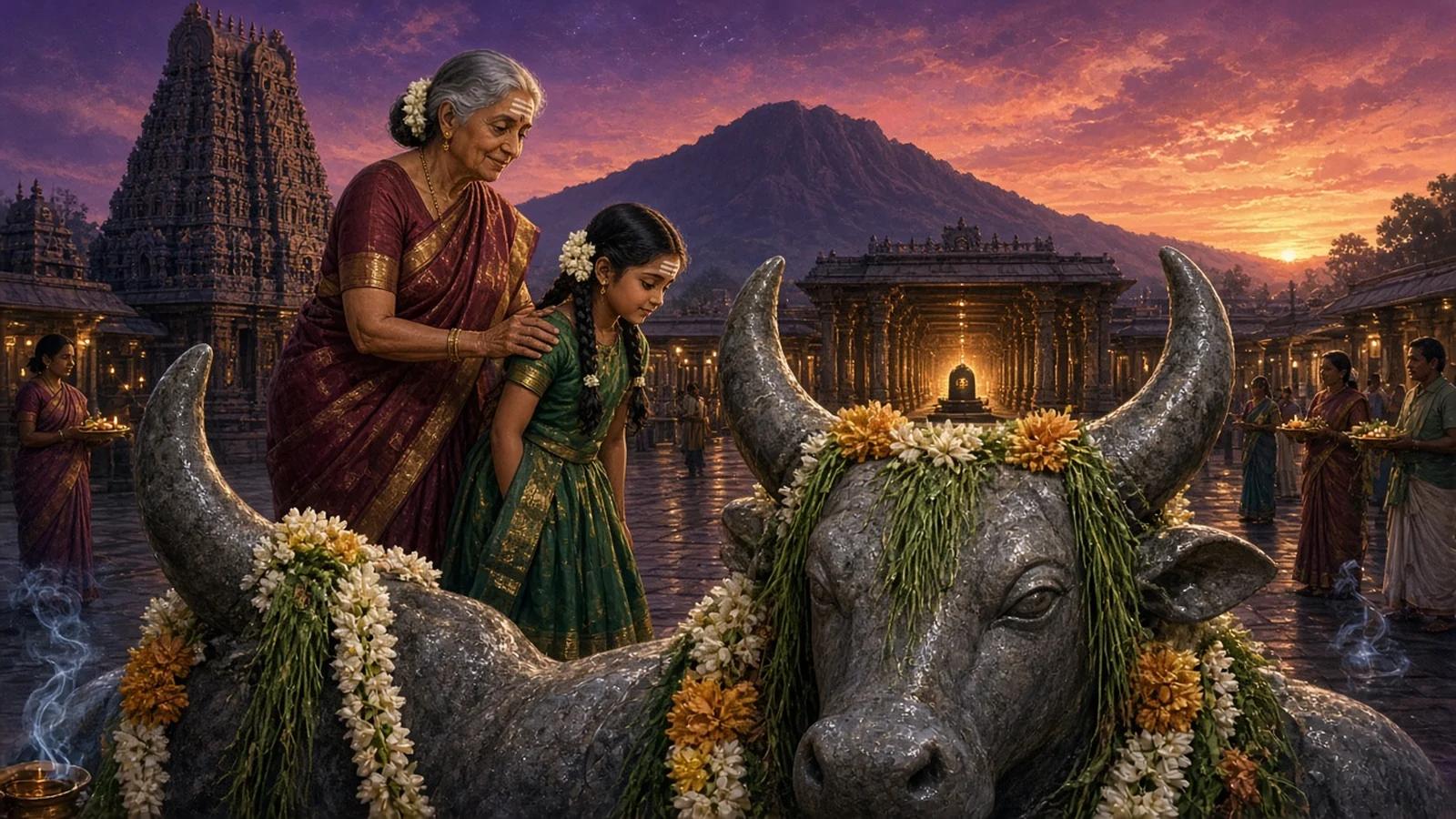
Before it was light, Nani was already on the steps at Panchganga with a brass pot in each hand.
"Today they come down," she told the boy, who was eight and had been promised the boats. "All of them. Every god there is. They come to the river to bathe on this one morning, so we bathe first and leave it clean for them."
"Why today?"
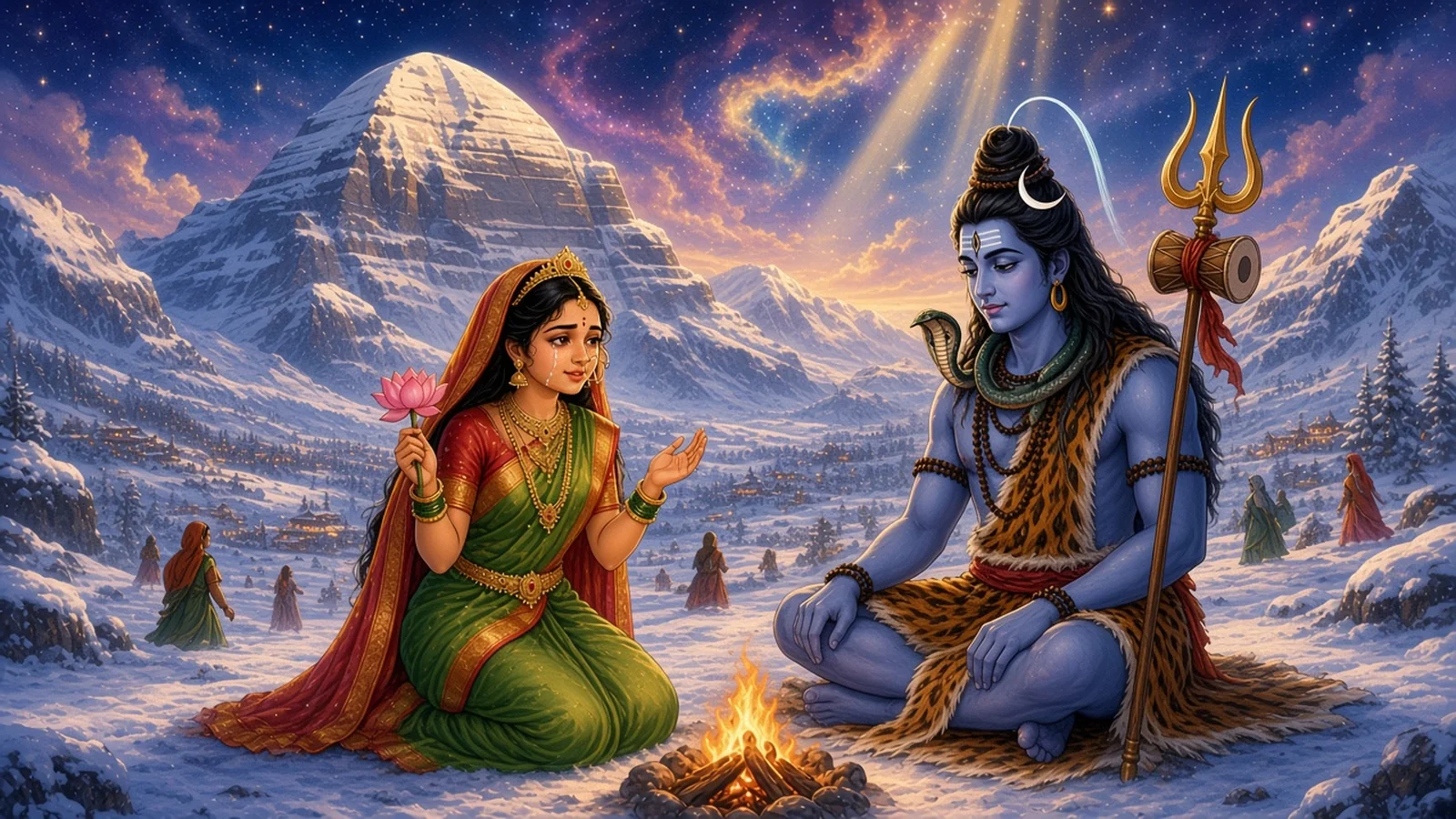
"Because of the three cities." She went in up to her waist, dipped, and came up blowing. "Three demon brothers had three cities that flew. Nothing could touch them unless one arrow went through all three at once, and they lined up once in a thousand years. Shiva waited. On this full moon he loosed the arrow, and the cities burned, and the gods lit lamps for him in heaven. Tonight we light them for the gods."
The whole of it is told in The Three Cities and the Single Arrow. Nani told it in four sentences with the Ganga running past her knees, which is how Kashi tells most things.
All through the month of Kartik a lamp had burned at the ghat every evening for the family's dead, the akash deep that the month asks for. Tonight it would have company.
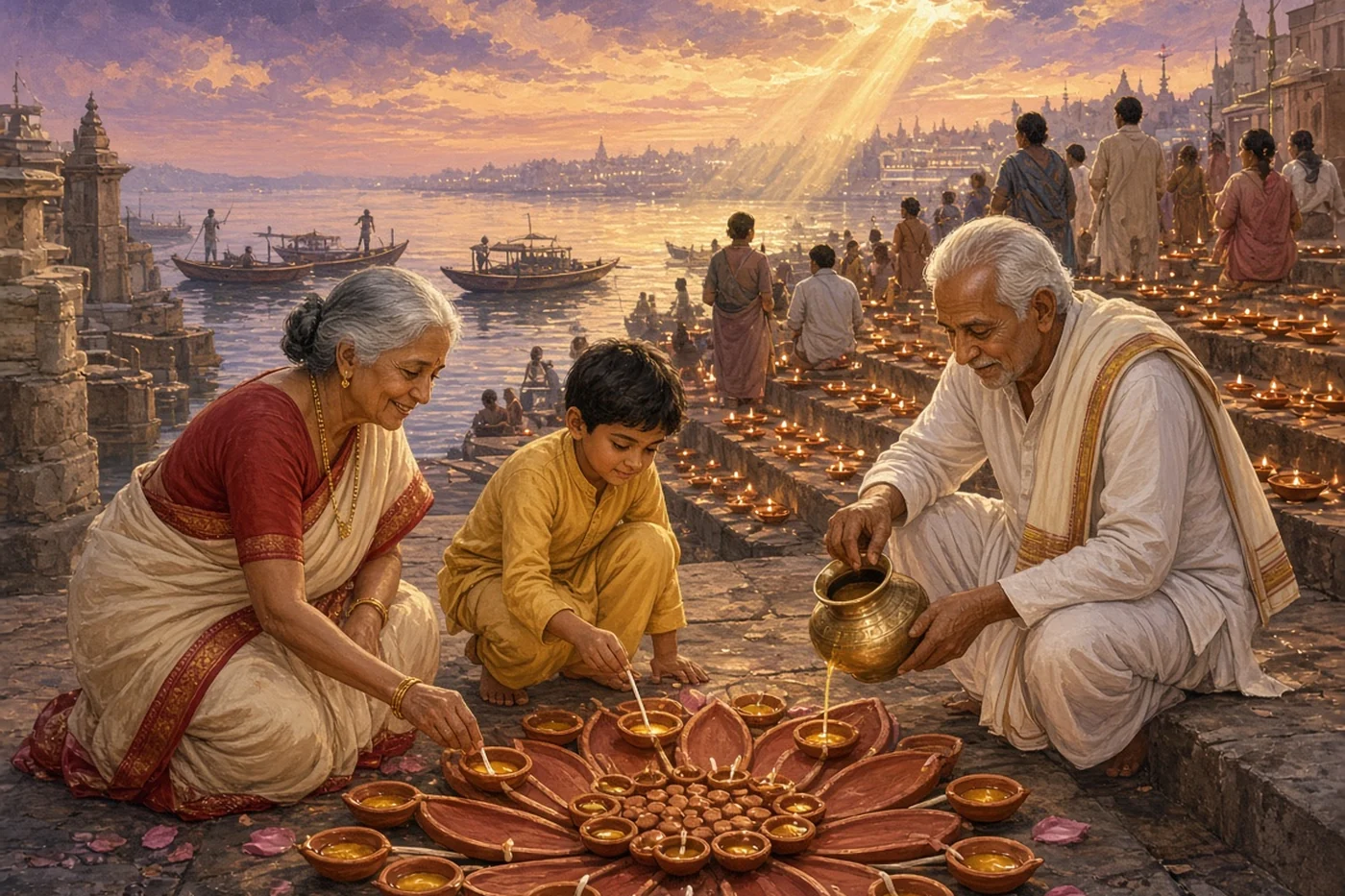
By afternoon the steps from Assi to Rajghat were covered in rows of small clay lamps, set out by priests, volunteers and anybody who came down with a packet of them. The boy's job was the wicks. His grandfather's was the ghee. Nani did the drawing: a lotus of lamps on the landing, a swastika on the step below.
"How many are there?"
"Last year the government said twenty-five lakh," said his grandfather. "On eighty-four ghats. Nobody counted them. Nobody could."
A little after five the first lamp was lit, far up the river, by somebody important with cameras round him, and after that the bank caught fire from end to end as each ghat lit from the next. At Dashashwamedh the aarti began: twenty-one young priests in a line with their tiered brass lamps, two dozen girls with the whisks, the conches, and a crowd that the city puts at a lakh. A replica of the Amar Jawan Jyoti stood on the ghat, a bugler played the last post for the soldiers of Kargil and of the past year, and medals called the Bhagirath Shaurya Samman were handed out. The ghat itself had been dressed with twenty-one quintals of flowers and fifty-one thousand lamps of its own.
Then the boats. Hundreds pushed off at once, so full that the water came to the gunwale, and from the middle of the river the boy saw the city as the gods were meant to see it: every step a line of fire, the palaces above them lit, the temple of Vishwanath glowing over the roofs, and beyond Chet Singh Ghat a laser show painting the old fort wall with the story of Kashi until a quarter to nine. Fireworks went up over the water.
"Did they come?" the boy asked, when they were walking home with the empty pots.
"Look at the river," said Nani. "Would you have stayed away?"
As Odisha keeps the dawn: Boita Bandana
East India · Cuttack and the Odisha coast · 2 min read
In Cuttack the same full moon begins before sunrise, and it begins with a boat the size of a shoe.
Bou had made it the night before out of a length of banana stem, cut and pinned, with a paper sail. Into it went a lamp, a betel leaf, a betel nut, a few flowers, a coin and a cowrie shell. The children carried theirs to the Mahanadi in the dark, past the walls of Barabati fort, down to the Gadagadia ghat, where half the city was already standing in the water.
"Say it as you set it down," Bou said. "Aa ka ma boi, pana gua thoi."
"What does it mean?"
"Four months," she said. "Ashadha, Kartika, Magha, Baisakha. The months the ships were away. And pana gua thoi: I have put in the betel leaf and the nut. That is what my grandmother said. Ask your father and he will tell you something else."
The boats went out on the current with their small flames, hundreds and then thousands, and the women gave the hulahuli, the long trilling cry, and somebody blew a conch.
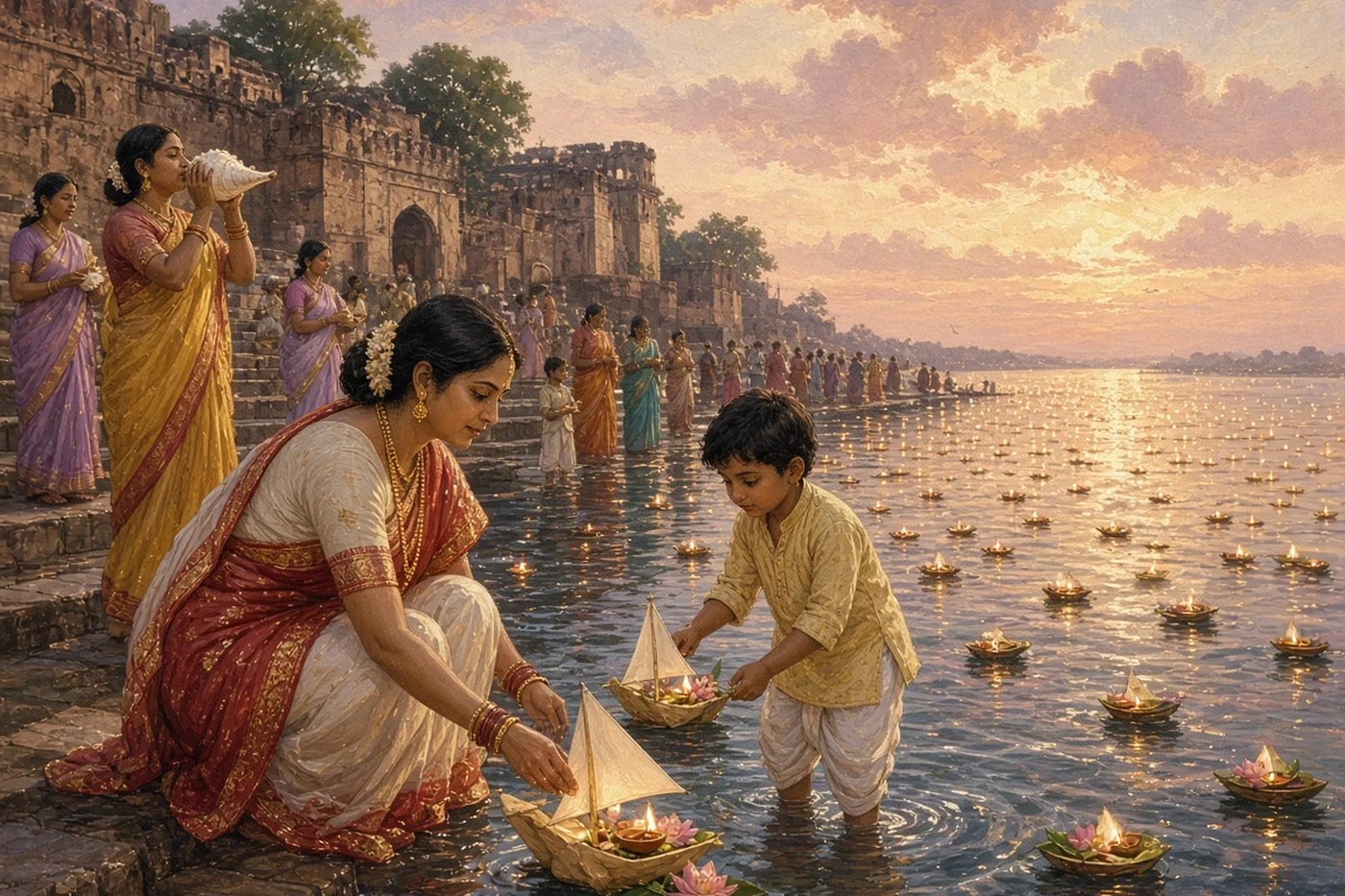
It is done, Odisha says, for the sadhabas, the merchant sailors of old Kalinga, who set out on this day for Bali and Java, Sumatra and Borneo and Sri Lanka, when the north-east wind began to blow in November, and came home on the south-west wind about May with their holds emptied of cloth and pearls and gems and ivory and filled with what they had bought. Their wives sent them off from the shore with betel and lamps, and the toy boats are those ships. Local tradition puts the first voyages in the third century before the Common Era.
The one thing the scholars agree on about the chant is that no two of them read it alike; some hear in its first word an older phrase, that one should not fear the sky or the water.
For five days before, the Panchuka, the house had eaten no fish and no meat, the last five days of the Kartika vow; from tomorrow it would again.
And at the ghat the fair was waiting. Bali Jatra, the Voyage to Bali, opens on Kartik Purnima every year on the sand below the fort and runs for a week and more, with stalls, two stages of dancers till eleven at night, and a crowd that in 2025 the state put at sixty-five lakh over eight days on sixty acres. In 2022 two thousand schoolchildren folded twenty-two thousand paper boats in thirty-five minutes for a world record, and in November 1992 the state sent a naval yacht out from Paradeep to sail the old route; it reached Bali in eighty-two days.
"Where is my boat now?" the boy asked, as the sun came up over the river.
"Halfway to Java," said Bou.