Festival · Three days with the goddess's door shut, the plough laid by, and a strip of red cloth on the fourth morning
Ambubachi Mela
Ambubachi is the yearly gathering at the Kamakhya temple on Nilachal hill above Guwahati, in the monsoon month of Ahar, when the goddess is believed to have her yearly course. At the moment of the Pravritti the temple door is shut, and for three days there is no worship inside, while across Assam the fields are not ploughed or dug, many households do not cook and no holy book is read. On the fourth morning, after the Nivritti, the goddess is bathed and the door opens, and the lakhs of pilgrims who have waited on the hill are given water from her spring and a piece of the red cloth that covered her.
When is Ambubachi Mela in 2027? The Nivritti, when the doors reopen, is Saturday 26 June 2027; it runs 22 to 26 June 2027. In 2028: Monday 26 June 2028. In the Assamese month of Ahar, the solar Ashadha, as the Sun enters Ardra in the sign of Mithuna; about 22 to 26 June.
Also calledAmbubachiAmbubachi MahayogAmbuvachiAmetithe Tantric fertility festivalKamakhya's yearly coursexaat or Baxumati'r rajasthala in the villages
In short
What is the Ambubachi Mela?
The yearly gathering at the Kamakhya temple in Guwahati in June, when the goddess is believed to have her yearly course. The temple door is shut for three days, worship stops and the fields of Assam are left unploughed; on the fourth morning she is bathed and the door opens.
When is Ambubachi in 2027?
Calendars give 22 to 26 June 2027. Reckoned from the Sun's entry into Ardra, the Pravritti should fall in the early hours of 23 June, the door stays shut on 23, 24 and 25 June, and it opens on the morning of 26 June; the exact minute is announced by the Maa Kamakhya Devalaya in mid June. In 2028 the dates are again 22 to 26 June.
What is the prasad at Ambubachi?
Angodak, water from the spring in the shrine, and angavastra, a small strip of the red cloth that covered the stone during the three closed days. The cloth is tied on the arm or worn at the neck.
What is not done during Ambubachi?
No ploughing, digging, sowing or plucking, no worship and no reading of holy books. Many households do not cook, and widows, brahmacharis and Brahmins eat no cooked food until the fourth day.
Next, in 2027Saturday 26 June 2027
22 to 26 June 2027
Prime godKamakhya, the goddess of the blue hill
with 2 more
WhereThe Kamakhya temple on Nilachal hill, Guwahati, Assam, and the Assamese villages that keep the days at home; pilgrims come from Bengal, Bihar, Odisha and the rest of India, and from Nepal and Bangladesh
How longFour days and three nights from the Pravritti to the Nivritti, with the doors reopening on the fourth or fifth morning; the crowds stay on the hill for most of a week
In the Assamese month of Ahar, the solar Ashadha, as the Sun enters Ardra in the sign of Mithuna; about 22 to 26 June
Why it is kept
Ambubachi is the one time in the year when Kamakhya's temple, which has a queue on any ordinary day, is closed to everyone. In the monsoon month of Ahar, with the Brahmaputra in flood below Nilachal, the goddess Kamakhya is believed to have her yearly course. Her door is shut at an exact minute, the Pravritti, and for three days nobody enters, while the pilgrims who have climbed the hill wait in the rain. On the fourth morning she is bathed, the door opens, and each of them hopes to go home with a little of her spring water and a strip of red cloth.
The goddess of Nilachal has no image. Under her temple, in a dark room reached by steep steps, she is a cleft in the rock that a spring keeps wet, and the Kalika Purana says it is the womb of Sati, which fell on this hill when Shiva carried her body east. That story is told in Where Her Womb Fell. A goddess worshipped in that form is a goddess who has her course, and Ambubachi is when she has it.
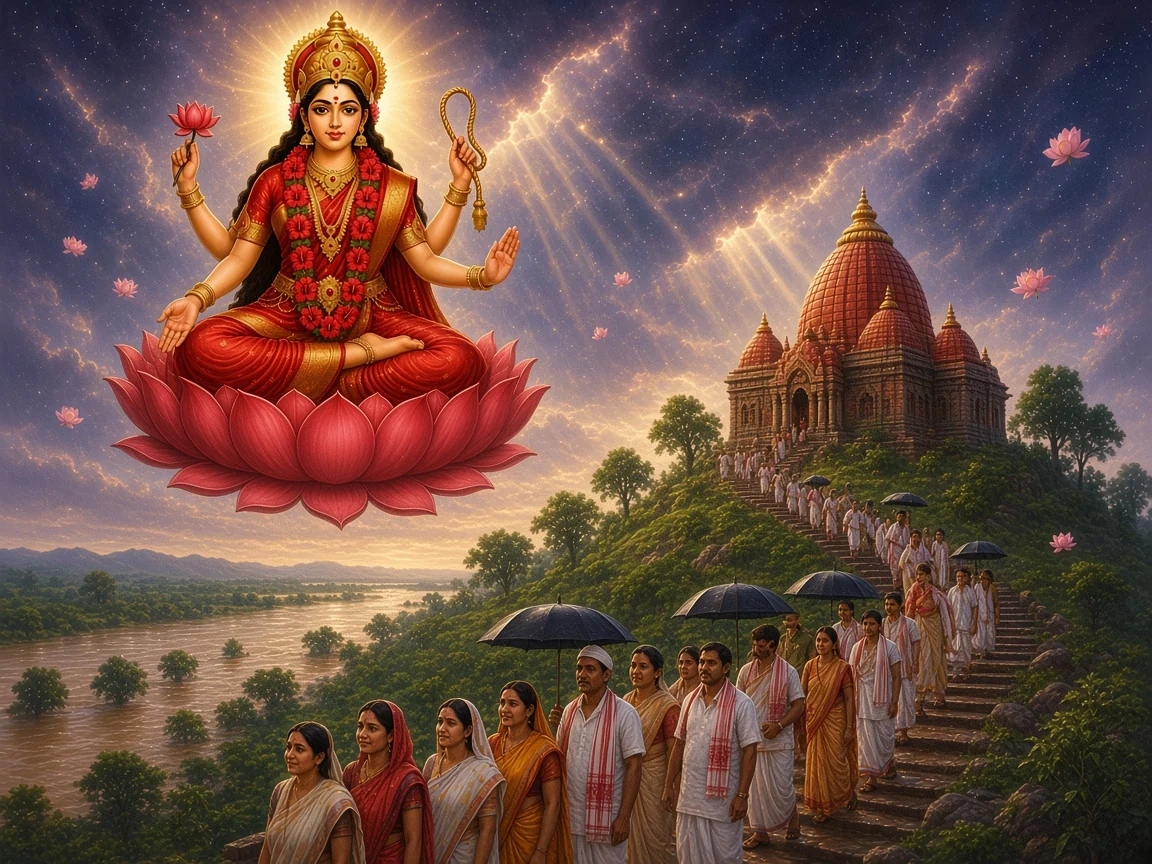
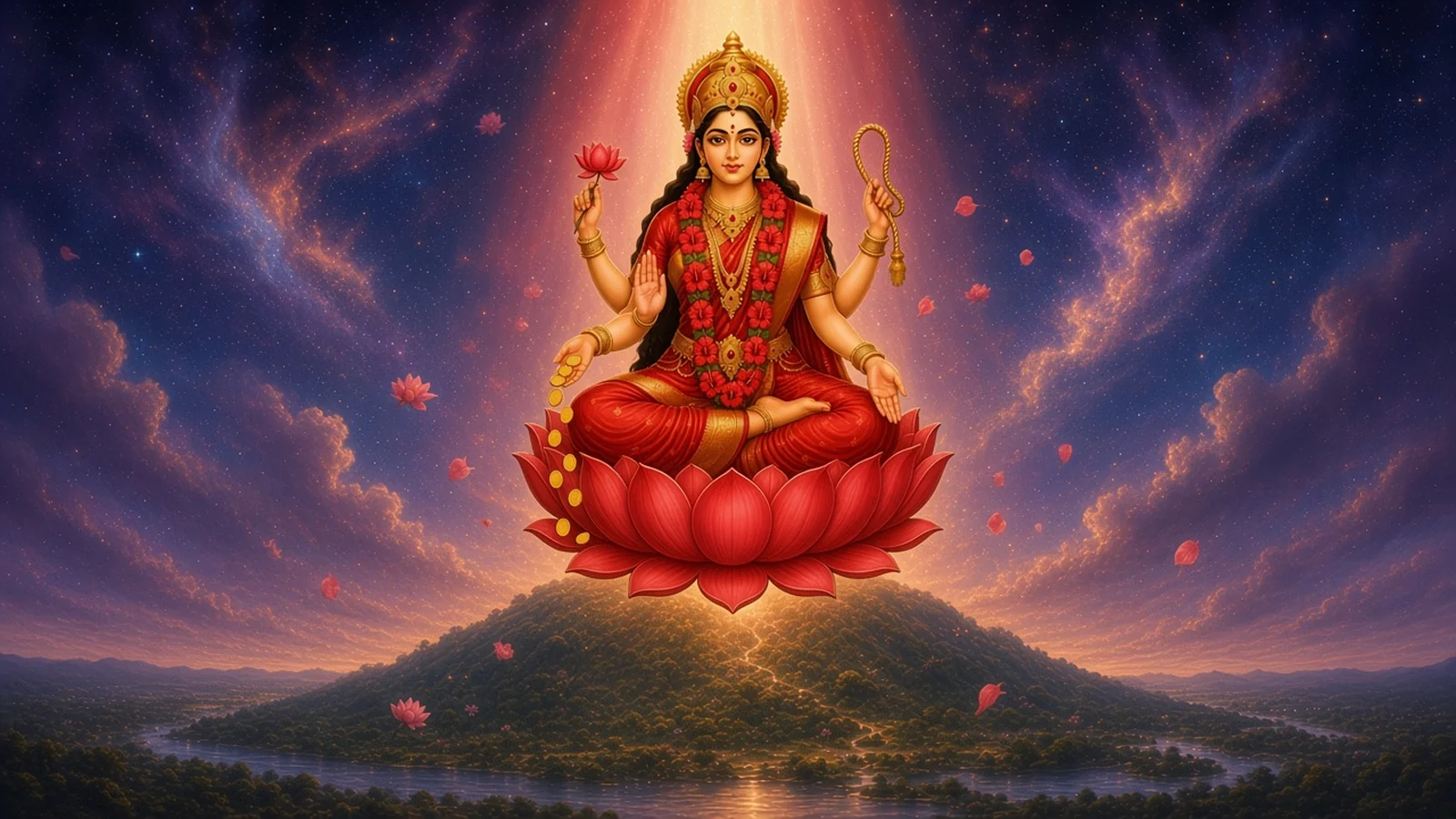
Nilachal hill above the Brahmaputra, where a lotus of light comes down on the seat of the goddess
The name is read as ambu and vachi, the issuing forth of water. In these weeks the rains are at their height and the Brahmaputra is in spate, and people say that its water runs red. People say that the Earth herself is in her course in these days, and that a woman in her month is not asked to work. So the plough is laid by across Assam, as it is in Odisha for Raja Parba and on the Tulu coast at Keddasa, in Three Days of Rest for the Earth. When the three days are over the ground is ready to bear, and the transplanting begins.
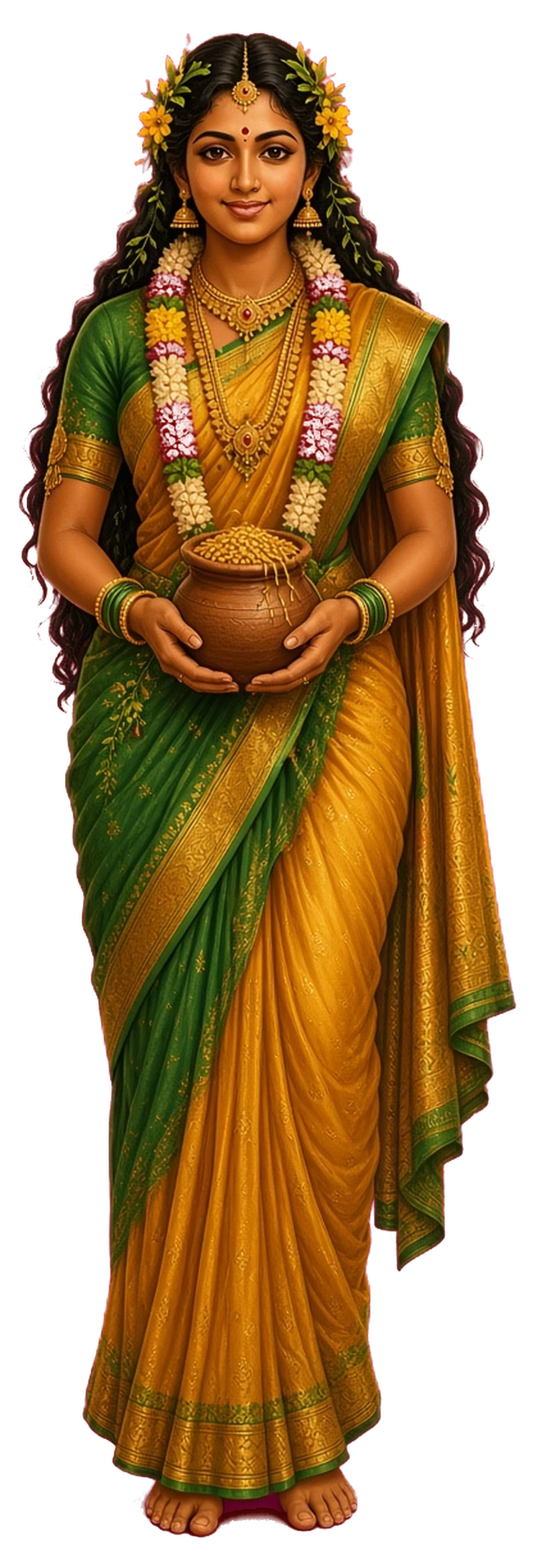
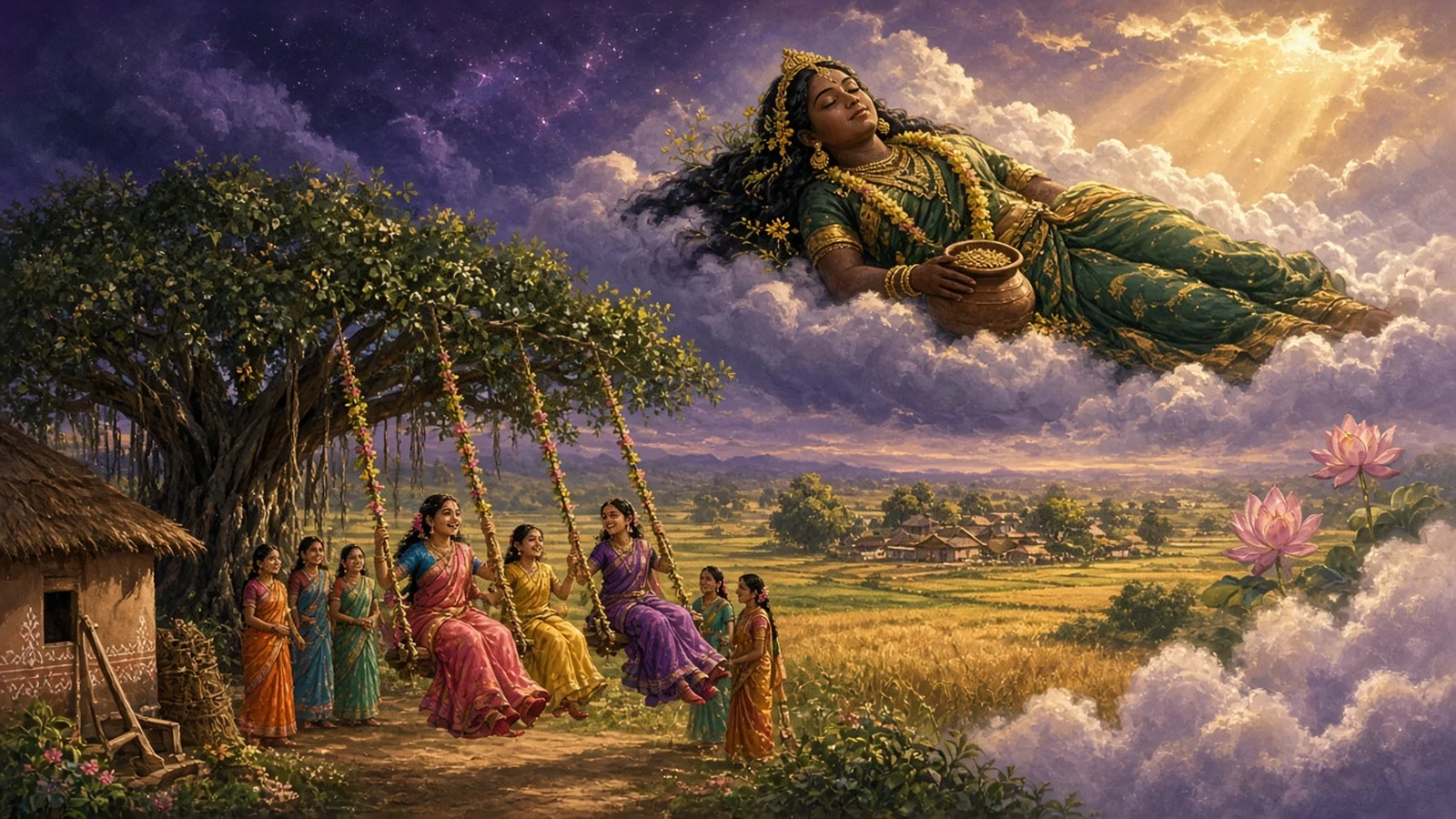
Monsoon over the Assam fields: the plough laid under the eaves while Mother Earth rests
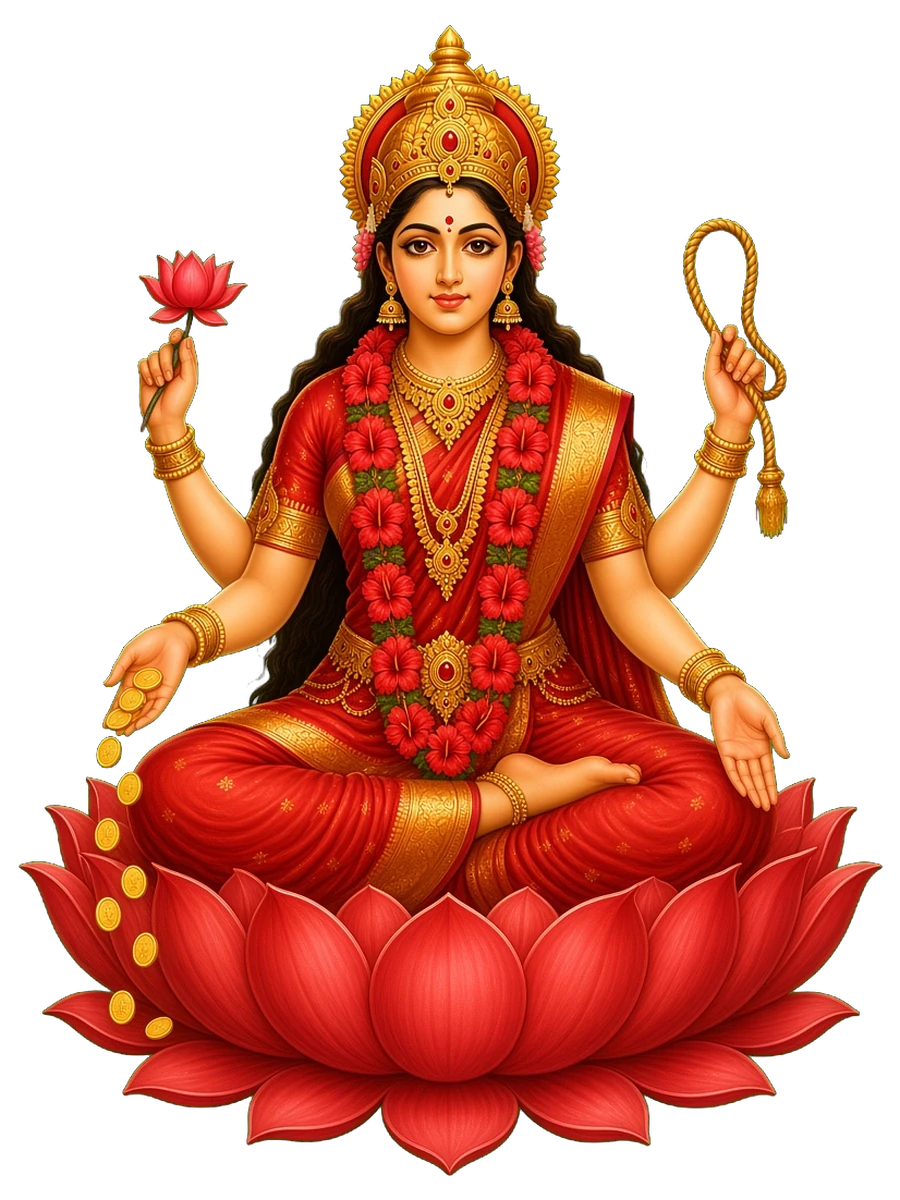
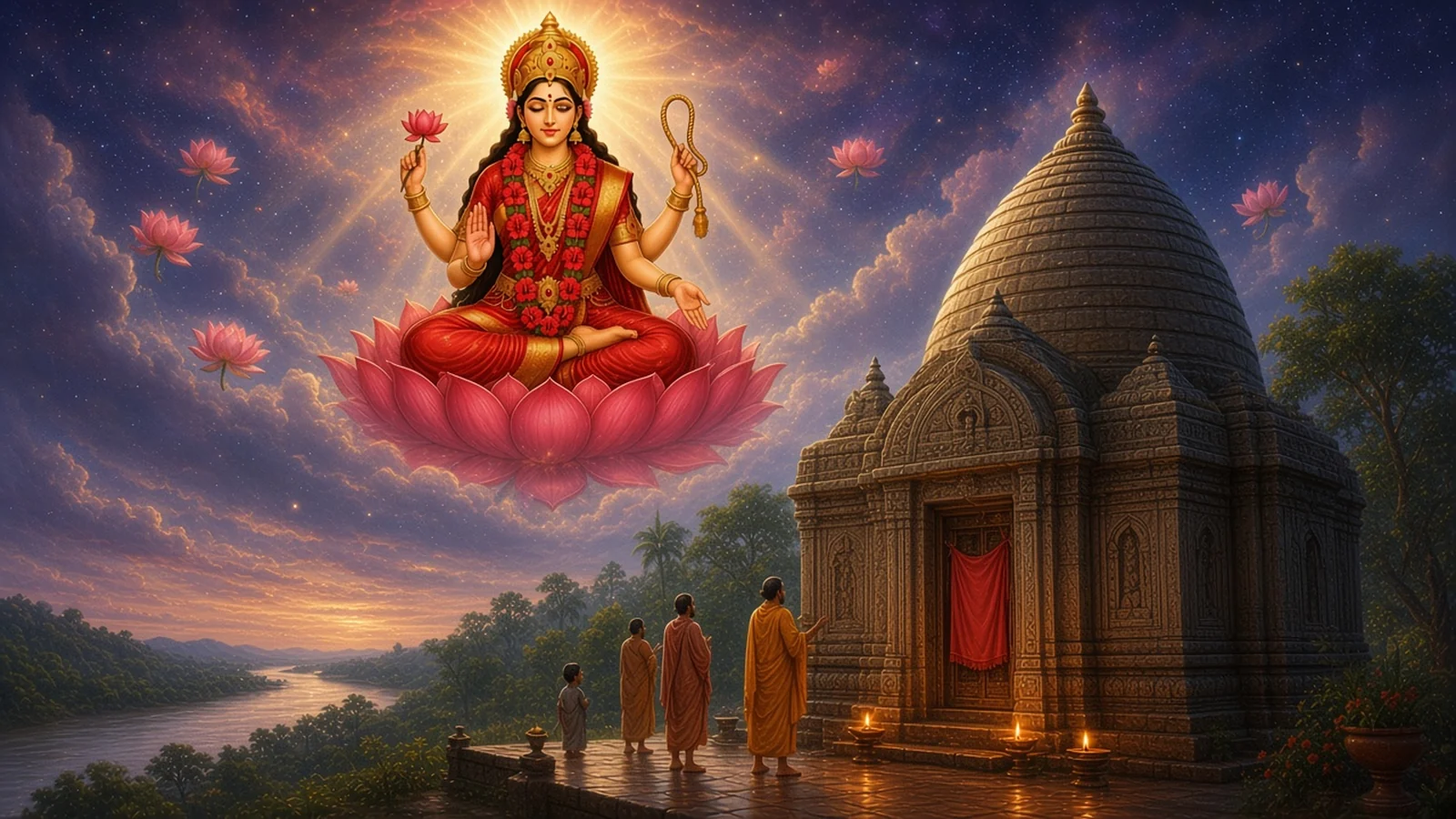
The goddess of Nilachal, worshipped in a dark room under her temple as a cleft in the rock kept wet by a spring, with no image. Ambubachi is her yearly course. The stone is covered in red cloth, her door is closed while she rests, and when she has been bathed on the fourth morning the cloth and the spring water are her gift to the pilgrims.
In these days the goddess is taken for the Earth herself, and the Earth is held to be in her course as the monsoon rains begin. That is why the soil is left alone, and why many pilgrims come for the Earth's sake rather than for the Tantric rites; the villages call the days Baxumati'r rajasthala, the Earth's menstruation.
The Kalika Purana says that when Shiva carried Sati's body across the world, her womb came down on this hill, and that the stone in the shrine is what it became. The yearly course is kept at the seat where it fell.
Three days the doors are shut
1
The Pravritti
The moment the almanac fixes for the Sun's entry into the first quarter of Ardra, in Ahar · Tuesday 22 June 2027
Prabrittithe onsetthe closing of the doorthe start of the Ambubachi Mahayog
The temple office announces the minute in mid June, and at that minute the door of the inner room is shut, the stone already covered with the red cloth by its keepers. The moment moves through the day from year to year: 2.56 in the afternoon of 22 June in 2025, a little after nine at night in 2026. Reckoned from the Sun's entry into Ardra, it should come in the early hours of 23 June in 2027, which the almanac counts as the night of 22 June, and on the morning of 22 June in 2028; the temple fixes the minute. Pilgrims are on the hill well before it.
The Pravritti: the keepers shut the inner door and hang it with plain red cloth as pilgrims wait
The three days and nights after the Pravritti · Wednesday 23 June 2027
AmetixaatBaxumati'r rajasthalathe Earth's days
No one enters the inner room and no worship is done there; outside its door three lamps are kept burning and a singer sits up the nights. Across Assam the other temples close, the holy books are not read, and no one ploughs, digs, sows or plucks. Many households do not cook; widows, brahmacharis and Brahmins eat no cooked food, and many go without fish and meat, eating mangoes, jackfruit and plums. On the hill the sadhus and tantrics show themselves, and the queue begins. The door stays shut on 23, 24 and 25 June 2027.
Three lamps burn outside the shut door while a singer keeps watch through the night
About three and a half days after the Pravritti; the door opens the morning after · Saturday 26 June 2027
NribrittiNibrittithe fourth morning
The temple's keeper lifts away the red cloth, the stone is bathed with panchagavya and water and dressed in a new red sari, and the daily worship is done; then the door opens and the queue moves in to touch the wet stone. At home the pots, clothes and doorsteps are sprinkled with holy water, and the ploughs go back to the fields. In 2027 the door is expected to open on the morning of Saturday 26 June, and in 2028 on Monday 26 June. The paid special darshan is stopped for the first two days because of the crowds.
The fourth morning: the door opens and the pilgrims in the rain move in
From the reopening through the days after · Saturday 26 June 2027
angodakangavastraangabastraraktavastrathe red cloth
Two gifts are given: angodak, the water of the spring, and angavastra, a strip of the red cloth that covered the stone through the three days. The cloth goes first to the temple office; each panda has listed in advance how much he needs, three metres at most, and cuts it into strips for his pilgrims. The strip is tied on the arm, the right for a man and the left for a woman, or worn at the neck on a thread.
A panda hands each pilgrim a small folded strip of red cloth on the fourth morning
The temple and its approach roads become a town for the week. In 2026 the state put up camps at Kamakhya railway station, Pandu Port and Naharbari, the district added seven service camps, four control rooms and water at thirty points; no vehicle went beyond the Nursery point, pilgrims walked up, and footwear was left at the camps. The tourism minister expected about 8 lakh people, after some 7 lakh in 2025; the district and the police planned for 10 lakh.
The Assamese villagesAmeti at home
In the villages the days are kept as the Earth's own. Prerna Pradhan found the goddess-worshipping Hindus of the villages, the bamuniya, calling them xaat or Baxumati'r rajasthala and stopping digging, ploughing, sowing and plucking altogether; on the fourth day the house is washed and sprinkled before work begins again.
Bengal, Bihar and OdishaThe trains to Guwahati
Most of the pilgrims come from outside Assam. The state's chief secretary expected them mostly from Bengal, Bihar and Odisha in 2026, and Janet Chawla wrote of widows travelling from Bengal, Odisha and Bihar to keep the days on the hill.
Nepal and BangladeshFrom across the borders
Pradhan records pilgrims from Nepal and Bangladesh at the festival. The Sentinel notes the oral tradition that sadhus and sannyasis from Nepal and the Himalayan foothills were among its first keepers.
Shakta and Tantric worshippersThe Kulachara seat
Kamakhya is the centre of the Kulachara Tantric path, and Ambubachi is the great meeting of its followers. To them the goddess's course is the moment her power is strongest; the encyclopedia calls the festival the Tantric fertility festival.
Sadhus, tantrics and BaulsThe once-a-year ascetics
Sannyasis, black-clad Aghoris, khade babas who stand on one leg for hours, and the Bauls, the singing minstrels of Bengal, camp on the hill. Some tantrics, the encyclopedia says, are seen in public only in these days.
Assamese households and the temple's own familiesThe house keeps the rule
For most Assamese Hindus Ambubachi is kept at home, as a pause in the year's farming and worship. On the hill the Bardeuri families run the temple through their elected Dolois, and the athporia, the keeper who cleans the stone each morning, covers and uncovers it.
How it is kept
Before the Pravritti the athporia and the door-keeper cover the stone with the red cloth the temple supplies, and then the door is shut. Nobody goes in. Outside it three lamps burn through the three days and nights, a singer keeps watch there by night, and the cooked offering the goddess receives every day is not made.
The hill fills all the same. Sadhus and tantrics, some of them seen in public only in these days, camp under the trees and on the stairs; the Bauls of Bengal sing; householders queue for a night or two, praying to the carved walls and ringing the bells because they cannot reach the stone. Assam's government sets up camps at the foot of the hill and closes the road to vehicles, and the temple suspends its paid darshan for the days of the rush.
Sadhus in saffron and black, a Baul singer and householders in the rain on the temple stairs
At home the rules are kept by the household. No one digs, ploughs, sows or picks fruit, the household shrine is left dark, and the holy books stay shut. Many families do not cook, and the strictest, widows above all, live on fruit. On the fourth morning the stone is uncovered, bathed and dressed in a new red sari, the daily worship is done and the door opens. At home the pots and clothes are sprinkled clean and the field is taken up again. The two days in one composite family, in a village and on the hill, are told in The Doors That Close in June.
At home: a grandmother eats mangoes and jackfruit, the hearth cold and the holy books wrapped
The festival has also become a place to talk about menstruation. Writers in Assam have pointed out that the same society that receives the goddess's cloth as a blessing still keeps its own women out of the kitchen and the prayer room in their monthly days.
In the old texts
The Kalika Purana, written in Kamarupa around the tenth or eleventh century, gives the seat its origin and lays down its worship, and it knows the Earth's course as a moment of power: it says Naraka, the demon king of Pragjyotisha, was conceived when Vishnu's boar came to the Earth while she was in her course. His service of the goddess and his fall are in The King Who Lost His Goddess. The Devi Bhagavata Purana, listing the goddess's places, calls the Kamakhya seat the best of all and says that the goddess has her monthly course there. Writers on the festival name the later Yogini Tantra with the Kalika Purana as the books behind the menstruating goddess; we have not read it.
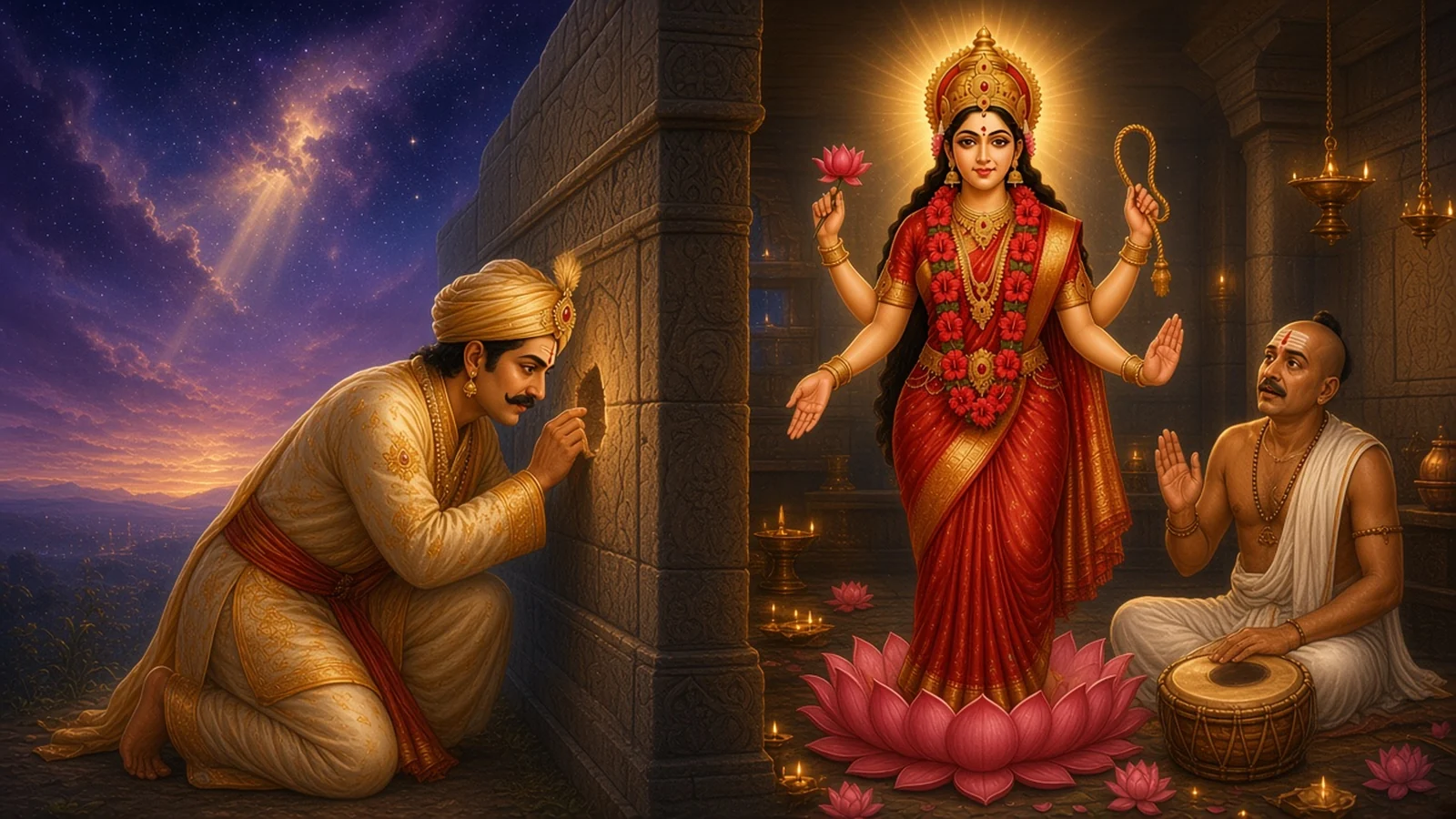
No text describes the mela itself, and no record dates its start. The Sentinel suggests it grew after the Koch kings restored the temple. E. A. Gait, drawing on the chronicles in his History of Assam (1906), says that Bisva Singh, founder of the Koch line, revived the goddess's worship, and he gives the inscription that dates the rebuilding under his son Naranarayana and Chilarai to 1565. Why that king's descendants never come near the hill is told in The King Who Looked Through the Wall. The encyclopedia notes the stream of pilgrims from Bengal to the temple in the nineteenth century.
Where this page comes from. Written by Devalok from the Maa Kamakhya Devalaya's notices for 2026, the 2023 to 2025 timings as the Ambubachi Mahayog Parichalana Committee, PTI and ETV Bharat reported them, Drik Panchang's table of the Sun's passage through Ardra for 2026 to 2028, the Assam Tribune, The Guwahati and Asom Times on the 2026 arrangements, the encyclopedia articles on the mela and the temple, The Sentinel, the Assam Tourism department as Times Now quotes it, Discover East, Prerna Pradhan's paper in the Journal of the Indian Anthropological Society (2021), Janet Chawla on Boloji, Karishmeeta Das in Mainstream Weekly, the Kalika Purana and the Devi Bhagavata Purana in translation, and E. A. Gait's History of Assam (1906), as recorded in the Devalok Lore. Our own words throughout.