Devalok ← All gods
Also calledMatanginiUcchishta MatanginiUcchishta ChandaliniRaja MatangiRaja MatanginiRajashyamalaShyamalaMantriniLaghushyamaSangitayoginiMatangeshvarithe green goddess of speech

In short

Who is Matangi?
The ninth of the ten Mahavidyas, the forms of the one Goddess. She is the goddess of speech, music and learning, a wild forest Saraswati, worshipped with leftovers.
Why is she offered leftovers?
The Shaktisamgama Tantra says she rose from food that fell at a feast of Vishnu, Lakshmi, Shiva and Parvati and asked them for what was left over. So she is Ucchishta Matangini, the Matangi of the remnant.
Is she the same as Lalita's minister?
The Lalitopakhyana says Mantrini, called Shyamala, agreed to be born as the daughter of the sage Matanga, and the child was called Matangi. The tantras call Lalita's minister Raja Shyamala.
Why is she called an outcaste goddess?
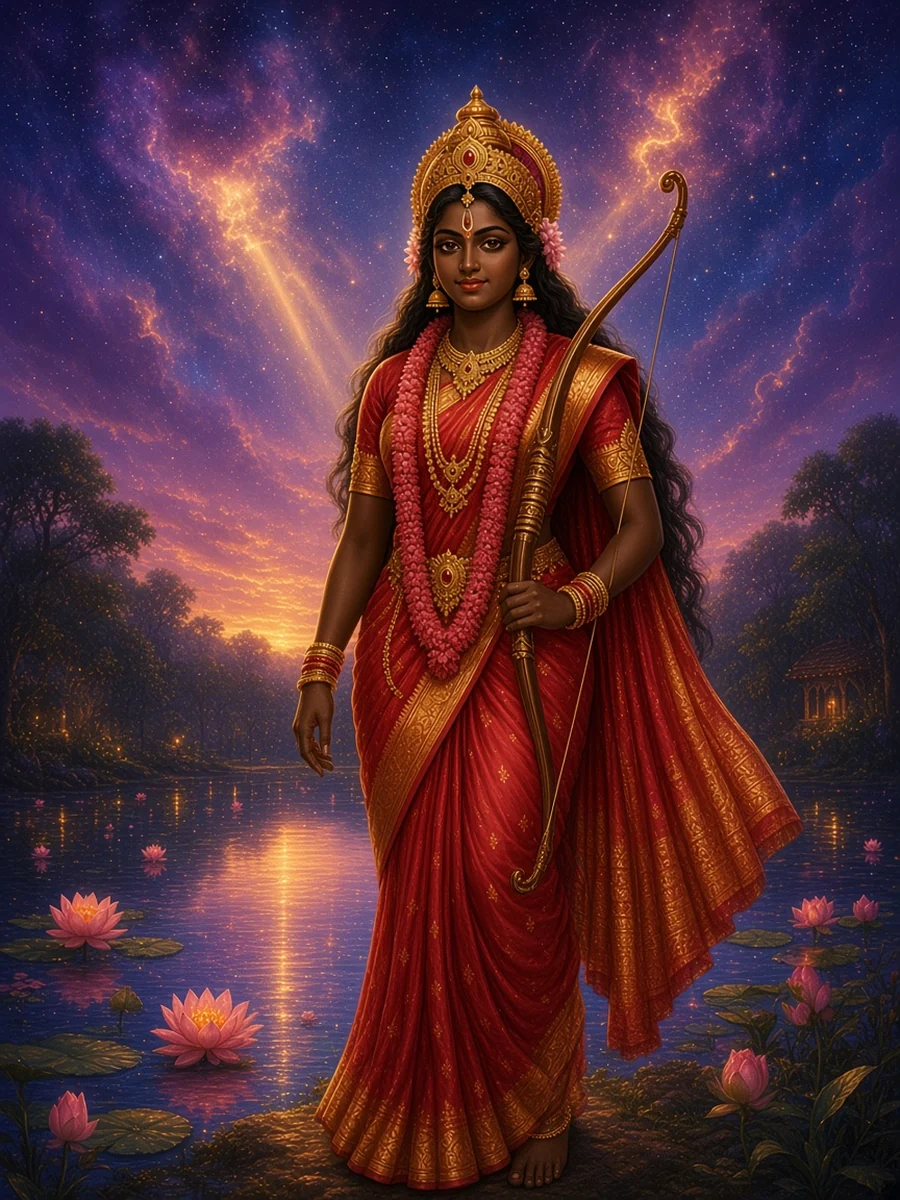
In one tantra Parvati comes to Shiva disguised as a huntress of the Chandalas, a people outside the old caste rules, and asks that the form last for ever. Matangi's worship turns the usual rules of purity round.

Artwork ›

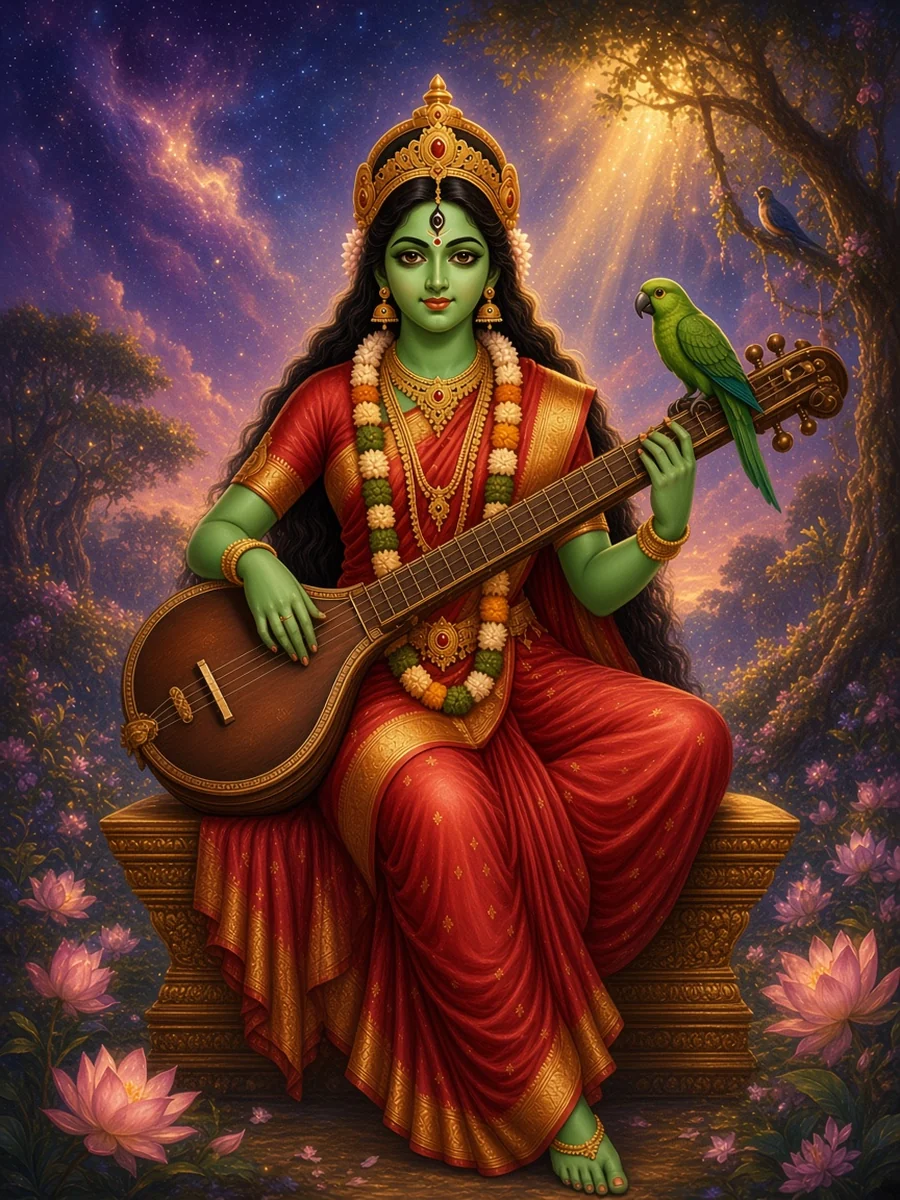
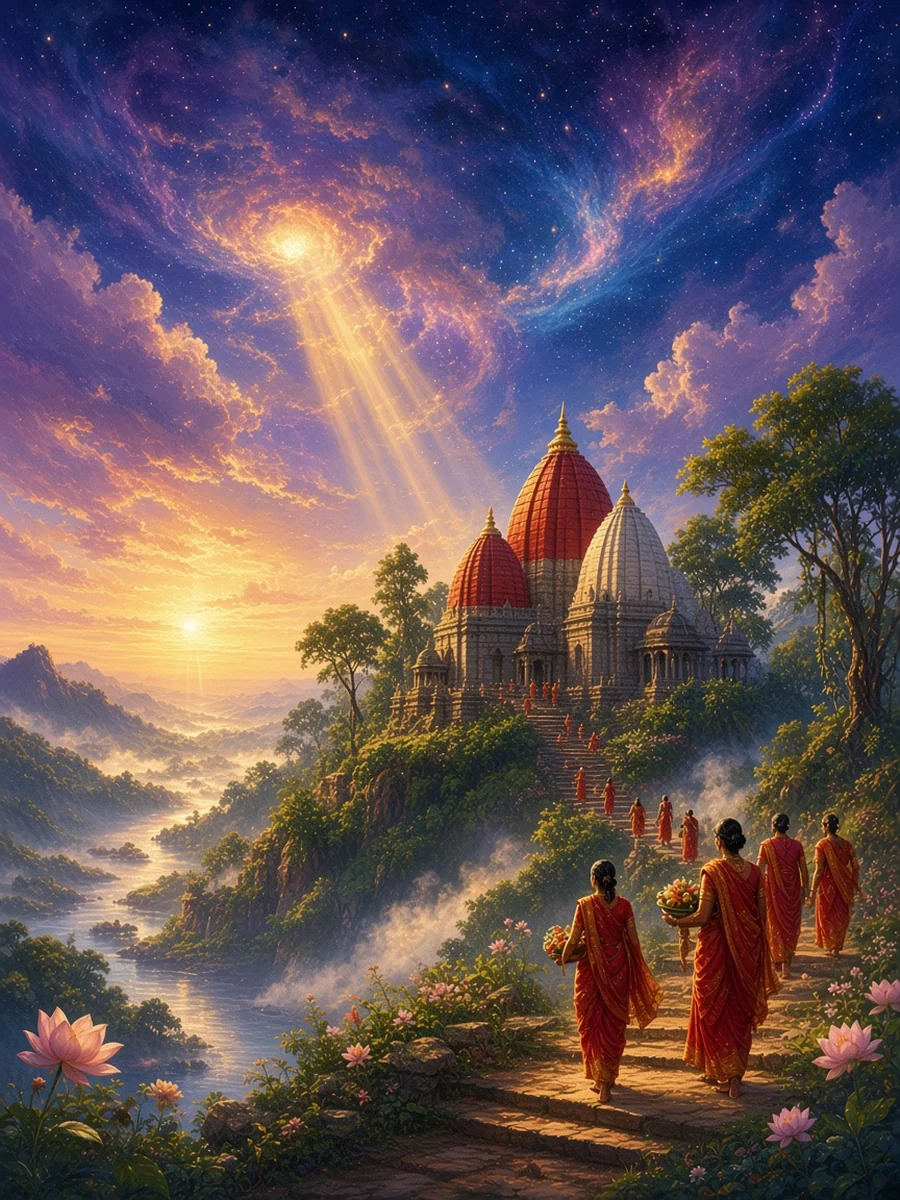
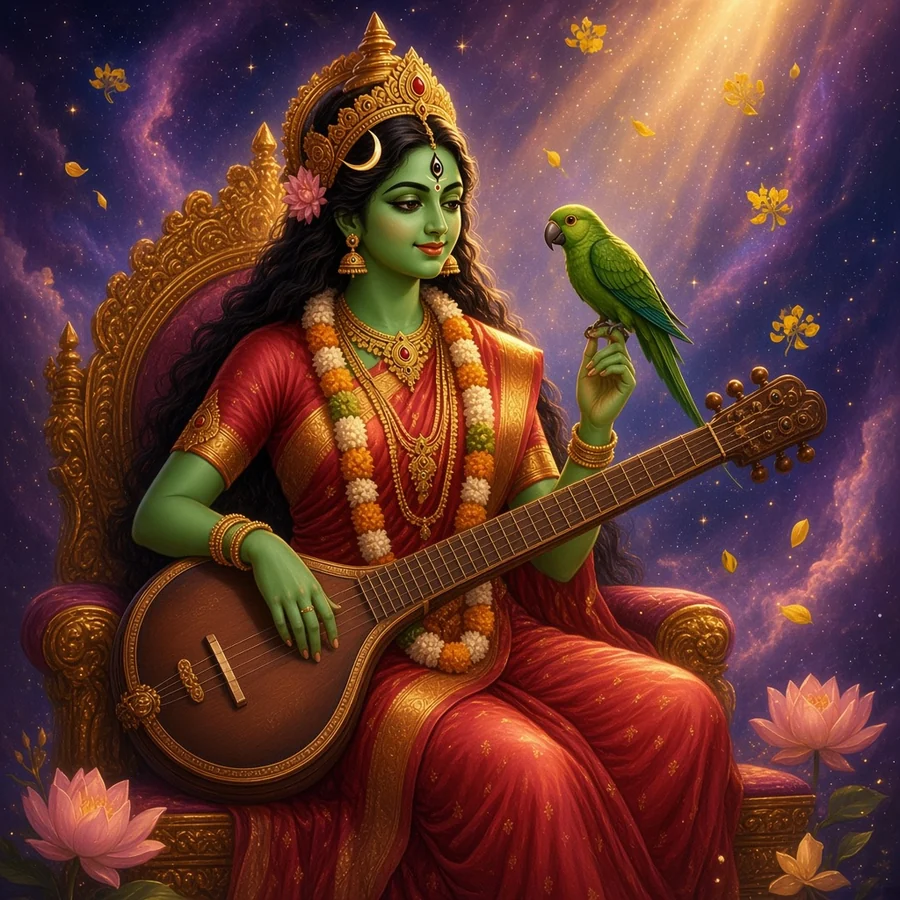
Music in the kadamba grove The huntress by the lake

For kids

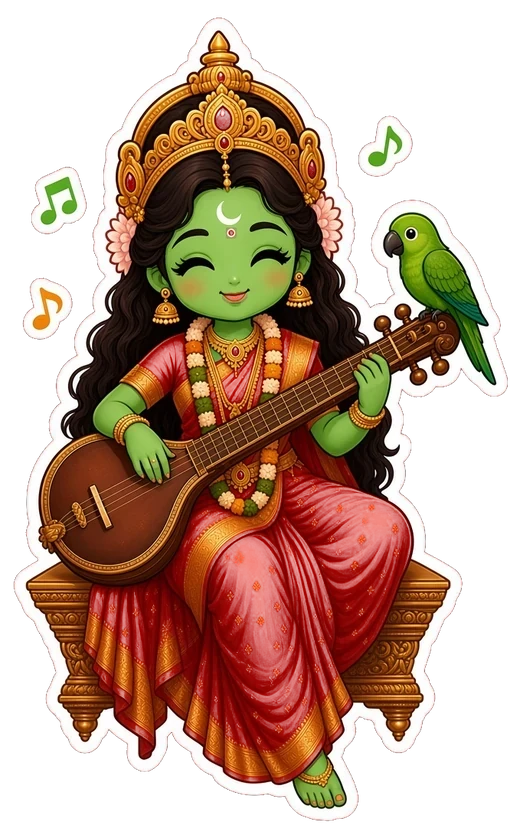
Speak sweetly
Speak sweetly
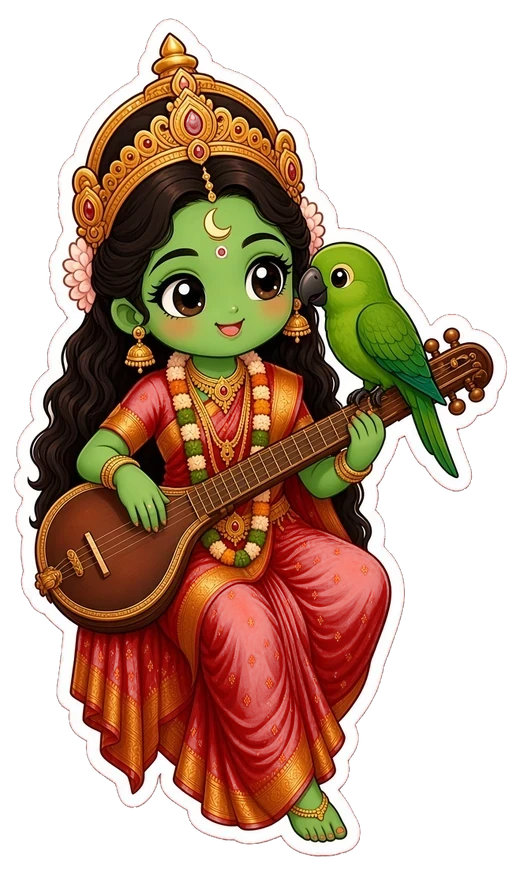
The parrot told me
The parrot told me

At a glance

TraditionShakta
FormA young goddess

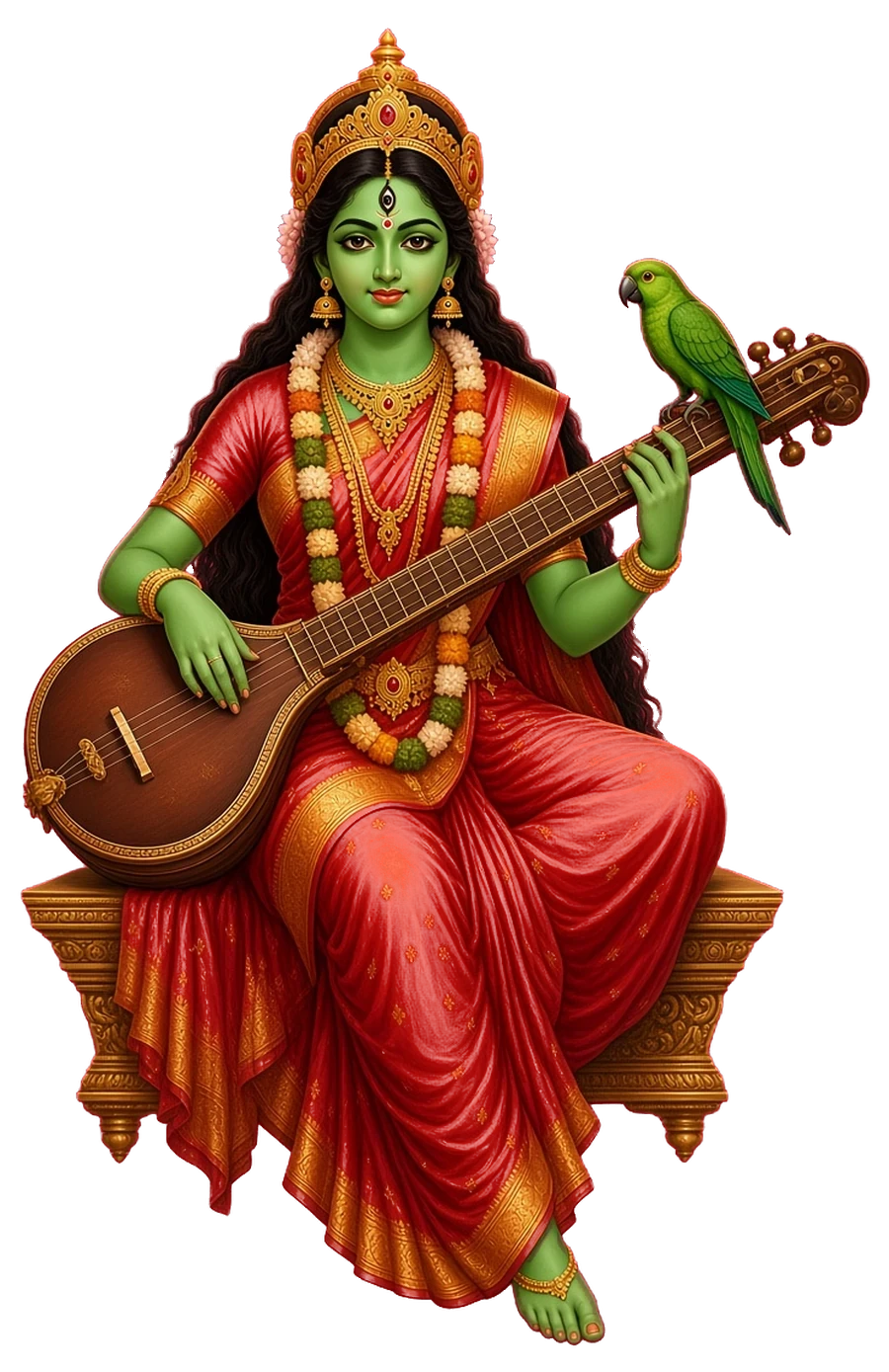
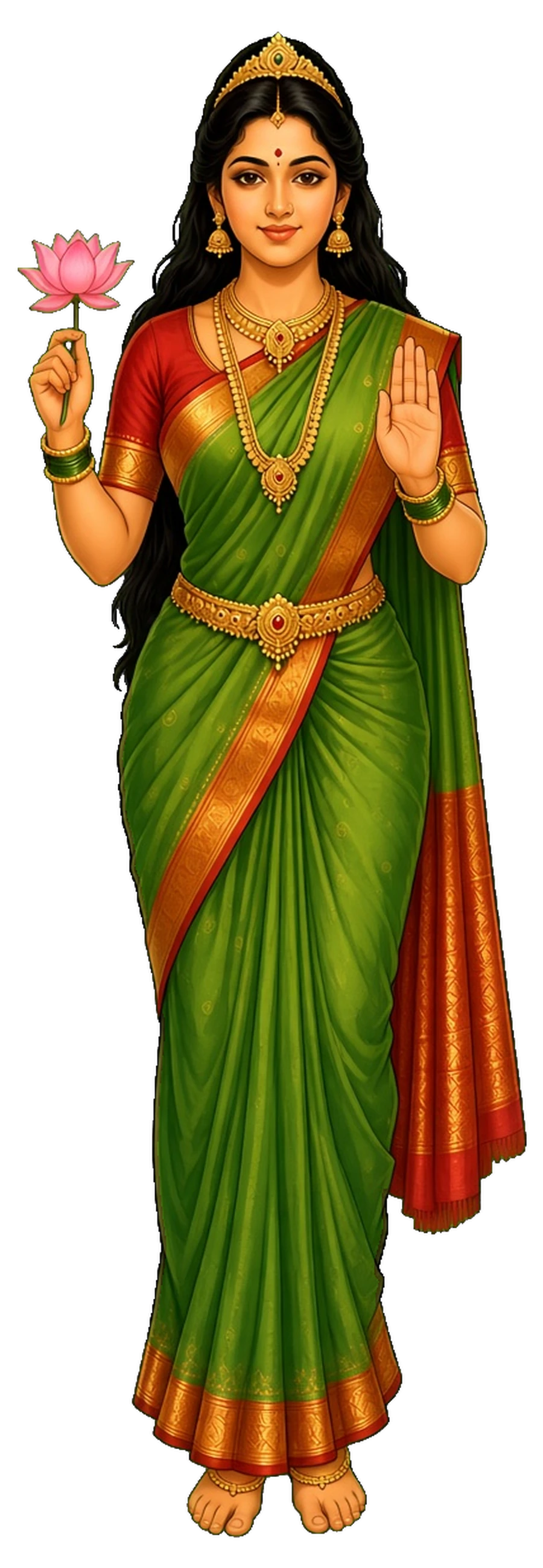
dark or emerald green, the crescent moon on her brow, seated on a jewelled throne or an altar

In her handsA veena

in another form four hands with a noose, a goad, a sword and a club

Who Matangi is

Matangi is the goddess of the word that sings. She is one of the ten Mahavidyas, the ten forms of the one Goddess, and she is the ninth of them in the usual order. She is young and dark, often green as an emerald, with the moon in her hair. She plays the veena, a parrot chatters beside her, and her worshippers call her the tantric Saraswati: the goddess of speech, music and the sixty-four arts, but a Saraswati of the forest and the edge of the village rather than of the temple school.

Manikyavinam upalalayantim madalasam manjulavagvilasam, mahendranila dyuti komalangim matangakanyam manasa smarami: I call to mind the daughter of Matanga, softly playing a veena of rubies, slow and dreamy, sweet in her play of words, her gentle body glowing like a sapphire (the Shyamala Dandakam, ascribed to Kalidasa).

She is also the strangest of the ten to worship. Her name in the tantras is Ucchishta Matangini, the Matangi of the remnant, and devotees offer her food they have already eaten from, which no other god will accept. Her worship manuals ask for no fast, no vow and no purifying bath first, and they let anyone say her mantra. The scholar David Kinsley called her the outcaste goddess, and read her as the one through whom a person makes peace with what they were taught to fear as unclean. Another of her names, Ucchishta Chandalini, takes the name of a people the caste rules kept outside the village.

She has a royal side too. As Raja Matangi and Shyamala she is the minister of Lalita, the queen of the three cities, the counsellor through whom every petition reaches the throne. In Sati's ring of ten forms around Shiva she stood in the north-west, the Mahabhagavata says, as the daughter of the sage Matanga, and on Kamakhya's hill in Assam she is a stone in the dark inner room beside Shodashi and Kamala.

Her stories on this site: The Leftovers of the Gods, where she rises from the food that fell at a feast on Kailash; The Huntress at the Lake, where Parvati comes to Shiva as a Chandala woman; and The Sage Who Envied the Mountain, where she is born as Matanga's daughter. She is one of the ten in The Goddess in Every Direction and The Hill of Ten Goddesses, and as Mantrini she rides beside Lalita in The Queen's War with Bhanda.
Before the Puranas

The Vedic roots of Matangi

Matangi is not in the Vedas. No hymn names her, and the ten Mahavidyas appear as a group only after the tenth century, as David Kinsley shows. The Atharvaveda does praise the ucchishta, the remnant left over from the sacrifice, as holding the whole world, with the gods set round it like spokes round a hub and the hum of the chanted hymns inside it (11.7). Kinsley points to that hymn when he writes about her leftovers. It is a likeness, not an ancestor.

Kinsley finds an early hint of her in a Buddhist book, the Divyavadana, of about the third century. A Chandala girl named Prakriti, the daughter of Matanga, falls in love with the Buddha's disciple Ananda, and her mother, skilled in great mantras, tries to draw him to her by magic. The Buddha breaks the spell and Prakriti becomes a nun. There is no goddess in it, but there are the father's name, the outcaste daughter and the power to attract that the later Matangi keeps.

As a goddess she first appears in the lists of the ten. The Mahabhagavata and Brihaddharma Puranas put her in the north-west of Sati's ring, and the Mahabhagavata calls her the daughter of Matanga. In the seventh book of the Devi Bhagavata she is one of the powers that come out of the Goddess to fight the demon Durgama.

Her own stories are later still. The Shaktisamgama Tantra, which its editors date between the late sixteenth and the middle of the seventeenth century, tells how she rose from the leftovers of a divine feast. The Pranatoshini Tantra, a Bengali compilation printed in Calcutta, has Parvati come to Shiva as a huntress. The Svatantra Tantra makes her a green form of Kali, sent out of Tripura Sundari's eyes for the sage Matanga.

On the Shri Vidya side she is Shyamala. The Lalitopakhyana, the closing part of the Brahmanda Purana (a Purana that, Ludo Rocher reports, reached its present shape about 1000 CE), makes her Lalita's minister and has her born as Matanga's daughter, and Bhaskararaya, finishing his commentary on the Lalita Sahasranama in 1728, says the tantras call that minister Raja Shyamala. A Varanasi teacher told Kinsley that Matangi is Saraswati, made to spread music and learning.

See how the Vedic gods became the Puranic ones →

Related gods