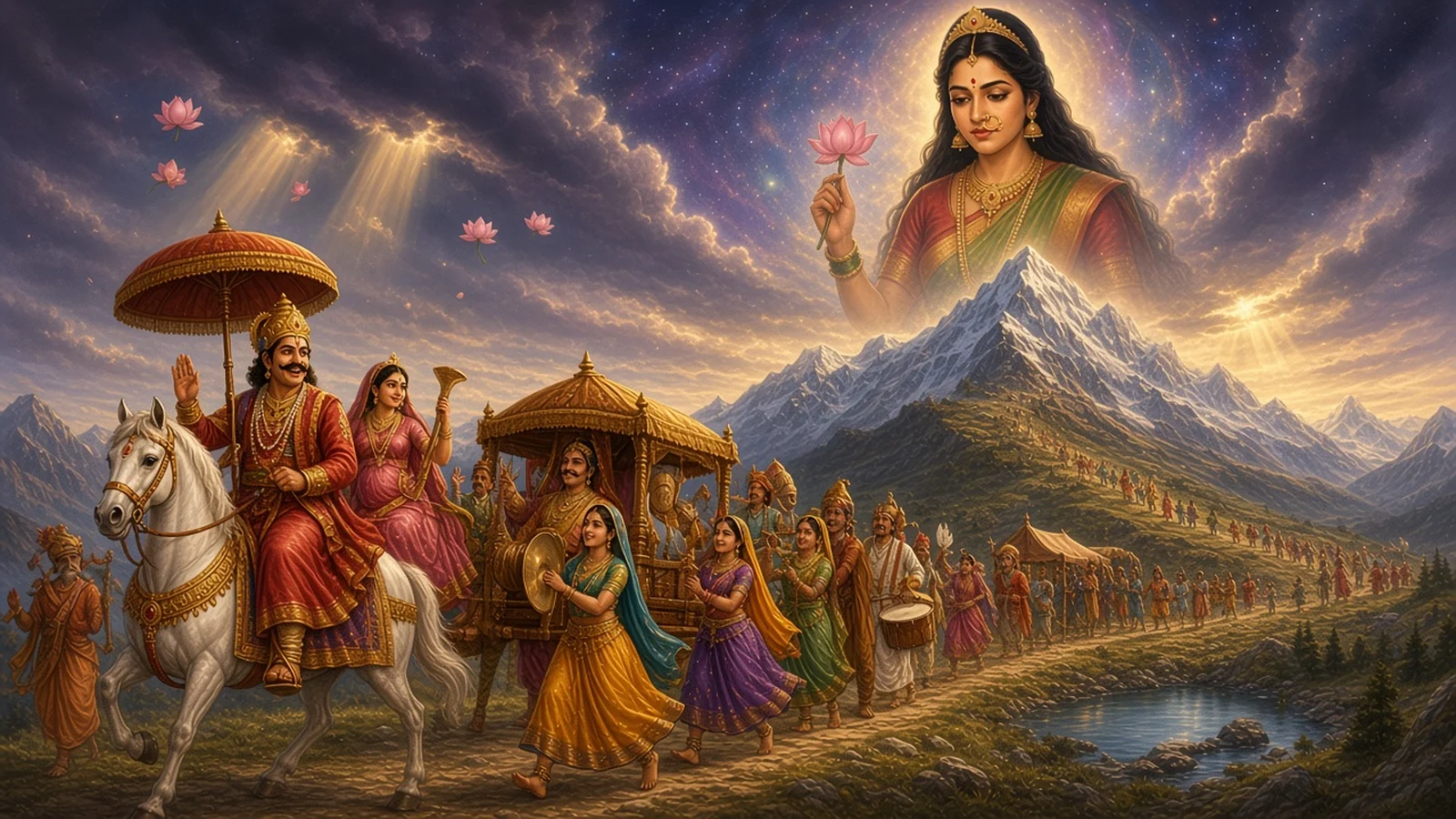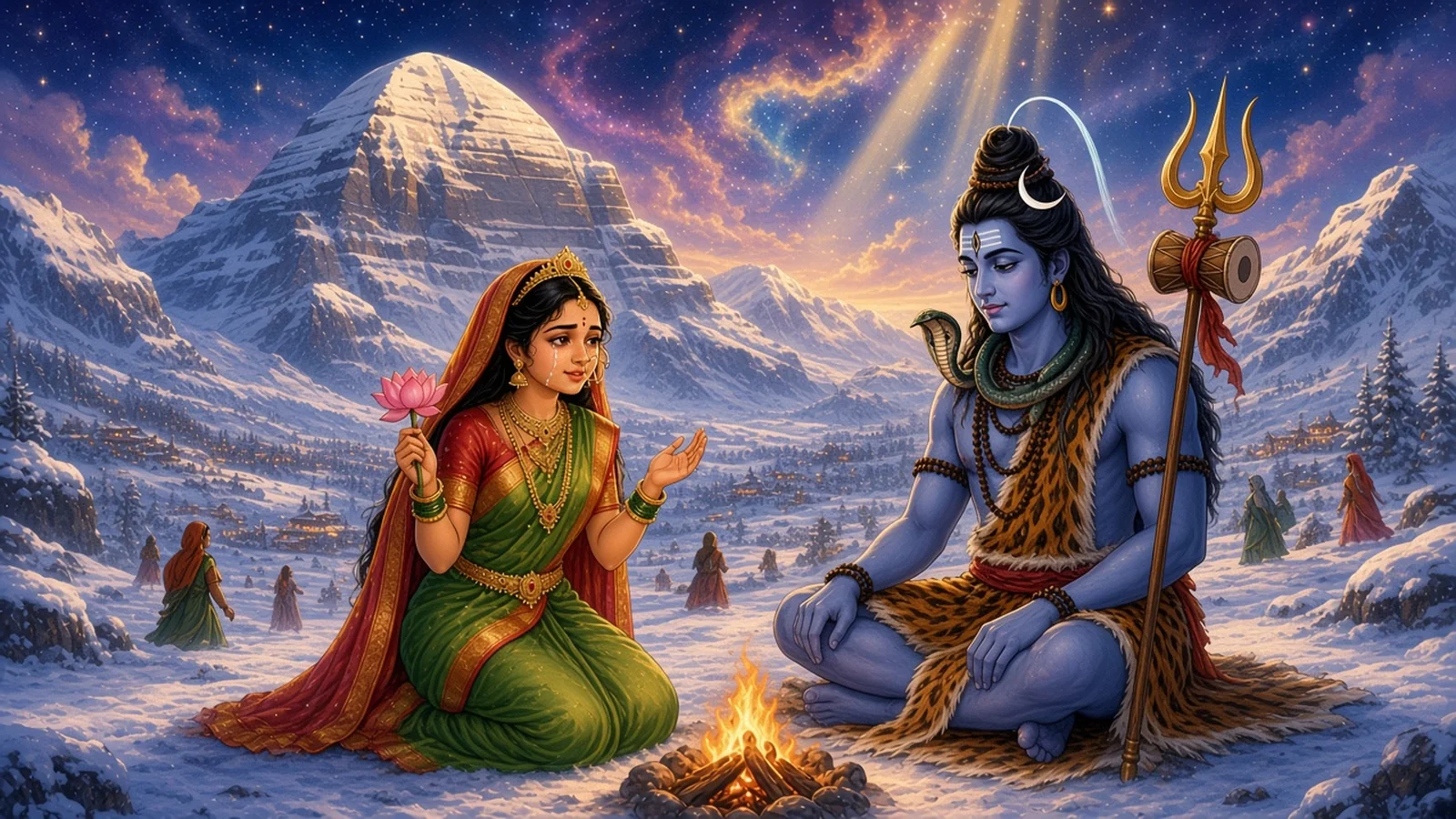
As the Shaktisamgama Tantra tells it
Kailash · as Shiva tells it to the Goddess, Chhinnamasta Khanda 6.27 to 40 · 3 min read
The Goddess had asked Shiva how each of the great wisdoms came to be, and he had told her of several already. Now he came to one more.
"Listen, Devi," he said. "I will tell you why Matangi was born."
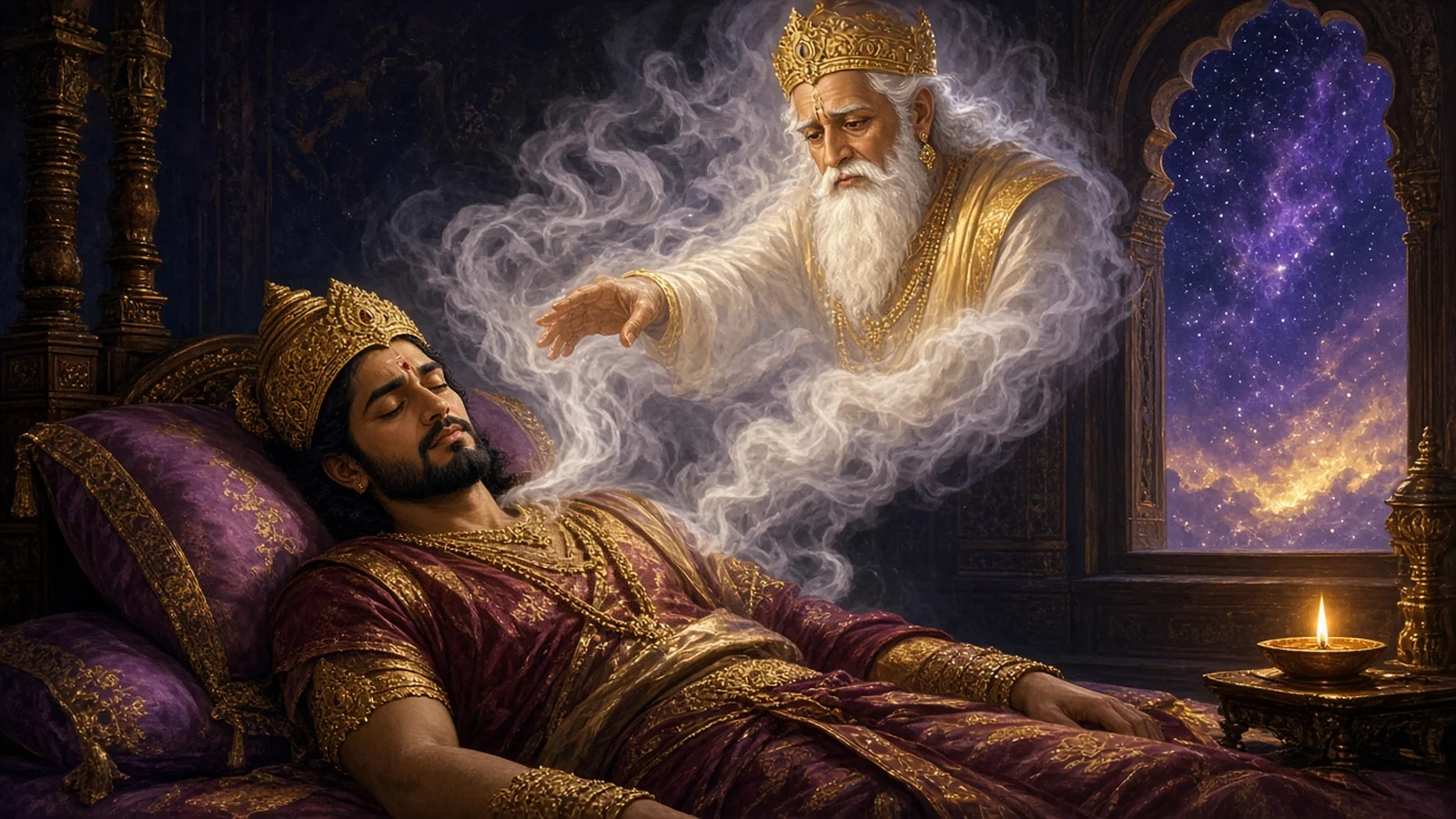
Far out in the ocean of nectar, Vishnu lay on the coils of Shesha, the serpent who is his bed, and beside him lay the goddess the tantra calls Shyama, the dark one. Two visitors came across the water. One was Narada, the wandering sage. The other was Tumburu, the singer of the gods. They joined their palms and bowed to the lord of Lakshmi.
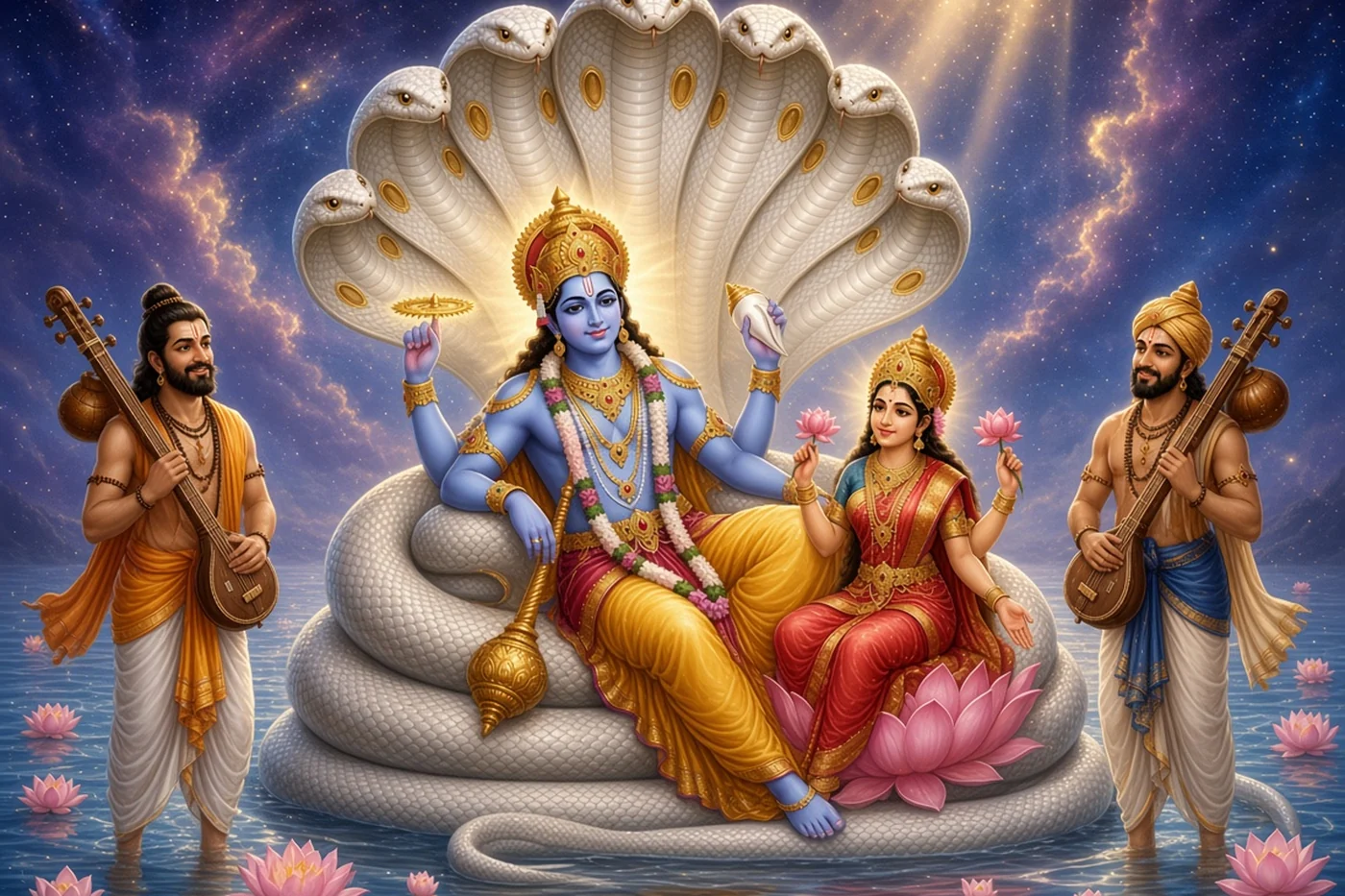
"Narayana," they said, "great god, master, teach us the knowledge of song."
Vishnu did not begin with notes or with the strings of a veena. He began with a visit.
"Once, long ago," he said, "I went to see Shankara. I found the great god sitting with Uma, the two of them in all their finery. 'Victory to you, great god,' I said, 'and to you, lord, with Uma beside you.' Shiva took me in his arms, and Uma took my dear Shri in hers. They gave us a wonderful seat, and I sat on it with Shri at my side."
"Then I saw the great circle. It was crowded with the hosts the tantra calls the Marichis, and it was full of every flavour there is, more tastes than anyone could count. We feasted together, and when every taste had become one taste, what was left over fell."
Narada and Tumburu said nothing. They waited.
"Out of what had fallen," said Vishnu, "a young girl came into being, full of every good quality. She did not ask for a seat or a crown. She turned to Parvati and to Shankara, and she said, 'Give me the leftovers. Give me the leftovers.'"
"The leftovers?" said Narada.
"The leftovers," said Vishnu. "And the two of them gave her what remained, gladly and with love, as their blessing."
Then Shiva and his Shakti spoke to the girl together.
"You who were born here, full of every good quality," they said, "listen. Those who repeat your name, make offerings to you in the fire and worship you will see their work succeed. Whatever they set their hearts on winning, they will win."
"From that time on," said Vishnu, "she was known in all three worlds as Ucchishta, the remnant, and she grants boons to those who seek her. All the hosts of the Marichis who were there heard it, and every one of them offered all they had to her."
What has any of this to do with the knowledge of song, you may ask. Vishnu came to that last.
"Then song and dance and the music of instruments rang out for the girl," he said, "and every kind of art was shown to her. From that day her name was Ucchishta Matangini. She is the one called Sumukhi, the lovely faced, and the Siddhavidya, the wisdom that is already perfect."
That was all Vishnu told his two visitors, and that was all Shiva told the Goddess of it. He went straight on to the next birth on his list, which was Ganesha's.
As Kinsley and the calendars tell it
Told across India · David Kinsley, Tantric Visions of the Divine Feminine (1997); Drik Panchang · 2 min read
The form most often met today is shorter. It is the summary of this same chapter that the scholar David Kinsley gave in his book on the ten Mahavidyas, and the festival calendars repeat it. In it there are no visitors in the ocean of nectar and no question about song. There is only a visit between two divine households.
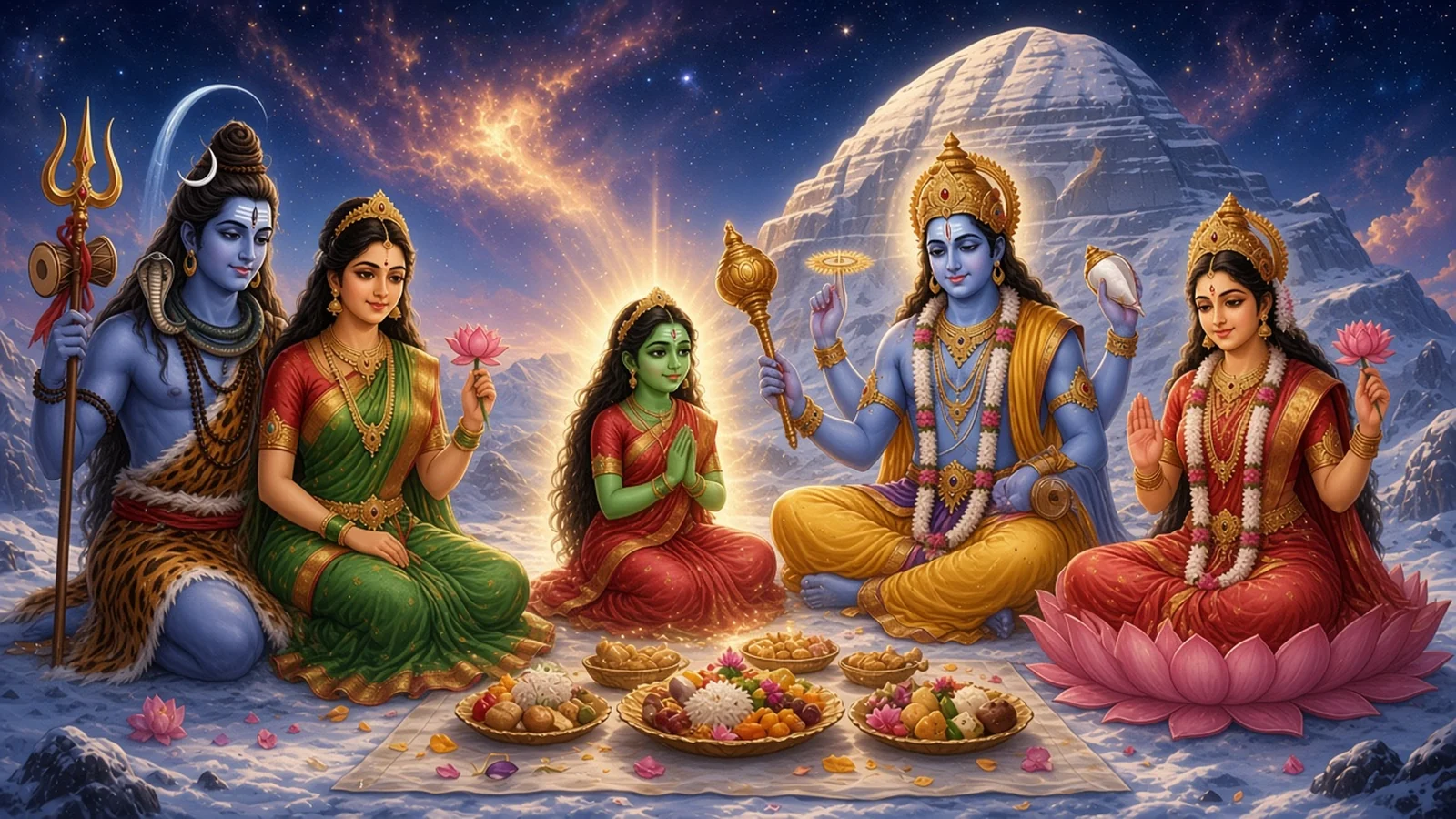
Vishnu and Lakshmi went to see Shiva and Parvati, and they brought fine things to eat, many kinds of good food, and set them before their hosts.
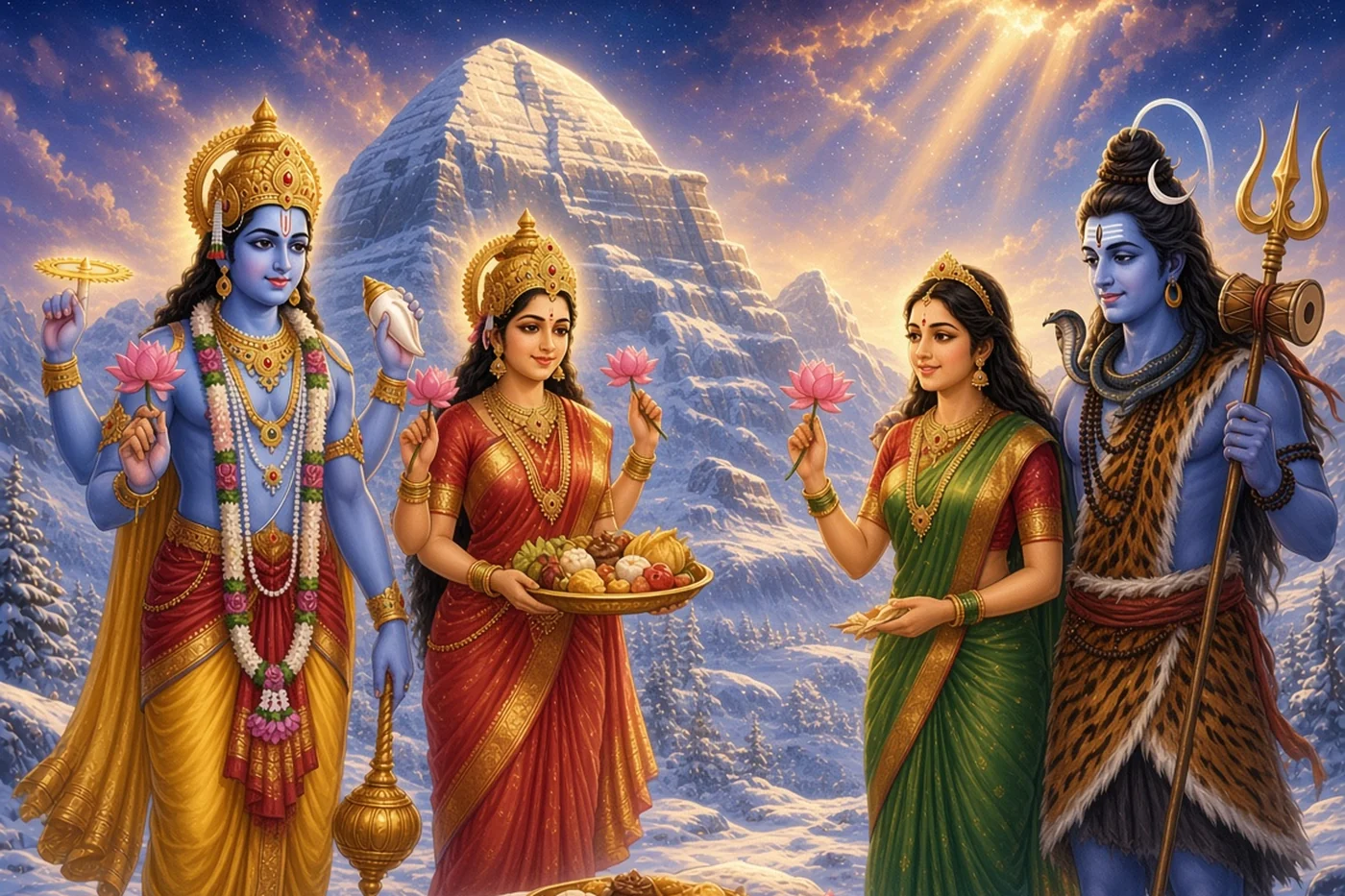
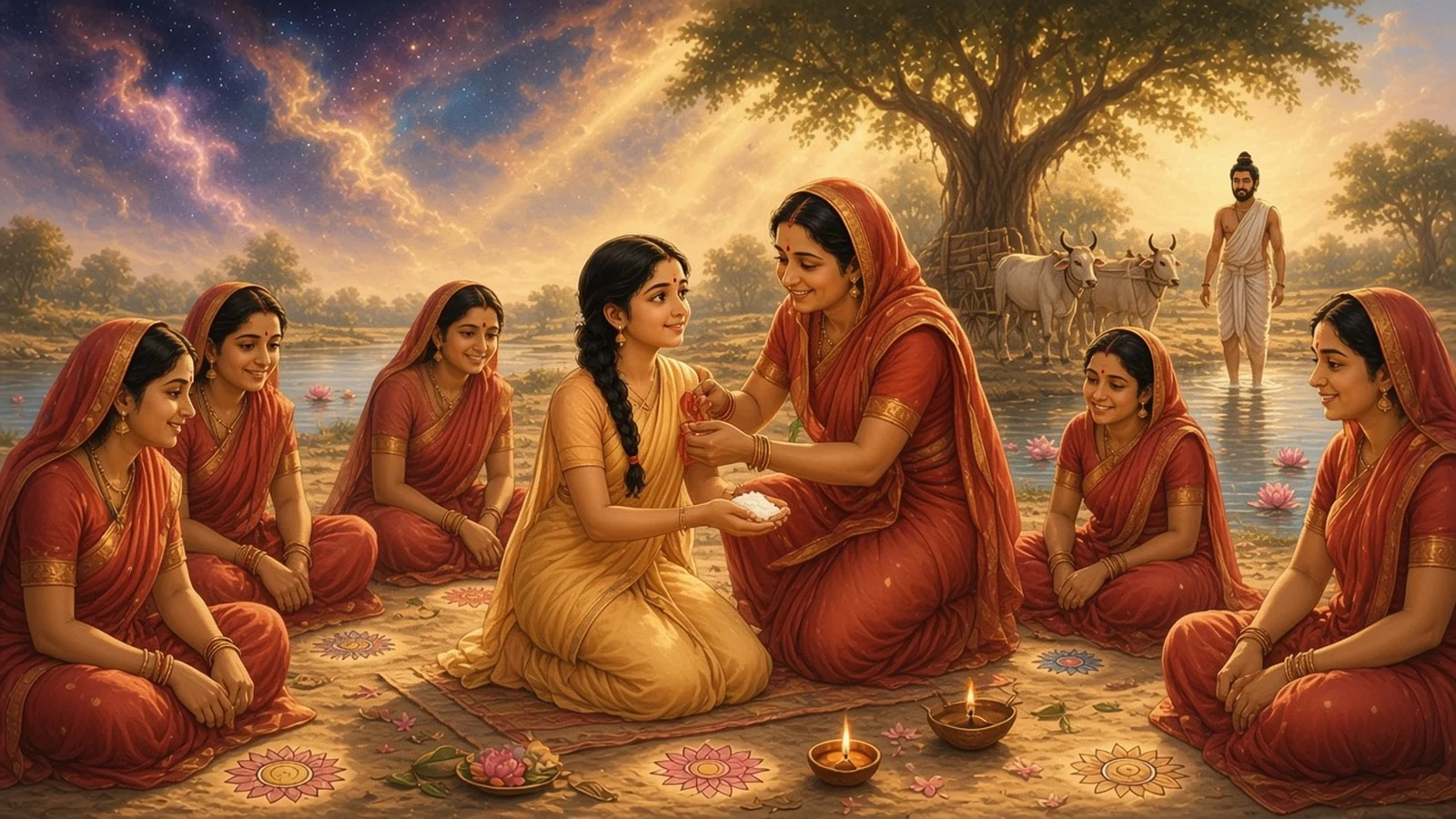
As the four of them ate, a few pieces fell to the ground. Nobody picked them up. From those fallen scraps a girl rose, lovely and gifted with every grace. She looked at the four great gods at their meal and asked them for one thing only: what they had left.
None of them refused her. Vishnu, Lakshmi, Shiva and Parvati each gave her their leftovers, and gave them as prasada, the food a god has tasted and hands back as grace.
Then Shiva spoke to the girl.
"Those who say your mantra and worship you," he said, "will see their work bear fruit. Their enemies will be in their power, and what they long for will come to them."
From then on she was known as Ucchishta Matangini, the giver of every boon.
Kinsley points out how strange this is. In a Hindu shrine the god is served pure food first, and the worshipper takes back what the god has left. With Matangi the order is turned round. Her worship manuals tell devotees to offer her their own leftover food, with the meal still on their hands and lips, and they say that no fast, no vow and no purifying bath is needed first, and that anyone at all may say her mantra. Kinsley reads her as the goddess through whom a person makes peace with all that they have been taught to fear as unclean.