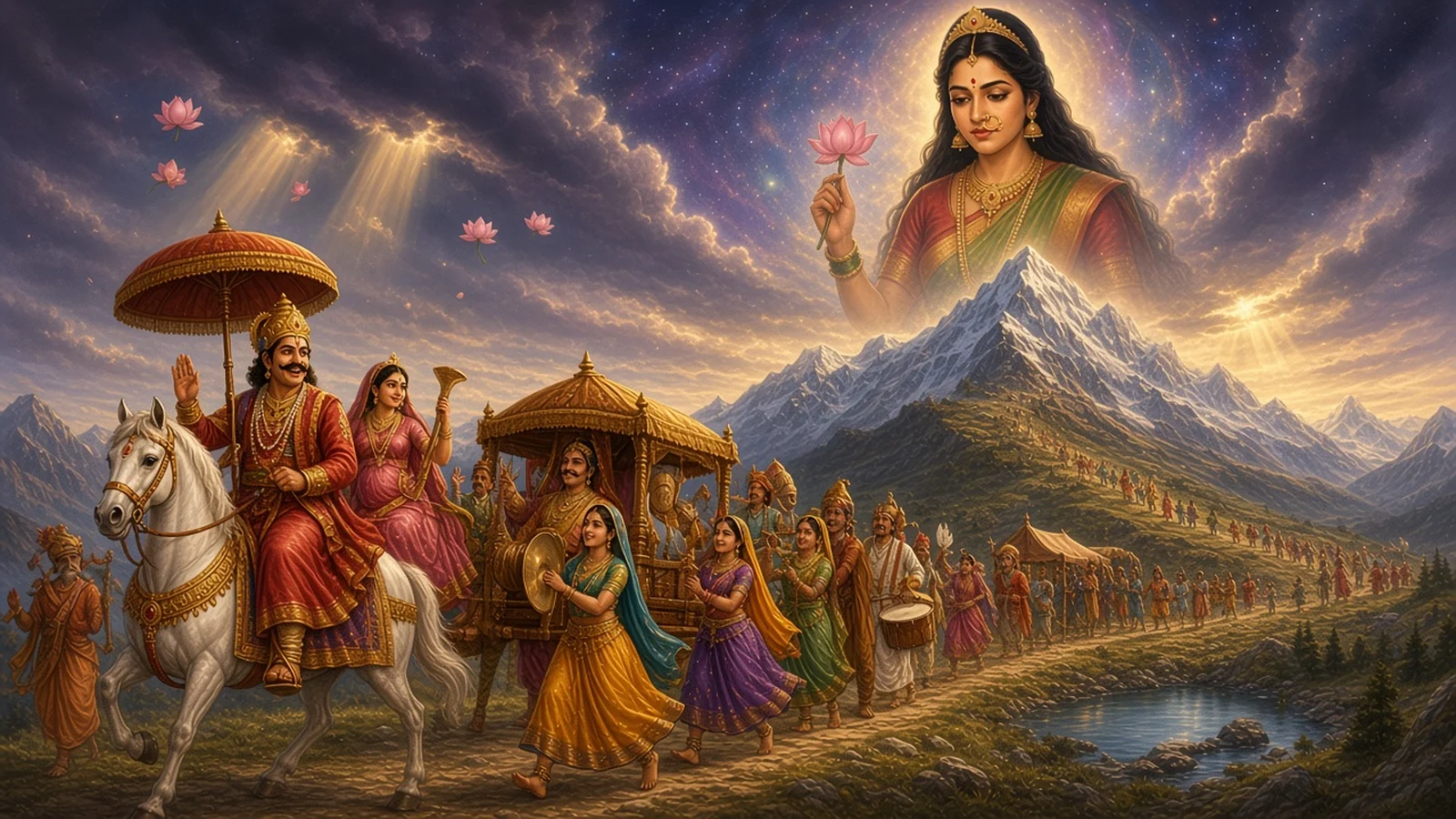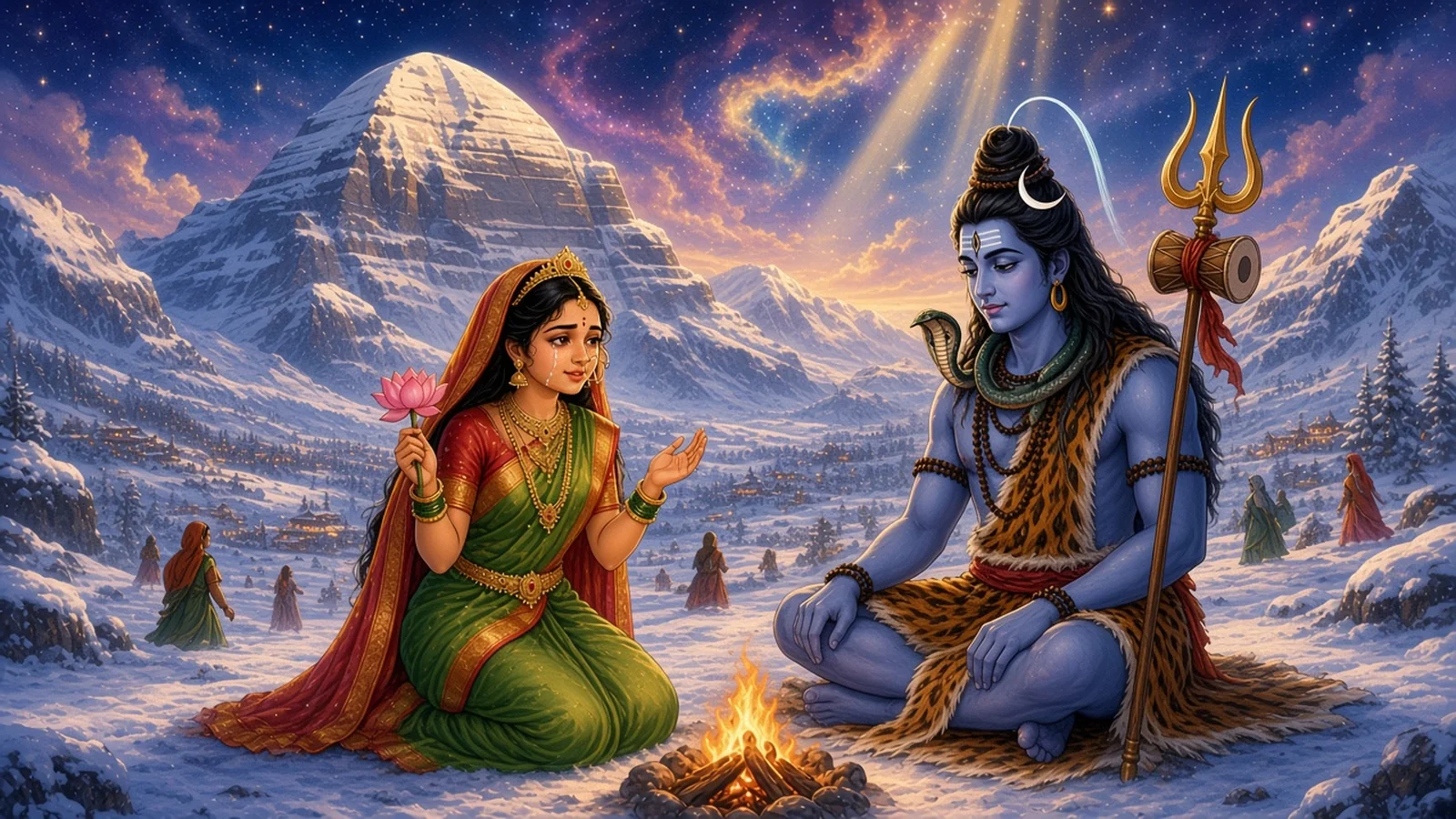
As the Devi Bhagavata tells it
Devi Bhagavata Purana 9.12 and 9.13 · Goloka · 3 min read
Narada had heard that Ganga flows from the feet of Vishnu, and he had heard that she lives always with Shiva, and he wanted to know how one river could be in so many places. Narayana told him that it began with a song.
It was the full moon of Kartika in Goloka, the highest of the heavens, and Krishna was keeping the Rasa festival in Radha's honour. Brahma had come, and the gods, and the sages. Saraswati sang of Krishna to the drums and the strings, and when she finished they gave her gifts: a jewelled necklace from Brahma, rare gems from Shiva, the Kaustubha jewel from Krishna himself, gold earrings from Lakshmi.
Then Brahma turned to Shiva. "Now you," he said. "Sing us the Rasa."
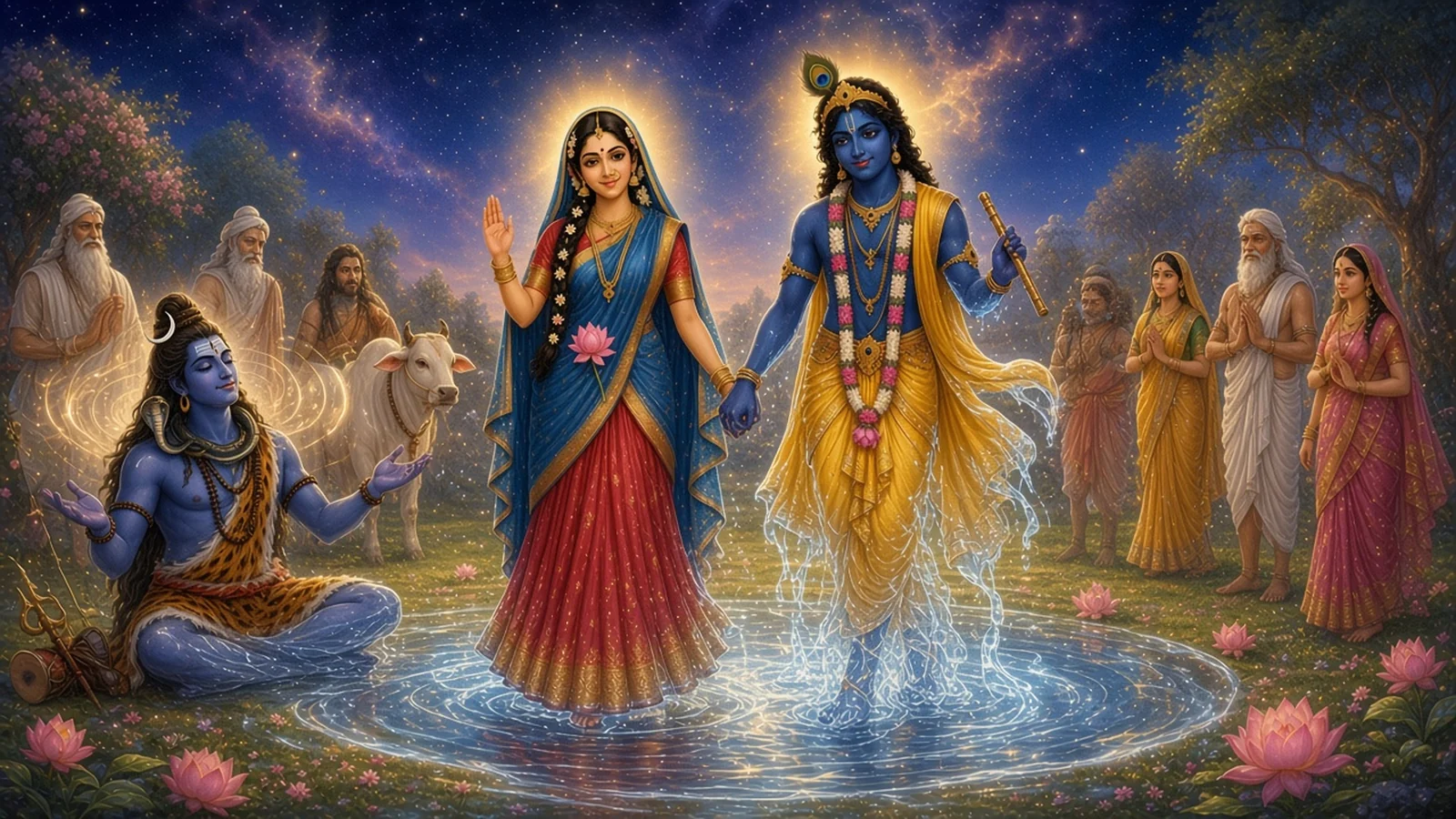
Shiva sang. The gods who heard him forgot themselves. They stood like figures carved in stone, and it was a long, hard climb back to their senses. When they came to, Radha and Krishna were gone, and the whole circle of the dance lay under water.
The cowherds and the milkmaids wept aloud, and the gods wept with them. Brahma closed his eyes and looked within.
"They have not left us," he said at last. "They have become this water, to set the world free."
They praised Krishna and begged to see him. A voice answered out of the air. Radha and Krishna were the self of all things, it said, never apart, and they took a shape only as a kindness to those who loved them. Let Shiva promise to make a scripture for their worship, with its mantras hidden from the wicked, and they would show themselves again.
Shiva cupped the water in his two hands. "I swear it," he said, "on Ganga's water." And Radha and Krishna stood again in the circle, and the dancing went on. But the water stayed. It was Ganga, Krishna himself in the form of a river.
Once Radha came into the assembly and found Ganga sitting at Krishna's side, and her face went red.
Ganga rose. She praised Radha and asked after her health, but her voice shook and her throat went dry, and she slipped down to Krishna's feet for shelter. He lifted her up and held her until she was calm. Radha said hard things then, to Krishna and to her, and Ganga sat with her head bowed. Being a yogini, she saw where it would end, and she left the hall as water.
Radha was a yogini too. "I will drink her," she said, "in a single sip."
Ganga knew it at once. She went the one place Radha would not look. She went into Krishna's feet.
Radha searched Goloka, then Vaikuntha, then the world of Brahma and every world below it, and did not find her. Without Ganga the waters failed everywhere. The lakes of Goloka turned to mud, and the creatures of the water lay dead on the dry beds. Brahma, Vishnu and Shiva, Ananta and Dharma, Indra, the Sun and the Moon, the sages and the saints, all of them were parched with thirst, and they came to Goloka and praised Krishna.
"She is under my feet," Krishna told them, "hiding from Radha. Ask Radha. When Ganga has nothing to fear, I will give her back."
So Brahma praised Radha with all four of his mouths. "She was born of the two of you," he said, "when you turned to water at Shiva's music. She is your daughter. Teach her your mantra. The four-armed lord of Vaikuntha will be her husband, and on earth the Ocean."
Radha agreed to protect her.
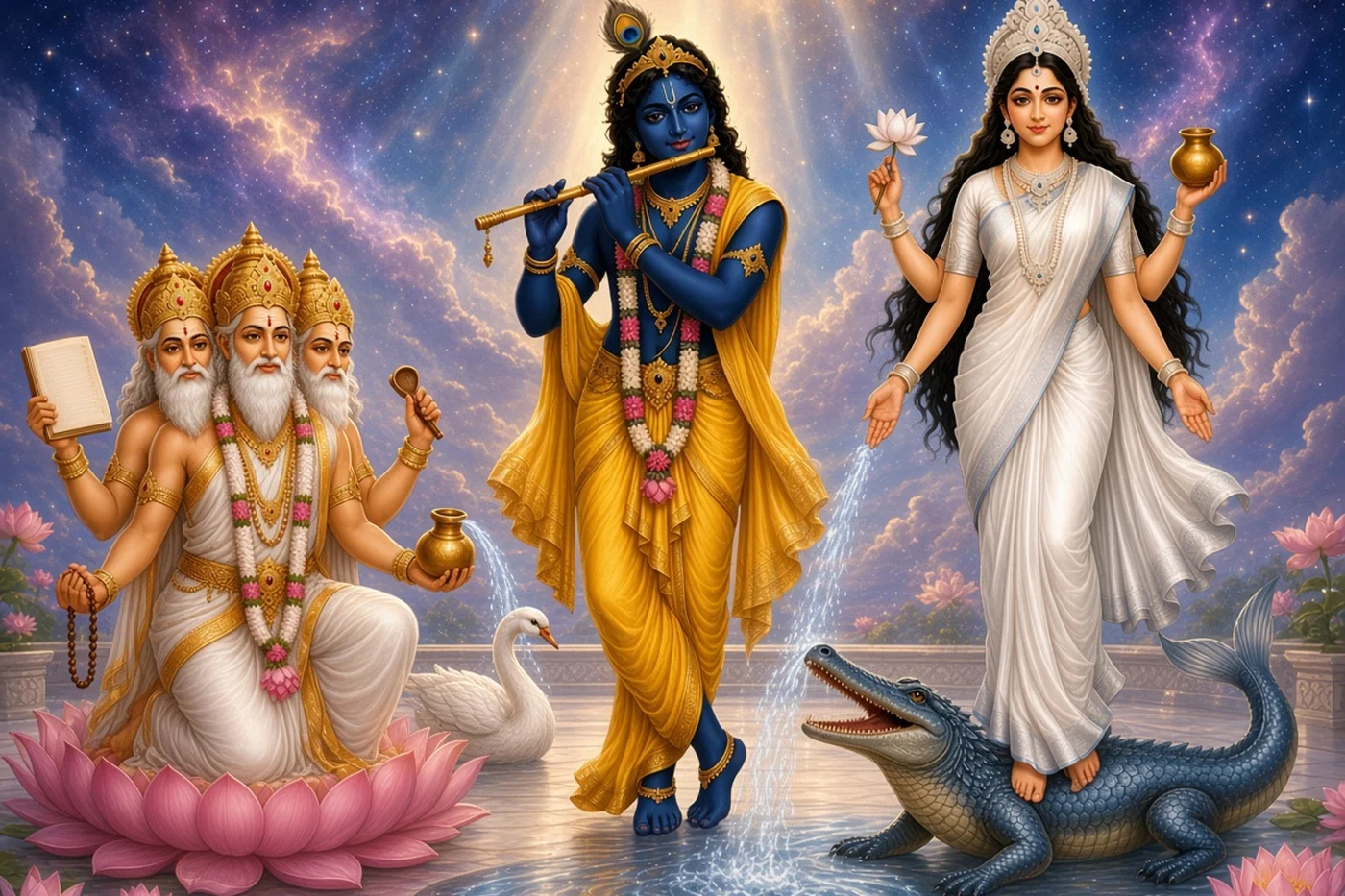
Then Ganga came out of the tip of Krishna's toe. Brahma caught some of her water in his water-pot, and Shiva took some on his head. She went to Vaikuntha and became one of Narayana's wives, with Lakshmi and Saraswati and Tulasi. And because she had come out of the lord's foot, they named her Vishnupadi.
As the Ramayana tells it: the mountain's elder daughter
Valmiki Ramayana, Bala Kanda 35 · the bank of the Ganga · 2 min read
Valmiki's Ramayana knows nothing of Goloka. Its story of Ganga's birth begins on a riverbank, with a boy's question.
The sage Vishvamitra was leading the young princes Rama and Lakshmana to Mithila. They had spent the night by the river Shona, and in the morning Rama asked how they would cross. "By the road the sages take," said Vishvamitra, and they walked on through the forest. By midday they had reached the Ganga.
Swans and water birds rode on her. The travellers bathed and offered water to their ancestors and to the gods, lit the sacred fire, ate what had been offered, and sat down round the old sage. Rama could not keep his question in.
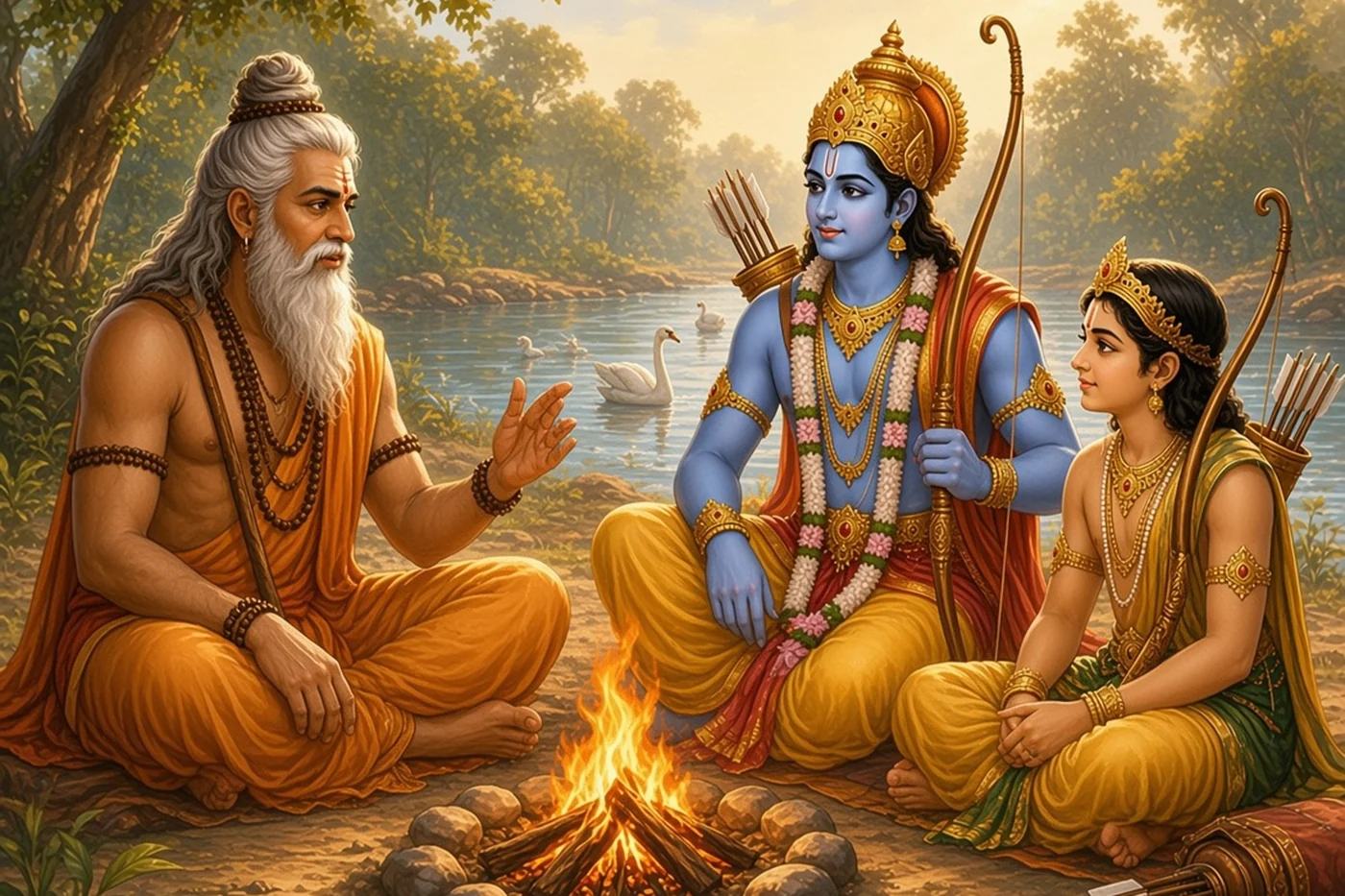
"Tell me about this river," he said. "She runs through all three worlds. How does she come down to the ocean?"
"Himavat, the king of the mountains, has two daughters," said Vishvamitra, "and there are none like them. Their mother is Mena, the daughter of Mount Meru. The elder is Ganga. The younger is Uma."
The gods, he said, had work that needed doing, and they came to the mountain king and asked him for his elder daughter. Himavat gave her freely, for the good of the three worlds. The gods were glad, and took her up with them, and in heaven she flows, pure, as the river of the gods.
The younger daughter stayed at home. She kept long and hard vows, and her father gave her in marriage to Rudra, the god who has no equal.
"So the mountain has two daughters," said Vishvamitra, "Ganga and Uma, and the whole world honours them both. That is how Ganga first went up into the sky."
He did not answer the rest of the boy's question that day. How the river came back down, by a king's long penance and through the hair of Shiva, takes him several more chapters of the poem.