As Kadammanitta keeps it: a night of the bird
South India · Kadammanitta, Pathanamthitta district, in the first days of Medam · 3 min read
Lekha came home to Kadammanitta for Vishu with her baby on her hip and a bag of medicines from the town.
The baby was four months old and had not been well for weeks. He fed badly and cried in the evenings, and his belly was hard and round under her hand. The doctor had a word for it and a bottle of drops.
Her grandmother Kalyani took the boy from her on the verandah and turned him toward the light.
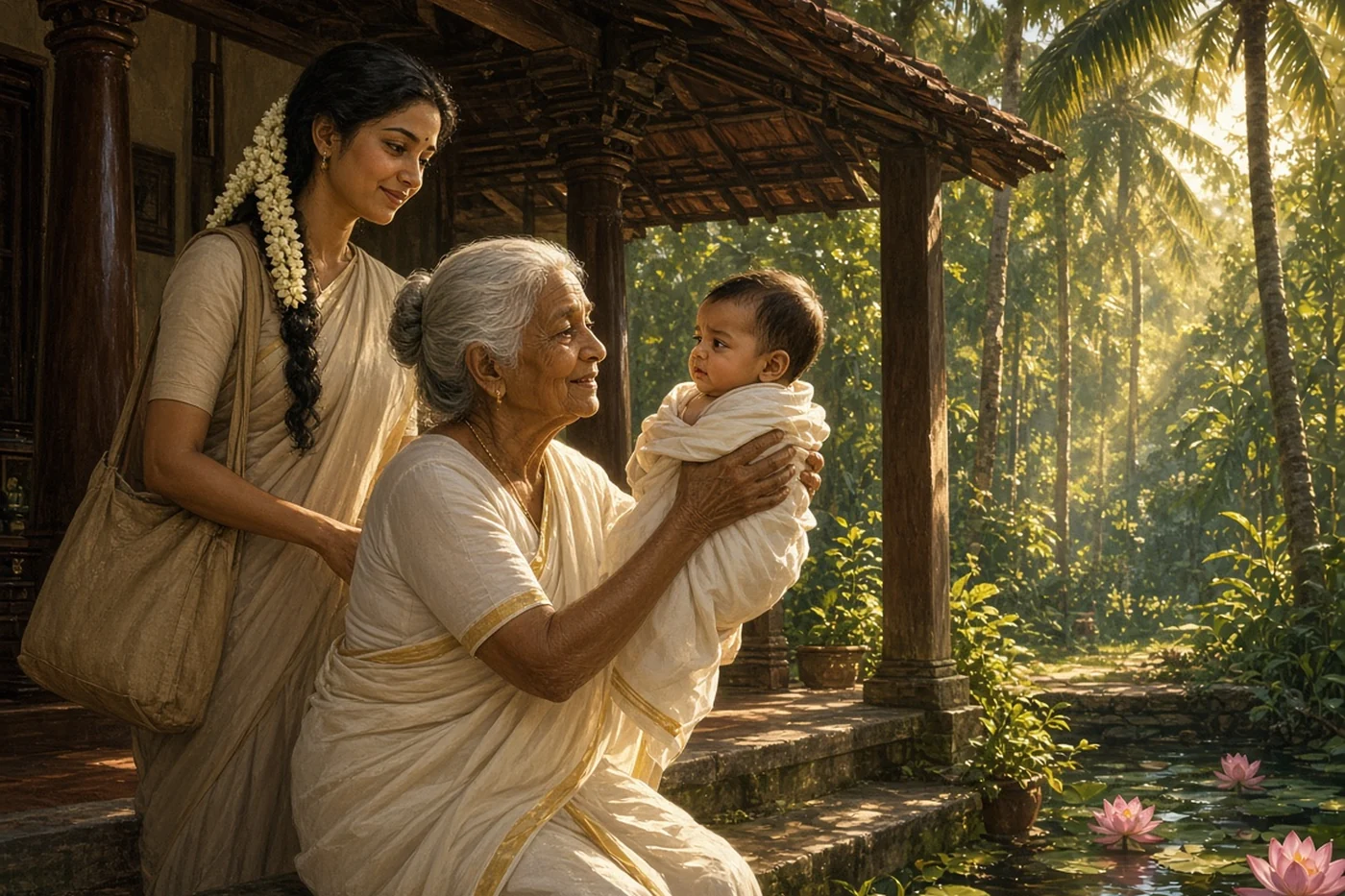
"Has a bird been calling near your house?" she asked.
Lekha laughed. "Ammamma. It is colic."
"Then let the doctor do his work," said Kalyani. "But listen. There is a bird that sits in the trees near a house where a new baby has come. It calls, kunje, kunje, little one, little one. And the baby grows thin and pale, and the belly swells." She rocked him. "You can throw stones at it and drive it off. It comes back. It only goes for good when it has been given what it wants."
"And what does it want?"
"Its own dance," Kalyani said. "You will see."
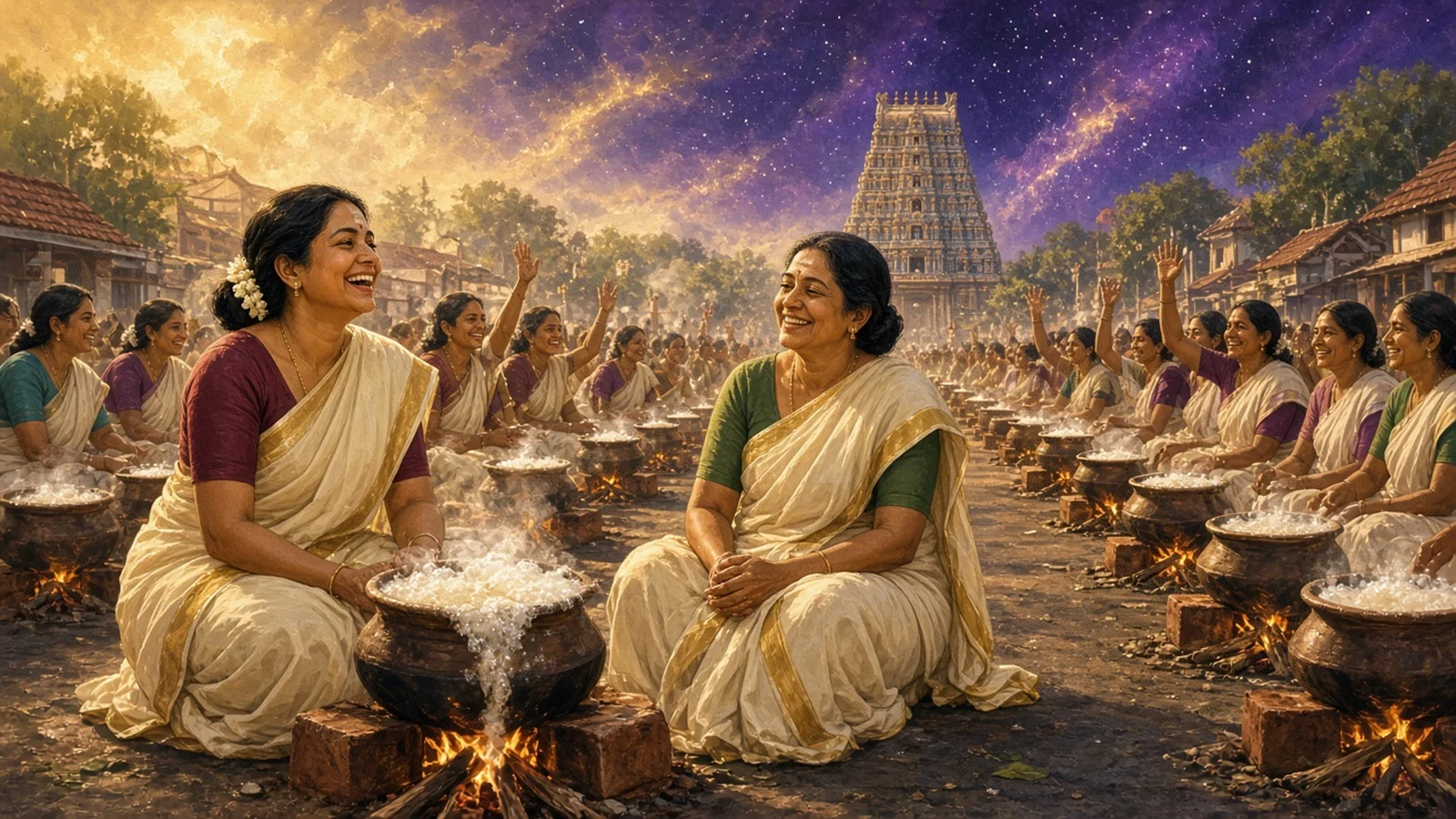
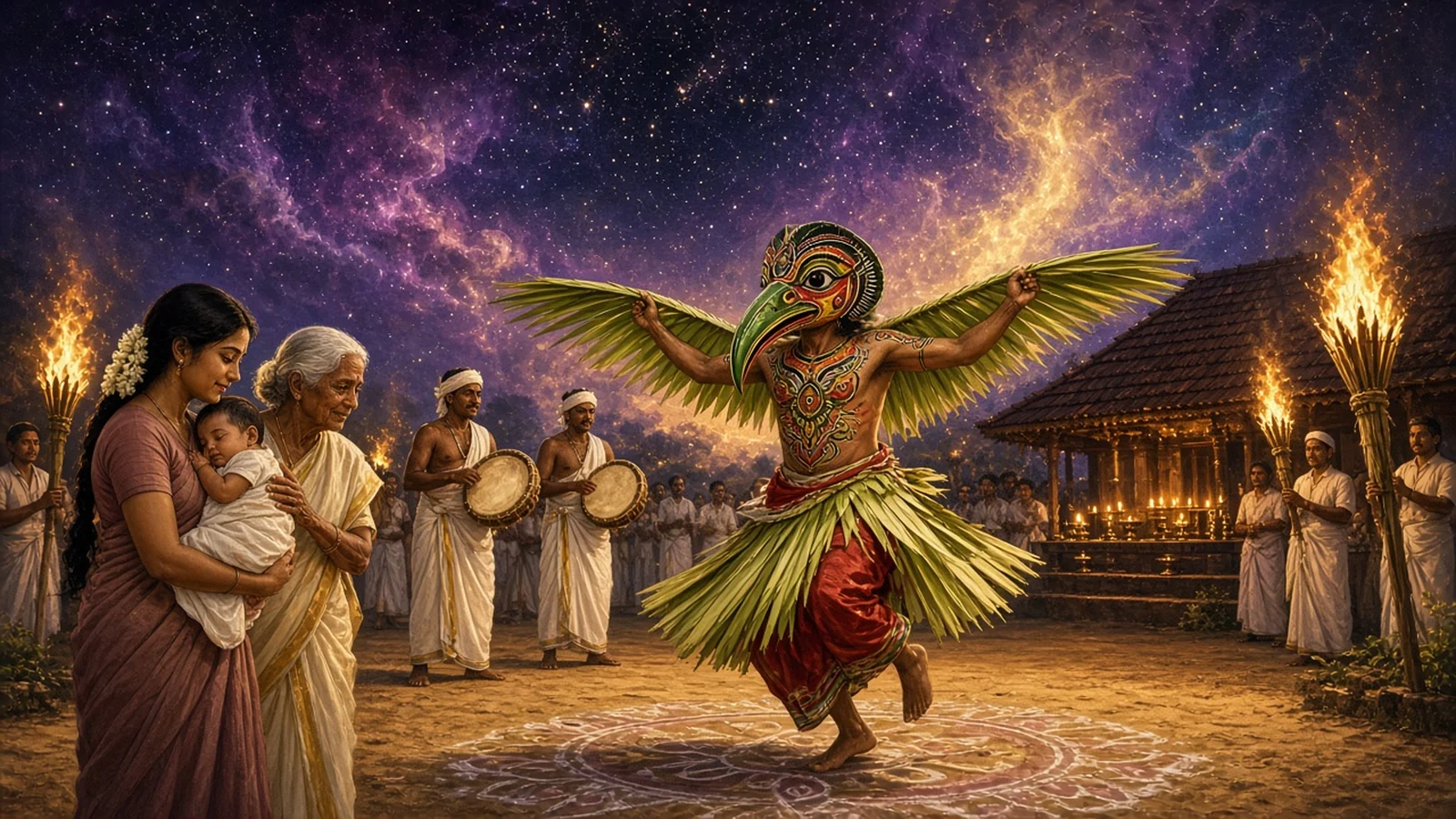
At the temple the torches had been burning since the first of Medam. On the first day a bundle of dry coconut leaf had been lit from the lamp inside the shrine and carried out, and since then the thappu drums had been calling the goddess down to watch.
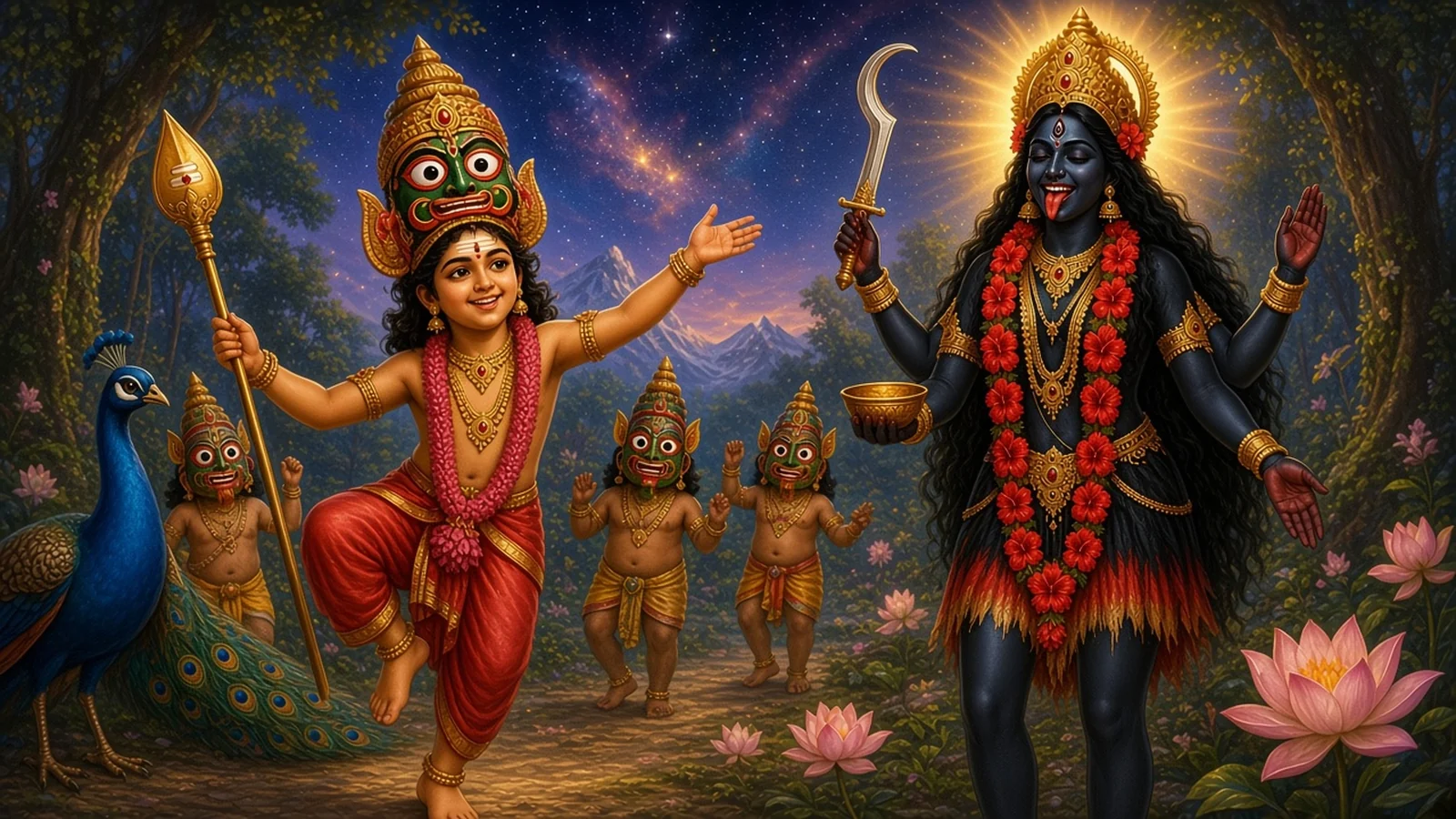
Late in the night the kolams came up to the kalam in the light of the choottu, carried high, the drums and shouts going ahead of them. Ganapathi came first, as he always does, and went through his steps to the four sides.
Lekha stood at the edge of the crowd with the baby asleep against her shoulder and her grandmother's hand on her arm.
The Pakshi came after midnight.
It had a long green beak that curved down from its face, and a chest piece, and a skirt of young coconut leaf over red silk. Across its back lay a long frond of tender leaf with the spine pulled out, and the dancer held its two ends out in his hands, so that when he lifted his arms the bird had wings.
He came in with small, quarrelsome steps. He pecked at the ground. He hopped sideways and turned on someone in the crowd as if to fight, and the children shrieked and pressed back. Then he raised the wings and ran a wide circle round the kalam as though the air had caught him.
The singers sang of Kamsa, the wicked king, who once sent a bird to kill the baby Krishna.
The drums came faster. Someone set off a cracker, then another. The women's ululation went up all around the ground, and the bird whirled until Lekha could not follow his feet.
"Now," Kalyani said into her ear. "Now she has come into him."
Then, all at once, it was over. The dancer stood still with the wings hanging, breathing hard, and the drums dropped back to their slow beat.
Kalyani let out her breath.
"There," she said. "It has had its dance."
The baby had slept through all of it.
They stayed until the grey came into the sky, when the great Bhairavi kolam swayed into the torchlight to beg the goddess's pardon for anything done wrong in the night. Walking home, Lekha asked her grandmother whether the bird had gone.
"Ask me in a month," said Kalyani.
As the kolam-makers tell it: seven sheaths for a bird
South India · Kadammanitta, the afternoon before a kolam night · 2 min read
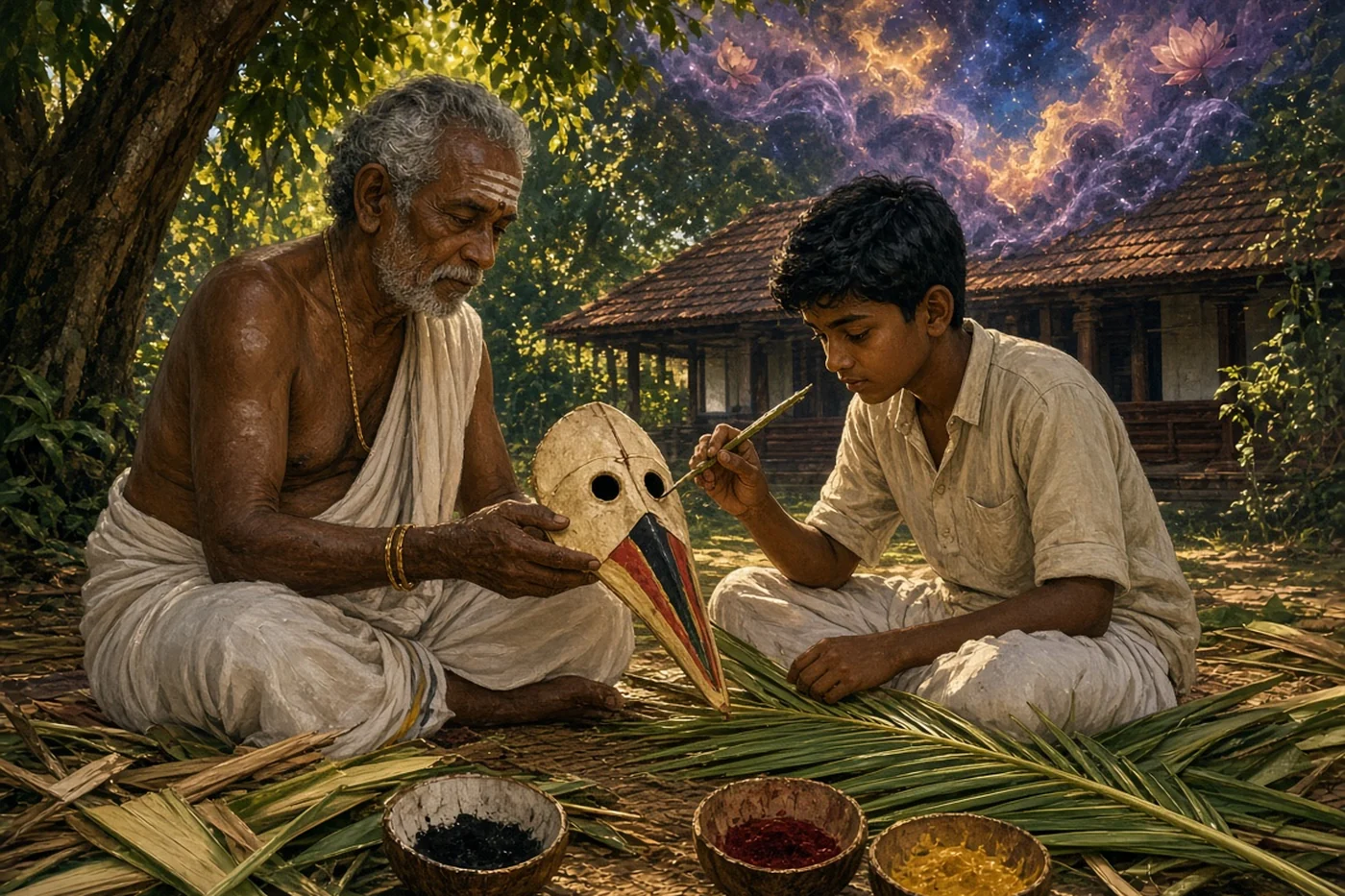
Anandu was fourteen, and this year his asan had let him help with the bird.
They worked in the shade behind the temple with a heap of green areca sheaths that had fallen that week. The asan cut both ends off each sheath and showed the boy how to shave the top skin away with the small knife until the piece was thin, even and pale.
"Not that one," the asan said, catching his wrist. "Leave the green on that one. A bird needs its green."
Seven sheaths went into the Pakshi. The colours sat in coconut shells around them: black from mango leaves burnt to powder, red ground from a red stone, yellow pressed from the manjachanna plant. White needed nothing; it was the shaved sheath itself. The brushes were stalks of young coconut leaf, split and frayed at one end.
The face was cut first, with round holes for the dancer to see through. Behind the thin painted sheath the asan stitched a backing of unshaved sheath with a coconut leaf spine, so that the face would not curl up in the night's heat.
"Eyes first," he said, when the boy picked up a brush. "Always the eyes."
Beside every line he drew, he drew a second, finer one, close beside it. Then he fixed the beak at the mouth, a long curved strip cut from the sheath. The wings would be the last thing: a young coconut frond with its spine drawn out, laid on the dancer's back at the very end.
The dancer himself did not come near them. He had been keeping his fast and his rules for days, and would come only when it was time to be dressed.
"Why a bird?" Anandu asked.
"Because it is the bird that comes for the babies," said the asan, holding the face up to the light. "Tonight it comes for its own offering instead."
By morning the kolam would be finished with. Kolams are made for one night and thrown away after it, and next year he would cut a new bird from new sheaths.