As Dakshineswar tells it on the night of Kali Puja
Bengal · the Dakshineswar temple, the Ramakrishna Mission's account · 4 min read
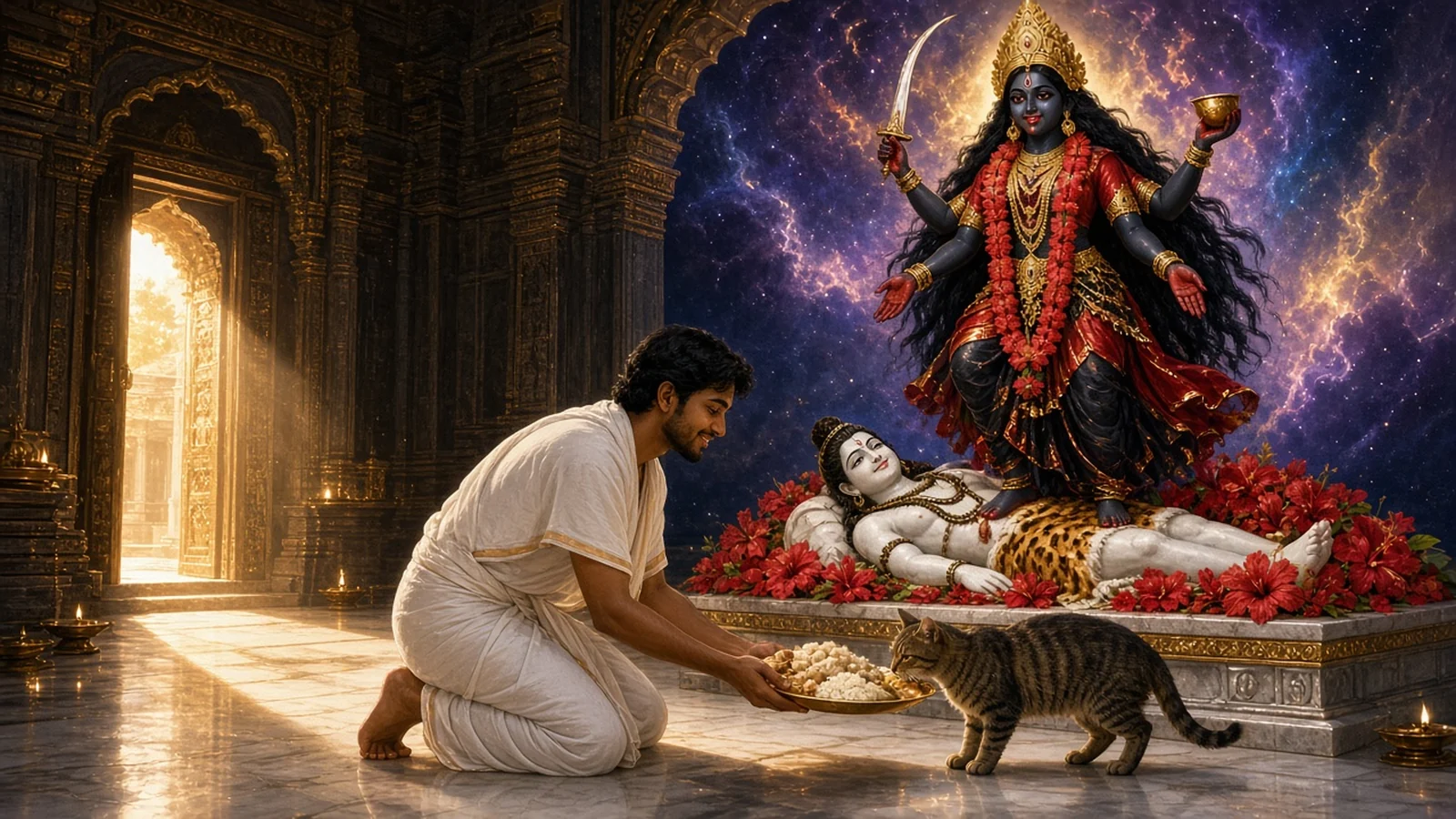
On the new-moon night of Kartik the crowd at Dakshineswar is at the gate long before midnight. Inside, Bhavatarini stands in black basalt on a Shiva of white marble, red hibiscus heaped at her feet, and each person who reaches the door has a moment. Most use it to say one word, the word he used. Ma.
He was nineteen when he came here, and he did not want to come.
The temple was consecrated on 31 May 1855, the day of the Snana Yatra, and his elder brother Ramkumar was its priest. Gadadhar had followed him from Kamarpukur, and would not eat the temple's cooked food: in his father's house such food was offered to a god only under a Brahmin's roof, and this temple's owner was a widow the Brahmins called a sudra.
"Then do as you think right," said Ramkumar, who was tired. "But stay. I need you here."
He stayed. Mathur Babu, the owner's son-in-law, had noticed the quiet younger brother and wanted him in the Kali temple. The boy held out; he did not want to answer for the goddess's jewels. Then his nephew Hriday, sixteen, came looking for work, and he gave in on one condition, that Hriday would help him. His first task was to dress the image.
Ramkumar grew old and frail, Mathur moved him to the Radha and Krishna temple, and the younger brother became the priest of Kali. In 1856 Ramkumar died suddenly, as he was getting ready to go home on leave.
A priest's work is fixed: wake the goddess, bathe her, dress her, feed her, put her to bed. He did all of it, and then more.
He sang to her, the songs of Ramprasad and Kamalakanta, for hours. He touched the flowers meant for her to his own head first. He held a morsel up to her mouth and would not take it away until he was sure she had eaten.
"Eat, Ma. Eat. Then I will eat."
At night he went into the jungle north of the temples, an old burial ground that people avoided even by day, took off his cloth and his sacred thread, and sat down to call her.
"When you call the Mother you put everything down," he told Hriday, who had followed him and was frightened. "Your caste as well. This thread only reminds me that I was born a Brahmin."
She did not come. He stopped sleeping. He rubbed his face in the dust and wept so hard that strangers thought his mother had died. "Are you real, Ma?" he would cry. "Or are you only a song?"
One day it was more than he could bear. A sword was kept in the Mother's temple. He ran to it and seized it, meaning to end his life.
The temple went. The doors, the walls, the image went. There was nothing but light, a sea of it with no shore, waves rushing at him from every side, and it took him and he fell. When he came to himself the only word in his mouth was Ma.

After that he could not be managed. He sat before her like a stone for hours, or laughed and danced and talked to her as a son talks. The officials said he was mad. Then came the day of the cat.
A cat came into the shrine, and the priest looked at it, and gave it the food that was to be offered to Kali.
The manager of the temple garden, who answered for the worship, had seen enough. He wrote to Mathur Babu that the young priest was feeding the Mother's offering to a cat.
Mathur Babu had once crept in to watch this priest at worship, and had come away sure that the stone was alive while the boy stood before it. He wrote back.
"Leave him alone. He may do as he pleases, and nobody is to stop him."
Long afterwards the priest told it himself. "The Mother showed me that she had become everything," he said. "The image, the altar, the water pots, the doorstep, the marble floor. A bad man standing outside the temple. The cat too. What else was I to do with the food?"
The crowd is still moving. The people who reach the door tonight say Ma, as he did, and are moved on.
As Kolkata tells it: the widow who built the temple
Bengal · Janbazar and Dakshineswar, 1847 to 1861 · 2 min read
Rani Rashmoni was born in 1793 at Kona, near Halisahar, in a Mahishya peasant family, married at eleven into the rich Das family of Janbazar in Calcutta, and widowed in 1836 with four daughters and a zamindari to run. She ran it. When the Company put a tax on fishing she had a stretch of the Ganga closed to shipping until the tax was taken off, and when the British stopped the puja processions she sent hers out anyway, and in the end they withdrew the fine.
In 1847 she made ready to go to Kashi. The party would go by river, in twenty-four boats loaded with relatives, servants and stores.
The night before they sailed she dreamed, and Kali stood in the dream.
"There is no need to go to Kashi. Set up my image in stone on the bank of the Ganga here, and see that I am worshipped and fed every day."
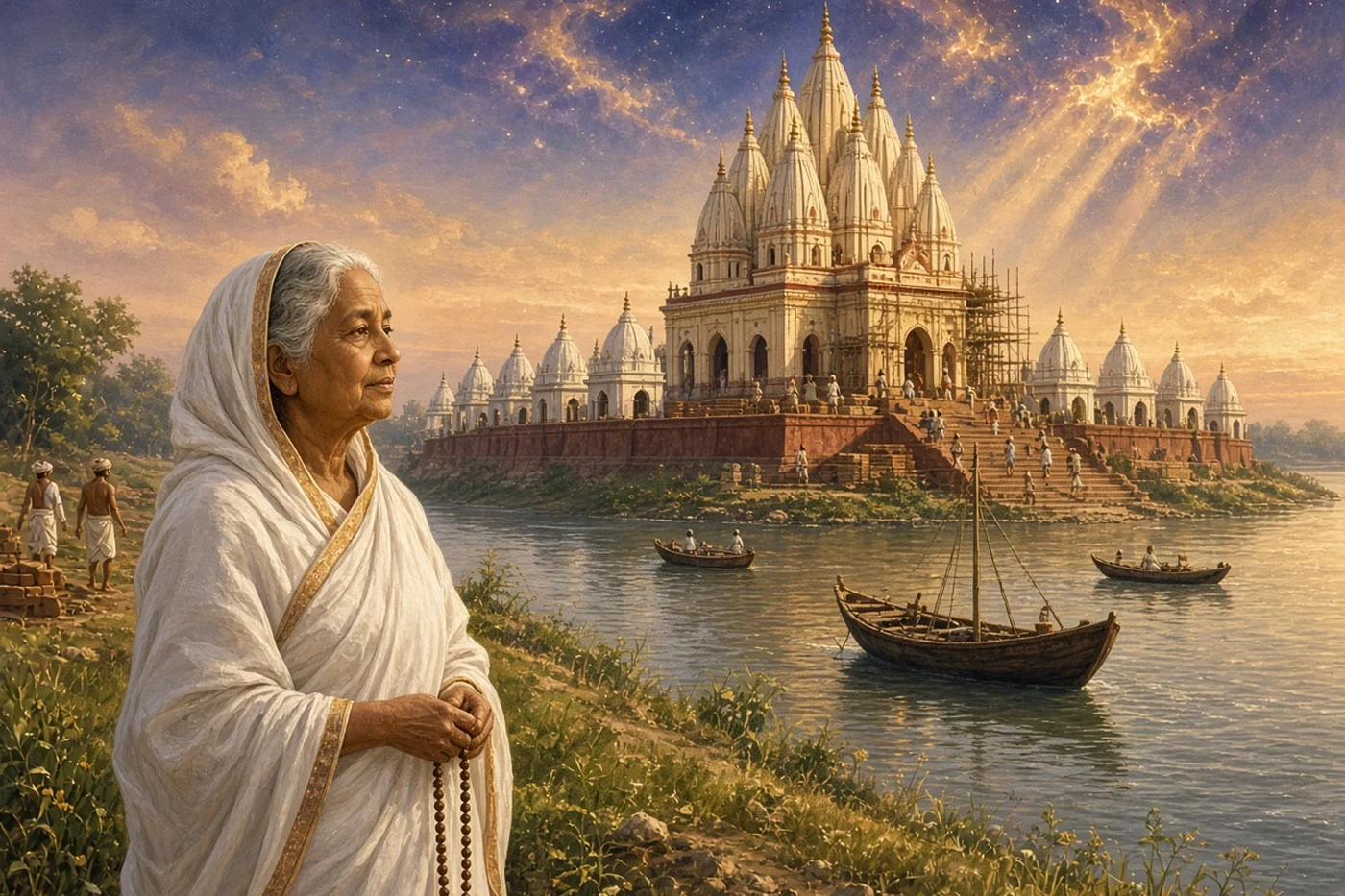
So she did not go. The owners on the western bank, which people said was as holy as Kashi, would not sell to her, and she found her land on the eastern bank instead: twenty acres at Dakshineswar bought from an Englishman, ground shaped like a tortoise's back, with a holy man's graveyard on it. The building took eight years and nine lakh rupees: a nine-spired temple for Kali, twelve small temples for Shiva along the river, a temple for Radha and Krishna, and music towers at the corners.
Then the trouble began, and it was not about money.
"Cooked rice, offered in a temple you own?" the pundits said. "No Brahmin will serve there, and no Brahmin will eat what the goddess is given."
She asked everyone. She offered to make the temple over in her guru's name, and it still was not enough. Then a Brahmin of her estate office, Mahesh Chattopadhyay, named a poor scholar from his own district, Ramkumar of Kamarpukur, who kept a Sanskrit school in the city. She wrote to him humbly, and he sent back an answer.
"Give the temple to a Brahmin, with money enough to keep it. Let him install the goddess and make the offering. Then the scriptures are kept, and anyone may eat her food."
She gave it in her guru's name and kept the running of it herself, and Ramkumar agreed to serve, for a while, he said, and stayed. The image was installed on 31 May 1855, with more than a lakh of Brahmins invited. Ramkumar's younger brother was there, and would not eat.
The Rani lived five years and nine months more. On 18 February 1861, ill, she signed over her estates in Dinajpur to keep the temple going, and the next day she died.