As Gokarna tells it
West India · Gokarna, Karnataka coast · 3 min read
Ravana, king of Lanka, was a great devotee of Shiva, and his mother was one too. She wanted the god himself in Lanka, not an image of him, and her son set out for Kailash to bring him home.
He did not ask politely. He sat before the mountain and began a penance so fierce that the stories still speak of it with a shiver. He cut off his own head and made it into a vina, strung it with cords drawn from his own body, and played on it, singing to Shiva, until the god could refuse him nothing.
"Ask," said Shiva.
"Your atmalinga," said Ravana. "Your own self, in stone. I want to take it to Lanka."
Shiva gave it to him, and with it one warning. "Carry it all the way. If you set it down on the earth even once, it will stay where it touches the ground, and no power in the three worlds will lift it again."
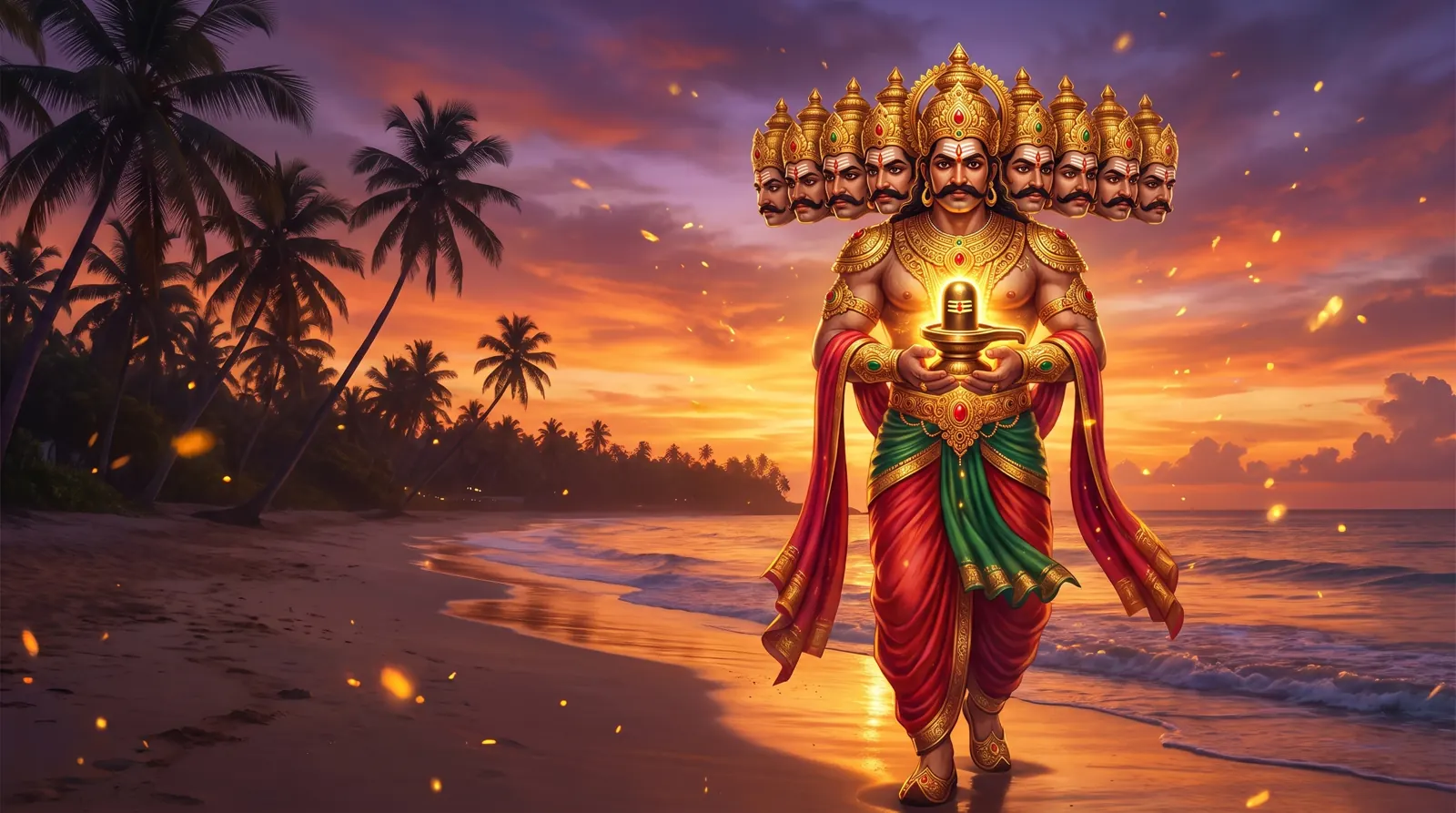
Ravana bowed, took the shining linga in his arms and started south.
The gods watched him go and grew afraid. With Shiva's own self in Lanka, Ravana would never be defeated. So they went to Ganesha, who has a gift for getting in the way.
Ravana walked down the long western coast with the sea on his right. As he neared the place we now call Gokarna, the sun began to sink. Ravana was proud and cruel, but he never missed his evening prayers. He had to stop, wash and pray. Yet he could not put the linga down.
A small Brahmin boy came along the beach, a sacred thread across his chest, his head shaved except for a tuft. He was Ganesha in disguise, though Ravana did not know it.
"Little one," called Ravana. "Hold this for me while I say my prayers. Don't put it down, whatever you do."
The boy looked at the heavy linga and then up at the king with ten heads. "It looks heavy," he said. "I'll hold it. But if it gets too heavy, I'll call you three times. If you don't come, I'll put it down."
Ravana agreed and went to the water.
He had barely begun when he heard the boy's voice. "Ravana!" Then again, quickly: "Ravana!" And a third time: "Ravana!"
By the time Ravana turned around, the boy had set the linga gently on the sand.
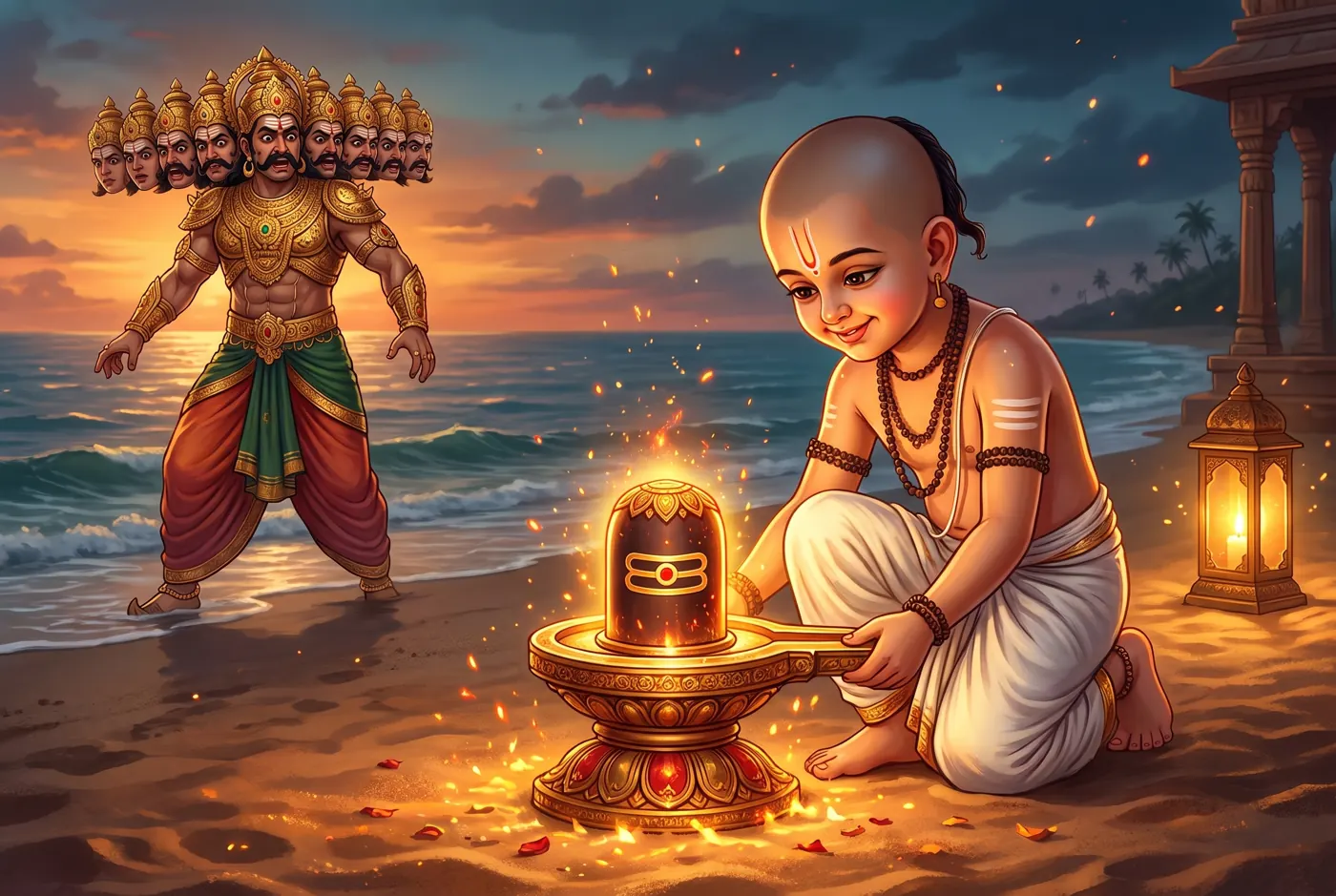
Ravana ran back and seized it with both arms. He pulled with all the strength that had shaken mountains. The linga did not rise. It only sank deeper and twisted in his grip. It is said that the earth there took the shape of a cow sinking into the ground, with only its ear left above, and so the place is called Gokarna, the cow's ear.
The linga stayed where the boy had put it. It is worshipped there today as Mahabaleshwar, the lord of great strength, a name that remembers how even Ravana's strength was not enough.
As Deoghar tells it
East India · Deoghar, Jharkhand · 1 min read
Far to the east, in the forests of Jharkhand, the temple of Baidyanath tells the same story with a different trickster.
Here Ravana's penance was a different sacrifice. He offered his heads to Shiva one after another, nine of them, and as he raised his sword to the tenth, Shiva appeared, stopped his hand and healed him the way a physician heals a wound. Then he gave Ravana the linga, with the same warning: never set it down before Lanka.
The gods turned to Vishnu, and Vishnu had a plan. As Ravana sipped water for his evening rite, Varuna, the god of the waters, slipped into it and into the demon king's belly. By the time Ravana reached the forest at Deoghar, he badly needed to stop and relieve himself, and the linga could not come with him.
A cowherd boy was grazing his cattle under the sal trees. His name was Baiju, and he was Vishnu in disguise.
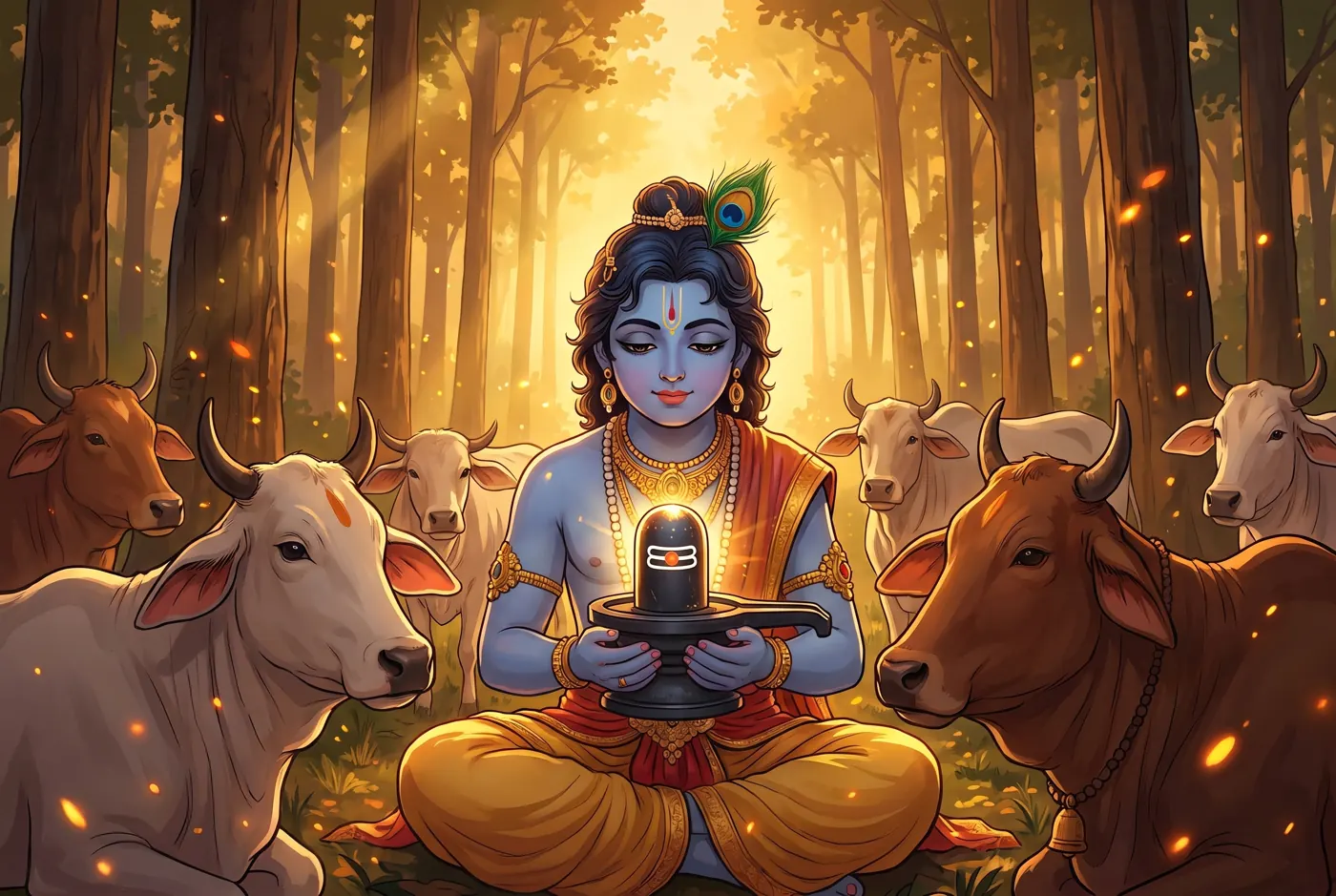
Ravana handed him the linga. Varuna made sure the king was gone a long, long time. Baiju waited, then set the linga on the ground and walked off with his cows.
When Ravana returned he tried to wrench it free. He pressed down on it with his thumb so hard that the stone still carries the dent. It did not move.
So the temple has two names. It is Baidyanath, for Shiva the vaidya, the physician who healed Ravana's wounds, and Baijunath, for the cowherd who stood under the sal trees and quietly set the linga down.