Festival · The longest night of the year, when Chidambaram bathes its dancing god before dawn and the women of Kerala dance round a lamp till midnight
Arudra Darshan
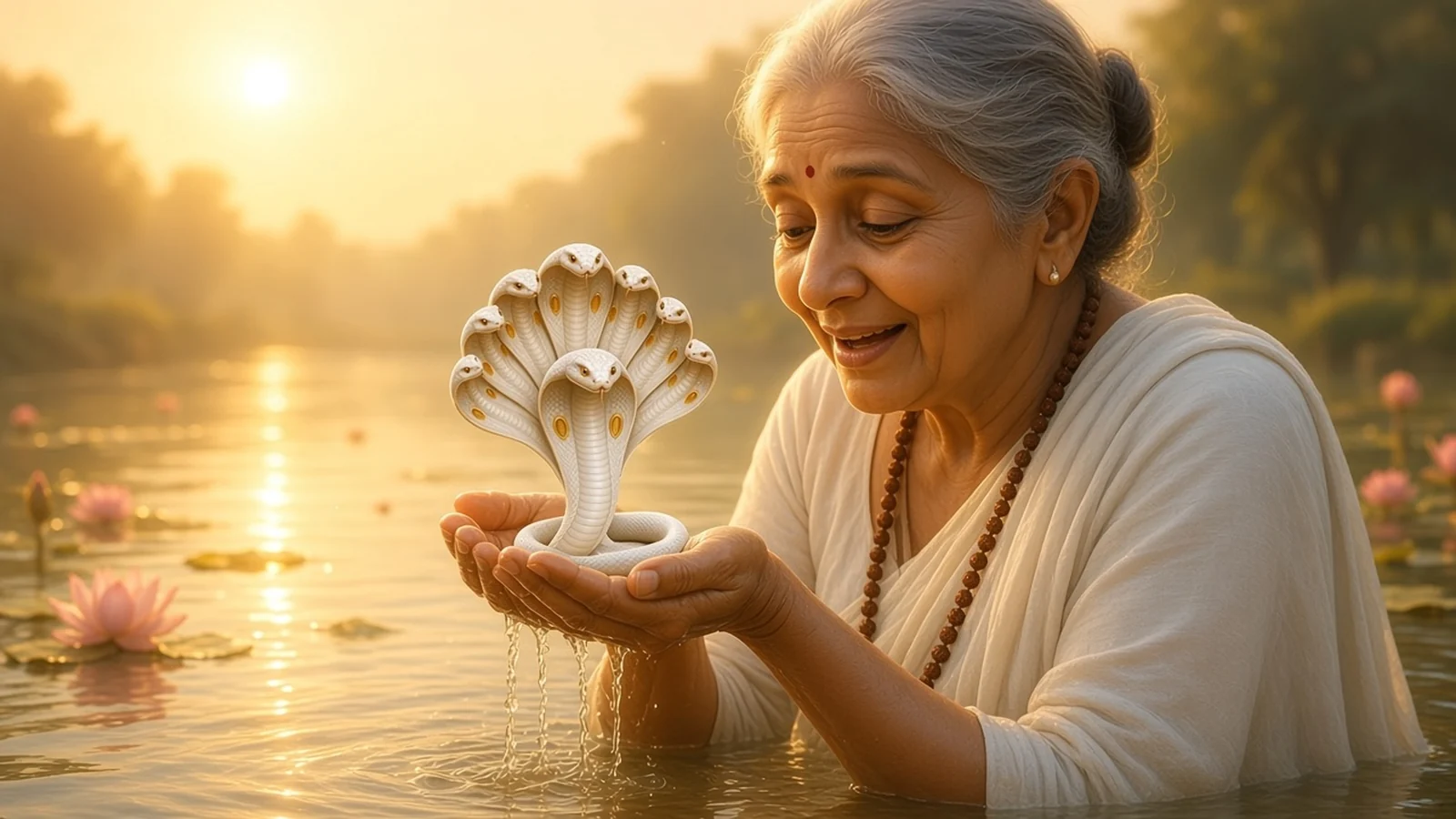
Arudra Darshan is kept on the Ardra star, Thiruvathirai, nearest the full moon of Margazhi, in the darkest weeks of December and January. At Chidambaram it closes a ten-day festival with the temple car, a bath of Nataraja that lasts until daylight and the god's dance out into the hall. In Kerala the same night is Thiruvathira, when women fast, swing and dance the Thiruvathirakali for Parvati and the husband she won.
When is Arudra Darshan in 2026? Arudra Darshan and Thiruvathira, the tenth day at Chidambaram, is Thursday 24 December 2026; it runs 15 to 24 December 2026. In 2028: Tuesday 11 January 2028. On the Thiruvathirai (Ardra) star in the Tamil month of Margazhi, the Malayalam month of Dhanu, close to the full moon, in late December or early January.
Also calledThiruvathiraiThiruvathiraArdra DarshanamArudra DarisanamMargazhi ThiruvathiraiDhanu ThiruvathiraAthirai
In short
What is Arudra Darshan?
The festival of Nataraja, Shiva as the Lord of the Dance, on the Ardra star in Margazhi. At Chidambaram it ends ten days with a bath of the god through the early hours and his darshan in the hall; in Kerala the same night is Thiruvathira, kept by women with a fast and a circle dance.
When is Arudra Darshan in 2026?
Calendars give Thursday 24 December 2026, the Thiruvathirai star running from 4.53 am that day to 1.47 am on the 25th, with Kerala's Dhanu Thiruvathira on the same day. The Chidambaram ten days are expected from Tuesday 15 December, with the car on Wednesday 23 December. There is no Arudra in 2027; calendars give Tuesday 11 January and Sunday 31 December 2028.
What is Thiruvathirai kali?
A sweet of rice and jaggery cooked with moong dal, coconut, cardamom and ghee, offered to Nataraja on Arudra and made at home. Chidambaram tells that it began with the broken-rice porridge a poor woodcutter, Sendanar, gave Shiva.
How is Thiruvathira kept in Kerala?
Women fast from the night before, taking no rice, and eat tubers and arrowroot. They swing, chew betel, dance the Thiruvathirakali in a circle round a lit lamp, wear the ten sacred flowers at midnight and bathe in the pond before dawn.
Next, in 2026Thursday 24 December 2026
15 to 24 December 2026
Prime godNataraja, the Lord of the Dance at Chidambaram
with 3 more
WhereTamil Nadu, above all Chidambaram and the other halls where Nataraja dances; Kerala; the Tamil Shaiva temples of Sri Lanka
How longTen days at Chidambaram, from the flag hoisting to the darshan; in Kerala the eve of Makayiram and the night and morning of Thiruvathira
On the Thiruvathirai (Ardra) star in the Tamil month of Margazhi, the Malayalam month of Dhanu, close to the full moon, in late December or early January
Why it is kept
Arudra Darshan falls on the night of the Ardra star, Thiruvathirai in Tamil, nearest the full moon of Margazhi, when the nights of the year are at their longest. Ardra is held to be Shiva's own star. At Chidambaram, where he dances in the golden hall, a ten-day festival ends that night with the car, a bath of the god that runs from before dawn into the morning, and the moment in the afternoon when the dancer comes back into his hall, the darshan the day is named for. In Kerala the same night is Thiruvathira, when women fast, ride the swing and dance in a circle round a lamp until midnight.
For Shaivas Arudra is the dancer's own day, and its signs are older than any single book: Shiva was called Athiraiyan, the one of Athirai, in Tamil long ago, and the Tevaram hymns of Sambandar and Appar already describe the festival at Mylapore and at Tiruvarur. The Chidambaram festival is believed to celebrate the cosmic dance itself. How the dance came to Tillai, through the sages Vyaghrapada and Patanjali, is told in The Dance in the Hall of Thillai; the Koyil Puranam, the Chidambaram temple's own book, as its retellers give it, sets that first dance on another star, Pusam in Thai, so the Arudra night is the festival's own belief rather than the date the story gives.
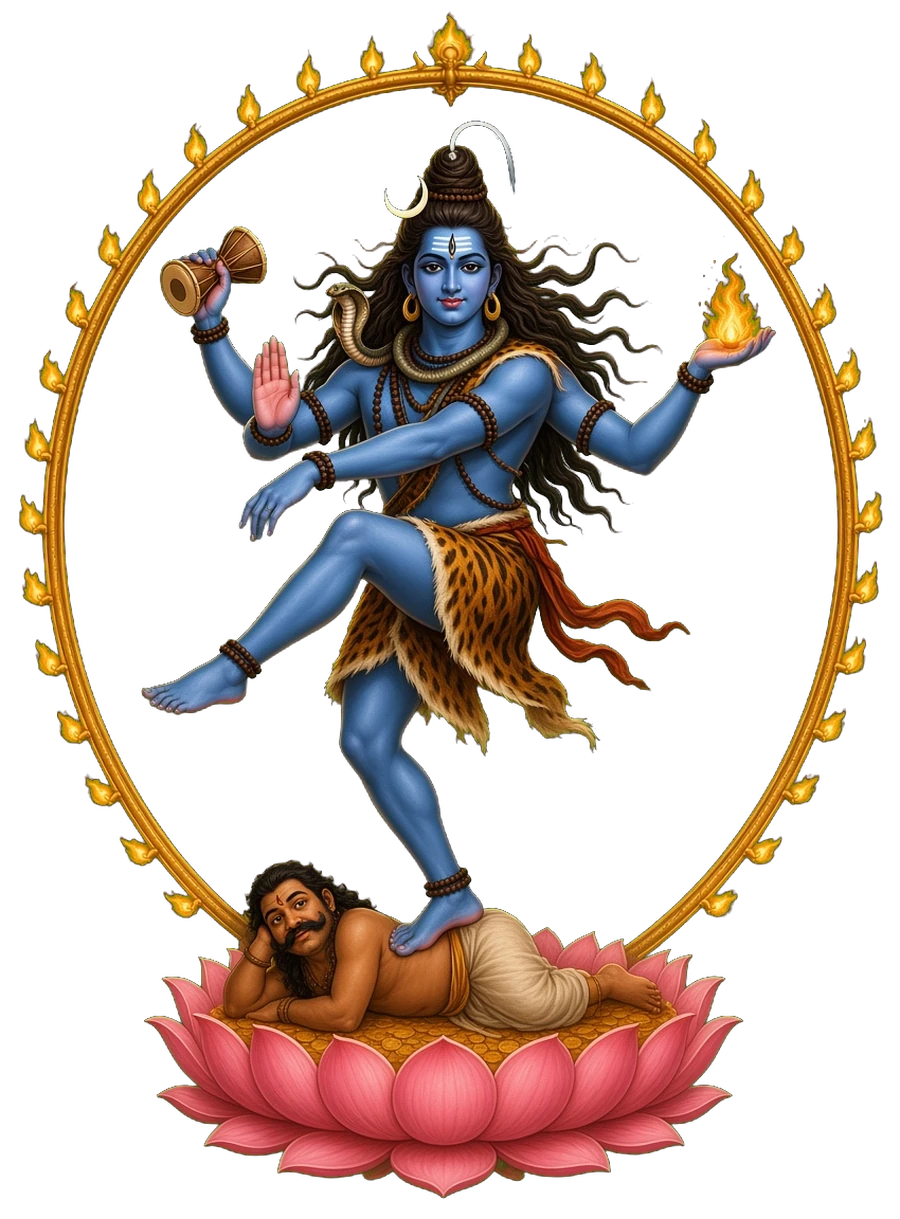
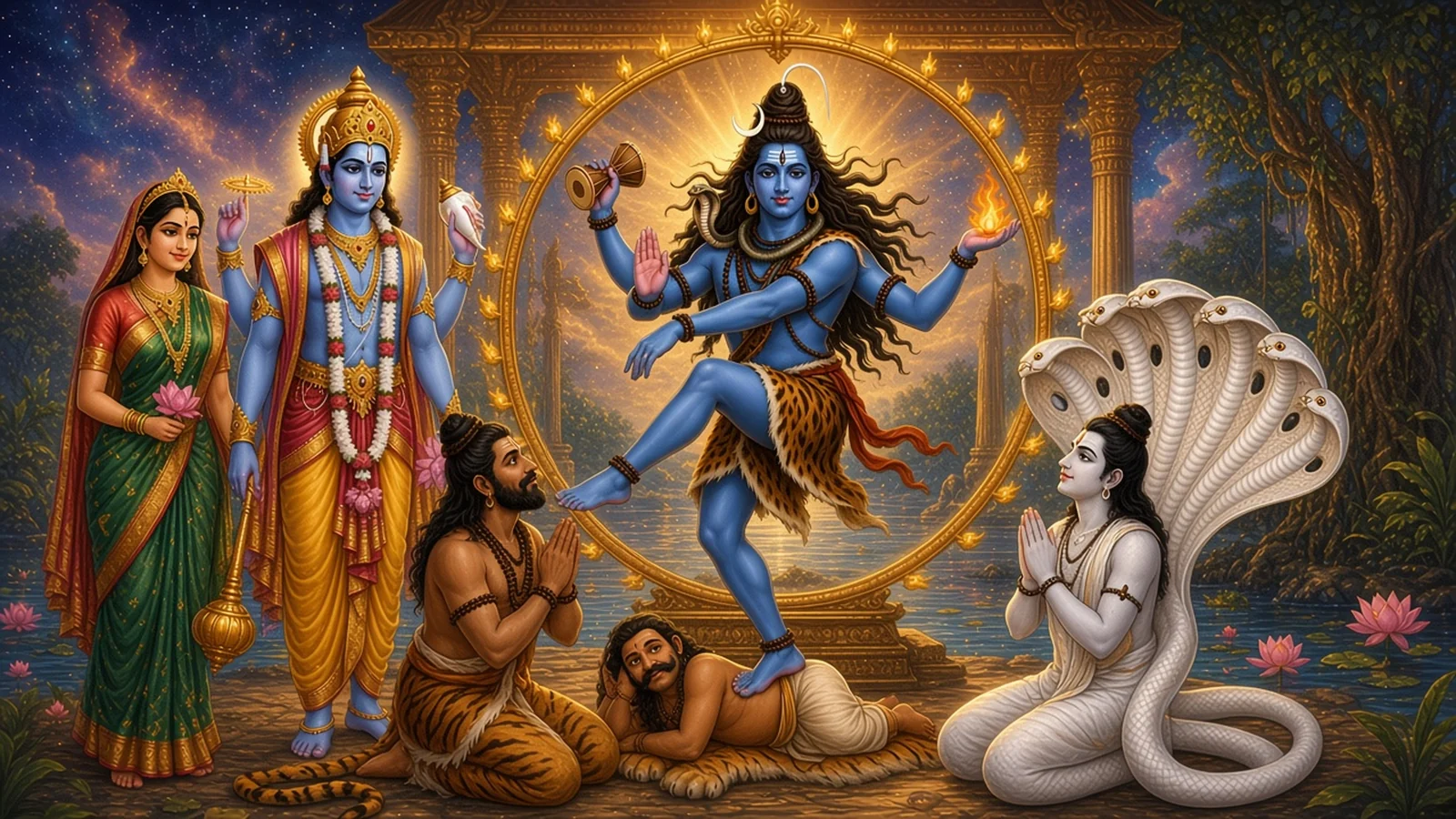
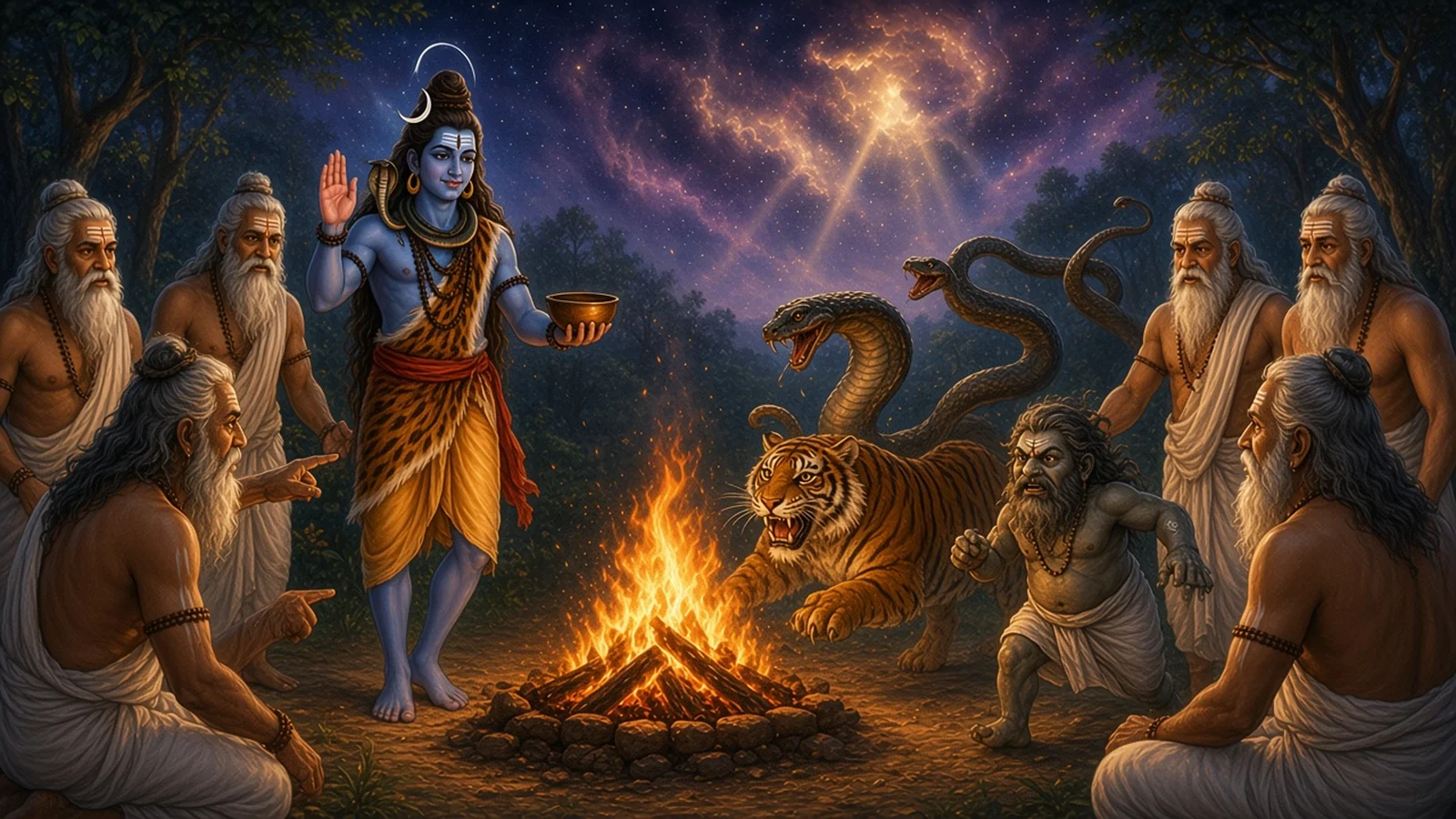
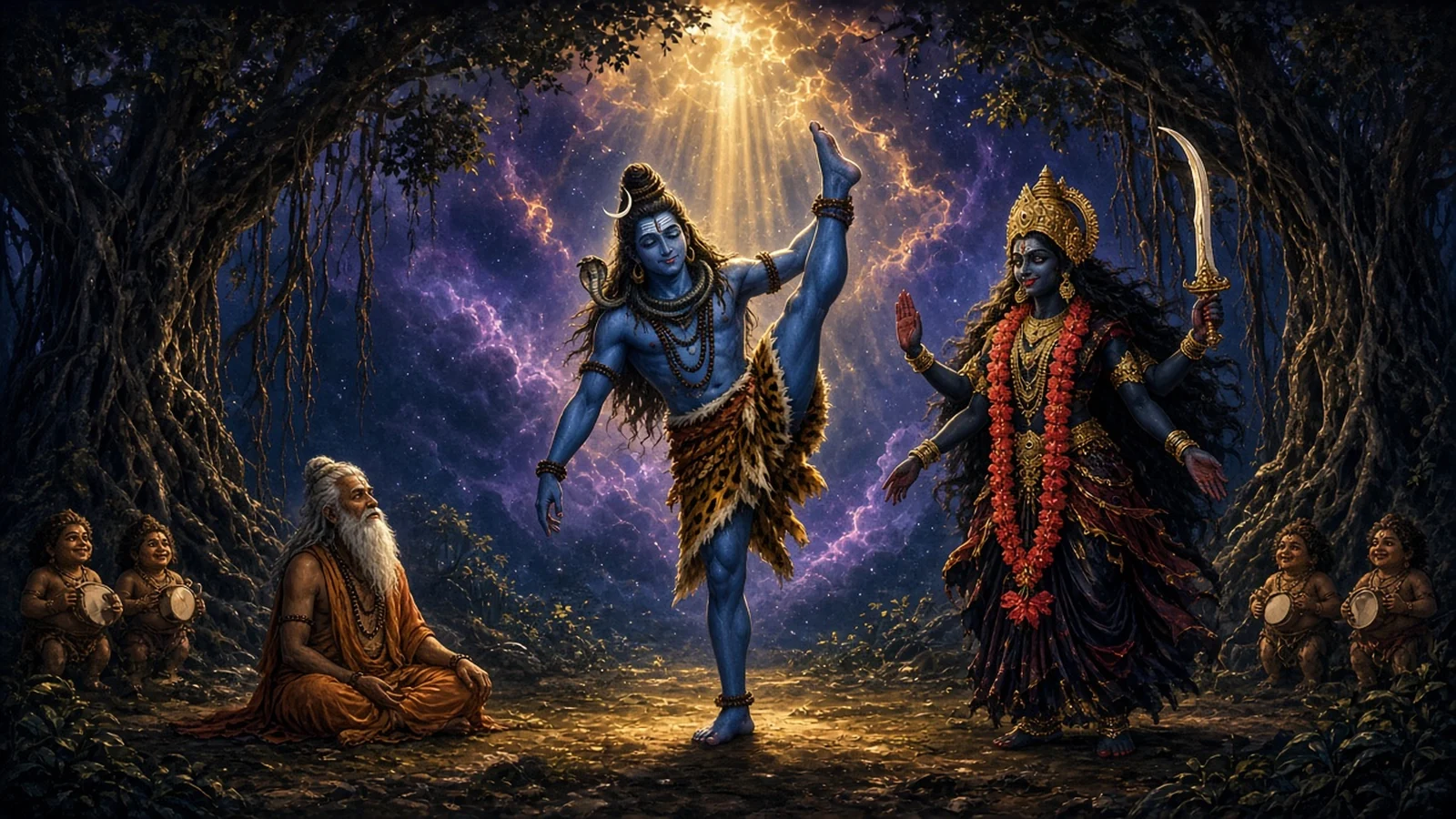
Nataraja dances in the golden hall of Tillai while the tiger-footed sage and the serpent sage watch
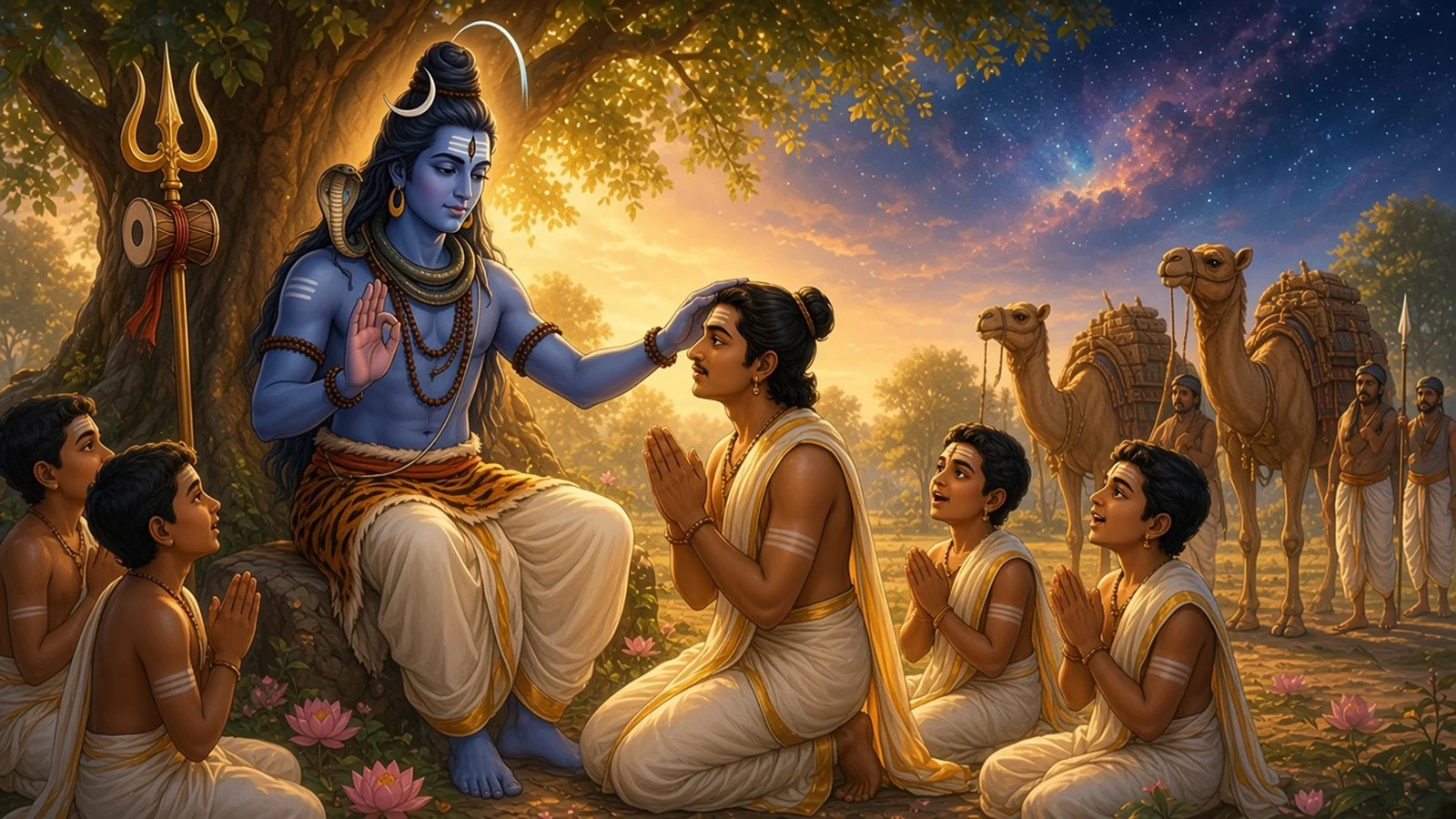
The day's food has a story of its own. A poor woodcutter, Sendanar, had only broken rice to give a guest, and the guest was Shiva, who carried the porridge into the temple; on Arudra the car would not move until the woodcutter sang. That is told in The Porridge the Woodcutter Brought, and it is why Nataraja is given kali.
The old guest carries the woodcutter Sendanar's pot of porridge into the temple at dawn
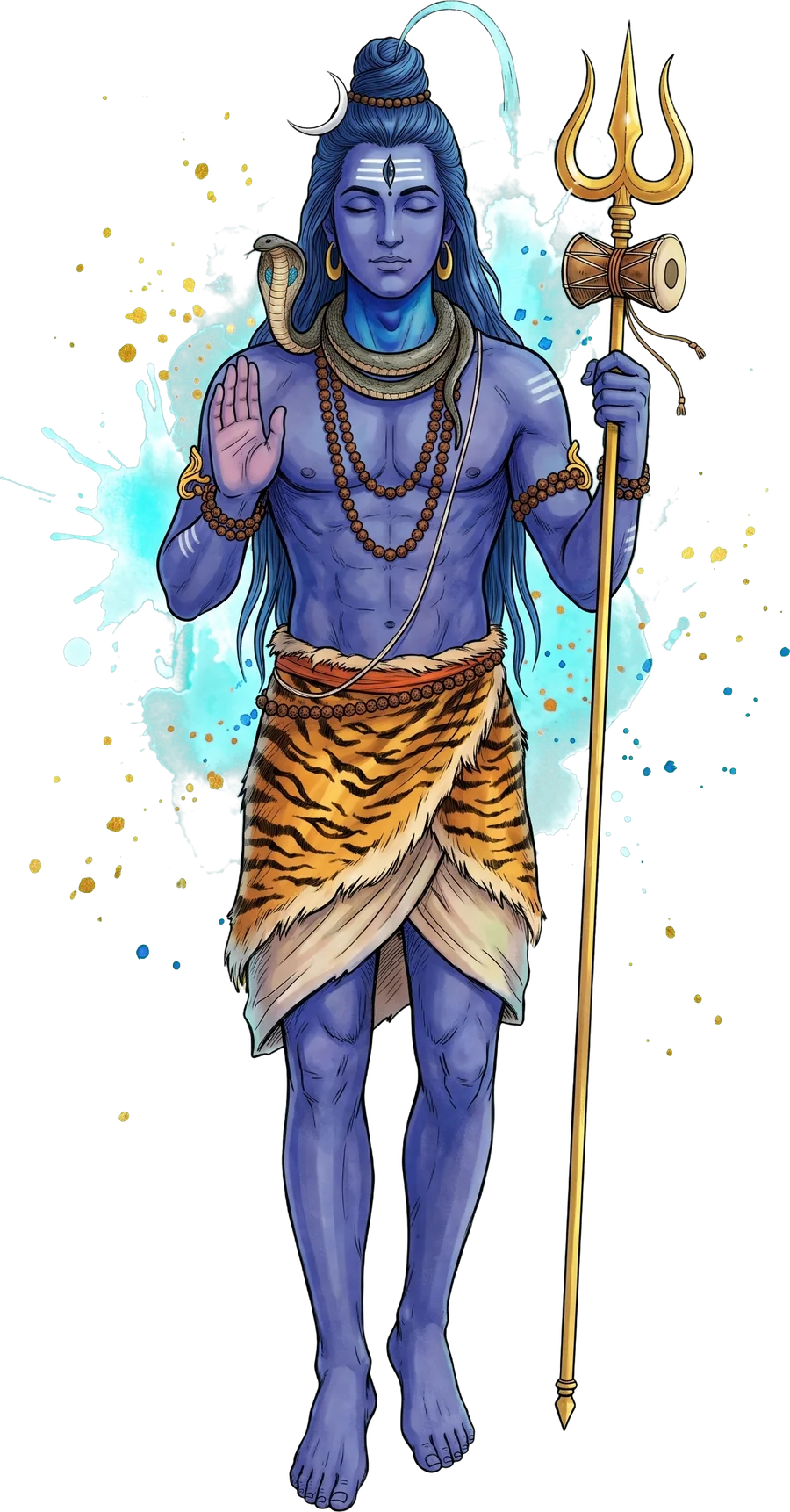
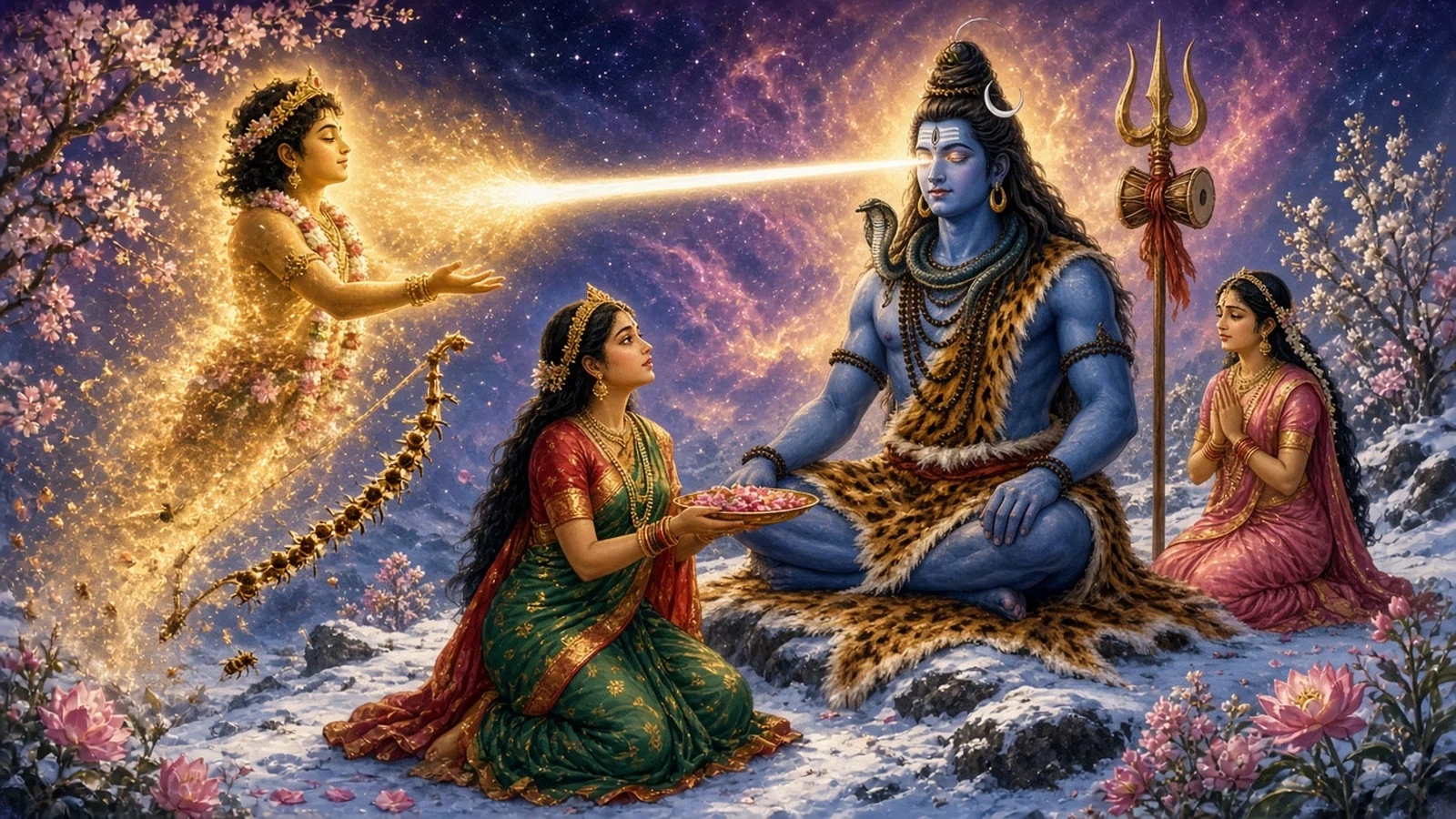
Kerala tells the night through Parvati. Thiruvathira is said to be the day Shiva, moved by her long penance, took her as his wife, and the women who keep it fast for husbands of their own. Other Kerala families tie the night to Kama, burned by Shiva's eye in The Burning of Kama; one tradition says the women keep it for his death and another for his rebirth.
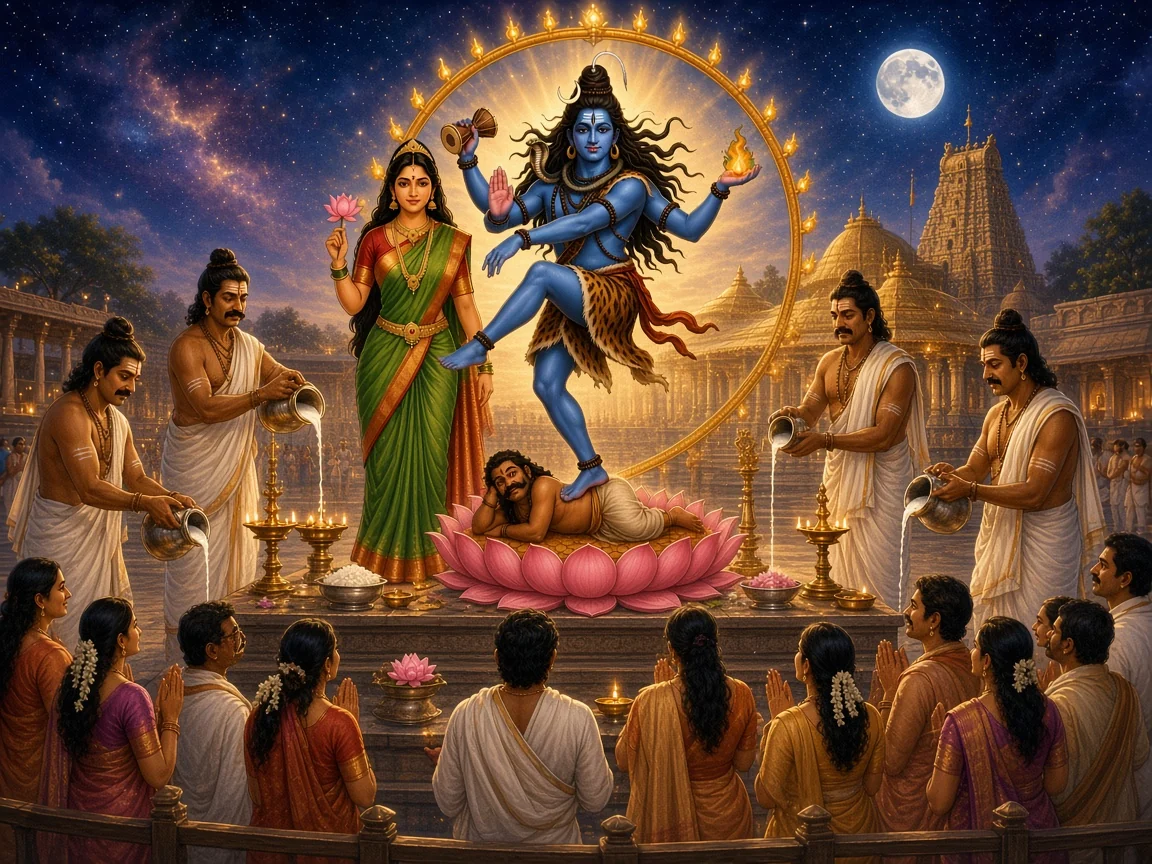
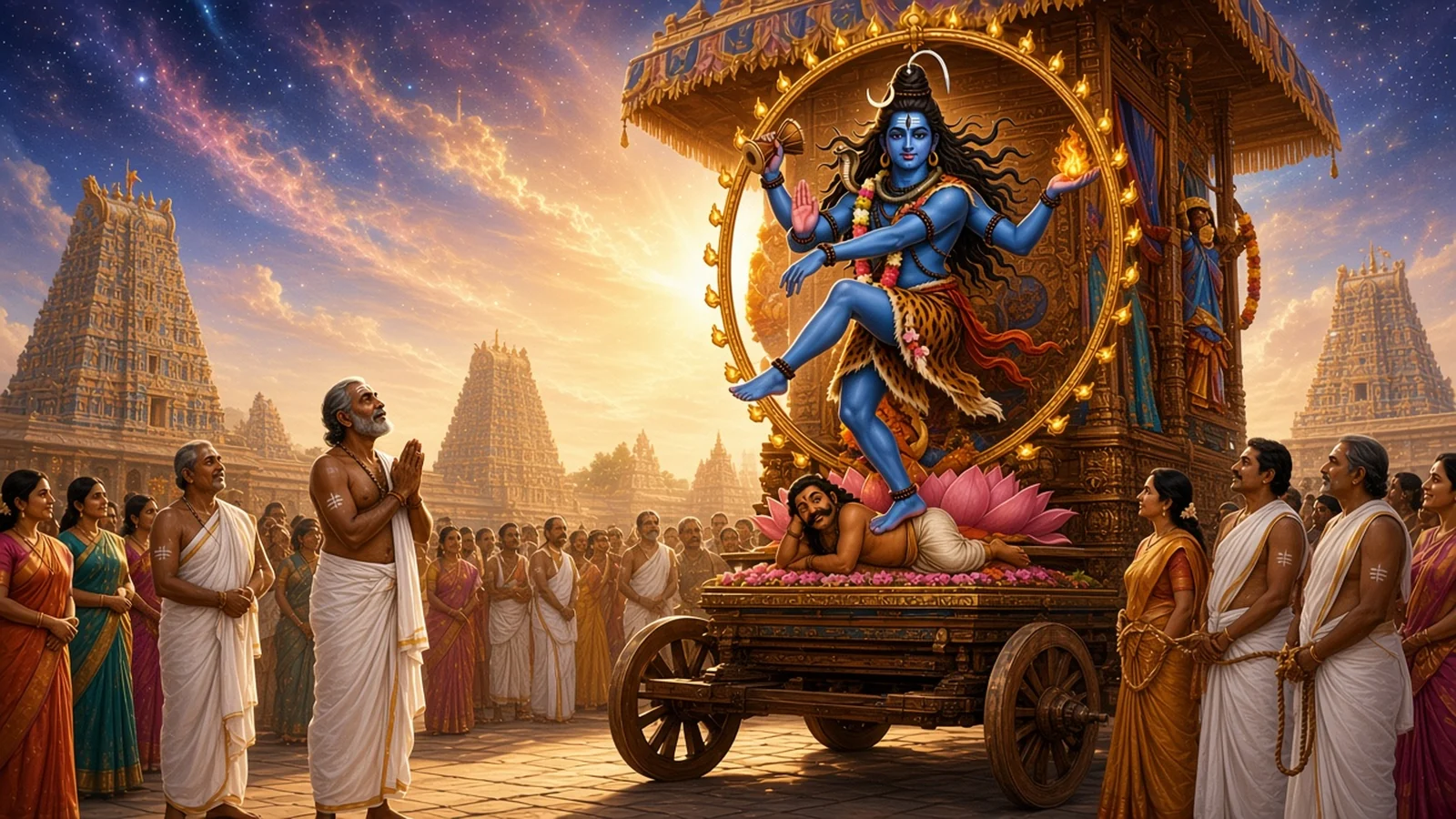
The festival is his. At Chidambaram the same bronze is both the god of the shrine and the god of the procession, so on the car day the dancer himself goes round the streets. He is bathed through the night of Arudra with his queen and comes out into the hall in the afternoon, and is offered Thiruvathirai kali.
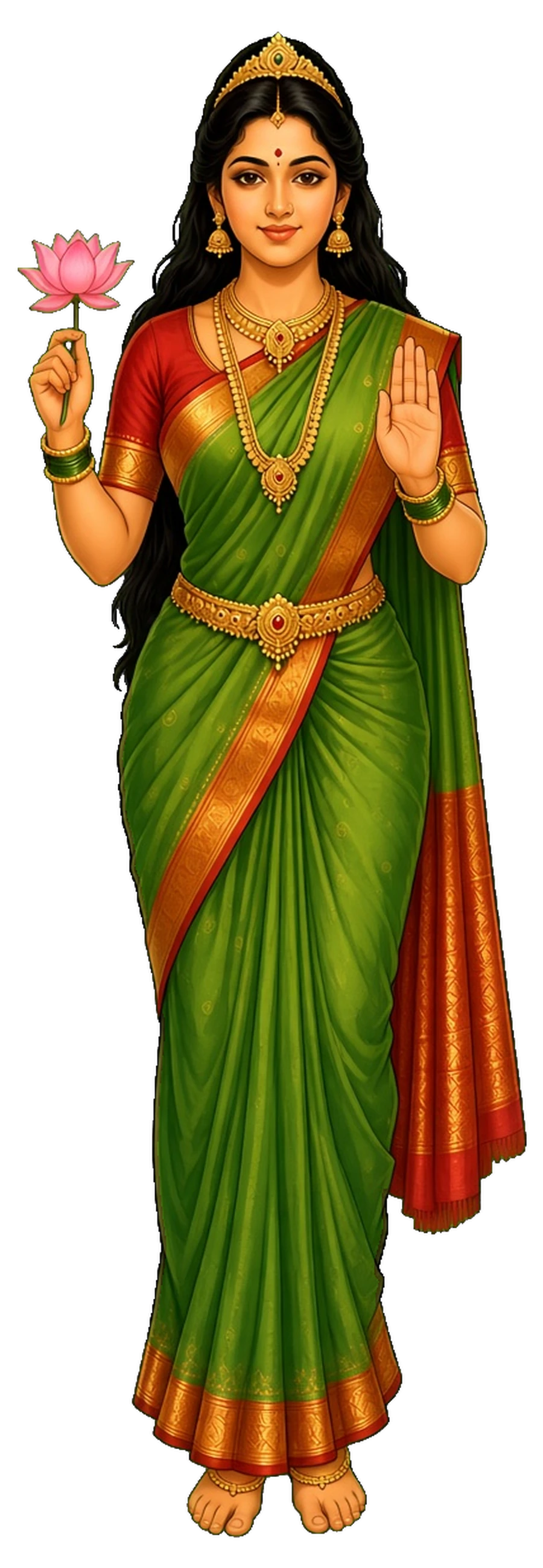
At Chidambaram she is Sivakamasundari, bathed beside the dancer. In Kerala Thiruvathira is told as the day Shiva, pleased with her long penance, accepted her as his wife, and the women who keep it fast for the same kind of marriage.
Ardra is held to be Shiva's own star, and in Tamil Nadu and Kerala the day is also called his birthday; an old Tamil name for him is Athiraiyan, the one of Athirai.
In Kerala some families say Thiruvathira is kept for Kama, burned to ash by Shiva's third eye; others say for his return to life. The women's dawn baths are said to be sung for the god of love.
The ten days at Chidambaram and the night in Kerala
1
Kodiyetram
Ten days before Thiruvathirai, in Margazhi · Tuesday 15 December 2026
the flag hoistingthe first day
The temple flag goes up at Chidambaram and the ten days begin. From this evening Manikkavacakar's image is brought before Nataraja and his Tiruvempavai is sung, one evening after another until the car day. A festival calendar gives Tuesday 15 December 2026; the temple's Dikshitars announce the days, so this date is expected, not announced.
The flag rises up the gilded flagstaff at Chidambaram and the poet Manikkavacakar is carried in
The second to the eighth day · Tuesday 22 December 2026
the vahanam nightsBhikshatana on the golden car
Each night the god goes round the four car streets on a different mount. On the eighth night, expected on Tuesday 22 December 2026, he rides the golden car as Bhikshatana, the naked beggar who walked into the forest of the sages.
The god rides the golden car through the night streets of Chidambaram as the beggar of the forest
The ninth day, on the Makayiram star · Wednesday 23 December 2026
the car festivalMakayiramthe eveMangalathira
Nataraja and Sivakami ride the great temple car, which thousands pull through the streets, and the car is remembered as the one that would not move until Sendanar sang. A festival calendar gives Wednesday 23 December 2026, expected. In Kerala the same evening is Makayiram: the women begin their fast, the eldest offers ettangadi, eight tubers roasted in the fire, to Ganesha, Shiva and Parvati, and the songs of Parvati's longing start.
Thousands pull the great temple car of Nataraja and Sivakami through the streets of Chidambaram
At Chidambaram the great bath of Nataraja and Sivakami in the outer hall runs from before dawn for some hours, the god is dressed in his jewels, the five deities go round at noon, and in the afternoon the dancer comes back into the hall, the darshan the festival is named for. Thiruvathirai kali is offered and eaten in Tamil homes. In Kerala the women stay up, dance the Thiruvathirakali round the lamp, put the ten sacred flowers in their hair at midnight and bathe before sunrise. Calendars give Thursday 24 December 2026 for both; the Chidambaram hours are expected.
In the afternoon the dancer is carried back into his hall at Chidambaram, the darshan of Arudra
The temple keeps two great festivals a year, Ani Thirumanjanam and Margazhi Thiruvathirai, and this is the larger. Ten days run from the flag to the darshan, with the car on the ninth and the bath on the tenth.
The five hallsWhere Nataraja dances
Arudra is kept at all five of Nataraja's halls, the golden one at Chidambaram, the silver one at Madurai, the hall of gems at Tiruvalangadu, the copper hall at Tirunelveli and the painted hall at Kutralam.
Tamil homes, and the Kongu countryKali and the seven vegetables
Families make Thiruvathirai kali of rice and jaggery with moong dal, coconut, cardamom and ghee, and a stew of seven vegetables to eat with it. In the Kongu region married women keep the Thiruvempavai Nonbu, ten days of fasting, eating before dawn and breaking the fast at moonrise.
KeralaDhanu Thiruvathira
Kerala keeps Thiruvathira in Dhanu as a women's festival, for a husband's long life or a good marriage. The women take no rice, eat tubers and arrowroot pudding, bathe in the temple pond at dawn splashing water as they sing, swing, chew betel and dance the Thiruvathirakali through the night. A bride's first Thiruvathira is Poothiruvathira.
Sri LankaEelathu Chithamparam
The Tamil Shaivas of the north keep Arudra at Karainagar Sivan Kovil, known as Eelathu Chithamparam, the Chidambaram of Lanka.
Tamil ShaivasThe dance and the hymns
For Shaivas of the Tamil country Arudra is the dancer's own day. The hymns of the Tirumurai are sung in the halls, above all Manikkavacakar's Tiruvempavai and Tiruppalliyezhuchi through Margazhi and Sendanar's Tiruppallandu, and the hymns of Sambandar and Appar already name the festival at Mylapore and Tiruvarur.
The Dikshitars of ChidambaramThe temple's own priests
The Chidambaram temple is run by its hereditary Dikshitar priests, who fix and perform the ten days, the car and the bath; they keep their own account of the temple's past, the source of the story of Sendanar's kali.
The women of KeralaThiruvathirakali
Thiruvathira and its dance were once kept by Namboothiri, Nair and Ambalavasi women in the courtyards of their houses. Today women of every caste and religion learn the dance, and in 2017 a single performance set a world record with more than six thousand dancers.
How it is kept
At Chidambaram the flag goes up ten days before the star. Each evening Manikkavacakar's image is carried to Nataraja and his Tiruvempavai is sung, twenty verses in the voices of girls who wake each other to bathe in Margazhi. His life, from the king's horses to his last day in this temple, is told in The Minister Who Bought No Horses. Each night the god goes out on a different mount, on the eighth as Bhikshatana on the golden car, and on the ninth he and Sivakami ride the great car. In the early hours of the tenth they are bathed in the Raja Sabha for three or four hours, then dressed in their jewels and taken round at noon in a procession of five gods, and in the afternoon the dancer is brought back into his hall. One of the six great baths the god receives in a year, it is the one the crowds come for.
Manikkavacakar bows to Shiva, come as a teacher under the kurundai tree at Tirupperunturai
In Tamil homes the morning means Thiruvathirai kali and a stew of seven vegetables, and in the Kongu country married women end ten days of fasting at moonrise.
In Kerala the women begin on Makayiram, the night before, with ettangadi, eight tubers roasted in the fire and offered to Ganesha, Shiva and Parvati. On Thiruvathira they take no rice, eat tubers and arrowroot pudding, chew betel, ride the swing, and dance the Thiruvathirakali, eight or ten of them clapping round a lit nilavilakku. At midnight they wear the ten sacred flowers, and before sunrise they bathe in the temple pond, splashing the water as they sing.
Kerala women in cream and gold dance the Thiruvathirakali round a lit lamp on Thiruvathira night
In the old texts
No Purana sets out this festival. Its hymns are in the Tirumurai, the Tamil Shaiva canon: the Tiruvempavai and Tiruppalliyezhuchi of Manikkavacakar in the eighth book, sung through Margazhi in Shiva's temples, and Sendanar's Tiruppallandu, the thirteen verses that close the ninth. Manikkavacakar's life, with the horses, the jackals and the flood, is told in full in the Tiruvilaiyadal Puranam of Madurai, a late book, though Appar already knew the jackals. Sendanar is not in the Periya Puranam; his life comes from the later lives of the Tirumurai poets and from Chidambaram's temple history.
Kerala's night comes down by custom and song. The dances and songs of Thiruvathirakali, with verses to Ganesha and Saraswati and the closing Mangalam, are a women's tradition, and the reading that ties the night to Kama is cited by the encyclopedia from a Kerala writer of 1900, and is still given by the women who sing the songs.
Where this page comes from. Written by Devalok from the encyclopedia articles on Thiruvathira, Thiruvathirakali and Manikkavacakar, Drik Panchang and the Kerala Calendar for the dates, the Live Trend festival calendar and grandtemples.com for the Chidambaram schedule, Kerala Tourism on Thiruvathirakali, The New Indian Express (2009) and kerala.com on the Kerala night, the life of Sendanar on shaivam.org and the ninth Tirumurai at saivasiddhanta.net, and reports in The Hindu (2013, 2014) and DT Next (2018), as recorded in the Devalok Lore. Our own words throughout.