As a Mylapore family keeps it
Chennai · the Kapaleeswarar temple, Aadi Pooram · 4 min read
The bangles had been bought the evening before, two dozen of them, red and green, and they lay on the kitchen shelf in their paper. The grandmother was up at five. By seven she had her son's wife and her granddaughter standing with her on the eastern steps of the temple tank, in a crowd that was nearly all women.
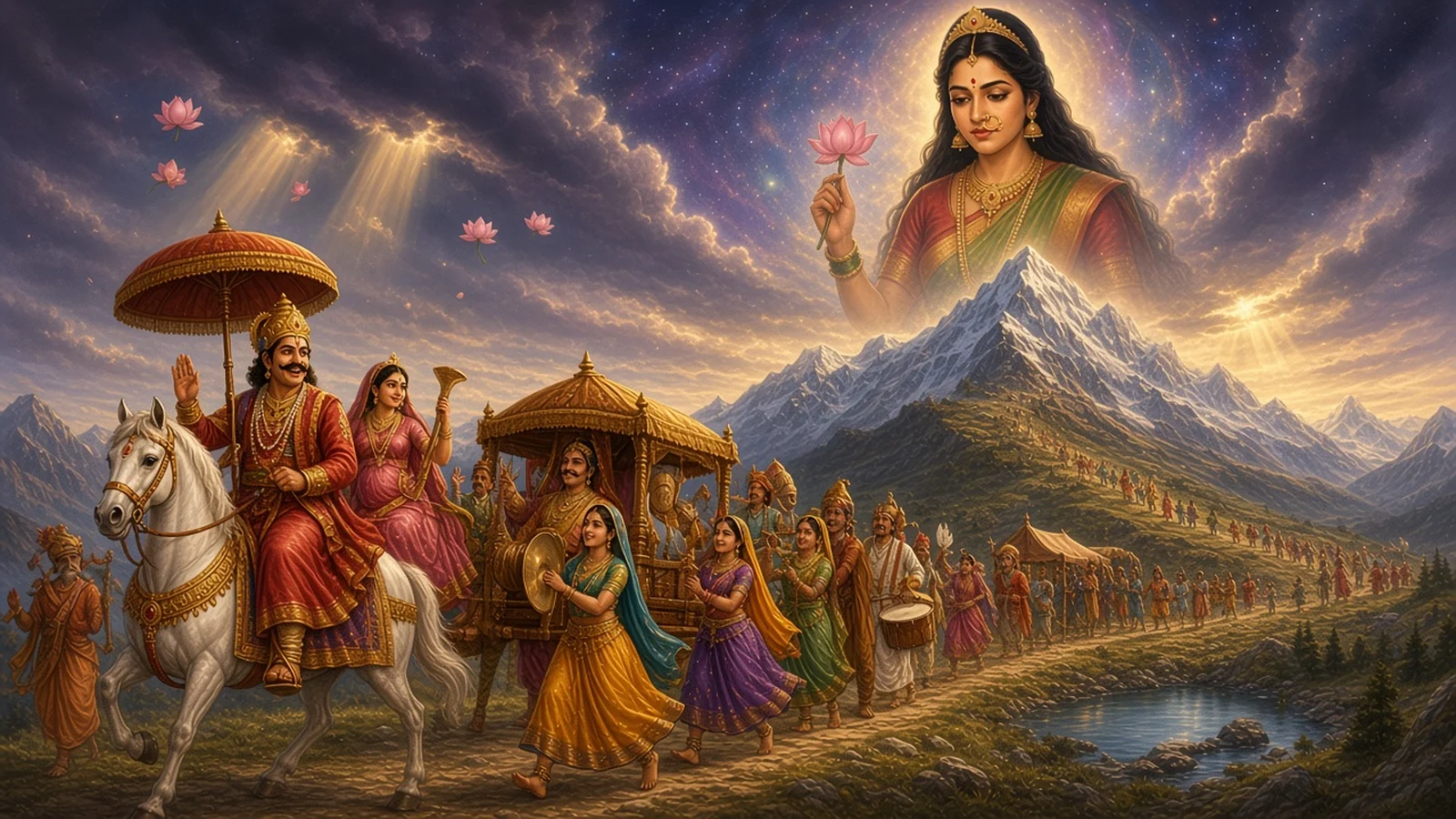
The Goddess came out of the temple at a quarter past, through Sannidhi Street and South Mada Street and Tank Street, with the drums ahead of her, and was set down in the pavilion on the steps. Then the priests bathed her. Milk, water, sandal, water again, for the best part of an hour, while the crowd pressed and sang.
"Why is she bathed out here today?" the girl asked.
"Because today she is the one being looked after," her grandmother said. "Watch."
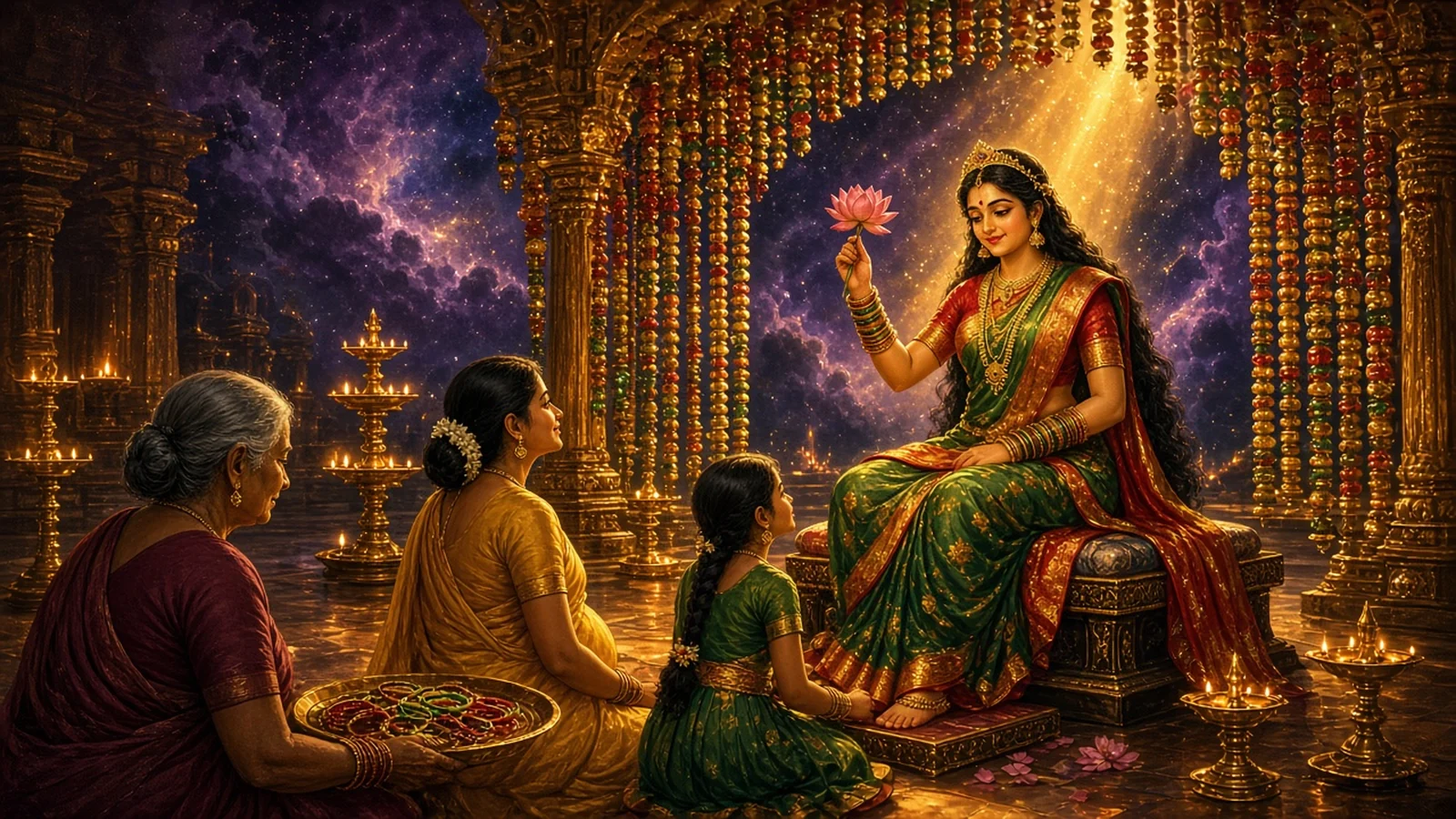
They carried Karpagambal back inside, and now she was covered in bangles. Rows of glass up both arms, and more bangles hung in curtains round the hall where she was set, hundreds of them, red and green and yellow and gold, catching the lamplight and clicking in the draught.
At home the son's wife put her feet up and the grandmother brought her buttermilk and sat beside her.
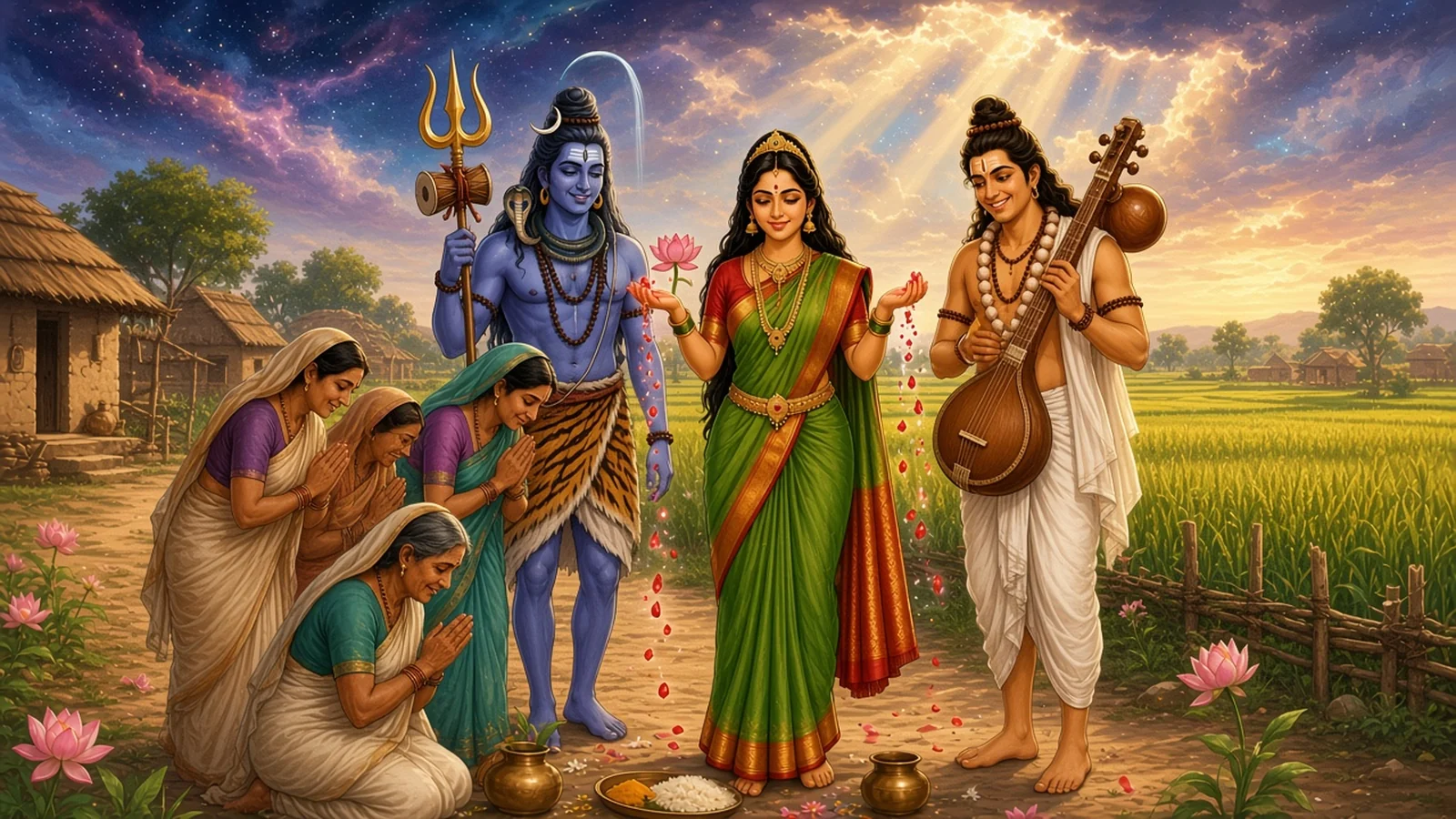
"Next month your mother will do yours," she said. "They will put the sandal and turmeric on your hands and your face to cool you, and sing, and throw the flowers, and feed you seven kinds of rice, tamarind and lemon and curd and all the rest, more than you can eat. And every woman who comes will slide bangles on your wrists, glass, red and green, always an odd number. Then you stay with your mother until the child comes."
"And the bangles are for luck?"
"The bangles are for the child. It can hear now, the elders say. From the seventh month it hears. And the first thing it should hear, all day, every time its mother lifts her hand, is that sound."
"Then why does the Goddess get one? She is not having a baby."
Her grandmother took a bangle from the paper and turned it in the light. "Aadi is her month. On the first day the sun turned south, and the gods went to sleep, the elders say, it is their night now, so there are no weddings this month and nobody moves house. But Amma does not sleep. The rains are coming. The fields are being sown. The Fridays are hers, the women cook koozh in pots at her temple door, and on the eighteenth they take rice to the river. And on her star they do for her what we will do for your aunt. The women who say it plainly say that she is carrying. The whole year is in her. Look at the paddy."
"Is that in a book?"
"It is in the women." She slid the bangle back. "There is a story they tell. A woman went into labour alone, after a festival, when everyone had gone home, and cried out till she fainted, and a midwife came out of the dark and delivered the child. When the woman saw who the midwife was, she promised her a day of bangles every year. That is a story. The bangles are what we do."
They went back at half past five. The Goddess had been rubbed with sandal paste from head to foot and seated in the valaiyal pandal, the pavilion of bangles, and the women were offering their own in the Navaratri hall, where volunteers took them two dozen at a time and passed back others that had lain at her feet.
After half past seven she went out again, in her evening dress, round the mada streets, and the family walked behind her. When they were home the grandmother opened her hand. There were three bangles in it from the temple.
She slid one onto her son's wife's wrist. "From her. Wear it until the child comes."
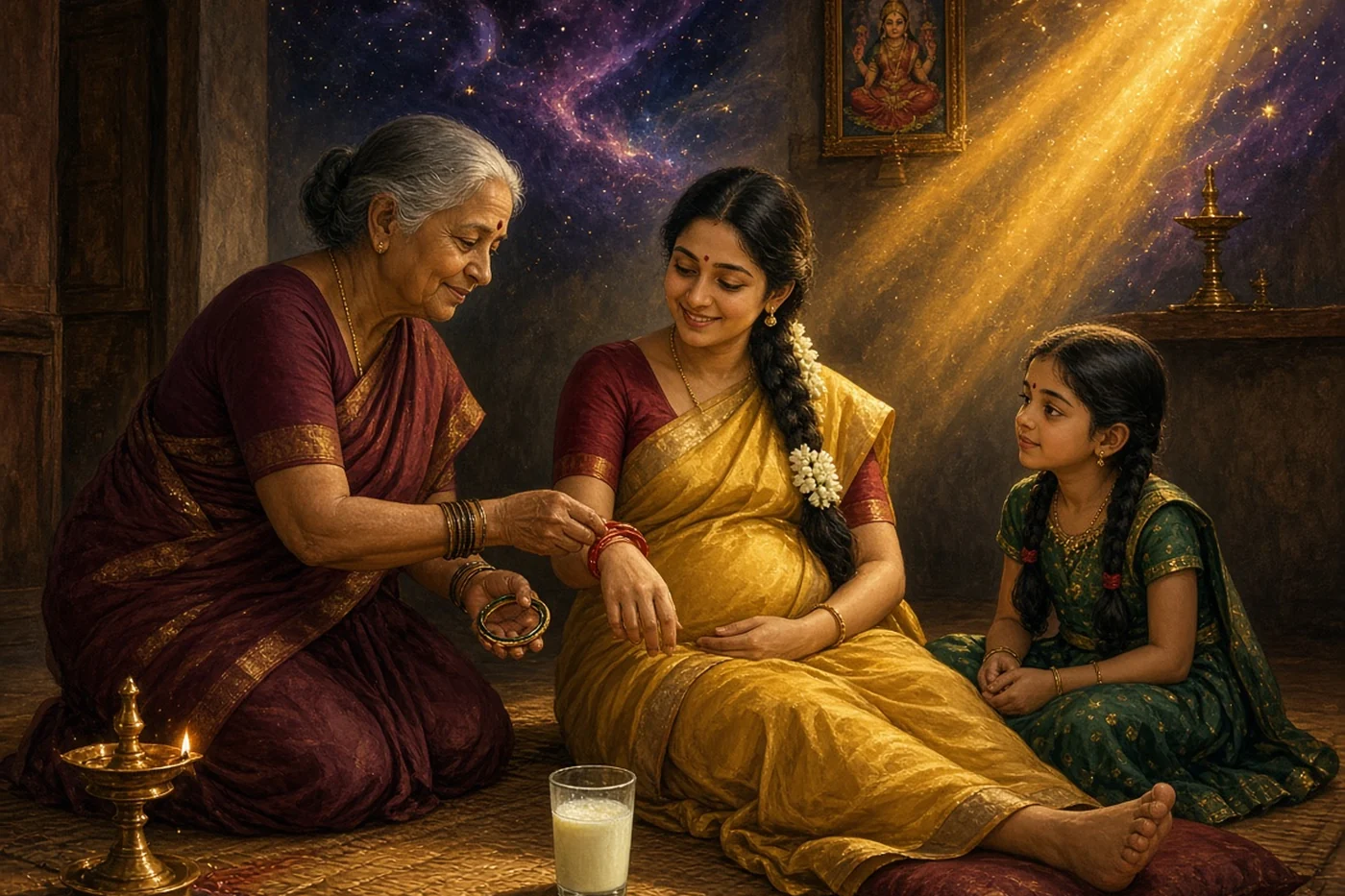
She slid one onto her own. The third she held out to the girl.
"Mine too?"
"Yours is for later," said her grandmother. "Keep it safe."
As the Kaveri country keeps the month
The Kaveri delta and Kongu Nadu · Aadi Perukku, the eighteenth of Aadi · 2 min read
Fifteen days before the Pooram star, the same prayer is taken to the river. The eighteenth of Aadi is Aadi Perukku, the day of the rising, and it is the one Tamil festival fixed by the date and not by a star or a weekday. The old poems know it; the Silappadikaram has it. By the eighteenth the monsoon has broken on the Western Ghats and the Kaveri has come up brown and fast between its banks, and a river in flood in Aadi is a promise about the harvest. The farmers sow that day.
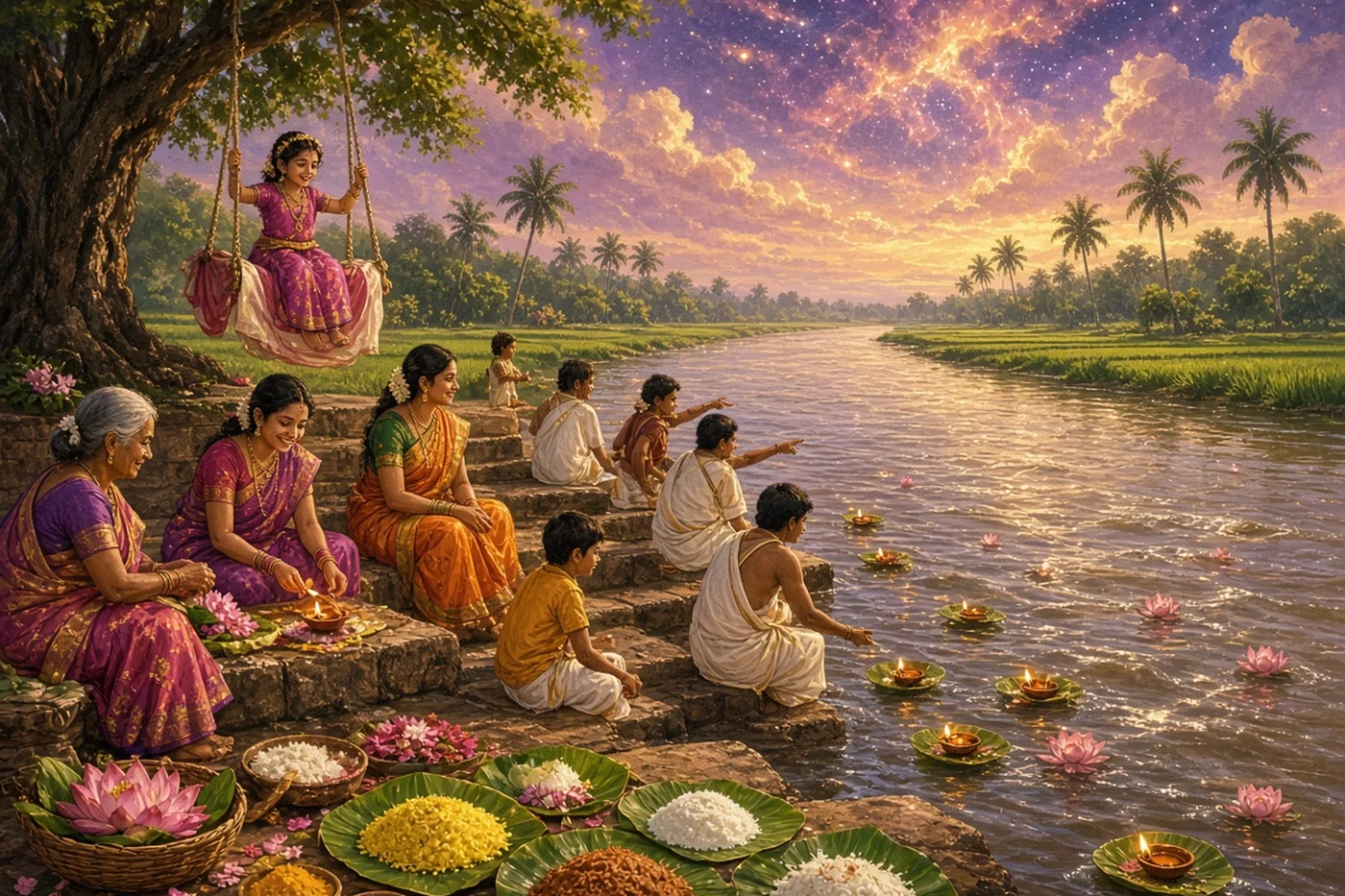
In the villages along the Kaveri the families go down to the water in the morning with their rice. Not one rice but several, lemon rice and tamarind rice and coconut rice and curd rice and sweet pongal, packed in leaves, and they eat them on the bank after they have given the river what is hers. They bathe. They float lamps on the water and set down rice and turmeric and flowers on the current for the river that feeds them, and the children watch to see how far the lamps go before they tip.
The Goddess is here too. Amman is worshipped on the bank, Mariamman in most places, and the seven maidens, the Saptha Kanniyar, who are said to grant what is asked of them on this day. A historian of the Tamil calendar has written that Aadi was the sowing month before it was anything else, and that over the centuries it became, more and more, the month of the female gods, and above all of Mariamman; the heaped offering of rice and meat and fish made to her, kumba soru, looks like the perum soru, the great rice, of the early poets.
And it is the women's day. An unmarried girl asks the river for a husband. A married woman takes the turmeric thread of her thali off, ties a new one on, and asks for her husband's long life. And the married women of the Kaveri country hold a baby shower for the Goddess herself on the bank, a valaikappu by the water, and ask her for children. Swings are hung from the trees and the ceilings, thooris, a rope or a sari knotted at both ends, and the girls swing on them till dark.
So the month gives the same prayer twice. On the eighteenth it goes to the river, which is the Goddess as water. On the Pooram star it goes to the Amman in her temple, dressed in bangles, who is the Goddess as a mother-to-be. In 2027 the river's day is 3 August and the bangle day is 5 August, two days apart; most years they are a fortnight or so apart. Either way the rice is cooked, the thread is changed, and the women come home with something on their wrists.