As the north tells it: the parting of her hair
North India · Ayodhya, and a Hanuman temple on the morning of Hanuman Jayanti · 3 min read
Before the sun was up on Hanuman Jayanti the priest was already at work with a blunt knife, peeling the old coat off the god.
It came away in orange flakes, a year of Tuesdays. Underneath, the stone was black. A boy who had come with his grandmother for the sunrise aarti watched from the step, and when the priest began to stir fresh sindoor into a bowl of oil he could not hold the question in.
"Why do you paint him?" he said. "Nobody paints Rama."
"Rama does not need it," said the priest, not looking up. "Hanuman asked for it. Sit down and I will tell you while this is mixing."
Rama had come home from Lanka. The war was over, the crown was on his head, and Hanuman, with no more wars to fight for him, stayed in the palace and looked for work. He fetched water nobody had asked for and stood at doors that needed no guarding. Mostly he watched Rama, and when he could not watch Rama he watched Sita, because she was the one Rama watched.
One morning he found her sitting before her mirror with a small box open beside her. She took a pinch of red powder from it and drew a line along the parting of her hair, from the forehead back.
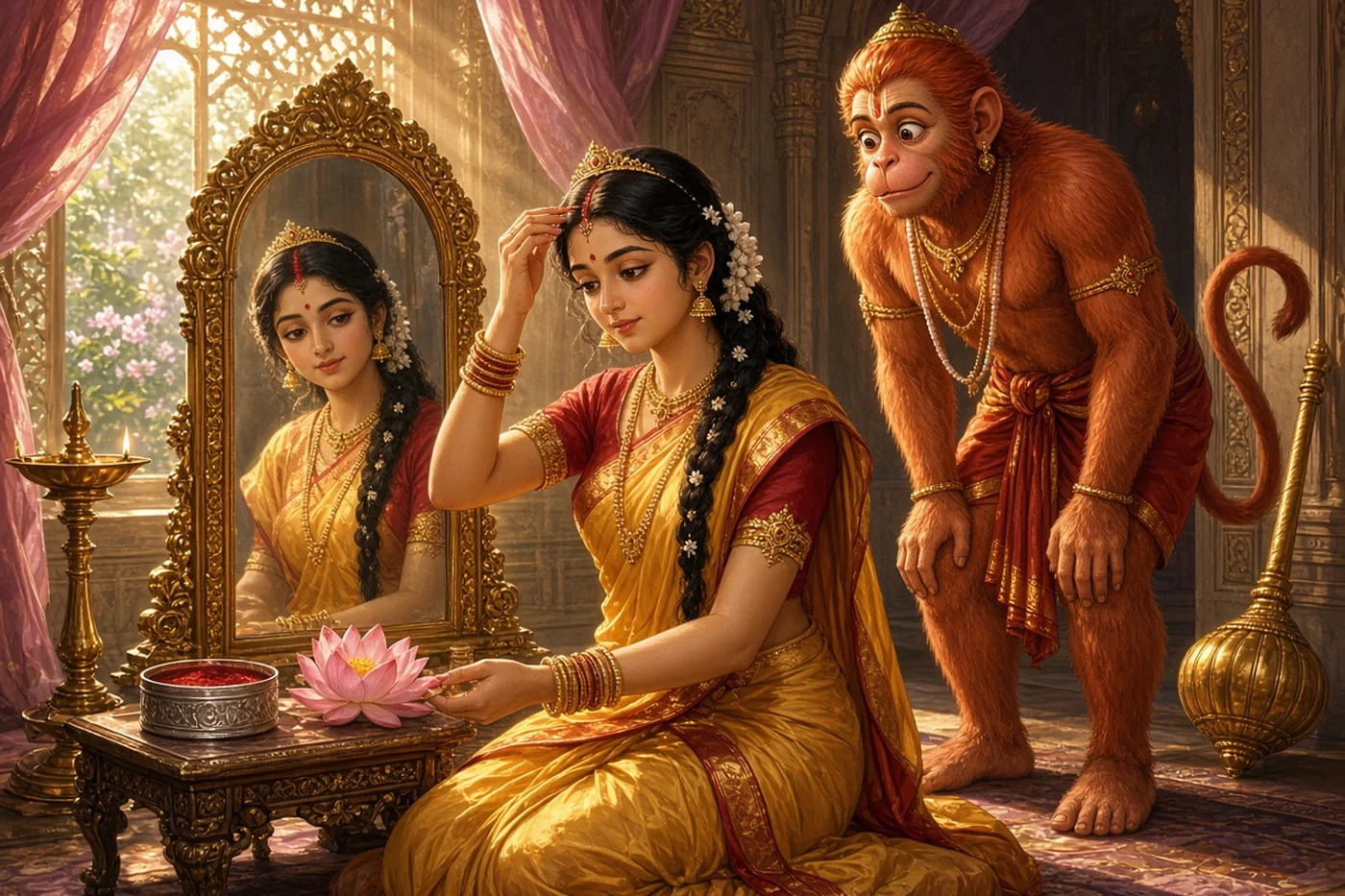
Hanuman came closer. "What is that?"
"Sindoor."
"Why do you put it there? Does it hurt?"
Sita laughed. "It does not hurt. A married woman wears it for her husband. It is a prayer that he will live long and be well. Every day I put it on, and every day I am asking for the same thing."
Hanuman looked at the thin red line and said nothing. He went out quietly, and Sita thought no more about it.
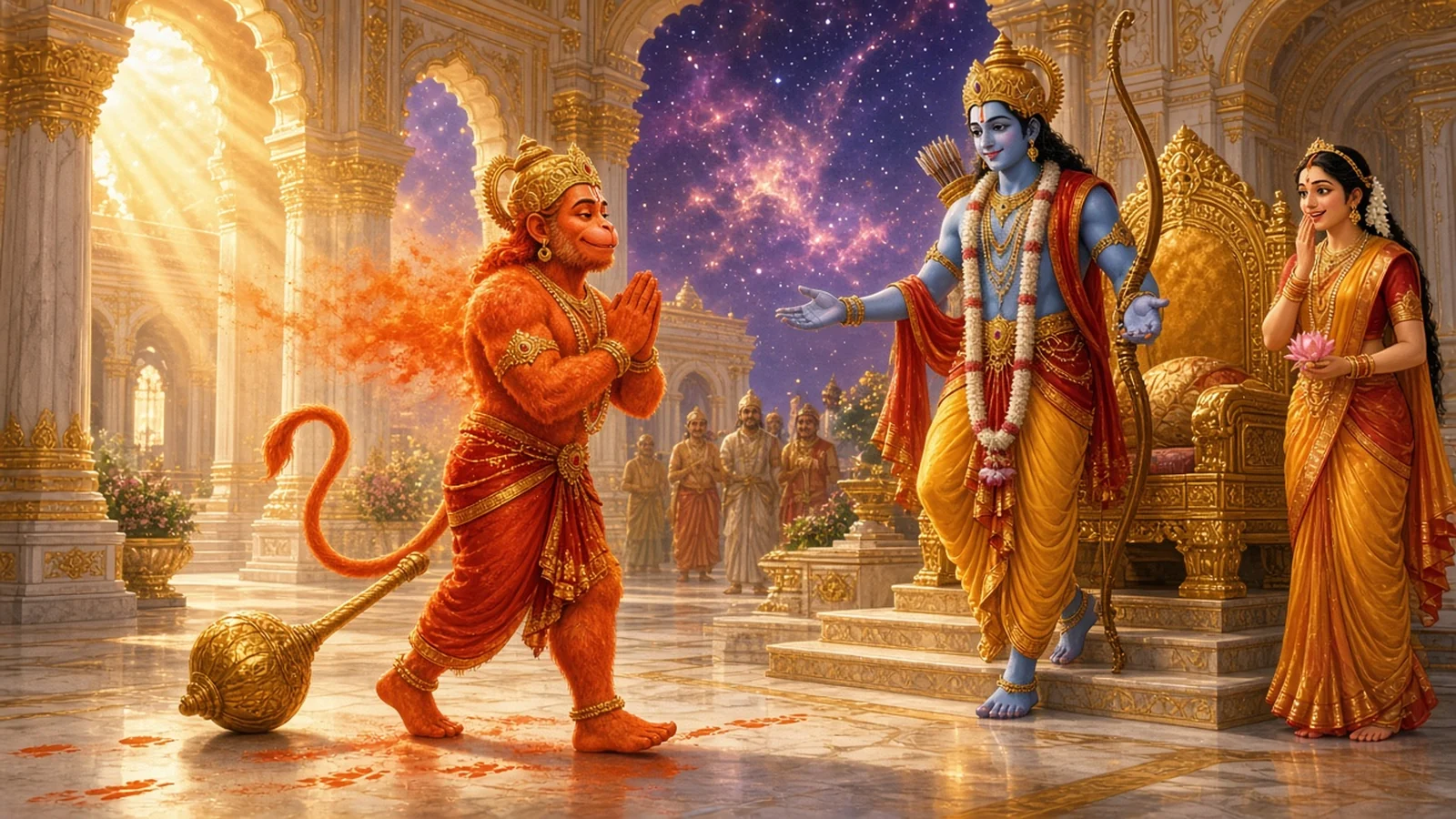
She heard the shouting an hour later. It began in the kitchens and spread through the courtyards, and when she came out the whole palace had stopped to look at one thing. Hanuman was walking towards the hall where Rama sat, and he was orange from the top of his head to the soles of his feet. His face, his ears, his tail, the fur of his arms, all of it. He had found the palace stores and emptied them over himself, and he left a red footprint on every flagstone.
The guards were laughing so hard they could not hold their spears straight. Rama stood up.
"Hanuman," he said, "what have you done?"
Hanuman folded his hands, and the sindoor fell off him in a small cloud. "Lord, I asked mother why she puts a line of this in her hair, and she said it was so that you would live long. One line, for one woman's wish, and it works. So I thought, if I put it over all of me, you will live for ever."
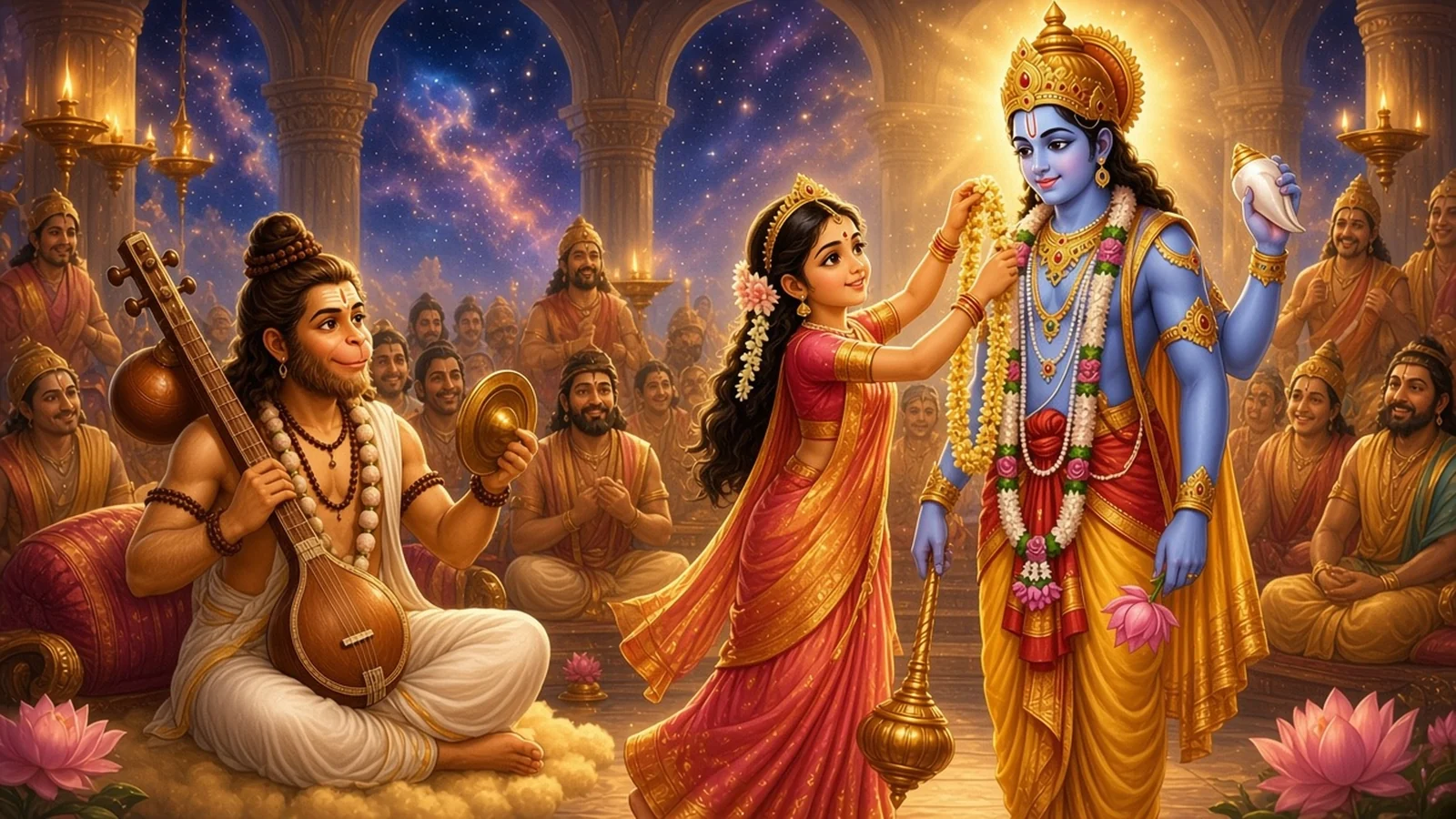
Nobody laughed after that. Rama came down the steps and put his arms round the orange monkey, and when he stepped back there was sindoor on his own chest and his own cheek, and he did not wipe it off.
"You have given me a longer life than I asked for," he said. "Now I will give you something. From today, whoever puts sindoor on you, in my name and in yours, has my favour as surely as you have it. Whatever trouble they are in, I will hear of it from you."
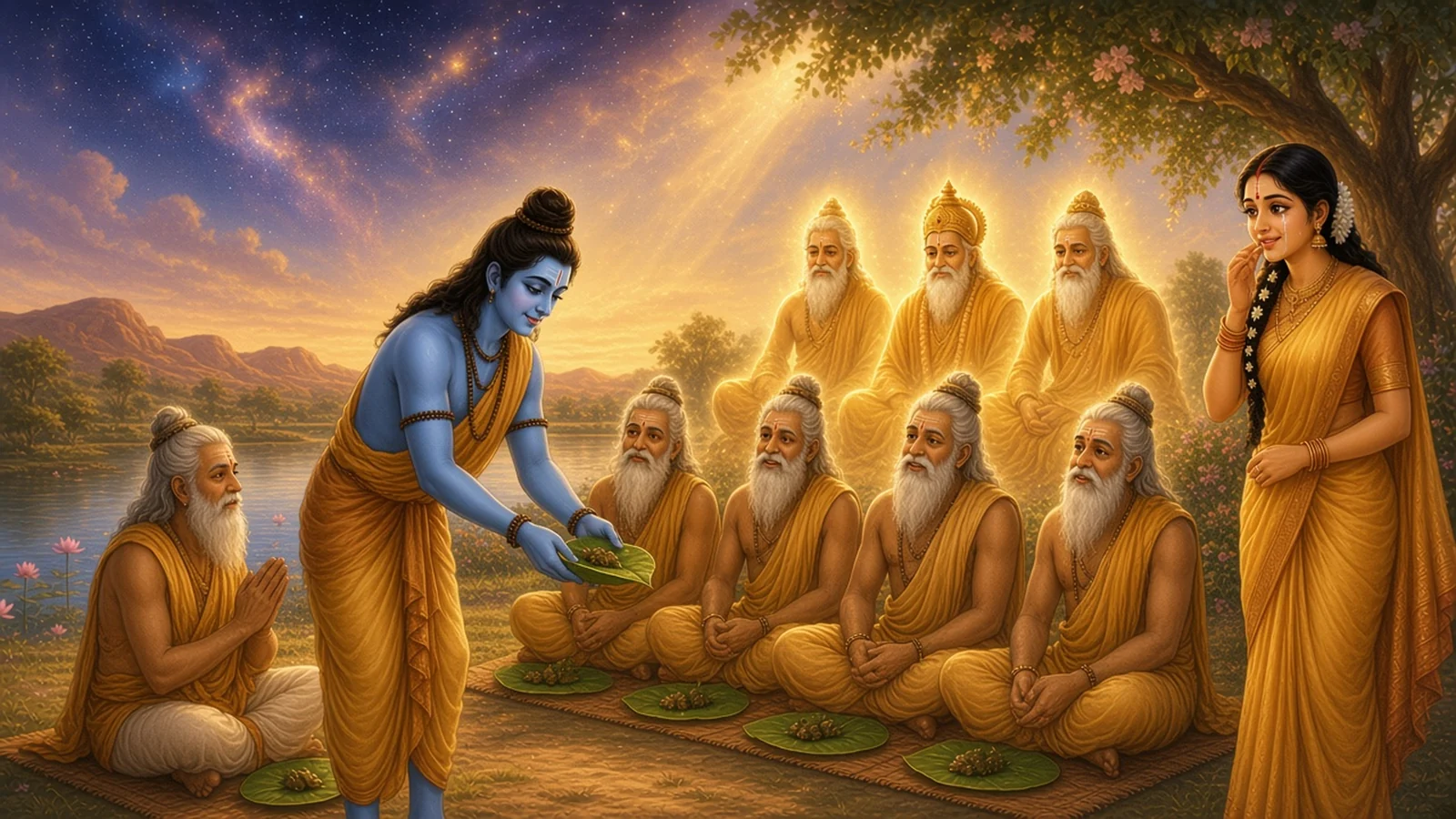
"So that is why," said the priest. He had laid the new coat on with the flat of his hand, and the god was orange again, the colour of the sun coming up over the temple wall. "That is why it goes on him on his birthday, and on Tuesdays, and why the wrestlers keep him in the corner of their pit. It is not paint. It is a wish, and the wish is for Rama, and Rama said he would hear it."
The boy looked at the god, at the priest's orange hands, and at the queue forming at the gate with trays of laddus and paper twists of sindoor.
"Can I put some on?"
"On his birthday," said the priest, "everyone can."
As another telling has it: the necklace with no name in it
North India · the pearls, the wound and the wrestlers' oil · 2 min read
Not everyone tells it with the parting of her hair. In another telling, which Joginder Narula set down from the tradition, it begins with a gift.
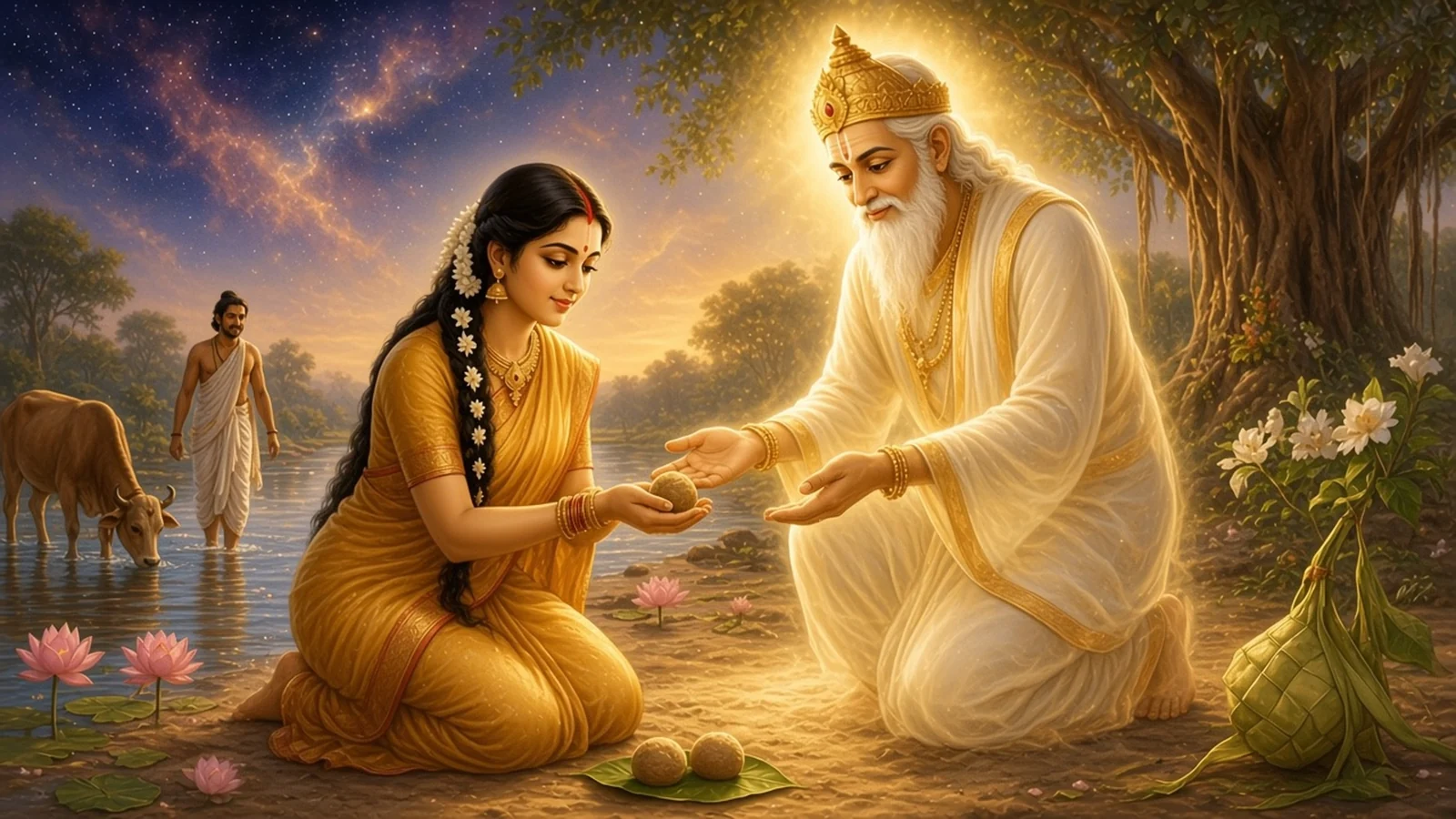
After the crowning Sita wanted to give Hanuman something of her own. She took off a string of pearls, the finest thing she had, and put it in his hands. Hanuman turned it over. He held each pearl up to the light and looked into it, and his face fell a little further with every one.
"What are you looking for?" Sita asked.
"Rama," said Hanuman. "His name. It is not in any of them." He gave the pearls back as gently as he could. "Mother, forgive me. What is a thing worth, if he is not in it?"
Sita understood him then as nobody else in the palace did. She touched the red mark on her own forehead and then touched his.
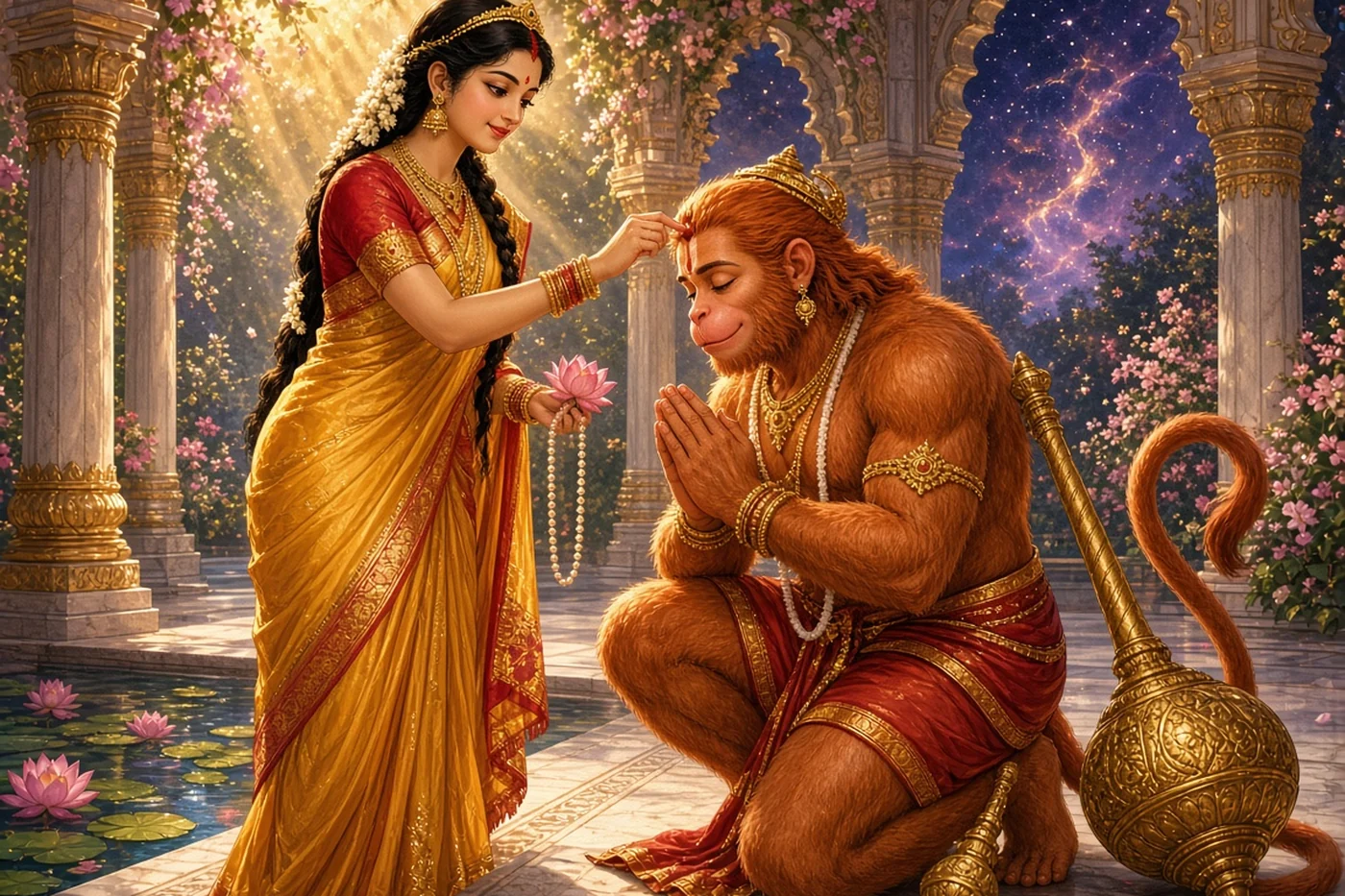
"This has his name in it," she said. "Every day I wear it I am saying his name. It is the sign of my good fortune, and my good fortune is Rama. Take this instead."
He took it the way he took everything, entirely. By evening the mark on his forehead had spread to the rest of him, and the palace had its orange monkey, and the ending is the one every telling shares: Rama's delight, and the promise that goes with the sindoor.
The villages add a reason that is not about Sita at all. In the war for Lanka, they say, Hanuman took a wound that would not close until it was rubbed with sindoor mixed with ghee, and then it healed in a night. Sindoor is still a wound medicine in the folk pharmacy of the north, and in this telling the red on his body is the healer's mark. The art historian K. C. Aryan read the smeared image that way, as the sign of a man of action, a hero's colour before it was a devotee's.
The wrestlers hold both reasons at once. In the akhara the god in the corner gets his oil and sindoor on Tuesdays and Saturdays like the god in any temple, and the pit itself is sprinkled with oil and red ochre before the bouts. For them the orange is strength, and the strength is Rama's, and the two were never different things.