As Kolhapur tells it: the dream and the Dasara morning
Kolhapur · the Kapil Tirth market and the Chhatrapati's court · 3 min read
The night they took her out of the temple there was no moon, and that was the point.
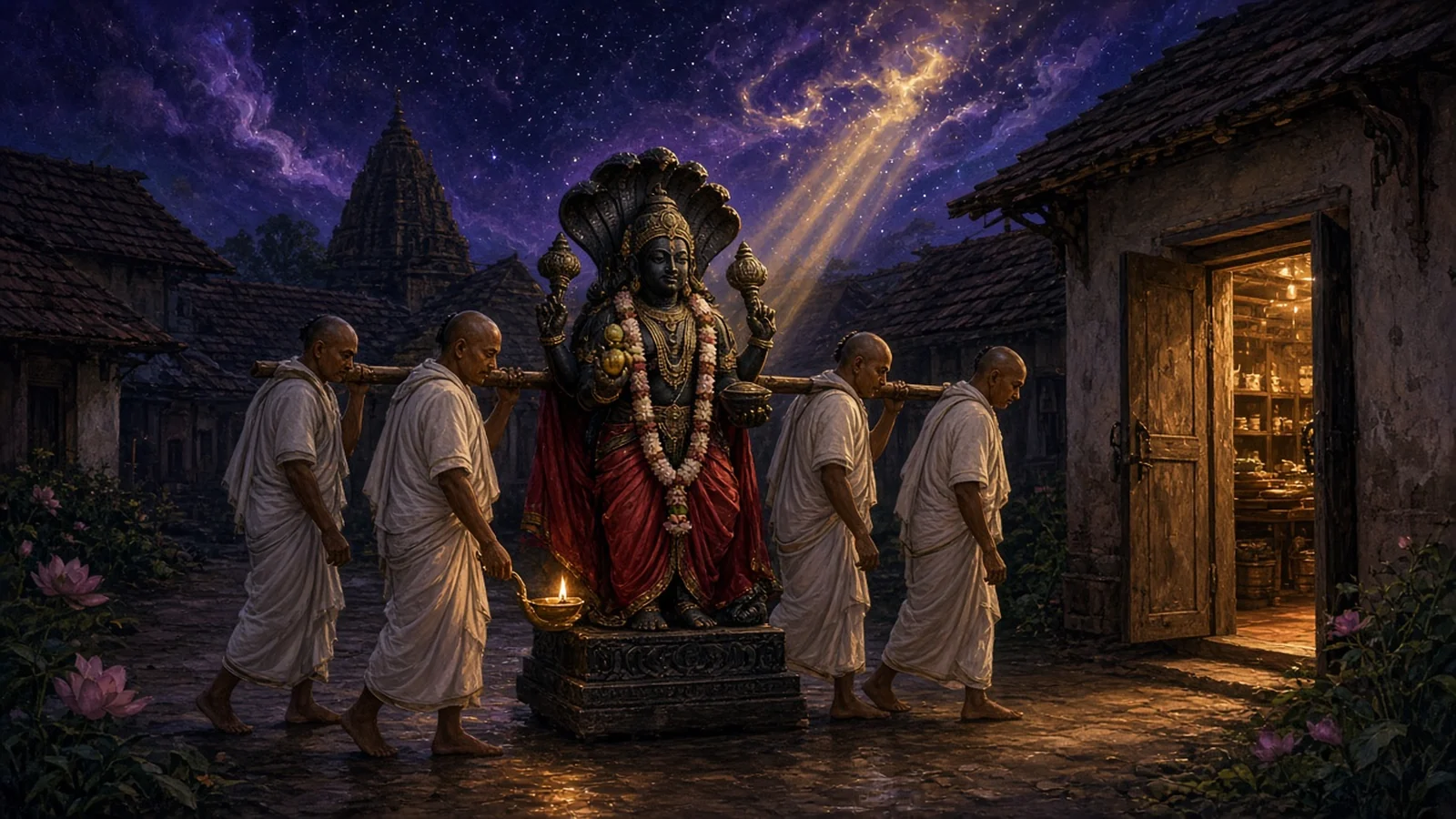
The sultans of Bijapur held the country then, and their soldiers had been through other temples. The priests of Ambabai did not wait to find out whether hers would be next. They lifted the goddess from the stone she had stood on for a thousand years, three feet of black rock, heavy as a grown man, and carried her through the dark lanes behind the temple into the market called Kapil Tirth, and into a house.
"Nobody is to know," the eldest of them told the family. "Not your neighbours. Not your daughters' husbands."
"How long?"
"Until it is safe."
It was not safe for a very long time. The house kept her in an inner room, and the family did the worship as a household does, quietly, and the children grew up and had children, and the temple on Mahadwar Road stood with nothing in its sanctum. The city did not forget her. The Maratha kings who came after the sultans wrote her name at the head of their letters, Shri Karveer Nivasini Ambabai, the lady who lives at Karavira, while the lady herself lived in a market. Shivaji's papers call her that. So do Tarabai's, who set up her own court at Kolhapur in 1710 with her small son on the throne.
In 1714 the court changed hands. Rajasbai, another of the old king Rajaram's widows, put Tarabai aside and set her own son Sambhaji on the throne instead, a boy of sixteen who would rule Kolhapur for forty-six years. It is in his reign that the city places the dream.
The dreamer was a priest, Narhar Bhat Shastri. He went to the palace with it in the morning.
"She came to me in the night," he said. "She said she has waited long enough. She said, I am in a house in Kapil Tirth, and the house knows which."
The Chhatrapati looked at him for a while. "Everybody in Kolhapur knows she was hidden," he said. "Nobody has ever said where."
"The house knows," said the priest.
So they went to the market and asked, door by door, and at one door the asking stopped. The family that had kept her for longer than anyone could count opened the inner room, and the king of Kolhapur and his priests stood in it in the lamplight and looked at a goddess who had not seen the sun in generations.
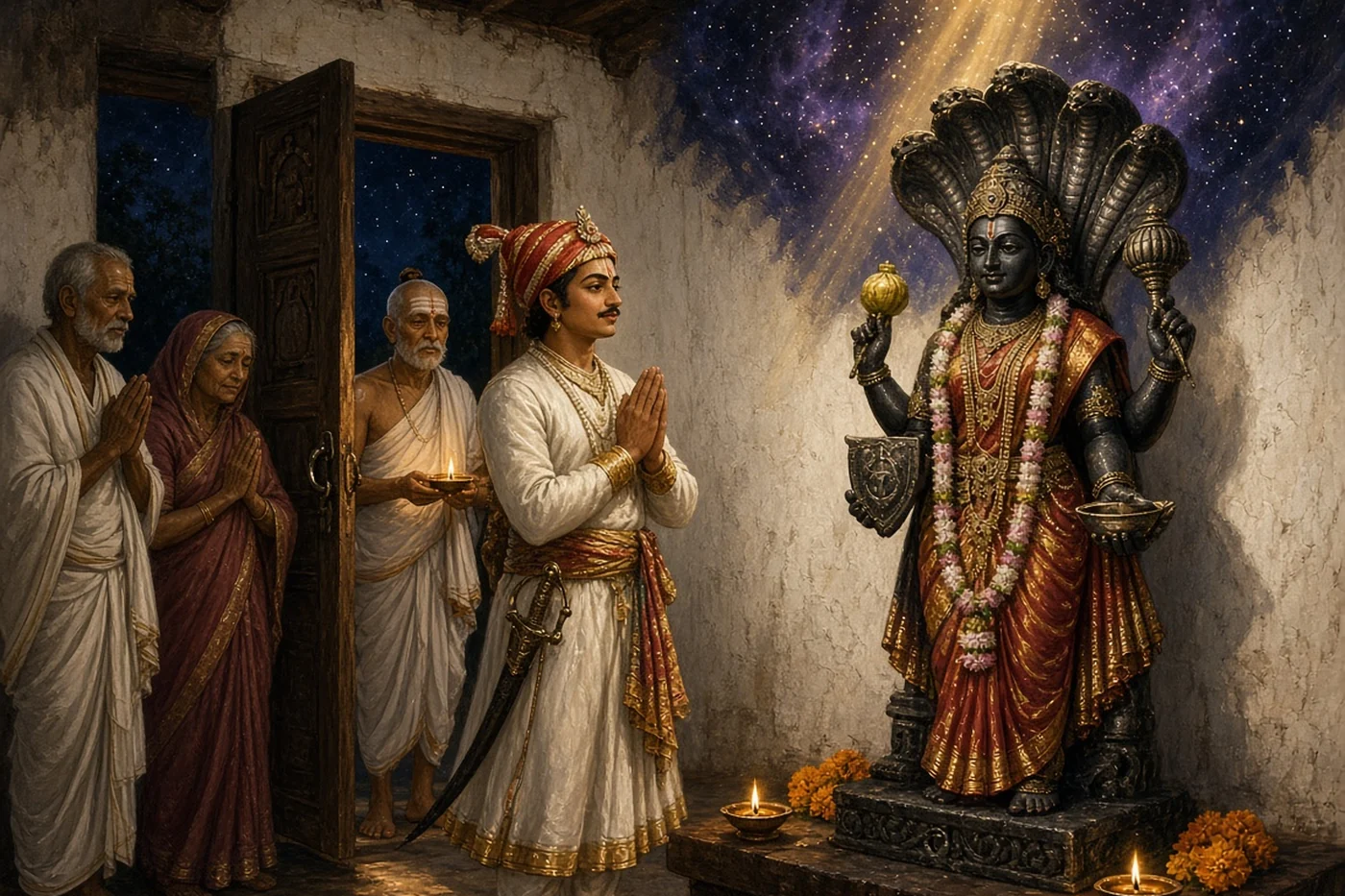
The day they chose to carry her back was Vijayadashami, the tenth day of Ashvin, the morning of victory, 26 September. The temple's own count makes the year 1715, and kept the three hundredth year in 2015. Sidhoji Hindurao Ghorpade of Panhala, one of the great men of the court, had the honour of setting her on her stone, with the Shripujaks, the hereditary priests, doing the rites. The Chhatrapati himself wrote it down in a letter, eight years later, so that nobody would have to rely on dreams again.
She has not left since. Every Dasara the city keeps the morning she came home: the palanquin goes out from the temple to Dasara Chowk and down to the Panchganga, and comes back, and the Chhatrapati's house walks with it.
As the city tells the years after
Kolhapur · from Tarabai's cannon to the plan of 2026 · 2 min read
Kolhapur tells the rest of her history as a city tells its own, by the things it can still see.
The cannon first. On Ashtami of Navratri a single gun is fired for her, and the city says Tarabai began it; a cannon from Shivaji's time, kept by the temple committee, is fired by the Jadhav family, who have held the honour for eleven generations, when the pots are set up on the first night.
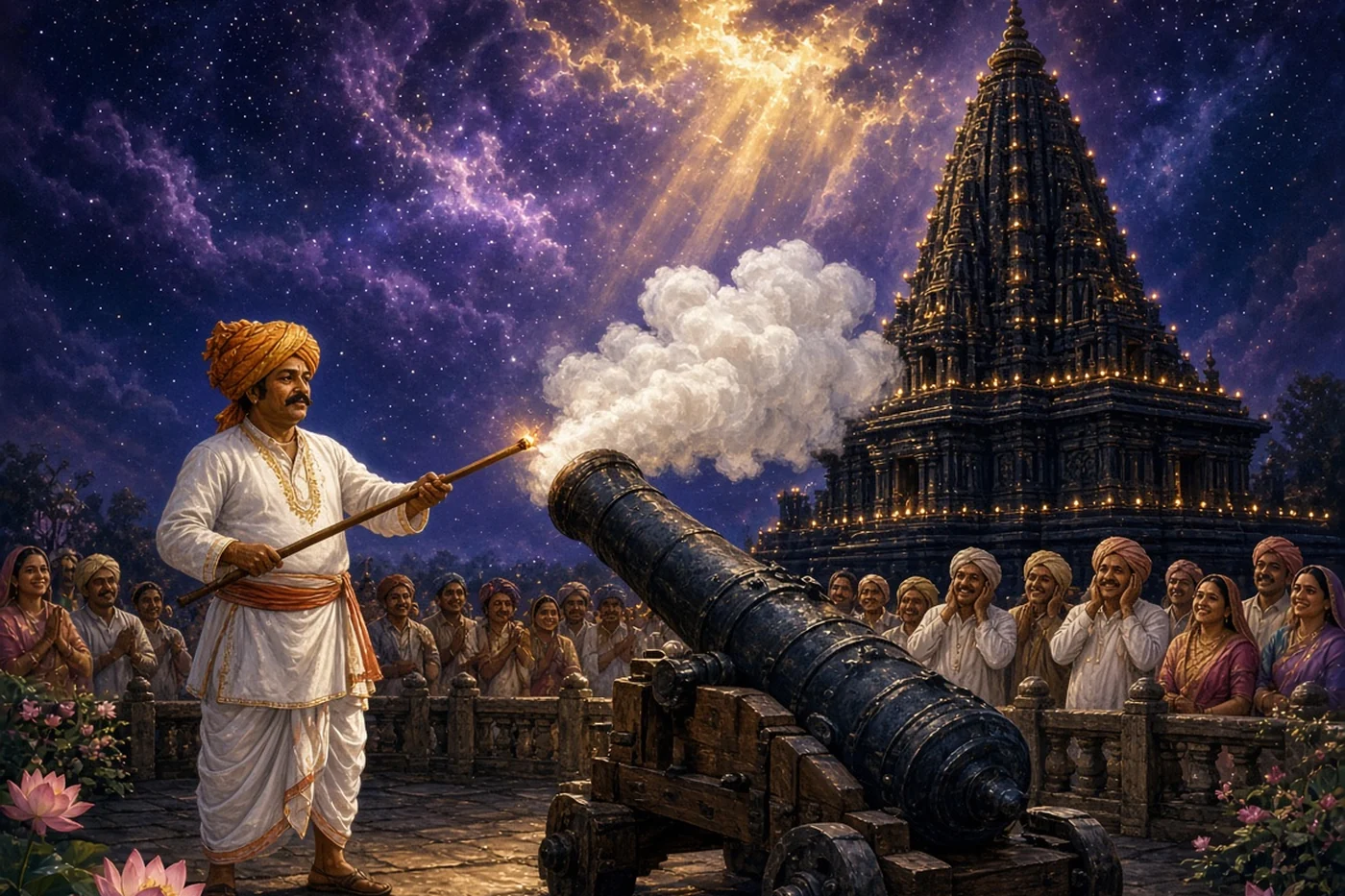
On the fifth night, Lalita Panchami, the goddess goes out in her palanquin to her sister Tryamboli on the hill east of the city, who turned her back on her after Kolhasura's war and is visited once a year to make it up, and on the way the Chhatrapati cuts a pumpkin with his sword before a young girl, for the demon. The pillared hall at the west gate was built between 1838 and 1842, when a British agent ran the state.
Then Shahu. He came to the throne in 1894 and ruled until 1922, and the city calls him Rajarshi. A Brahmin priest refused him the Vedic rites, saying a Maratha was no Kshatriya, and he answered by making a Maratha scholar his own Jagadguru. In 1902 he reserved half the state's posts for the backward castes; in 1917 he made primary schooling free and compulsory; in March 1920 he sat at Mangaon with a young lawyer named Ambedkar, called him the true leader of the oppressed, and ate with him. The temple's gates stood through all of it, and the city tells his reforms beside her.
The twentieth century was hard on the stone. Centuries of abhisheka, the daily pouring of milk and water, wore the image down, and in 1954, the city says, the Shankaracharya of Sankeshwar had it repaired with vajralep, the old diamond cement, and Shahaji of Kolhapur set it back in its place. A state committee, the Paschim Maharashtra Devasthan Samiti, came to run the temple.
In April 2016, after a court ruled that no woman could be barred from a place of worship, women walked into the sanctum, and a campaigner who went in wearing a salwar kameez instead of a sari was beaten; five of the temple's priests were charged. In 2018 the state passed an Act for this one temple, abolishing the Shripujaks' hereditary rights and their shares in the offering box and putting a management committee in their place. In 2019 the committee looked at designs for a new image, because the old one was wearing away, and the city said no, and the matter went to the archaeologists.
In June 2026 the Union Home Minister came to Kolhapur and launched a development plan for the temple worth about fourteen hundred and forty-six crore rupees, and that October the district expected twenty-five lakh people for Navratri. The goddess who spent generations in a back room in the market now has the largest building project in the city's history going on around her.