As an Odia house keeps the day
Odisha · Kumar Purnima, the full moon of Ashvin · 4 min read
The girl was up before the sun. Her grandmother had woken her in the dark, and she had bathed in cold water and put on the new sari that had been bought for this one day, and now she stood in the courtyard with her hair wet, shivering, in front of the tulsi.
Her grandmother came out behind her with the kula, the winnowing fan, heaped with what the day needed. There was khai, the puffed rice. There was a coconut, a banana, a cucumber, a betel nut, a piece of sugarcane, flowers, and a striped green janhi gourd from the creeper on the fence.
"Why the gourd?" the girl asked, as she asked every year.
"Because it is in the kula," said her grandmother. "Seven things, seven handfuls. Now face east and wait."
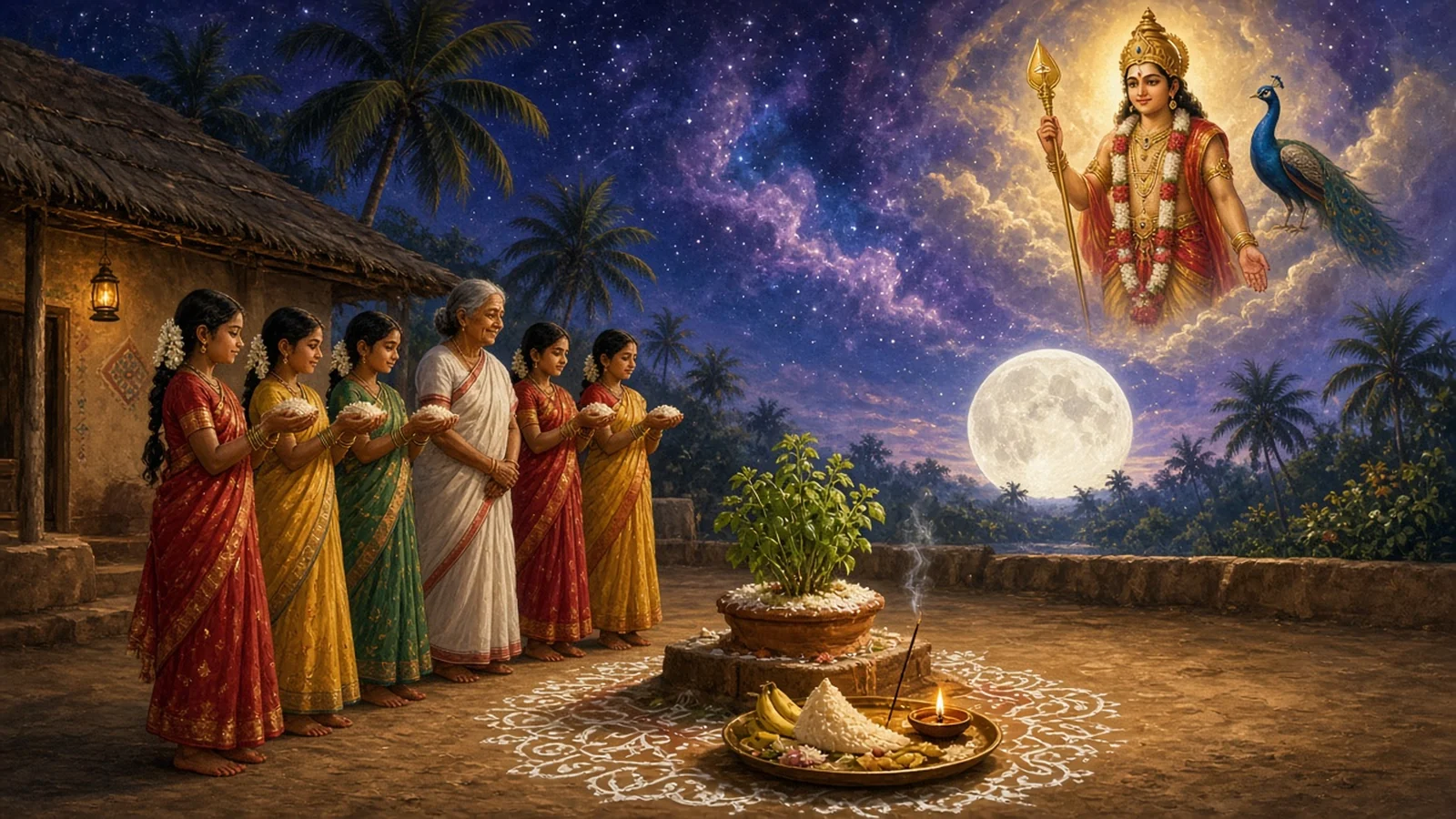
The sky over the paddy went grey, then gold, then the sun came up out of it, enormous and red after the rains, and the girl took a handful of khai from the kula and lifted it in her two cupped hands towards it and let it fall, and did it again, seven times. Anjuli, the handful. Her grandmother said the words for her, and her mother watched from the door with the little brother on her hip.
"Who am I asking?" the girl said, when the seventh handful had fallen.
"The Sun, this morning. The Moon, tonight. And through them Kumara."
"Shiva's son."
"Shiva's son, who the gods made their general when he was six days old, and who the books say won his war on this very full moon. The handsomest of them all. Every unmarried girl in Odisha is asking for a husband like him today. So was I, once. Look what I got." She laughed, and the girl's grandfather, who was awake and listening on the veranda, said nothing at all.
The day was long. The girl was not to eat until the moon came up, and the house smelt all afternoon of the pithas her mother was making for the guests, and she drew the jhoti, the white rice-paste patterns, round the foot of the tulsi, and painted her feet red with alta, and her friends came in their own new clothes and they practised the song.
Towards evening they made the chanda chakata together on a brass plate. Khai and ukhuda, the puffed rice sweetened with jaggery, banana and chhena and pieces of sugarcane, pressed into the shape of a half moon and dressed with flowers, with a lamp and incense beside it, set down by the tulsi where the moon would see it.
"Watch for it," said the grandmother. "The girl who sees the moon late gets an old husband."
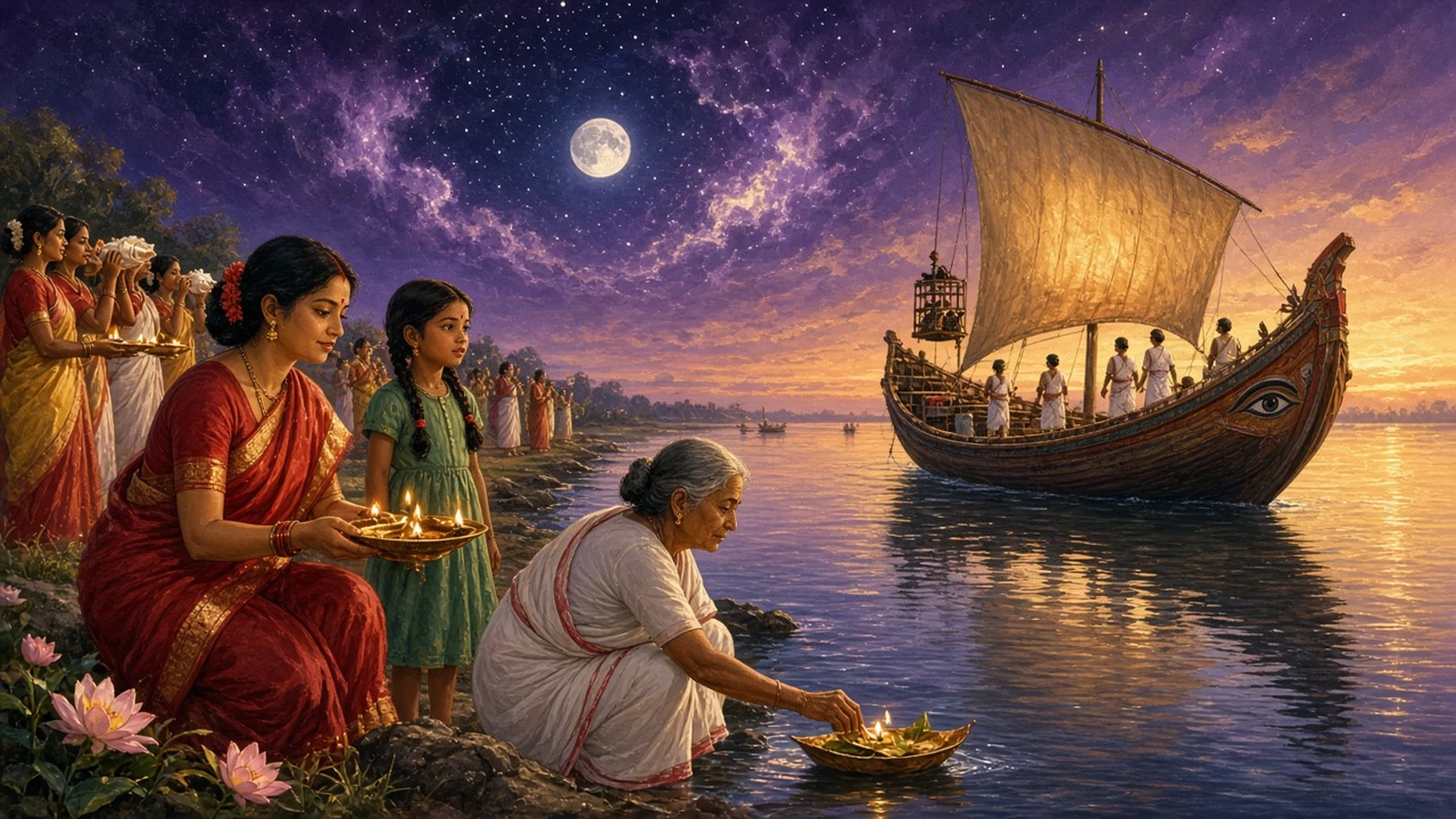
So they watched the eastern sky over the coconut palms, and when the rim came up, white as a conch, every girl in the lane saw it at once. They lifted the handful to it as they had to the sun, and sang.
"Kuanra punei janha lo, phula baula beni." The young moon of the unmarried girls, a plait of baula flowers. The song went round the courtyard twice, the women ululated, somebody blew the conch, and the fast was over. The prasad was broken up and rolled into balls and eaten.
Then the game. Puchi is played squatting, bouncing from one foot to the other with the arms folded, and the girl who keeps it up longest wins. They played it in the moonlight until they fell over laughing, and across the courtyard the men had brought out the pasa board and would throw dice half the night, because Lakshmi walks the earth tonight asking who is awake, and a sleeping house gets nothing.
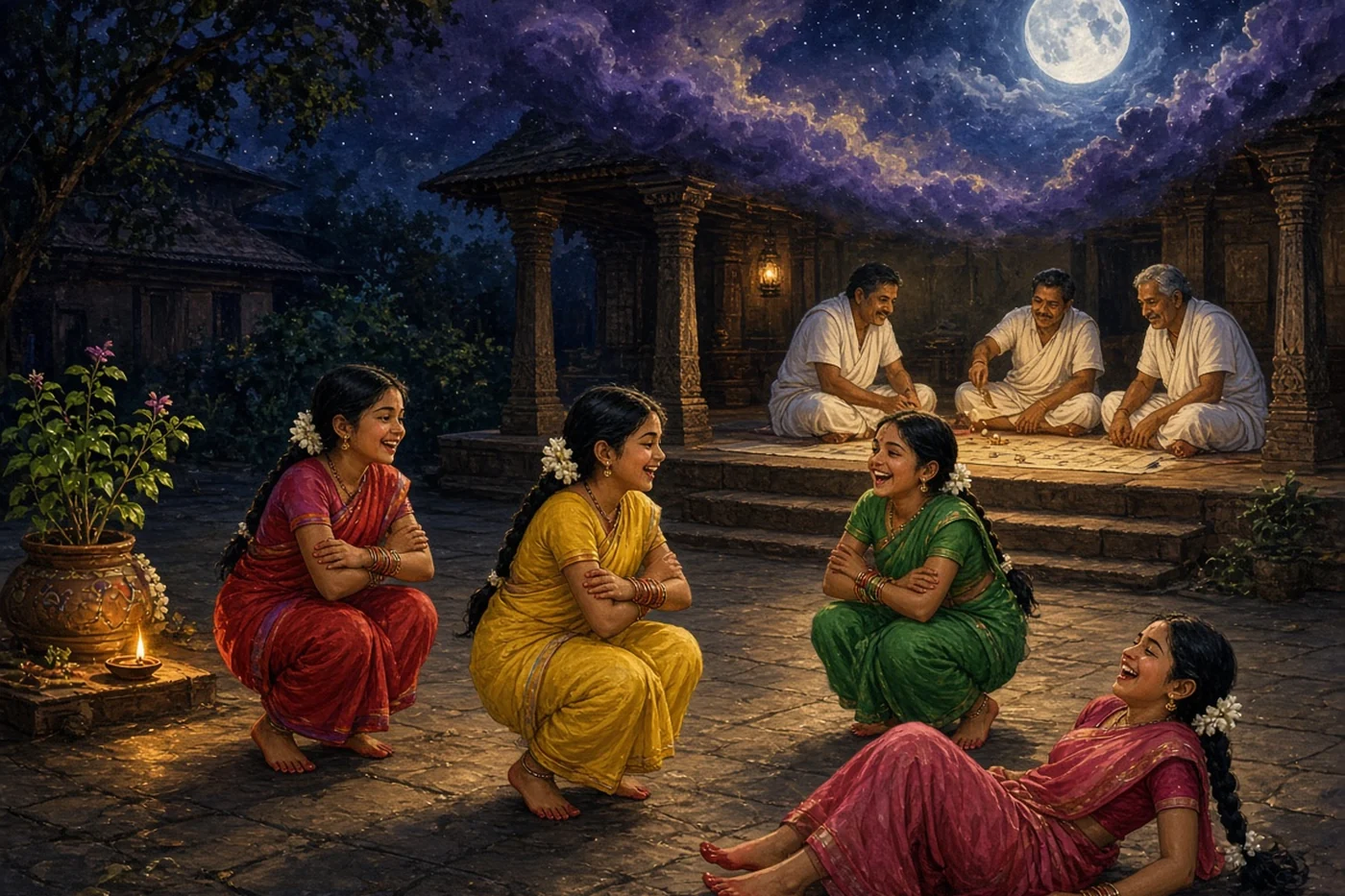
"Why is the moon so bright?" the girl asked, lying on her back in the courtyard afterwards.
"Because tonight it has all its sixteen parts," said her grandmother. "Every other night it is missing one. And what falls from a full moon is amrita. In Dhenkanal they have put up Gaja Lakshmi in forty pandals tonight, with her two elephants, and she will sit there eleven days. Tomorrow I begin the Kartika fast, and you go back to eating rice. Now sleep. He has seen you."
As the north and west keep the kheer
Uttar Pradesh and Bihar, Maharashtra and Gujarat · Sharad Purnima, Kojagiri, Sharad Poonam · 2 min read
Far from Odisha, on the same night, the moon is the whole of the festival.
In the towns and villages of Uttar Pradesh, Bihar and Madhya Pradesh the kheer is made in the evening, rice boiled slow in cow's milk with sugar and a few nuts, and after it has been offered to the house gods it is carried up to the roof or out into the courtyard and left there under the open sky, in a covered pan, in a silver vessel where there is one. Nobody touches it until morning. At dawn it is eaten as prasad and sent round to the neighbours.
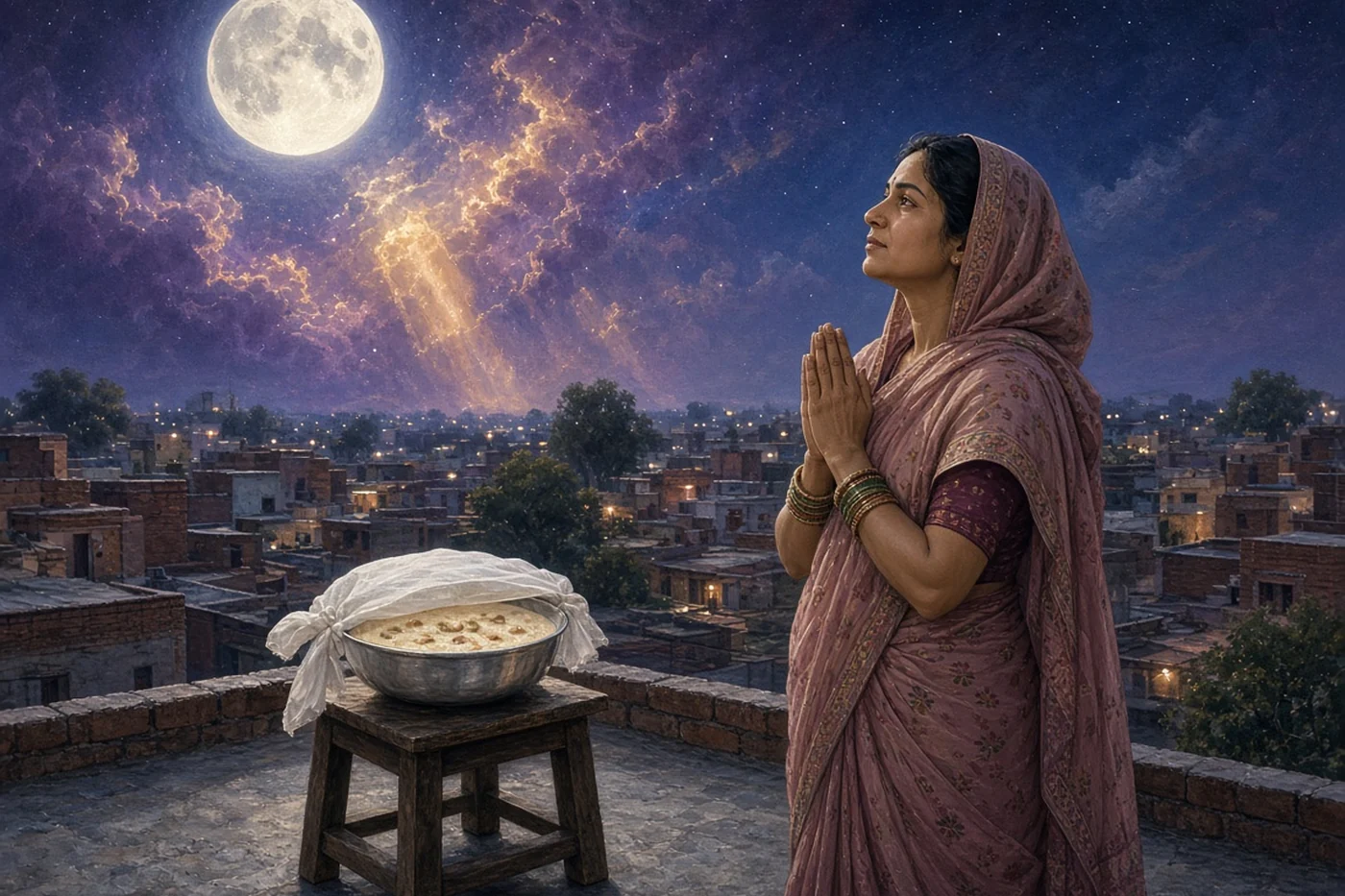
The reason is the one the Odia grandmother gave. On this one night of the year, the almanacs say, the moon is full in all sixteen of its kalas, and it stands nearer the earth than on any other full moon, and what comes down in its light is not light but amrita. Anything left out catches it. Kheer catches it best, because milk and rice are the moon's own food.
The old vaidyas read it their own way: the summer and the rains leave heat in the body, the first cool nights of autumn draw it out, and a bowl of sweet milk chilled all night in the sharad air is a tonic that cools and soothes. Some add that it eases the breath, and families with an asthma sufferer have kept the custom for that reason. The almanacs say plainly that this is tradition, not medicine.
In Maharashtra the night is Kojagiri, the night of "who is awake", and the house stays up. The milk is boiled down thick and spiced with saffron, cardamom, nutmeg and crushed nuts, masala doodh, and set out in the moonlight in a wide vessel until it has taken the moon's reflection, and then it is drunk, warm, by everyone sitting out on the terrace. The eldest child of the house is honoured that night, a lamp waved before the first born, new clothes, a sweet. In some houses, the tourism board records, people do not look up at the moon at all but down at its face in a pot of boiling milk.
In Gujarat it is Sharad Poonam, and the last night of the garba season. Milk and rice flakes, doodh-pauva, are offered to the moon and then eaten cold, and in the towns and villages people dance raas and garba in the open under it until late, because this is the night Krishna danced with the women of Vraja by the Yamuna, and Gujarat dances it back to him.
The night ends the same way everywhere. The pan comes down from the roof, the milk is cold and sweet and tastes faintly of the sky, and the month of Kartika has begun.