As Bhaderwah tells it
Jammu · Bhaderwah, Gatha and the climb to Kailash Kund · 3 min read
Garuda and Vasuki were both sons of the sage Kashyapa, by different mothers, and Garuda, the eater of serpents, wanted Vasuki dead. He came and called him out to fight.
Vasuki would not fight. The people of Bhaderwah say there was a promise Garuda had made to his mother Vinata, and Vasuki would not be the cause of its breaking. So he turned and ran into the hills, and Garuda came after him.
When night came he rested at Hainya, which is why the pilgrims still sleep there on the first night. In the morning he went on.
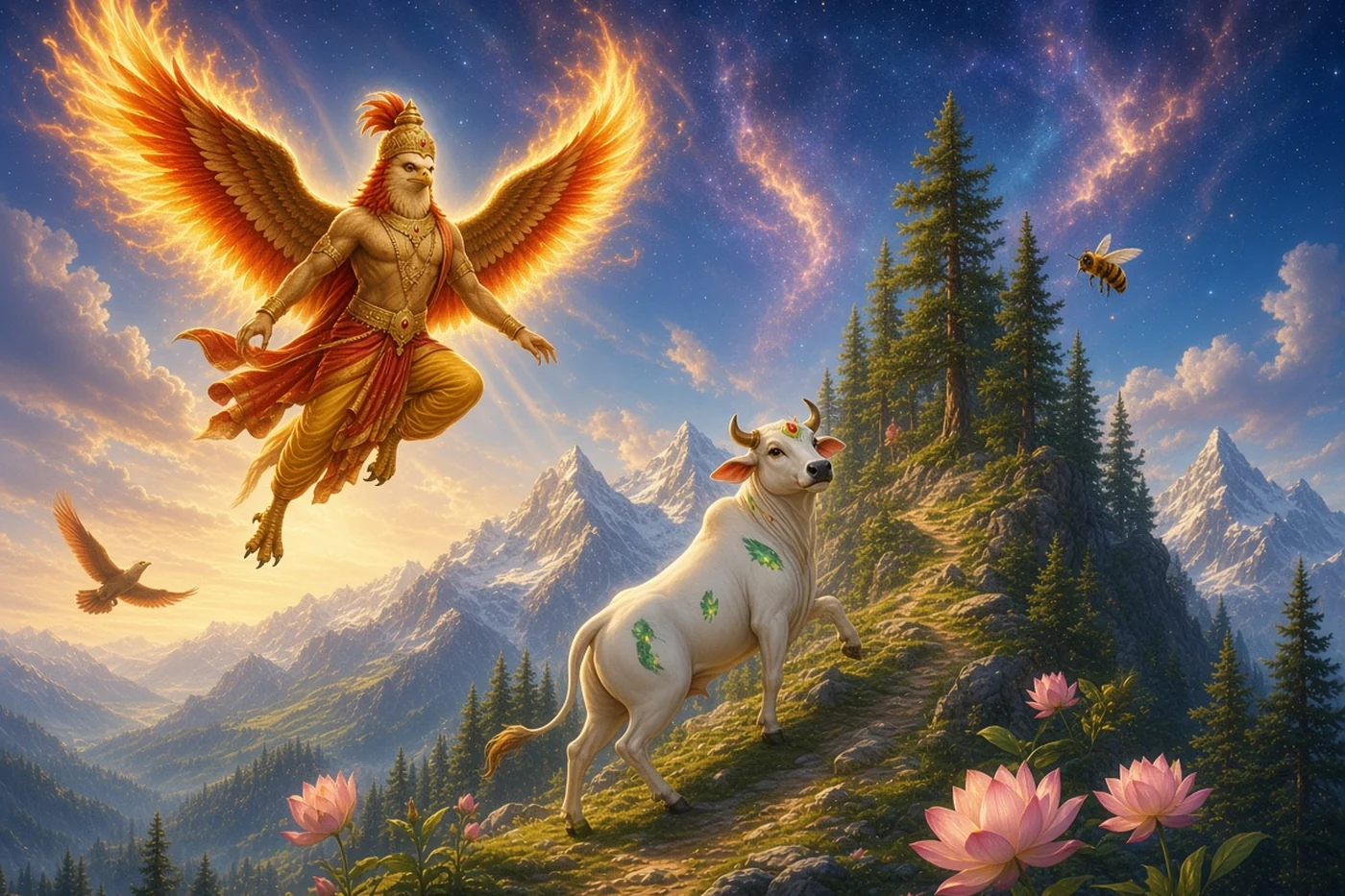
At a steep strip of rock he became a cow and went up it on four hooves, and that strip of stone is still called Gow Paeda, the cow's step. Higher up, where the trees end, he made himself smaller still and flew on as a honeybee, a gan, and the place is Gan Thuck.
By now he was worn out. Two young goddesses were gathering flowers and herbs on the slope, and they laughed to see the king of the serpents stumbling.
"Look at him," they said. "Running from a bird!"
Vasuki was too tired for patience. "Then stand there and laugh for ever," he said, and they turned to stone. The two stones are still on the path, and the pilgrims call them the Shagereene, the herb-gatherers.
He was thirsty, and there was no water. He threw down his conch, and water came up out of the ground where it struck, and that place is Shankh Padhar. He was hungry, and he ate the green grass by the path, and it turned sweet in his mouth. Pilgrims pick that grass today and carry it home as a blessing.
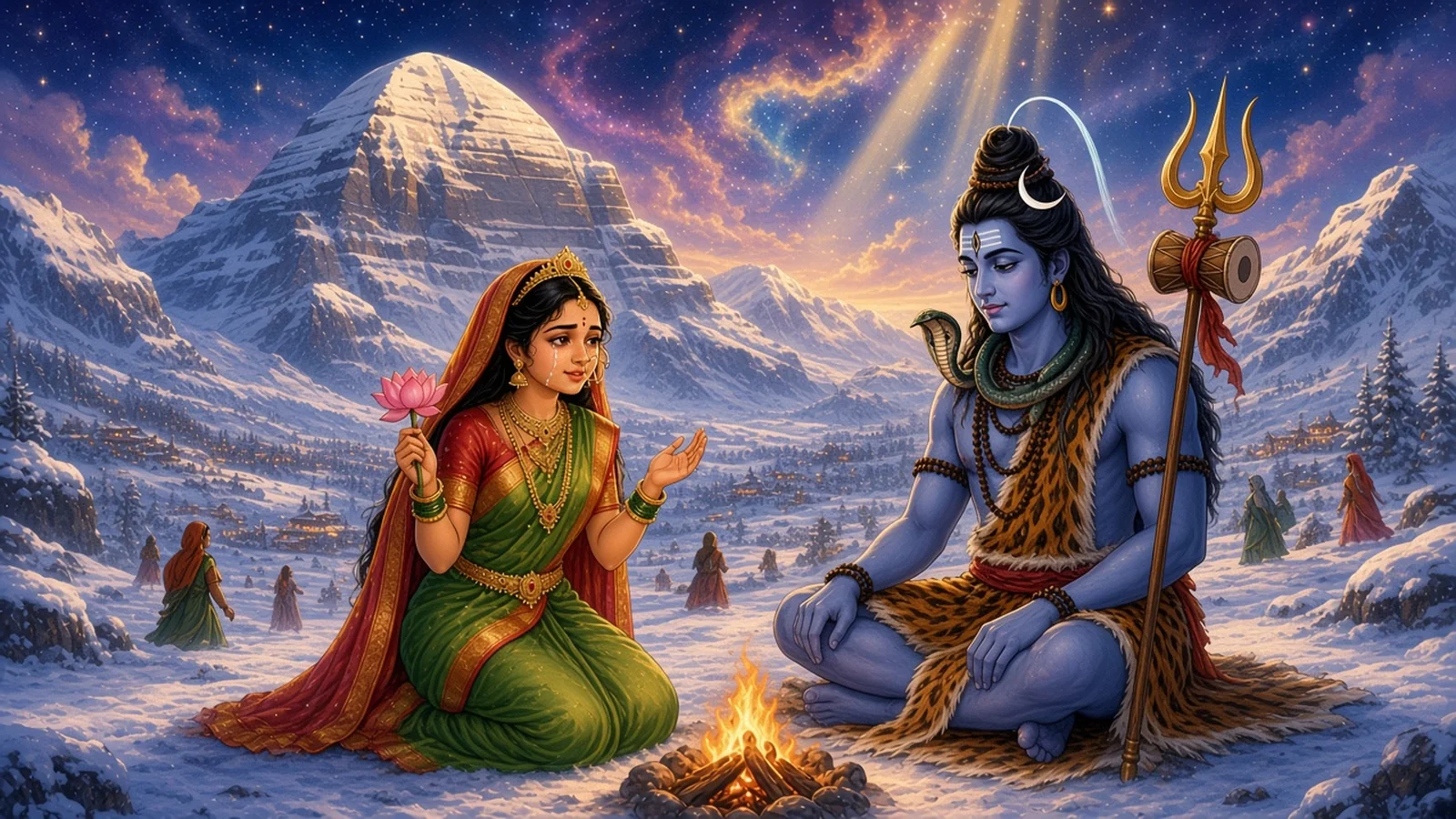
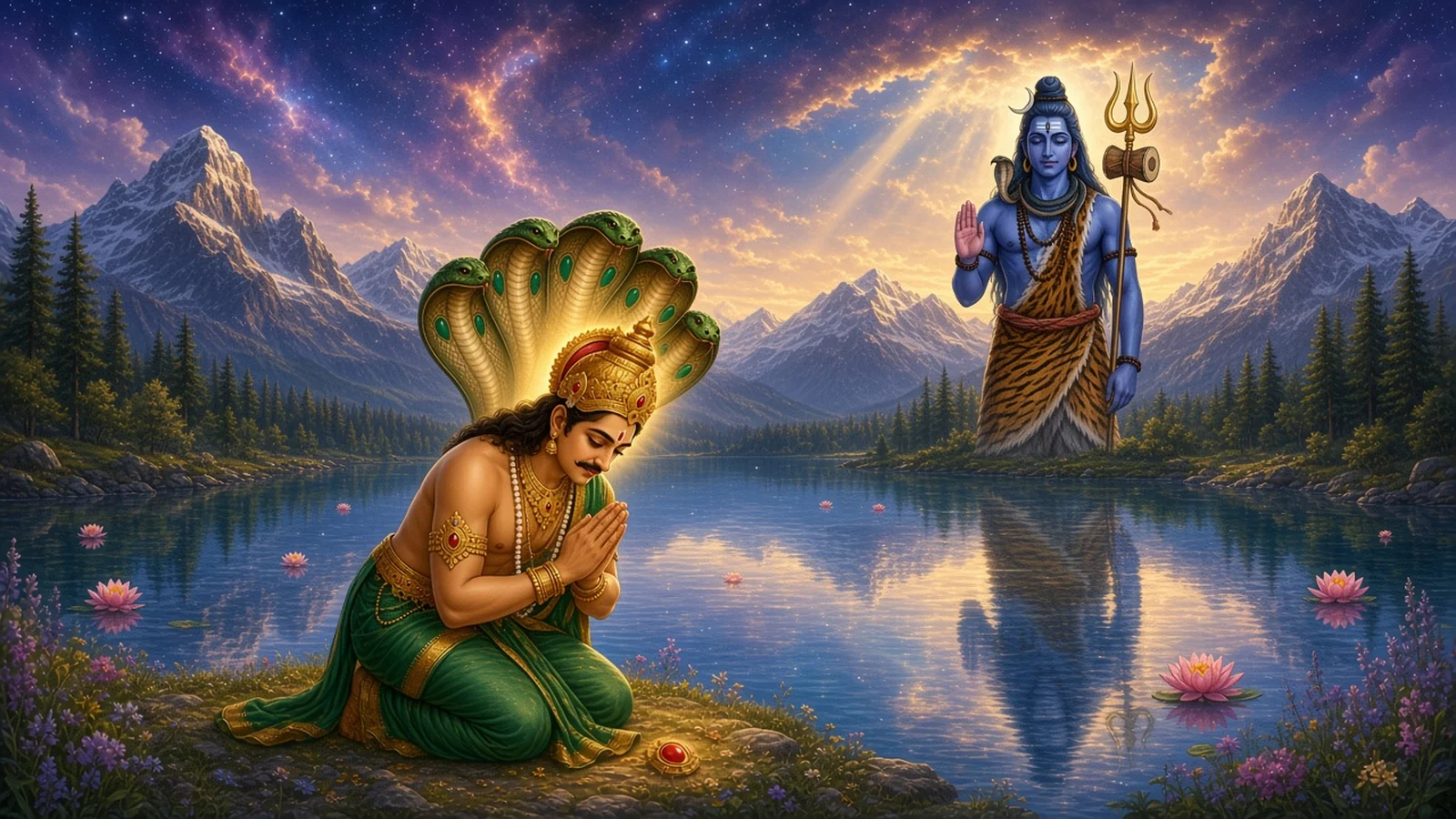
At last he came over the ridge to a lake lying cold and clear among the snow peaks. Shiva lived there, with all his family. Vasuki bowed before him and prayed.
"Lord, I have nowhere left to go," he said. "Garuda is behind me."
Shiva was pleased with him. "You are safe here," he said. "Stay."
And he gave the lake to Vasuki, and went away across the mountains to live at Manimahesh. The lake is Kailash Kund, and it has been Vasuki's ever since.
The people of Bhaderwah say a king, Jimut Vahan, also met Vasuki in those days and promised to guard him for as long as there was breath in his body. In the Vasuki Nag temple at Bhaderwah the two stand together in a single black stone.
Every year, in the month of Bhadon, the town keeps the flight. The holy mace sets out from the Vasuki Nag temple at Gatha with drums and flutes, and other villages' maces join it on the road. The pilgrims halt at Hainya, climb Gow Paeda, rest at Gan Thuck and pass Shankh Padhar, the way Vasuki went. On the last day they stand at the edge of the lake, more than fourteen thousand feet up, bathe in water that has come off the glaciers, and pray to the lake, to Shiva and to Vasuki.
"As many pebbles," they say, "so many Shivas." But the lake belongs to the serpent.
As Kukke Subramanya tells it
Karnataka · Kukke Subramanya on the Kumaradhara · 1 min read
At the other end of India, in the forested hills of the Western Ghats, the same flight ends somewhere else.
The temple tradition at Kukke says that Subrahmanya, Shiva's son, fought the demon Taraka on the hill called Kumara Parvata and killed him. Then he came down and washed his spear in the river at the foot of the hill, the Kumaradhara, Kumara's stream, and its water has been holy ever since. Here too he married Devasena, Indra's daughter, and the gods came to bless the place.
Garuda was hunting serpents in those days, and he was after Vasuki, the king of them all. Vasuki fled to this hill. He went into a cave at its foot, which the temple calls Biladwara, the door in the earth, and there he sat and did penance, and asked for shelter.
Subrahmanya came to him. He took Vasuki under his protection, and promised to stay in that place for ever, to guard the serpents and anyone who came to him in trouble with them.
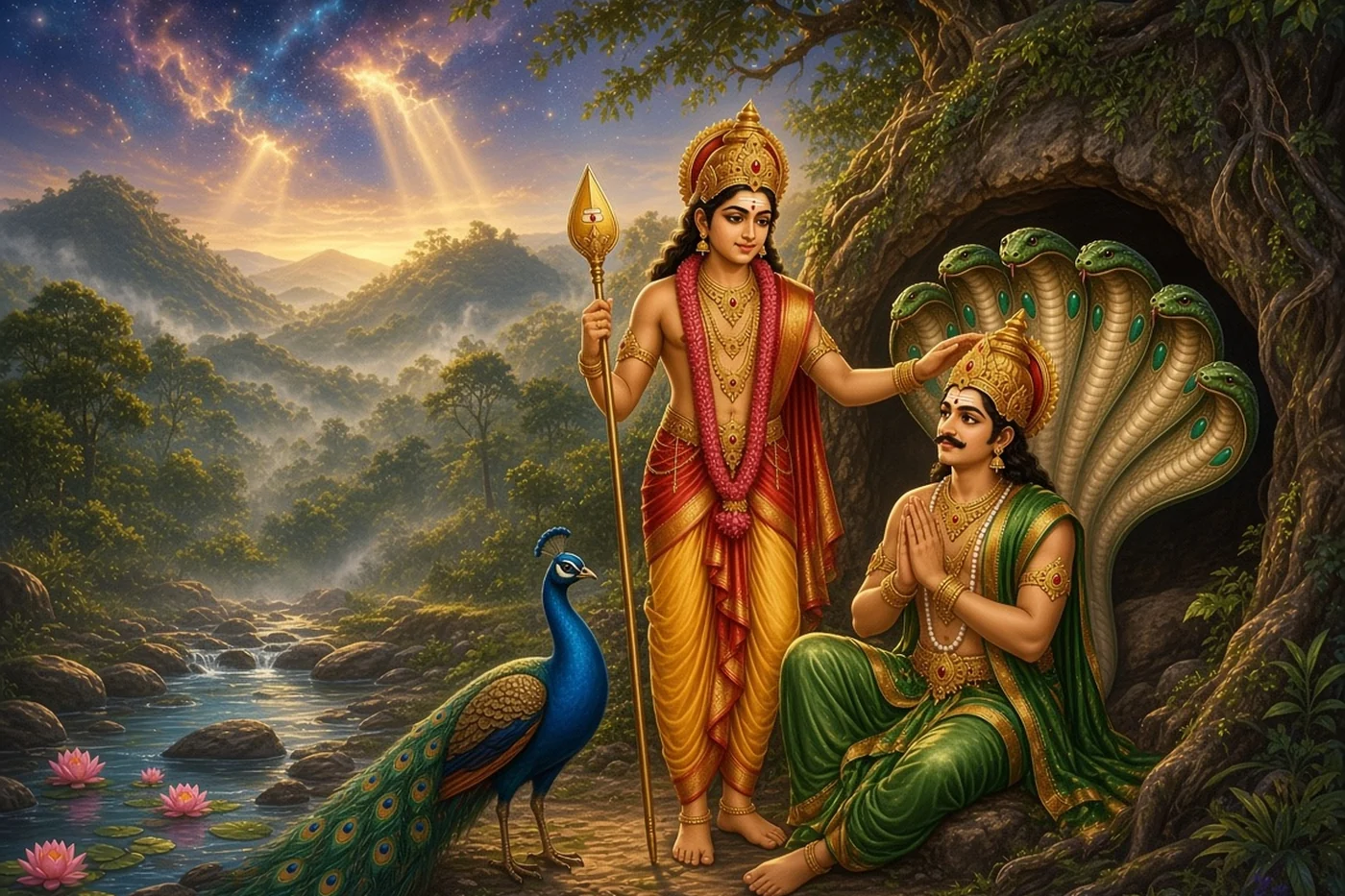
So at Kukke the god is worshipped as Shanmukha, the six-faced, with a seven-hooded serpent beside him for Vasuki, and in the ritual the god himself is honoured as a snake. Devotees say Vasuki and Shesha are still sitting in the cave. People come from all over the south for the rites that lift a curse of the serpents, and at the temple's entrance even Garuda, the old enemy, has a pillar of his own.