As a sadhaba house might have kept it
East India · a merchant family's house near a river port of old Kalinga · 3 min read
All through Kartika there was a ship in Sumitra's yard. She had drawn it in rice paste on the swept earth the first morning of the month, with its hull and its square sail, and every morning since she had laid things on it as cargo: a measure of rice, a comb, a twist of betel, a brass cup. Every evening she lit a lamp inside a pierced clay pot and her son hauled it up a tall bamboo pole until it hung over the roof.
"Why is it called the farewell lamp?" asked Kuni, who was eight.
"Because it burns for the ones who are going," said her grandmother. "All month. Then they go."
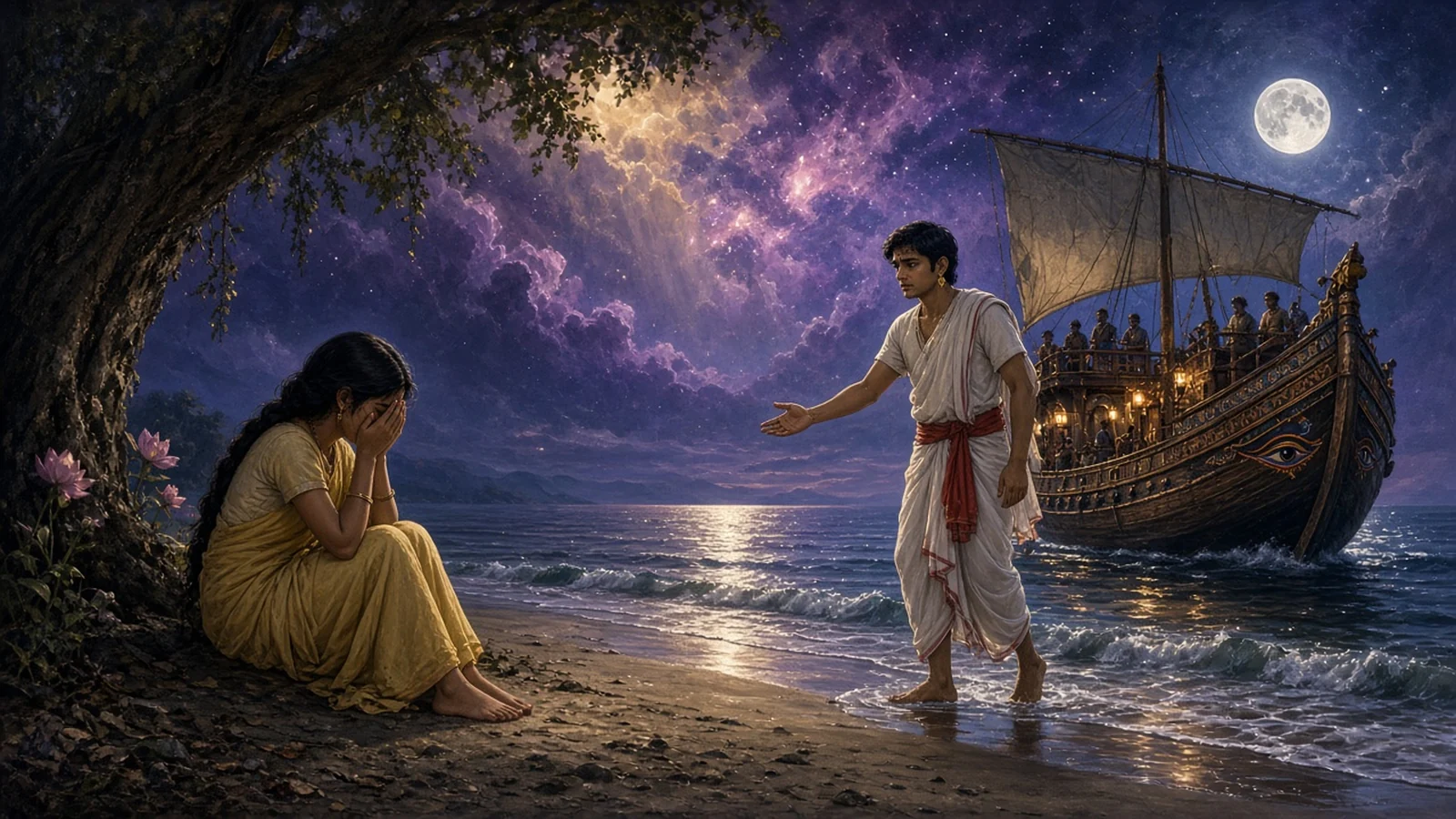
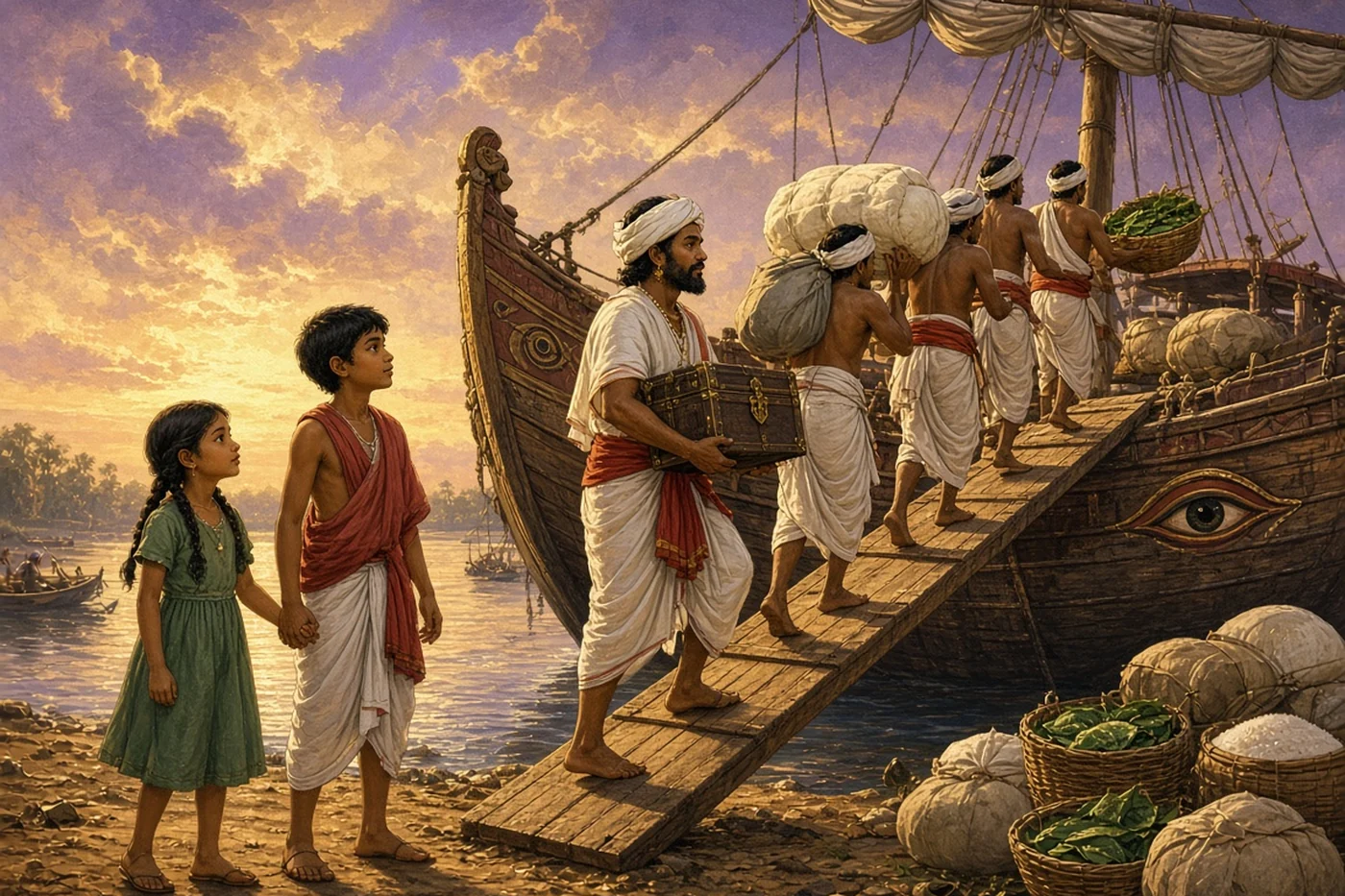
Her father, Raghu, spent the month at the river. The boita lay against the bank with men all over her, getting her ready for the sea. Kuni was allowed down once, holding her brother's hand, to watch the loading. Bales of cotton cloth went into the hold, and sacks of rice and salt, and baskets of betel leaf and nut, and spices, and a small locked chest that her father carried on board himself.
"What's in that one?"
"Pearls and stones," he said. "And ivory, wrapped up. You don't sell everything in one port."
"Where is the first port?"
He crouched and drew in the mud with a stick. "Here is our river. We go out on the full moon, when the wind turns and blows from the north-east. It pushes us down the coast, all the way to Lanka. There we fill the jars and take on coconuts. Then east, with the currents, to the islands. With luck we sight Bali in the middle of winter."
"And then you come back."
"Then we trade, two months, perhaps less. We must leave before the wind changes its mind. You will see the sail again when the mangoes are ripe."
"Bring me something."
"Camphor," he said. "And a piece of silk that comes from further away than I am going."
On the last evening the women went to the goddess Mangala's shrine with flowers. Sumitra stood a long time with her palms together. Kuni heard only the end of it.
"Bring the boita home. Bring them all home."
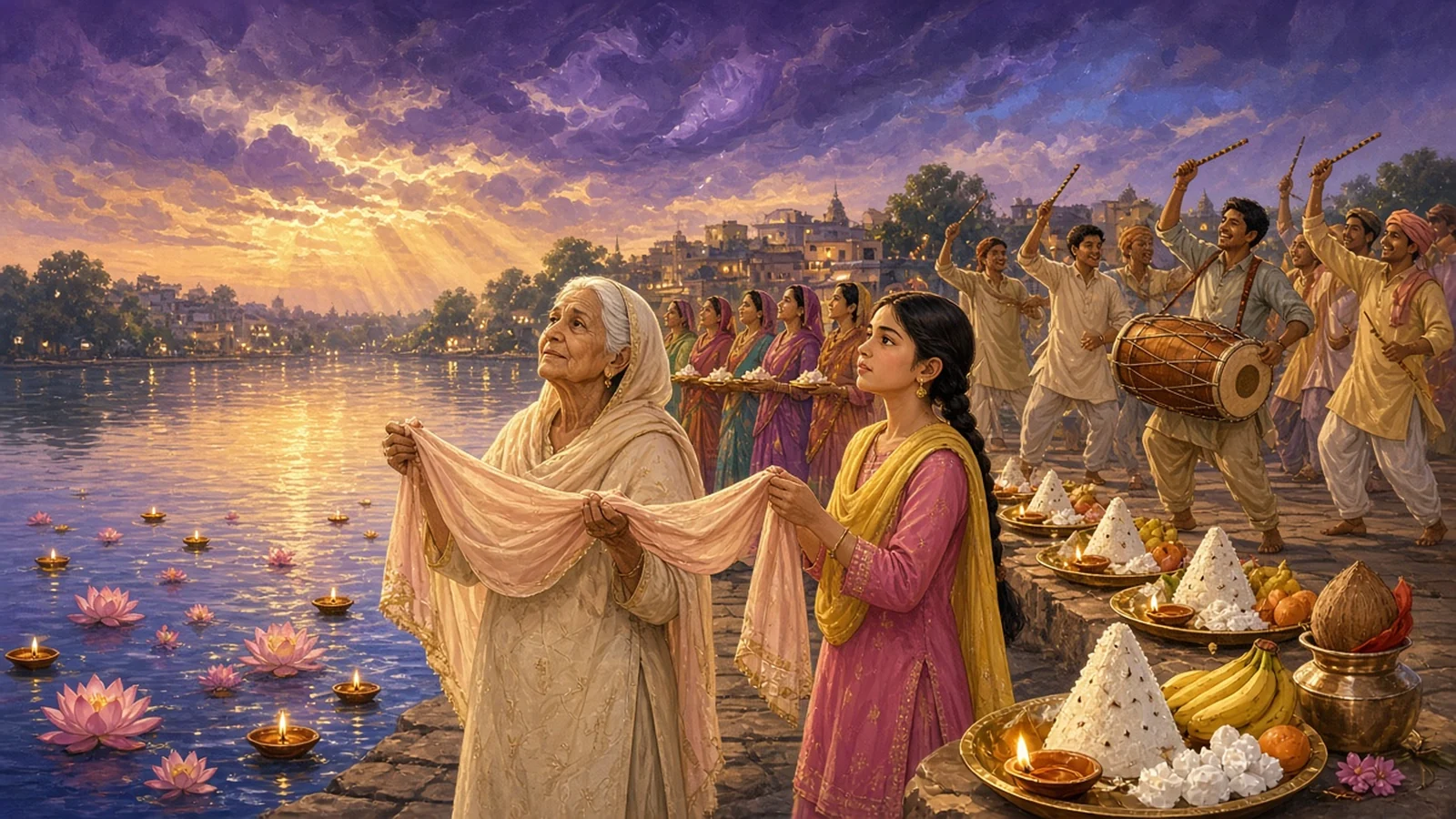
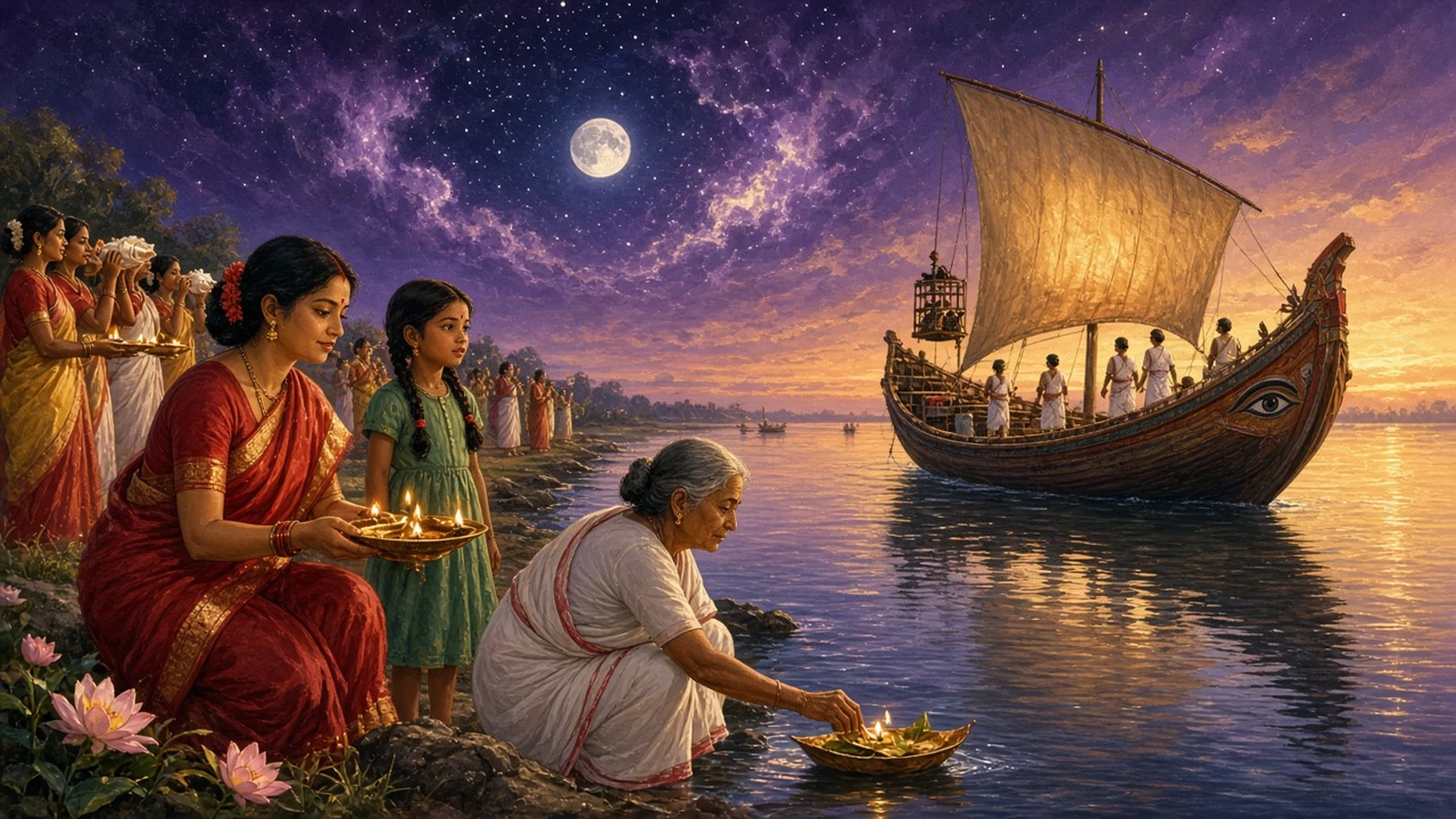
Nobody slept much. Long before light the lanes filled with women carrying lamps, and the conch shells began, and the bells. On the bank the whole house stood in a row. Sumitra and the other wives circled their lamps before the ship, and the long trilling hulahuli went up from every throat, so loud Kuni felt it in her teeth. Her grandmother put betel leaf and nut on a little boat of banana bark, set a wick on it, and pushed it out onto the water for the sea.
On deck a sailor checked the cage of crows they carried, to let loose when they needed to find land. The anchor came up. The sail took the wind and went grey, then pale, then gold as the sky lightened.
When it was too small to see, her grandmother turned for home.
"Now," she said, "we can eat."
The month of single meals was over. Up on its pole, the lamp was still burning.
As Cuttack keeps it now
East India · Gadagadia ghat on the Mahanadi, below Barabati fort, Cuttack · 1 min read
In Cuttack the same morning opens the fair. People who have bathed in the dark and floated their boats climb back up from the water, and on the broad sand by the river the stalls are already lit.
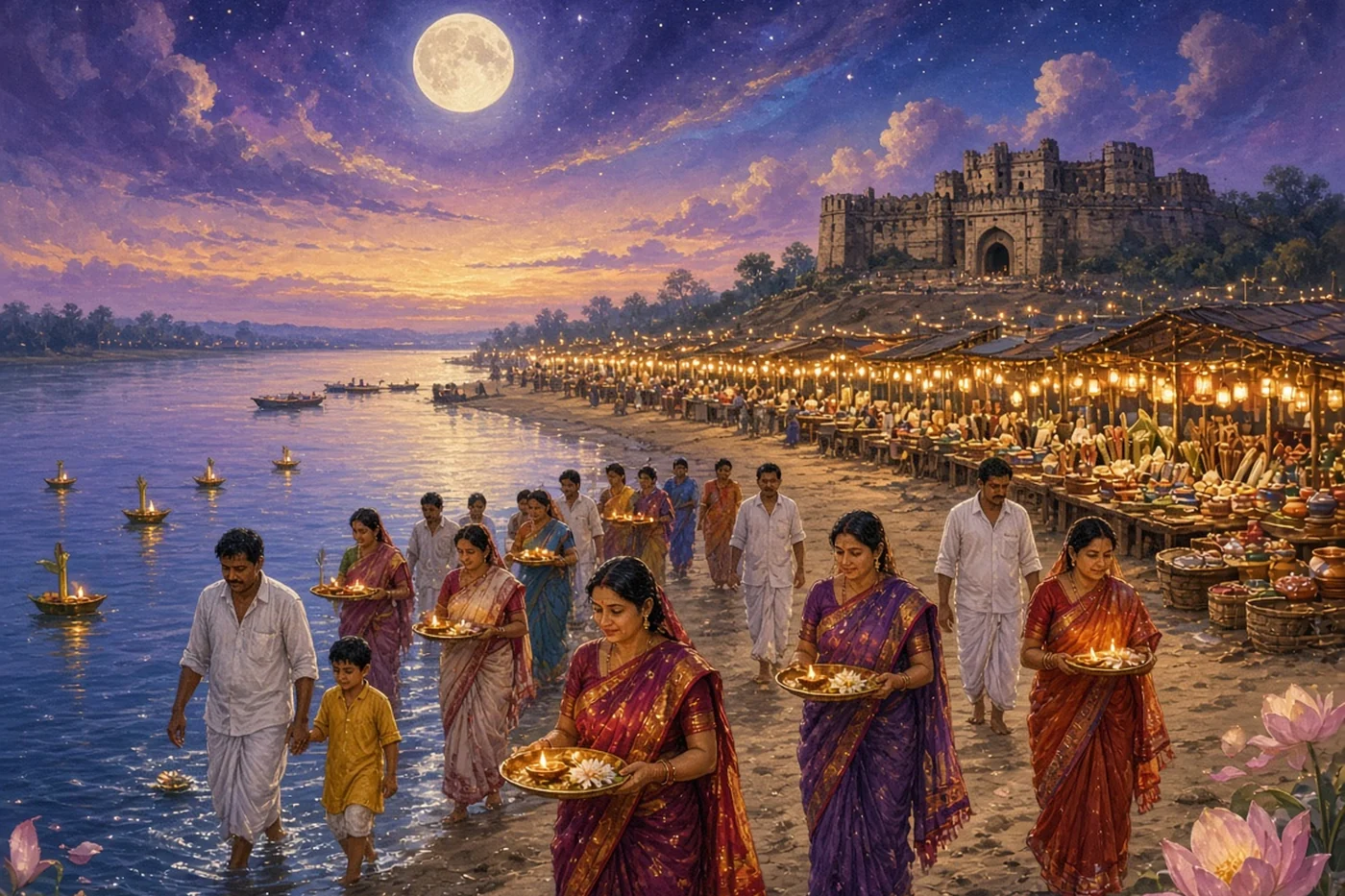
Colonel J. C. Mahanti, writing in 2015, remembered it otherwise. Until the middle of the 1960s Bali Jatra lasted a single afternoon and evening. Then it stretched to three days, and in his day to a week. He listed what used to be sold there: winnowing fans and bamboo baskets, cooking pots, toys of clay and cotton and papier mache. There were magic shows. People ate thunka puri and chena curry, and rasagolla as big as tennis balls.
The fair still keeps a god. From Bada Osha, the day before the full moon, the lanes of the city have been worshipping Kartikeswar, each with its own image, and from the full moon the processions come down to Gadagadia one lane after another to give him to the river. A press report of 2019 named him the fair's own presiding god, worshipped at the ghat through its seven days.
There is more than one account of the name. Most say it is the voyage to Bali. Others say Chaitanya once crossed the Mahanadi here singing, walking over the bali, the sand of the river bed, and that the fair on the sand took its name from that.
For 2026 the district announced that the fair would run from 24 November to 1 December, spread over both the upper and the lower grounds, with plastic banned from the stalls and food served on sal leaves. Indonesia was named its partner country. The organisers promised more than five hundred plots.