As the Linga Purana tells it
Uttarabhaga 3 · Shvetadvipa, the mountain north of Lake Manasa, and Mount Raivataka · 3 min read
King Ambarisha once asked the sage Markandeya how Narada came to know music, and Markandeya said he had the story from Narada himself.
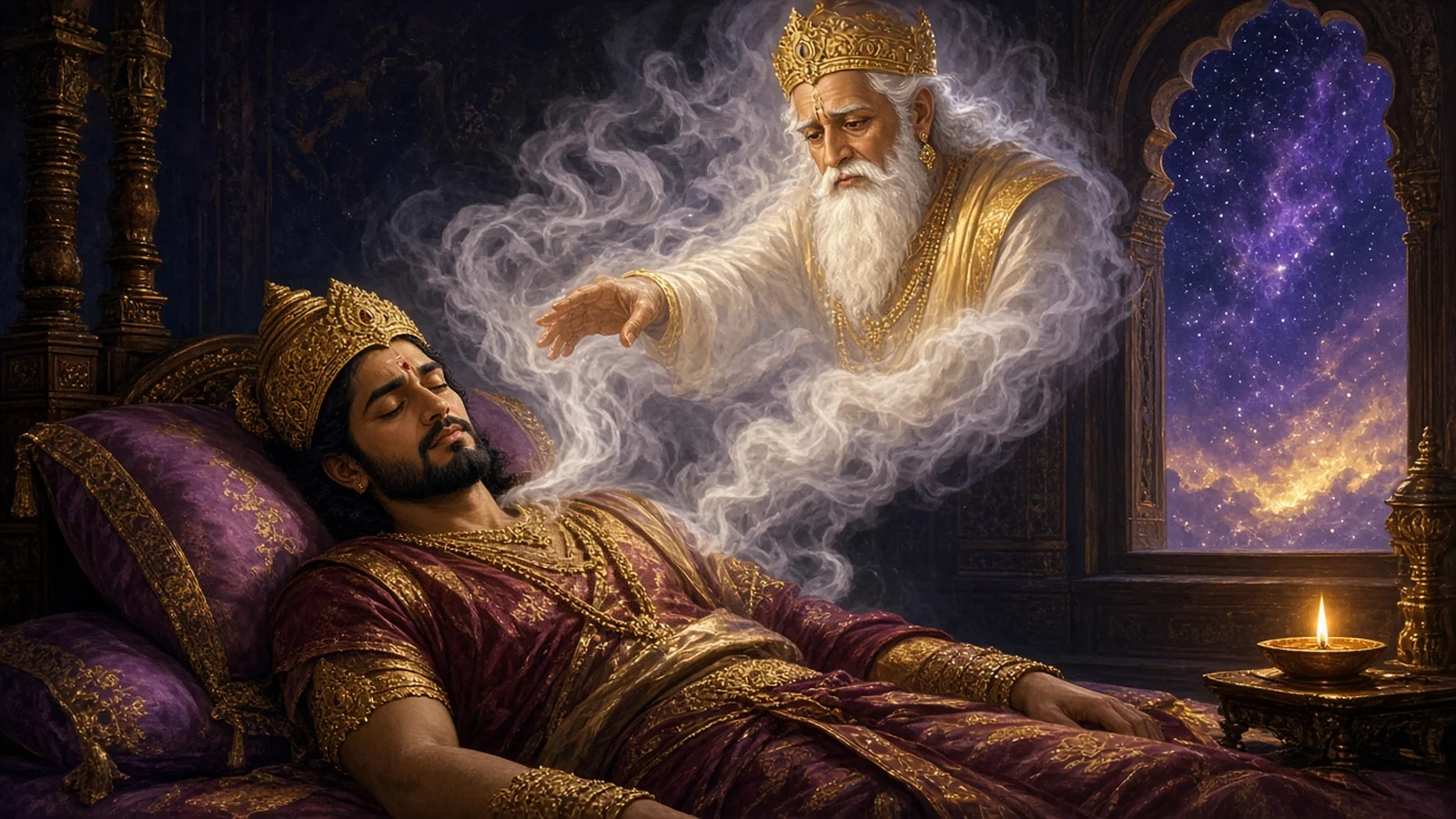
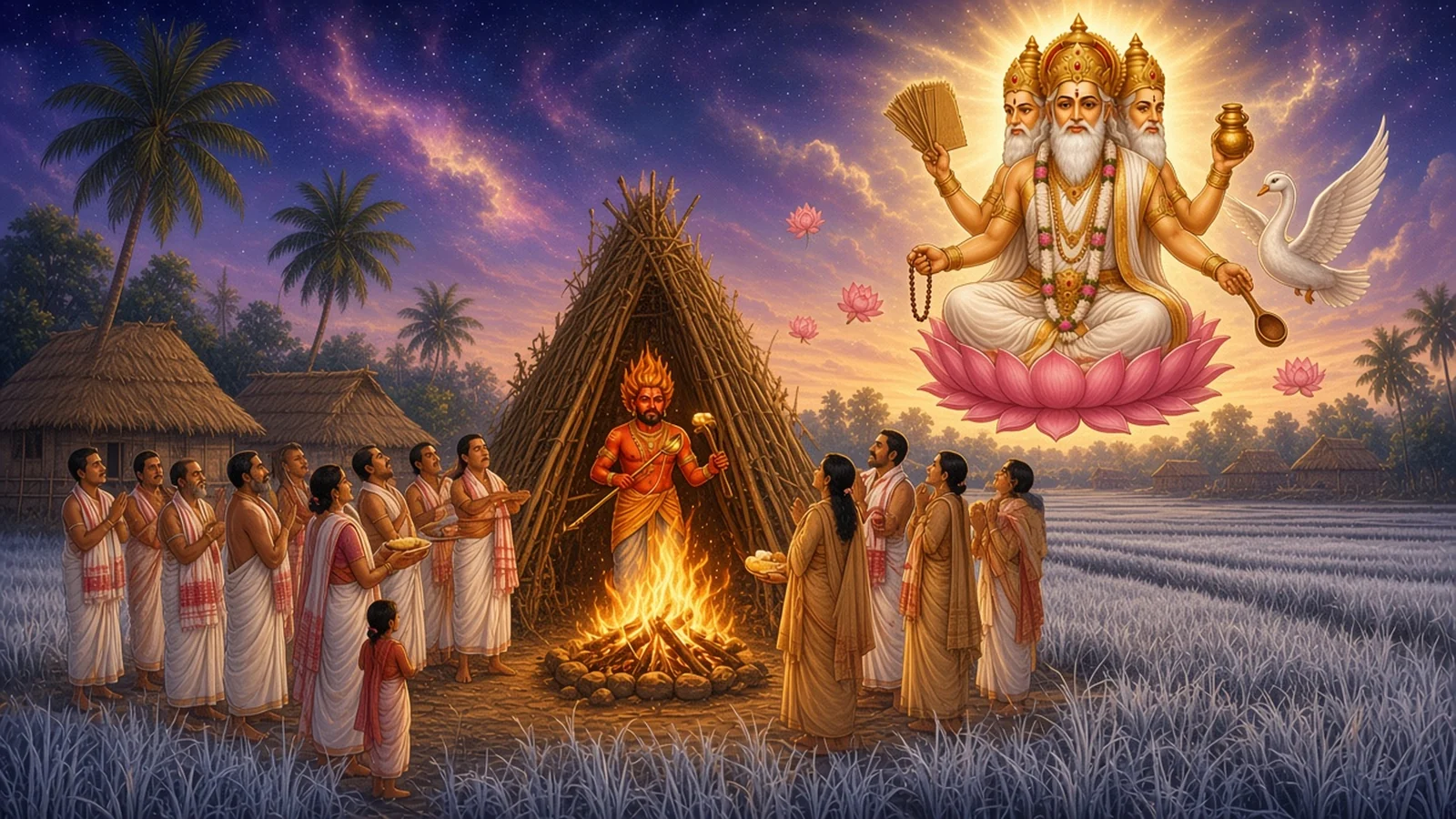
Narada had been standing near Vishnu, with Lakshmi beside the god, and Vishnu had set him aside. Then the Gandharva Tumburu came in, and Vishnu welcomed him and listened to his singing with delight. Even Brahma and the gods were sent away while Kaushika and his fellow singers sang, and those singers were made chiefs of Vishnu's own company.
Narada went away and did his sums. His gifts, his offerings, all his learning: put together, they were not worth a sixteenth part of one song sung for Vishnu. So he sat down to do penance, for a thousand years of the gods, and at the end a voice spoke from the sky.
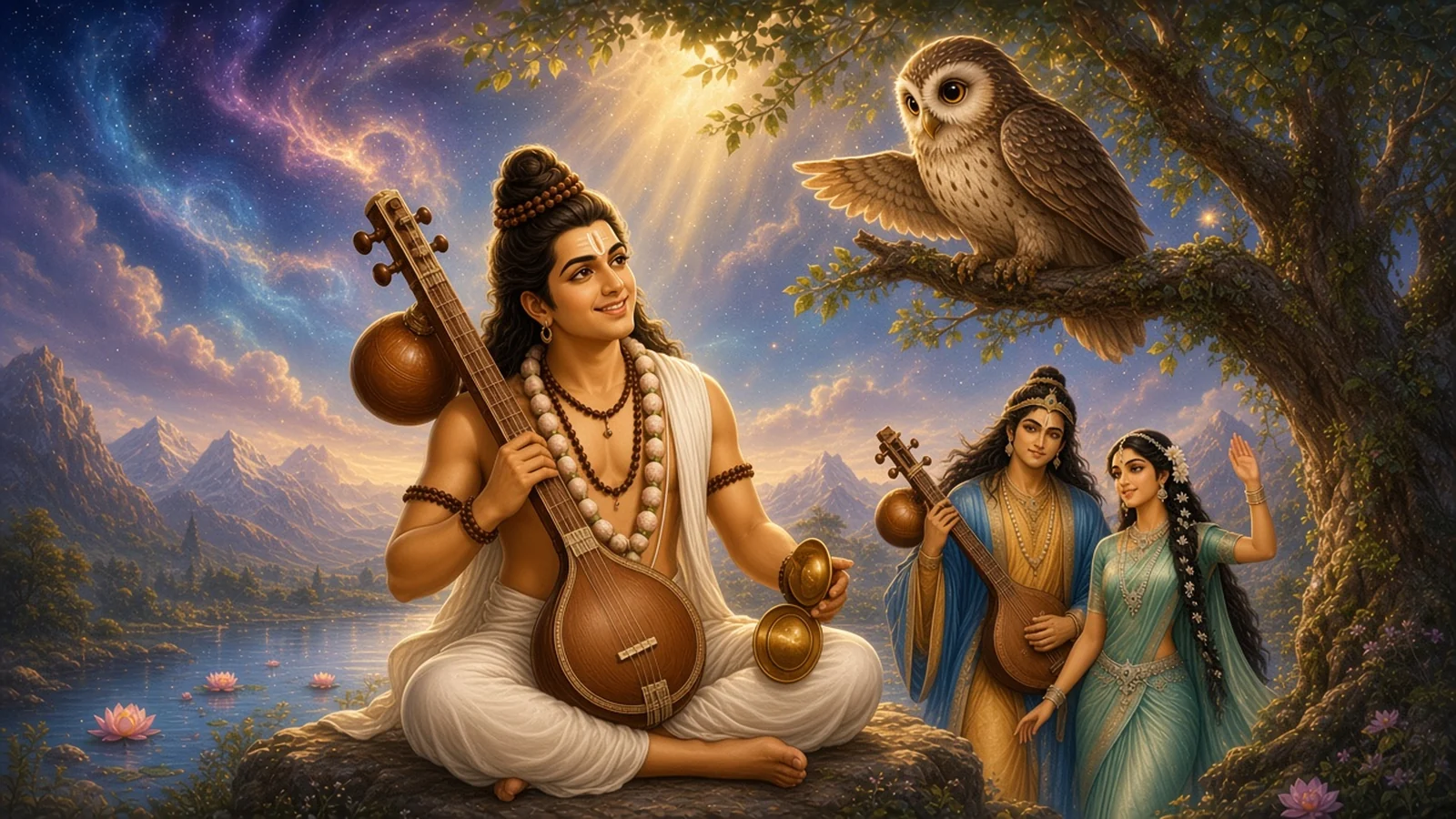
"Go to the mountain north of Lake Manasa. There is an owl there called Ganabandhu, the friend of song. Learn from him."
He found the owl sitting among Gandharvas and Kinnaras, Yakshas and Apsarases, all of them his pupils.
"Welcome, sage," said the owl. "Why have you come?"
Narada told him everything, Tumburu and Kaushika and the thousand years.
"Penance will not get you music," said the owl. "I sat among the Kinnaras for sixty thousand years, and twice as long again, before I had it. You must listen. Listen to every note." Then he gave the rules. Do not slouch when you sing, or open your mouth too wide, or roll your eyes, or admire yourself. Do not keep time with one hand, for it cannot be done. Do not sing when you are hungry, or thirsty, or afraid, or in the dark.
Narada bowed and began. He practised for another thousand years of the gods, until he knew the vina and the tunes and thirty-six thousand notes with all the shades between them, and the Gandharvas loved to hear him. When he offered his teacher a fee, the owl asked for little, and Narada blessed him and spoke of the day he would be Garuda.
Then he went to sing for Vishnu in Shvetadvipa, the white island.
"Good," said Vishnu. "But you are not better than Tumburu yet. Wait. At the end of the Dvapara age I shall be born as Krishna, the son of Devaki and Vasudeva. Come to me then and remind me, and I will make you his equal, or better."
So Narada wandered with his vina. He sang in the halls of Varuna and Yama, Agni, Indra and Kubera, and in Brahma's world beside Haha and Huhu, Brahma's own singers, and he was honoured everywhere. At last he went to Tumburu's house, sat down and began to sing. Then he saw the seven notes themselves present in that house, and he got up and left in a hurry. However well he played, the goddess of the notes would not come down onto his strings.
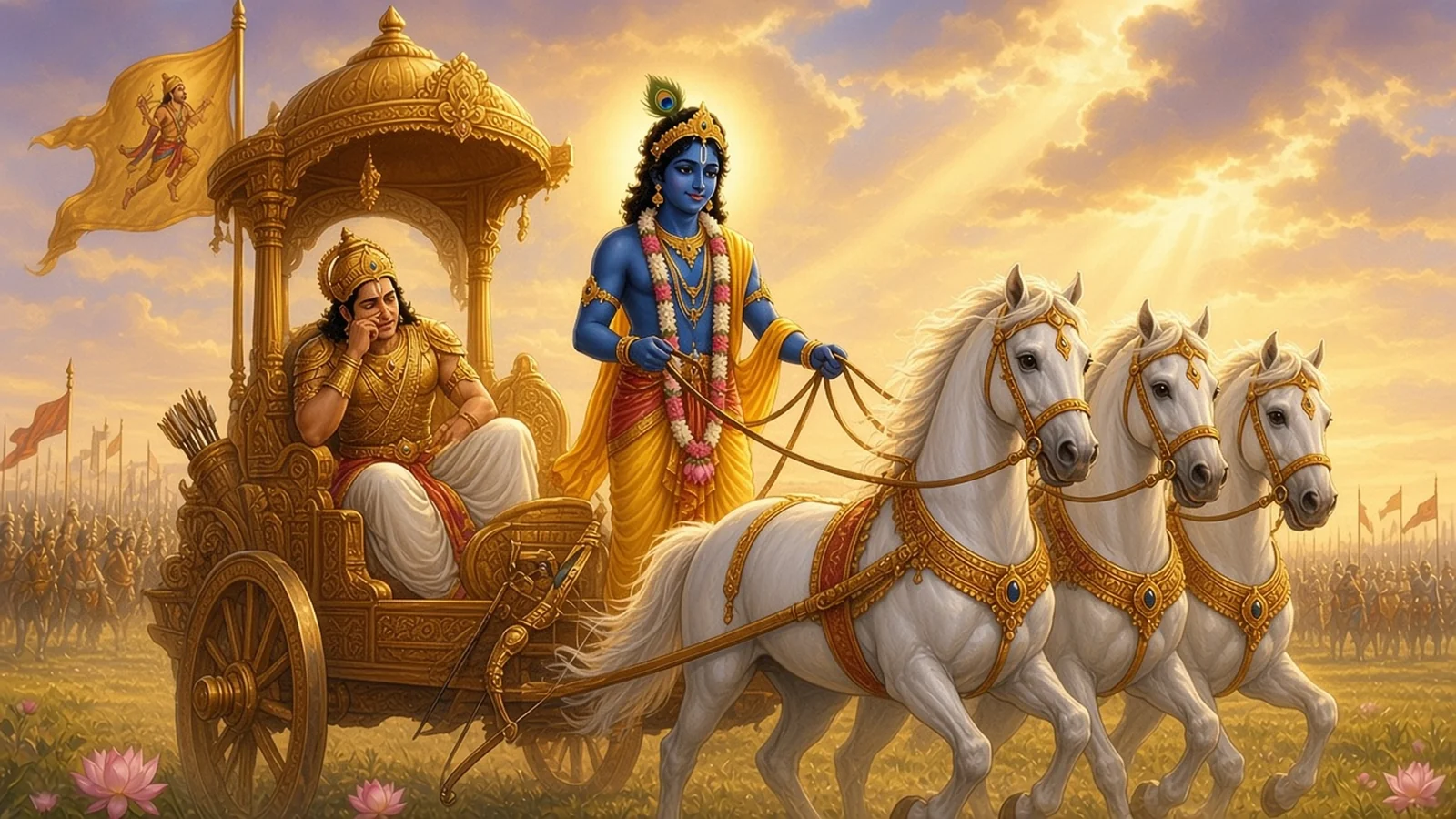
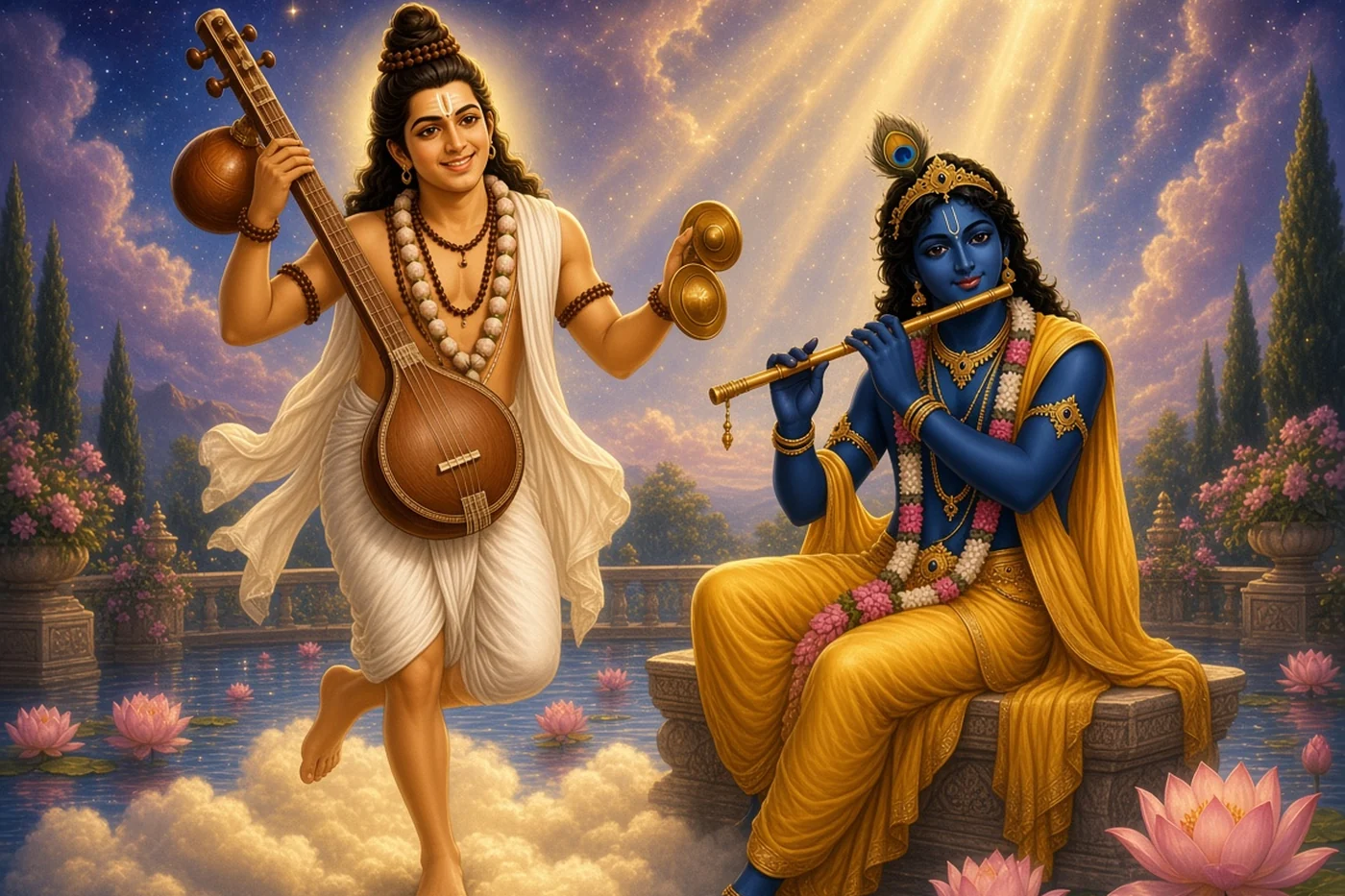
Ages passed. On Mount Raivataka he found Krishna and told him what Vishnu had said in the white island. Krishna smiled and turned to his queen.
"Jambavati, teach him."
She taught him for a year. Then Satyabhama taught him for a year. Then Rukmini taught him for three years, and at last the notes came and sat on his strings. Then Krishna taught him himself, and Narada went past Tumburu and danced for joy.
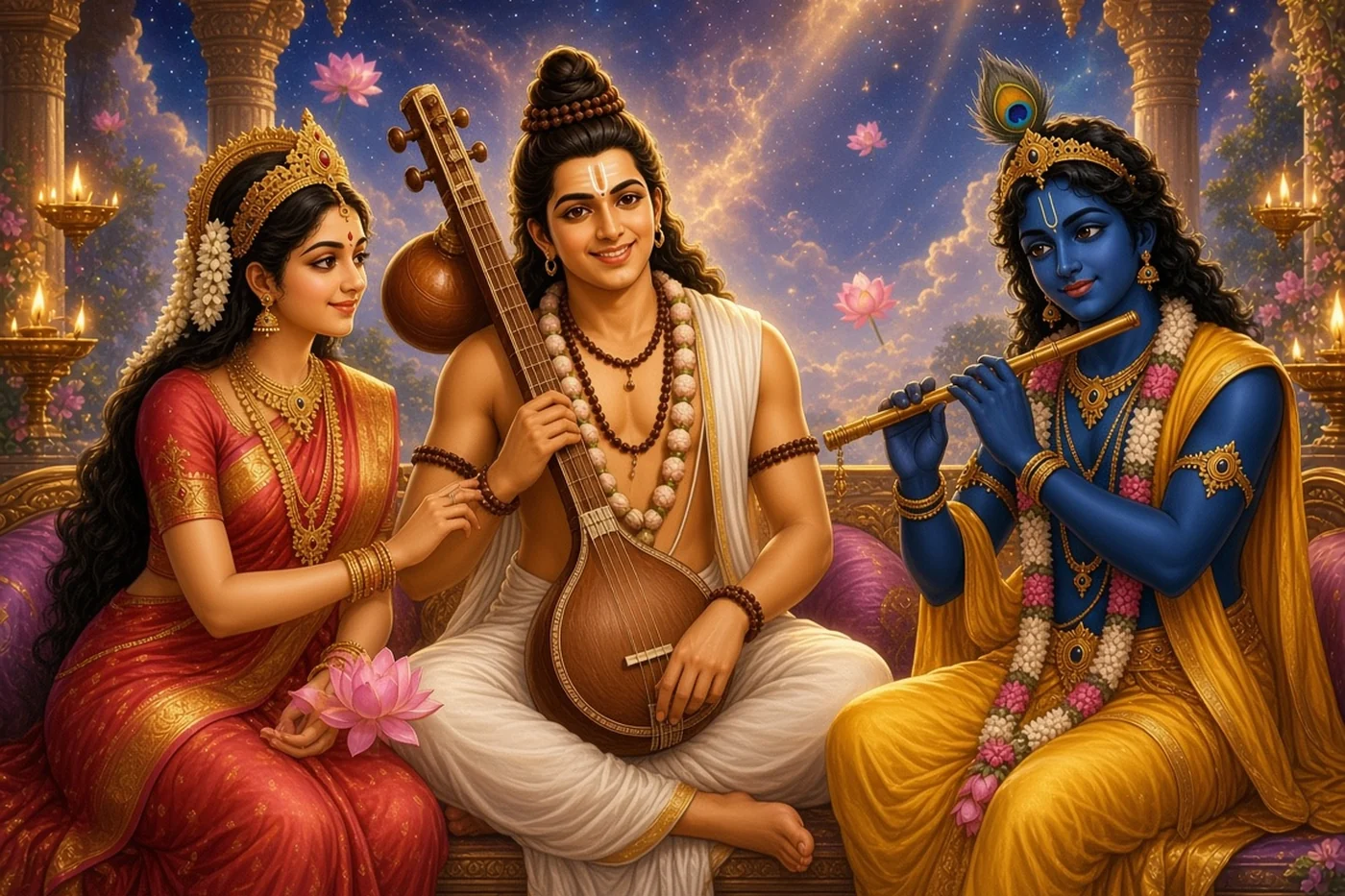
"Now you know it all," said Krishna. "Sing before me, and sing with Tumburu."
As the Adbhuta Ramayana tells it
Cantos 6 and 7 · Vaikuntha, the owl's mountain and Tumburu's house · 2 min read
Valmiki tells this to his pupil Bharadvaja, and in his telling the trouble begins at a festival. Vishnu held a great feast of song for Kaushika and the devotees who had reached him, and asked Tumburu to sing. The whole of heaven pressed in. The guards pushed the crowd back, and in the crush Lakshmi's maids shoved Narada aside.
He turned on Lakshmi herself. "Be born on earth from a demoness's womb," he said, "and be thrown away like a child nobody wants."
When his anger cooled he was sick with shame. Vishnu told him that if he wanted the honour that Kaushika and Tumburu had, he should go to the owl Ganabandhu in the Himalaya and learn to sing.
The owl taught him the rules and the notes, and Narada practised for a thousand years and thought himself ready. He went to Tumburu's house to beat him.
At the door he found a crowd of men and women, broken. Some had lost fingers, some a hand or a foot, some were bent out of shape.
"Who did this to you?" he asked.
"You did," they said together. "We are the ragas and the raginis, the modes of music. When you sing out of tune and out of time, we break. When Tumburu sings, we are whole again."
Narada said "Shame on me" and went to Vishnu in the white island, and Vishnu told him to wait for Krishna. He wandered and sang, and once more came to Tumburu's house and saw the notes Shadja and Dhaivata living there as women, and left ashamed.
In Krishna's time Jambavati taught him for a year and Satyabhama for a year. Rukmini taught him for two years and still the strings would not obey him. Then Krishna taught him, and every art of music came to him at once, and with it his jealousy of Tumburu went out of him like a lamp. He danced. Krishna told him to sing with Tumburu from then on.
And the curse he laid on Lakshmi in the crush at the festival came true. In the next canto Valmiki tells how she was born as Sita.