As Kathmandu tells it: the dice in the king's room
Kathmandu, the palace at Hanuman Dhoka · 3 min read
In the last years of the Malla kings, Jaya Prakash Malla ruled Kathmandu from the palace at Hanuman Dhoka, and the goddess of his house was Taleju. Her tall temple stood at the edge of the palace square, but her real seat was a diagram kept in a room nobody but her priests could enter.
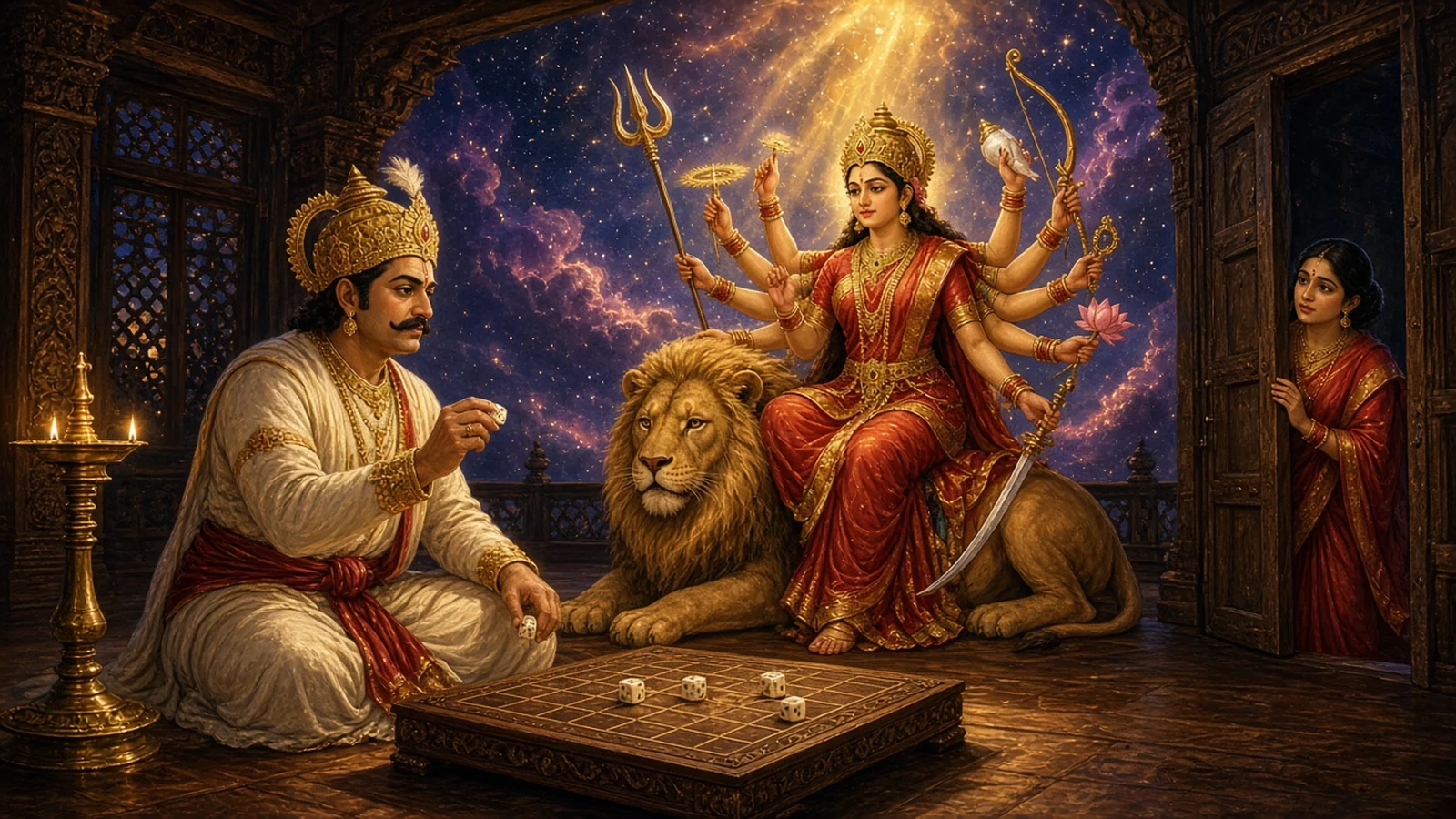
The tellers say that she did not stay in the diagram. Every night, when the palace was asleep, she came to the king's own room in the shape of a woman, and the two of them sat down on either side of a board and played tripasa, the game of three dice.
"I will come every night," she told him on the first night. "But nobody is to know that I come. Not your ministers, not your priests, not your wife."
"Nobody will know," said the king.
So night after night the dice rolled and the two of them talked until the lamp burned low. In the morning he went out to his court like any other king, and nobody wondered why he looked so tired.
But the queen wondered. A husband who shut his door every night and talked till dawn was a husband with a secret. One night she waited until the voices began, crept along the passage, and opened the door a crack.
She saw her husband on the floor with the dice in his hand, and across the board from him a woman more beautiful than anyone she had ever seen. And the woman looked up, straight at the door.
The dice stopped. When the king turned to see what she was looking at, the place across the board was empty.
She did not come the next night, or the night after. The king sat up alone with the board, and the dice stayed where they had fallen.
At last she came to him in a dream.
"I will not sit in your room again," she said. "You could not keep one secret for me. But I will not leave you altogether. Look for a little girl among the Shakyas, a girl who is still a child. I will be in her. Worship her, and you will be worshipping me."
"How will I know her?"
"You will know her."
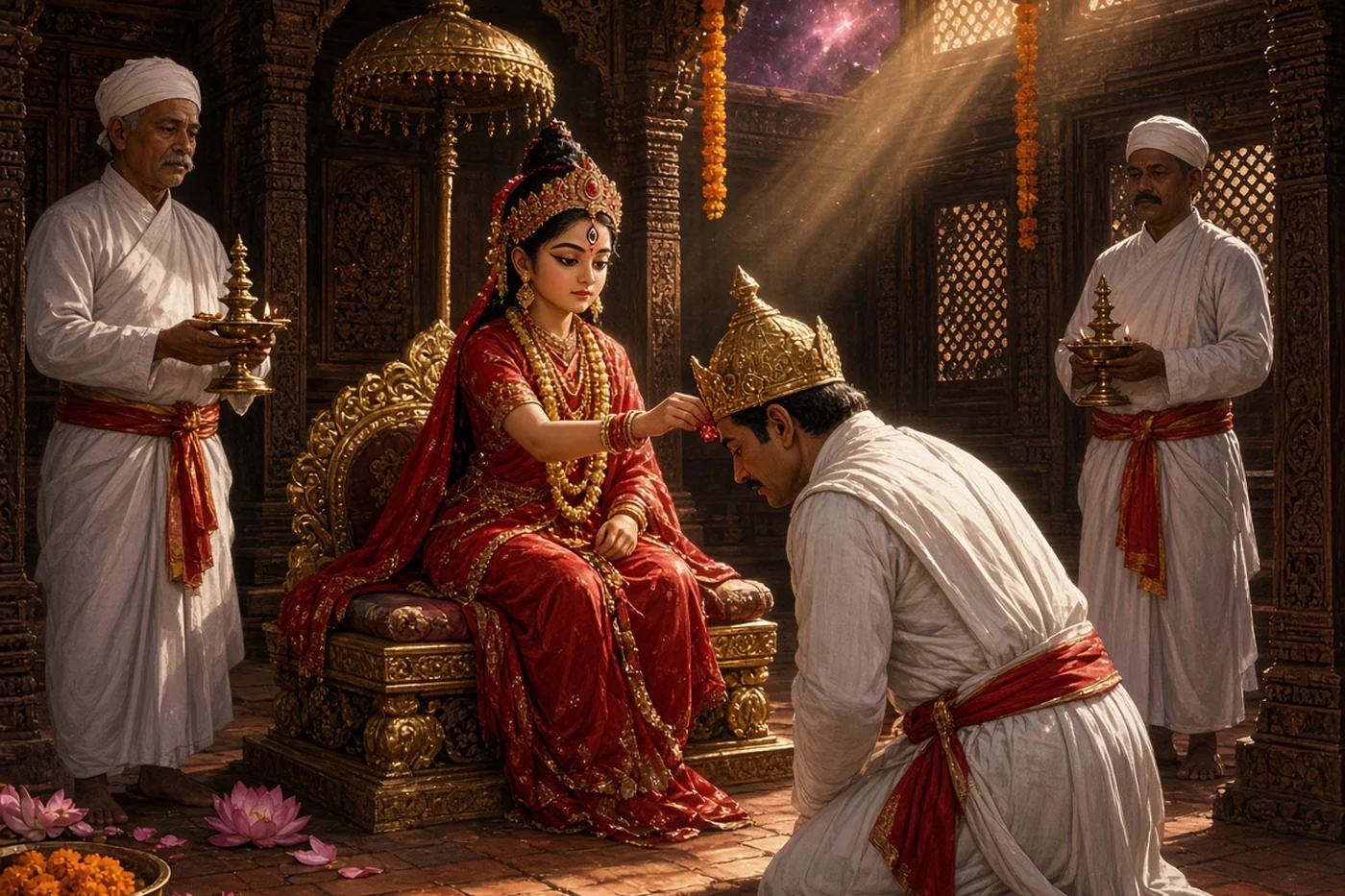
The king went looking among the Buddhist Shakya families of the city and found the child, and he made her the Kumari, the virgin goddess. The chronicles say it was Jaya Prakash who built her a house of her own beside the palace, its windows and doors carved with Durga, and who began the yearly festival when she rides through the streets in her chariot. Every year after that the king went to the little girl, bowed to her and took the tika from her hand, as the head of the country still does at Indra Jatra.
That is the telling most people in Kathmandu give. It is not the only one, and the tellers of the valley's three old cities each give the dice to their own king. In some Kathmandu tellings it is the king's daughter at the door, not his wife.
Other tellings give the story to Trailokya Malla, who ruled the undivided valley from Bhaktapur in the sixteenth century. In one his daughter walks in on them. In the version Michael Allen heard most often, the king himself breaks the bargain: across the dice he looks at the goddess as a man looks at a woman he wants. She vanishes, he weeps and repents, and at last she relents and promises to come back as a Shakya girl. Patan gives it to Siddhinarasingh Malla, who built the Taleju temple there, with his queen at the keyhole, and its Kumari comes from a Vajracharya family.
As the chronicles and the scholars tell it: from Simraungadh to the three palaces
The Terai and the Kathmandu valley · 2 min read
Taleju was a goddess of kings before she came to the valley. The chronicles say she was the family goddess of Harisimhadeva, the last Karnata king of Mithila, who ruled from Simraungadh in the Terai. One of them, the Nepalikabhupavamshavali, says the goddess warned him that foreign armies were coming and told him to carry her to Bhaktapur, and that he left with his family the next morning, in 1324; a chronicle of 1825 gives 1323. An oral telling recorded by Michael Allen goes further back: she was the goddess who stood first by Ravana and then by Rama, who carried her to Ayodhya as a yantra, and the kings of his line kept her until Harisimhadeva brought her north.
In these tellings she came as that yantra, a diagram, not an image. In Bhaktapur she was kept in the Mul Chowk, the palace's inner courtyard, behind the Golden Gate with its bronze Durga. When the valley split into three kingdoms each palace gave her a temple: Kathmandu's tall one built by Mahendra Malla in 1564, Patan's by Siddhinarasingh in 1620.
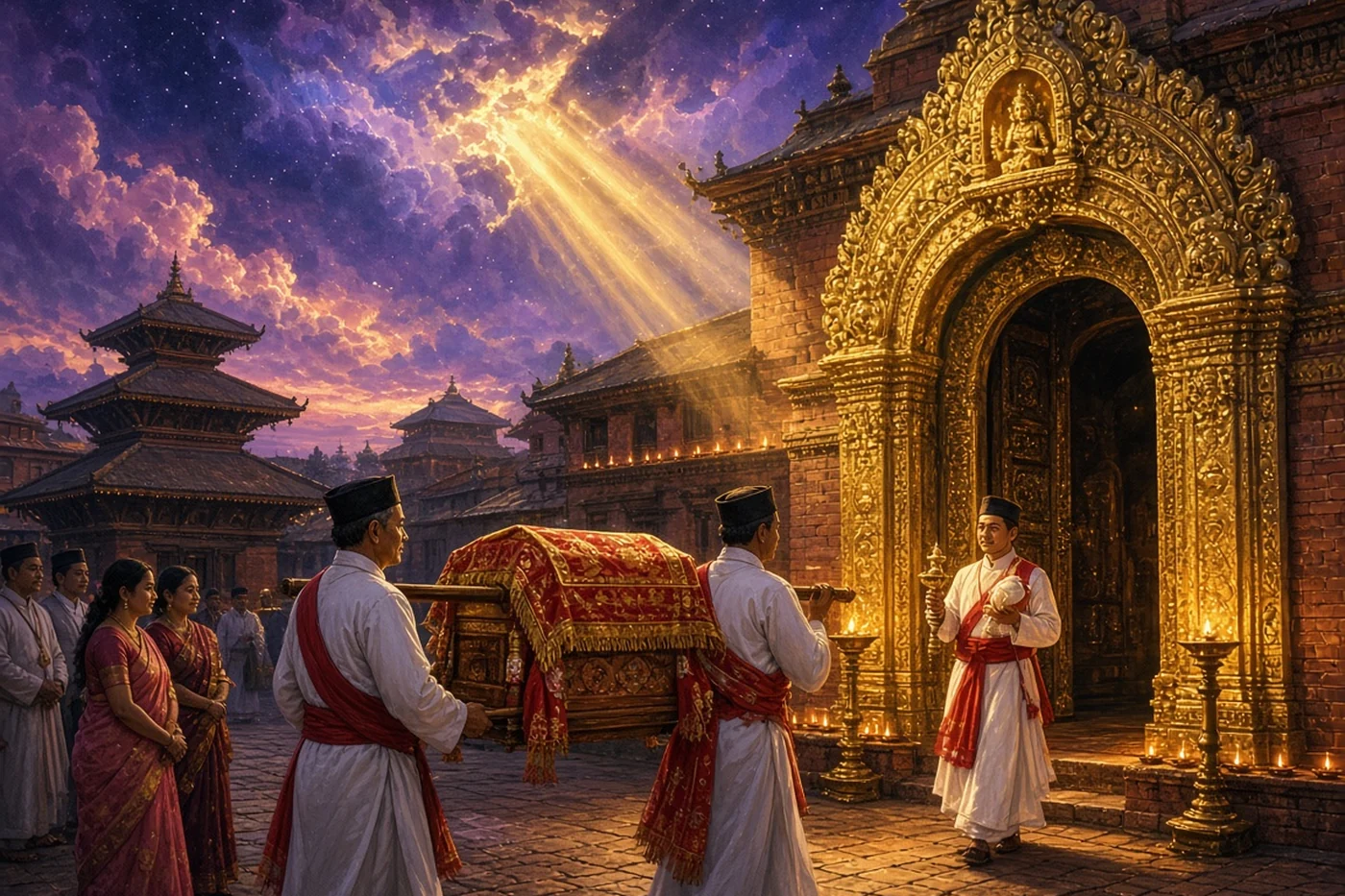
Her great days are Dashain's. Allen describes her yantra brought into a shrine in Kathmandu's Mul Chowk from the seventh day to the tenth, and on Kalaratri buffaloes and goats offered there to her under the state's own eye, their heads carried up to her shrine.
On the ninth night the Kumari walks on a laid cloth to the courtyard and is seated in that room among the heads to be worshipped. The animals, he notes, are offered not to the virgin but to the formless Taleju. The temple's front door opens to the public on that ninth day alone, and the Manandhars who keep her lamp in oil come in by the back. In Patan the Kumari is carried to Taleju on the ninth night, and after midnight, on Vijaya Dashami, she gives her own tika.