As the vow books tell it
North India · read aloud at dusk before the stars come out · 4 min read
In a town of the north there lived a moneylender, a sahukar, and his wife, and they had seven sons. Seven sons is a full house. The wife went about her day with a mother's arithmetic always running in her head: seven plates, seven shirts, seven foreheads to feel for fever.
Diwali was coming. In those days a house was made new for the festival with earth, not paint. The walls and the floor were plastered fresh with clay, and the clay had to be dug.
"I will go to the pit myself," she told her husband. "Nobody else digs it clean."
She took the small spade the women use, the khurpi, and went out past the fields to the place where the good earth was. She squatted down and began to cut the clay out in blocks, as she had done every year since she was a girl.
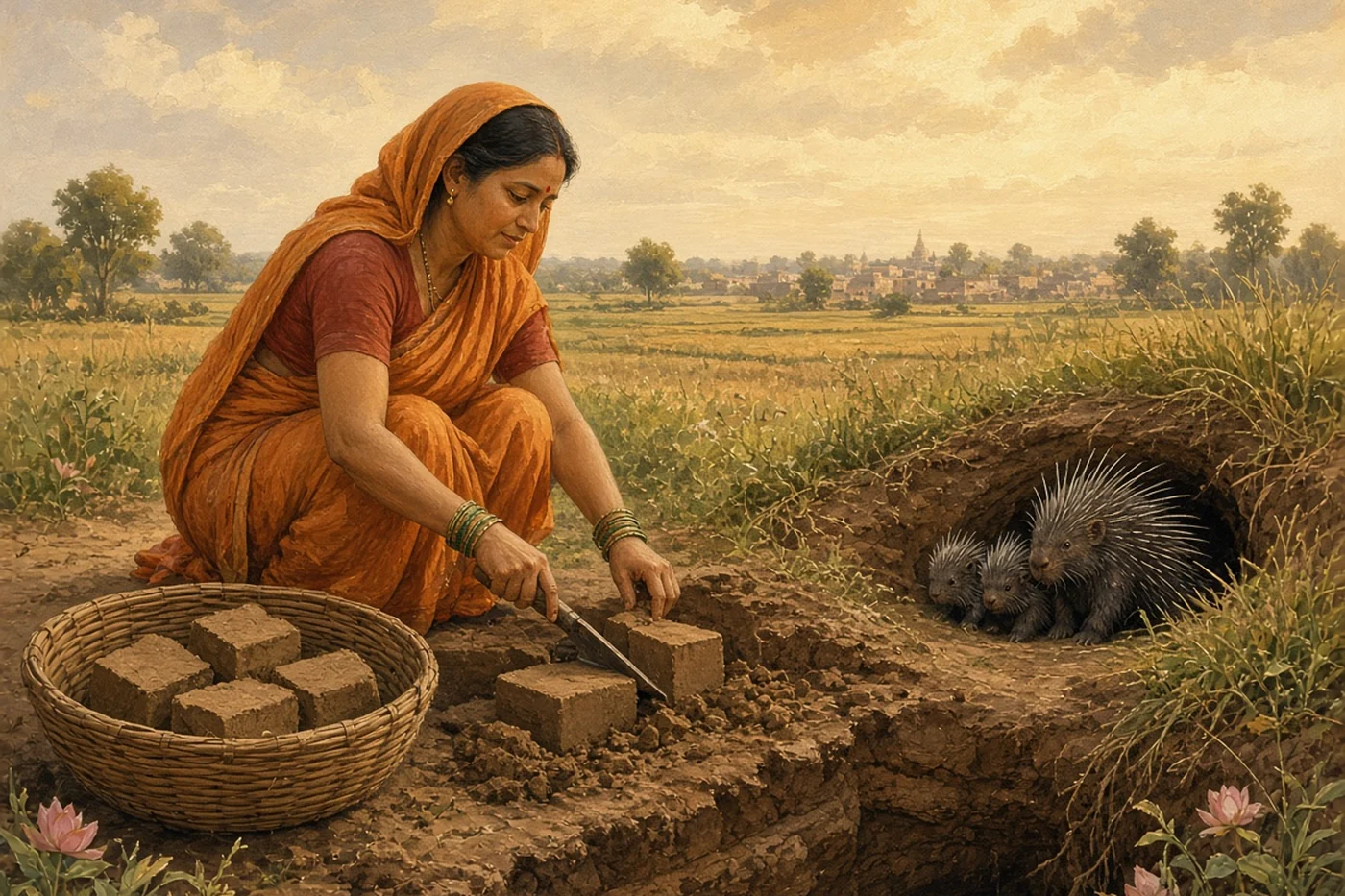
She did not see the burrow. The blade went into the bank and came out red, and something small cried once and then stopped. A syahu, the spiny creature the villages call a porcupine, had her young in that bank, and the spade had killed one of them.
The woman sat back on her heels. "I did not know," she said to the hole in the earth. "I did not see." There was nothing else to say. She could not put the cub back together. She filled her basket, because the house still had to be plastered, and walked home with her eyes down, and told nobody.
That year her eldest son fell ill and died. The family mourned him and called it fate. Before the year was out the second was gone, and then the third. The house that had been full began to empty, one plate at a time, and by the next Kartika there was not one of the seven left.
The sahukar sat with his ledgers and did not open them. His wife stopped sleeping.
One evening she went out and sat with the old women of the lane, who sat together at dusk as old women do, and the words came out of her at last.
"I have never done a wrong thing knowing it was wrong," she said. "But there is one thing. Last year, before Diwali, I went to dig clay, and my spade killed a syahu's child in its burrow. I did not mean it. After that my sons began to die."
The old women were quiet for a while.
"You have said it aloud," said the oldest of them. "That is half of it already. A sin that is hidden grows. One that is confessed is already half gone."
"And the other half?"
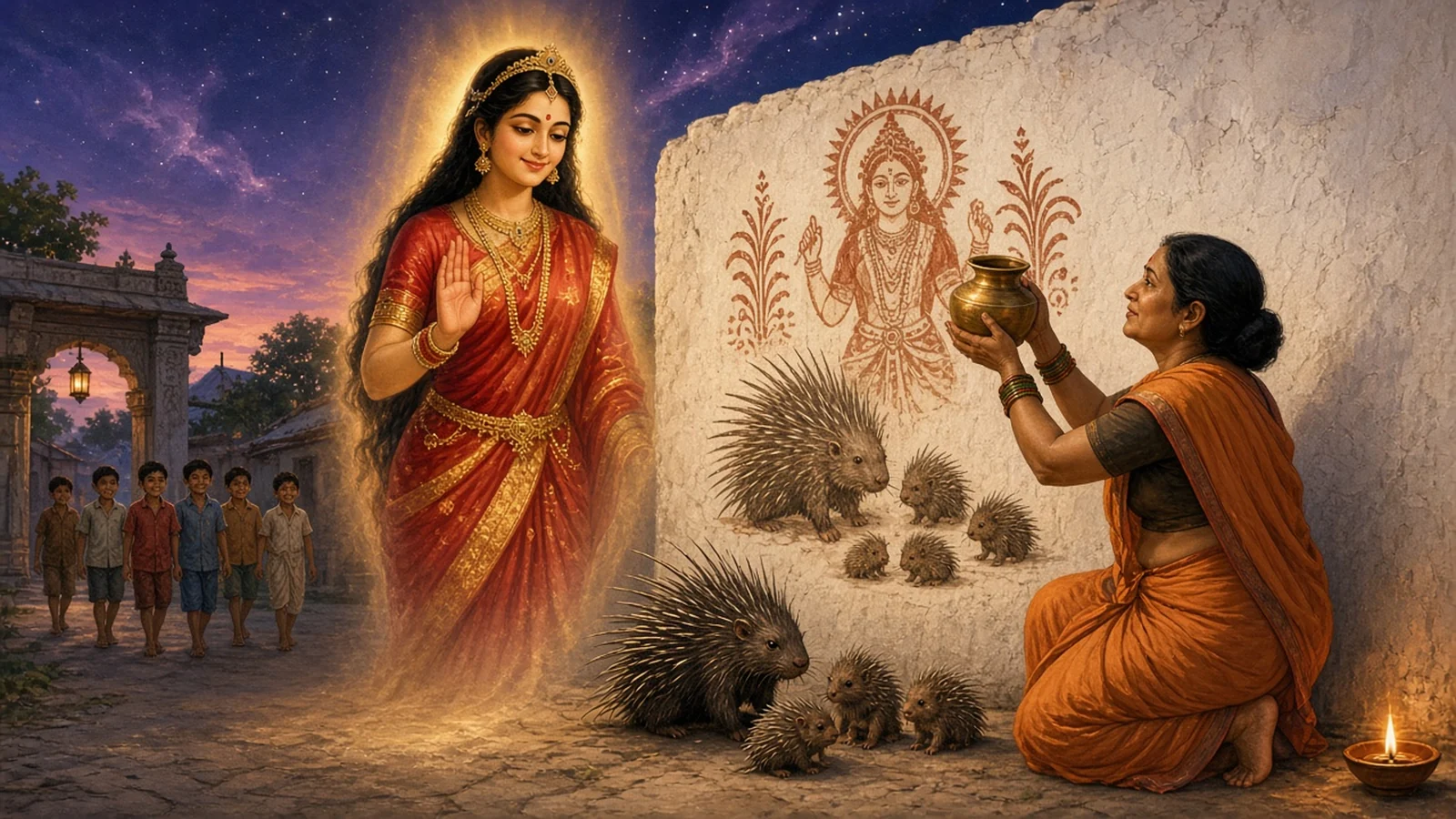
"The eighth day of the dark fortnight is coming, the ashtami before Diwali. Keep a fast that day for the Mother. Draw her on your wall, and beside her draw the syahu and her young ones, the ones you harmed. Say to her what you have said to us. Ask the syahu's forgiveness in front of her. Then see."
So on the eighth of dark Kartika the sahukar's wife bathed before dawn and took the vow, and ate nothing and drank nothing all day. In the afternoon she ground red ochre and drew on the wall of her house: the Goddess, and beside her a syahu with her little ones round her. She set a pot of water in front of the picture. When the first stars came out she offered them water from the pot and told the whole story again, out loud, to the wall, and asked to be forgiven.
The katha says the Mother was pleased, because the woman had hidden nothing. Ahoi Mata, who keeps the young of every living thing, forgave her, and the mother syahu forgave her, and her sons were given back. Some tellers say the seven came walking home one after another. Others say she bore seven sons again. Either way the house was full.
She kept the fast every year after that. Her neighbours' wives saw it and kept it with her, and their daughters-in-law after them, and that is the Ahoi fast, the vow books say, that the mothers of the north keep to this day, eight days before Diwali, for their children's lives.
As the longer katha tells it: the youngest bahu and the Surahi cow
Uttar Pradesh and Delhi · the sahukar's daughter version · 2 min read
In the other telling the sahukar has seven sons, seven daughters-in-law and one daughter, and it is the daughter who holds the spade.
She had come home from her husband's house for Diwali, and when her seven bhabhis went out to dig clay for the plastering she went with them, because she always had. Her khurpi struck into a bank and killed a syahu's child.
The mother syahu came out of the burrow. "You have killed my child," she said. "Then I bind your womb. You will never carry one of your own."
The girl was terrified. She turned to her brothers' wives one by one. "Take it for me," she begged. "Take the curse on yourself." Six of them looked away. The youngest, who was soft-hearted, said, "Give it to me, then," and the curse passed to her.
After that every child the youngest bahu bore died on its seventh day. Seven sons she bore, and seven times she buried a baby a week old. At last she went to a pandit.
"Serve the Surahi cow," he told her. "She is no ordinary cow. She will carry your trouble."
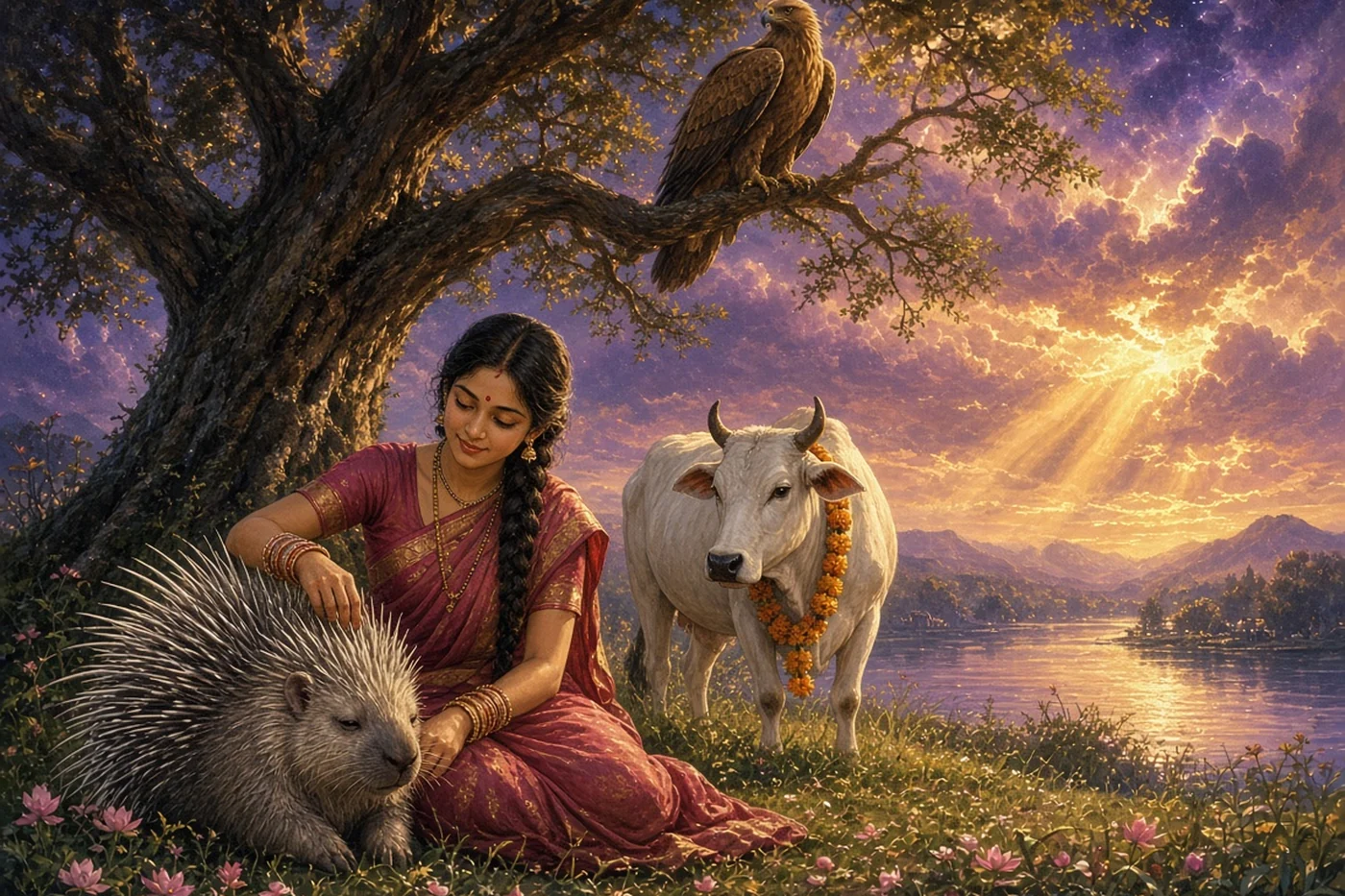
So the young woman swept the cow's shed before light each morning and fed her with her own hands, until one day the cow spoke. "Why do you serve me so?" The bahu told her everything. "Climb on my back," said the cow. "I will take you to the syahu."
They went a long way, across the seven seas, the katha says. Where they rested, the bahu saw a snake sliding up towards a nest where a garuda's chicks were crying, and she killed it with a stone. The mother garuda came back, saw blood by her nest, and flew at the woman. "Look again," said the bahu. "The blood is the snake's. Your children are alive." The bird looked, and was ashamed, and carried the woman and the cow on her wings the rest of the way.
The syahu was old now and tired, and the bahu sat down beside her and picked the lice out of her spines, as a daughter does for a mother. "Who are you, who serves me without being asked?" said the syahu. The bahu told her. "Then your womb is open," said the syahu. "You will have seven sons and seven daughters-in-law, and they will live."
And so she did. Ahoi, this telling adds, is the Mother who turns what cannot be, anhoni, into what is, honi.