As the Devi Bhagavata tells it
Book 7, chapters 31 and 33 · the Devi Gita · 3 min read
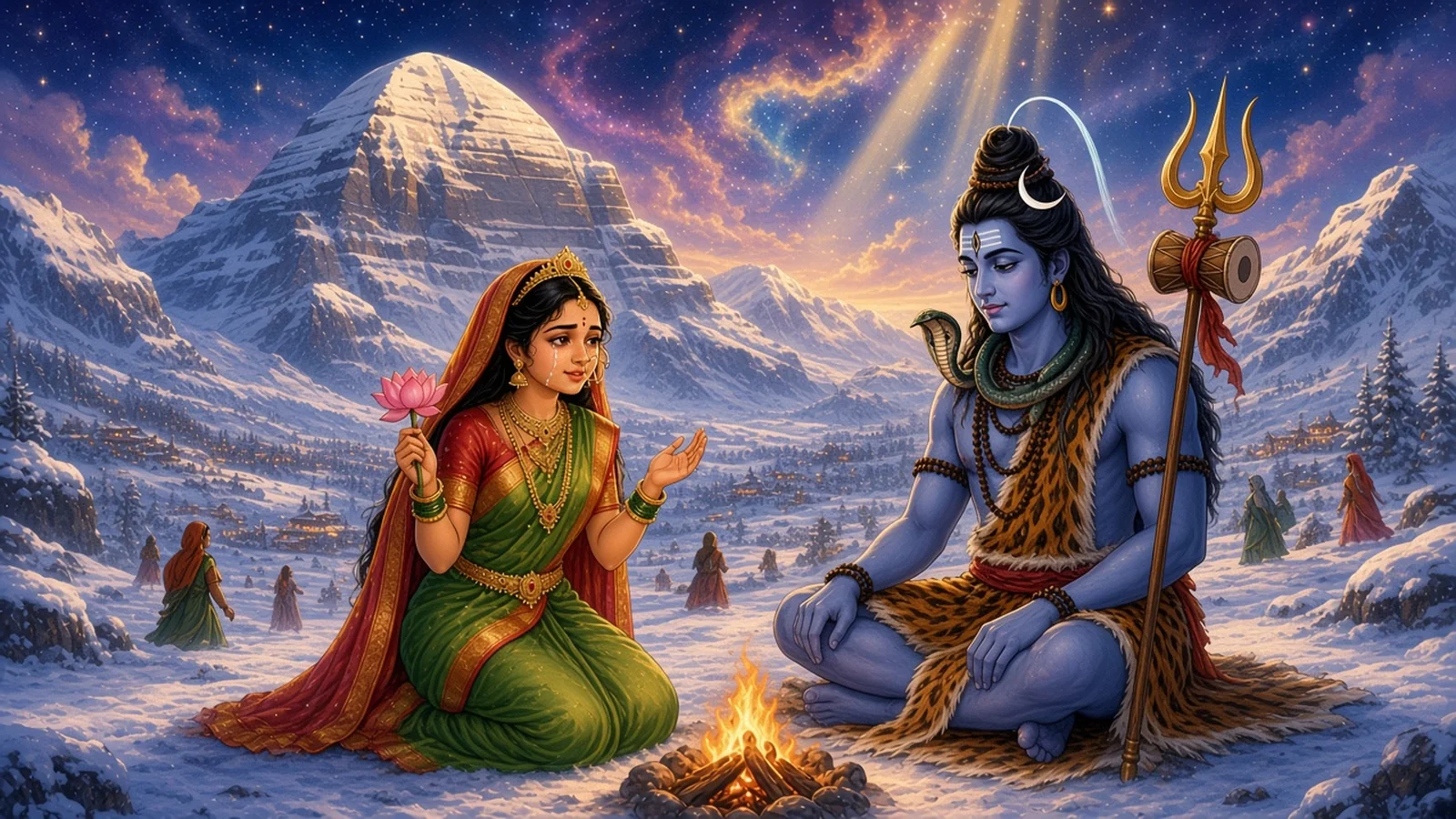
After Sati died, Shiva wandered the world with her body in his arms and would not be comforted. The world went wrong without him. A demon called Taraka had won a boon from Brahma: only a son of Shiva could kill him. Shiva had no wife and no son, so Taraka took heaven and the gods had nowhere to go.
They went to Vishnu.
"There is only one place left," Vishnu told them. "Go to the Mother. A mother scolds her child, but she does not leave it."
So Vishnu and Lakshmi and all the gods went up into the Himalaya. They fasted and kept vows, they repeated her seed syllable, they chanted the old hymn to the Goddess, and they did this for years.
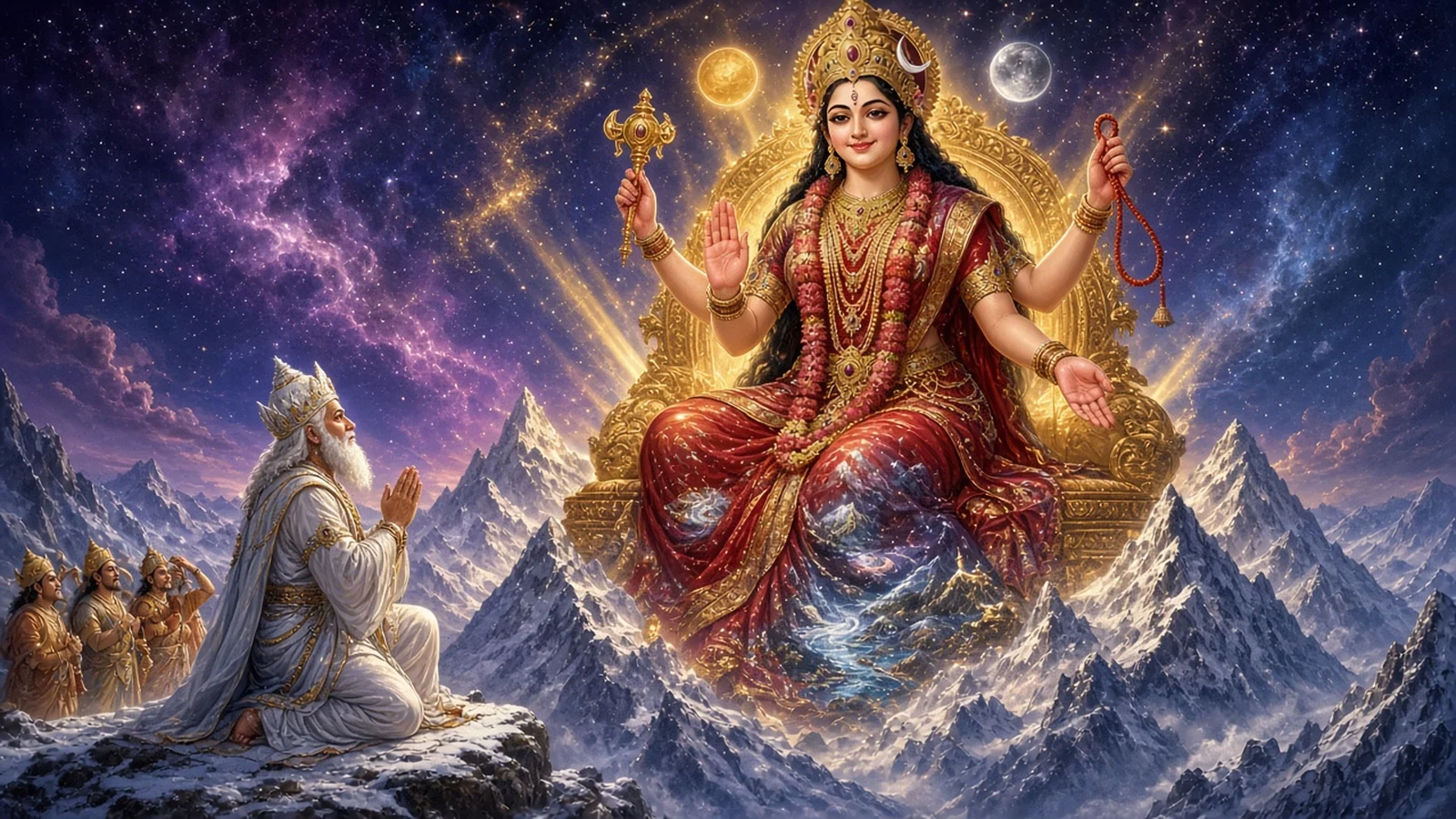
On the ninth day of Chaitra, a Friday, a light broke over them. It was brighter than a crore of suns and moons and lightnings together, and it had no edge anywhere. The gods shut their eyes. When they dared to open them, the light had become a woman with four arms, dressed in red the colour of pomegranate flowers, holding a noose and a goad, and lifting her other two hands to say: ask, and do not fear.
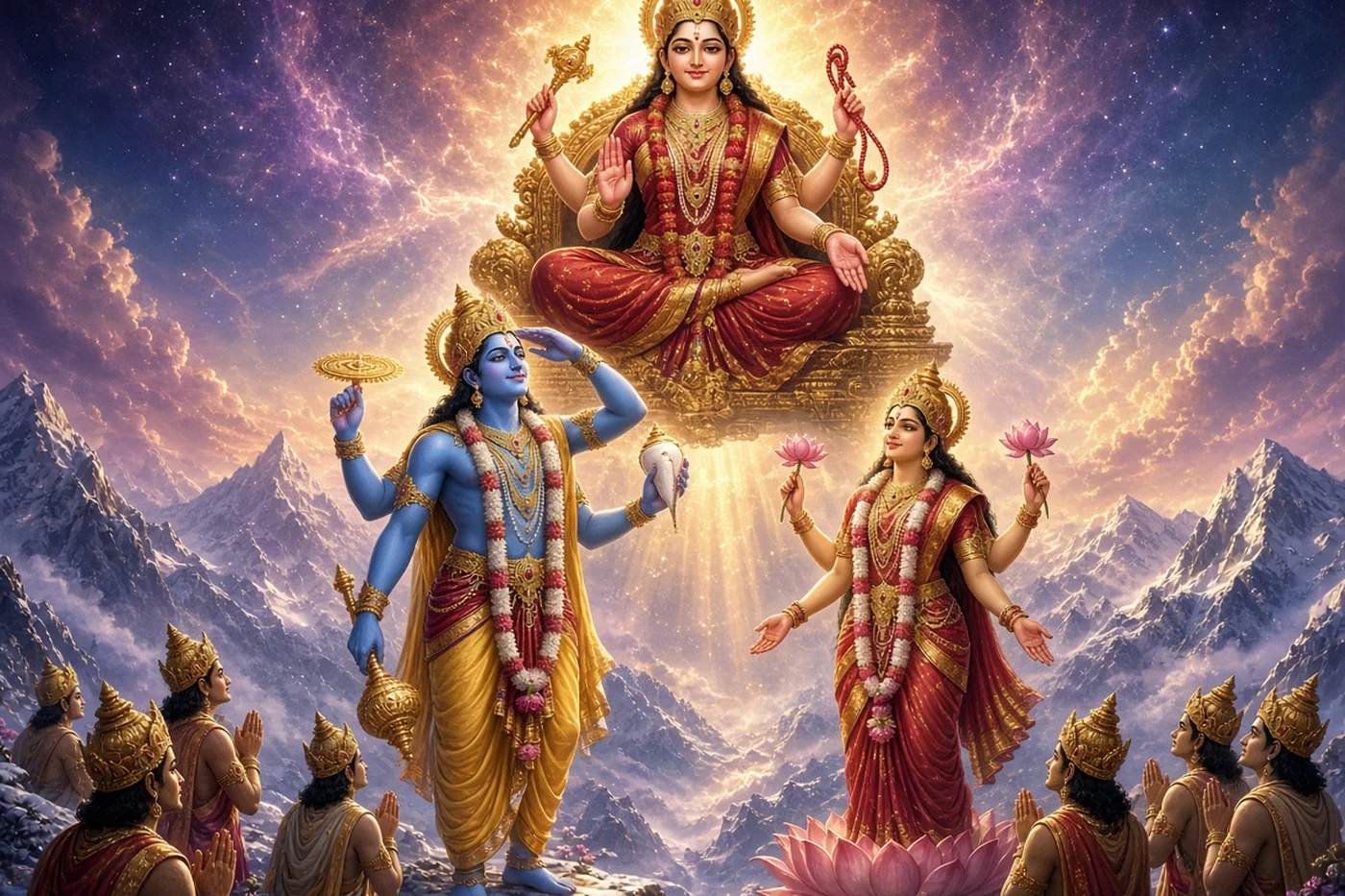
"Why have you come?" she asked them. "I am a wishing tree to those who love me."
They told her about Taraka, and about Sati, and about Shiva alone in the forest.
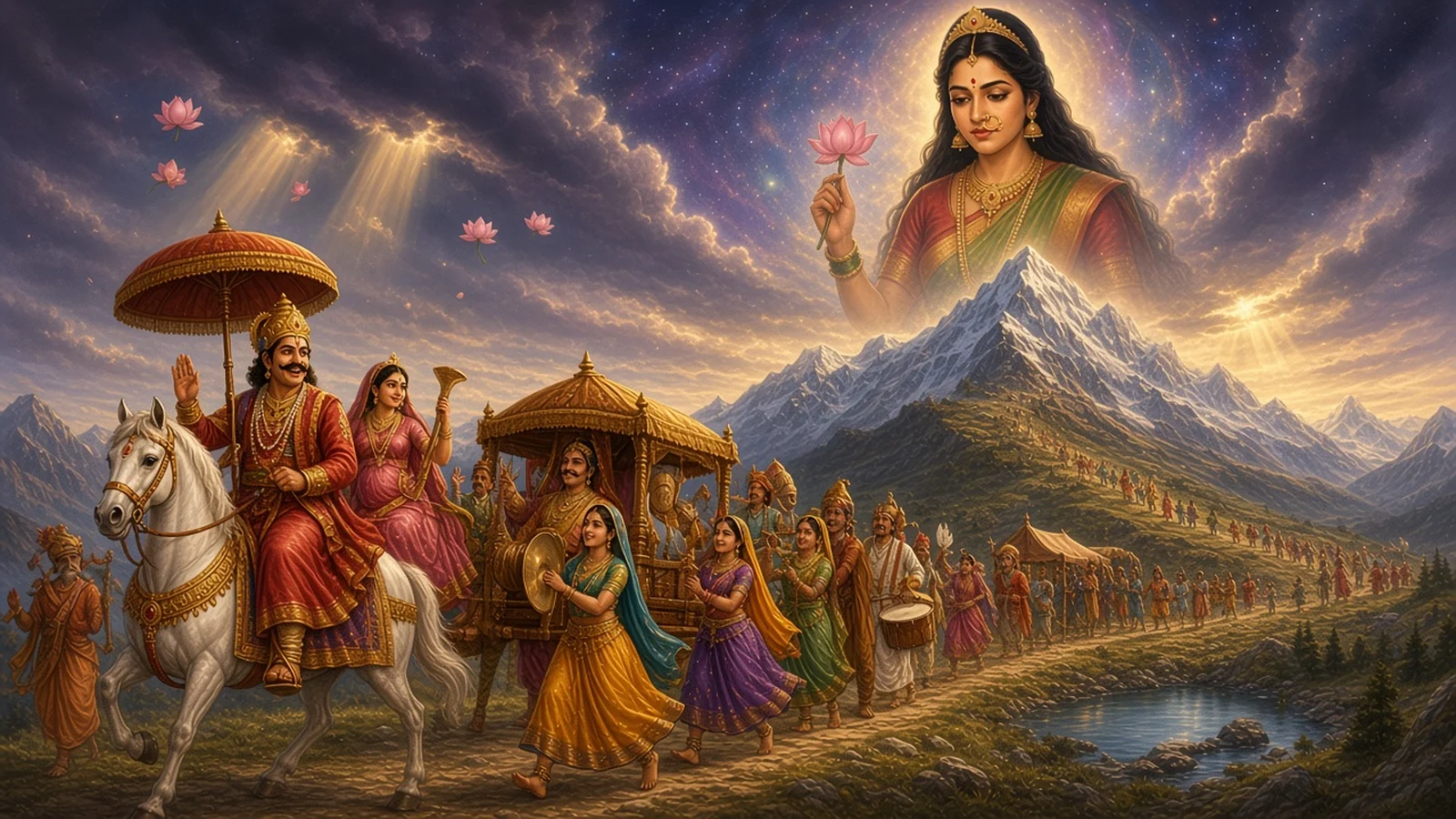
"Then my power will be born as Gauri in the house of the Himalaya," she said. "She will marry Shiva, and their son will kill your demon. The mountain loves me. I would rather be born in his house than anywhere."
Himavat, the mountain king, heard this and could not speak for a while.
"I am to be your father," he said at last. "Then before you come, teach me who you really are. Not what the gods see. What the Vedas mean."
So she taught him, and that teaching is the Devi Gita, the song of the Goddess. She told him that the world was her own power of appearance and that she was the one reality behind it. Brahma, Vishnu and Shiva, the sun and the stars, animals and people, all were she.
"Then show me," said Himavat. "Show me the form that is everything."
The gods agreed, and she showed it.
Her head was the highest heaven. The sun and the moon were her eyes, the four directions her ears, and the Vedas her words. Her heart was the universe. Mountains were her bones, rivers her veins, trees the hair on her body, day and night her two wings, the two twilights her clothes, and four-faced Brahma her eyebrows. Fire poured from her eyes. She had a thousand heads and a thousand feet, she licked the worlds with her tongue, and her teeth ground together with a terrible sound.
The gods could not bear it. They fell down senseless, and they forgot that she was their mother. The Vedas stood round her on four sides, and it was the Vedas who brought them back.
"Forgive us," the gods cried, weeping. "We are afraid. Put this form away. Show us the one we know."
The Mother of the world saw how frightened they were. The terrible body was gone. She sat before them again with the noose and the goad, her face soft and smiling, her eyes kind, and she went on with her teaching as if nothing had happened.
As the Kurma Purana tells it
The first part, chapter 11 · as Bibek Debroy retells it · 2 min read
The Kurma Purana is told by Vishnu as the great tortoise, and in his telling there is no demon and no crowd of gods. There is only a father, a mother and a little girl.
The king of the mountains had done hard penance, and his reward was a daughter. She had chosen to be born. While she was still small, his queen Mena said to him one day that he should look at the child's face, for she had been born for the good of every living thing.
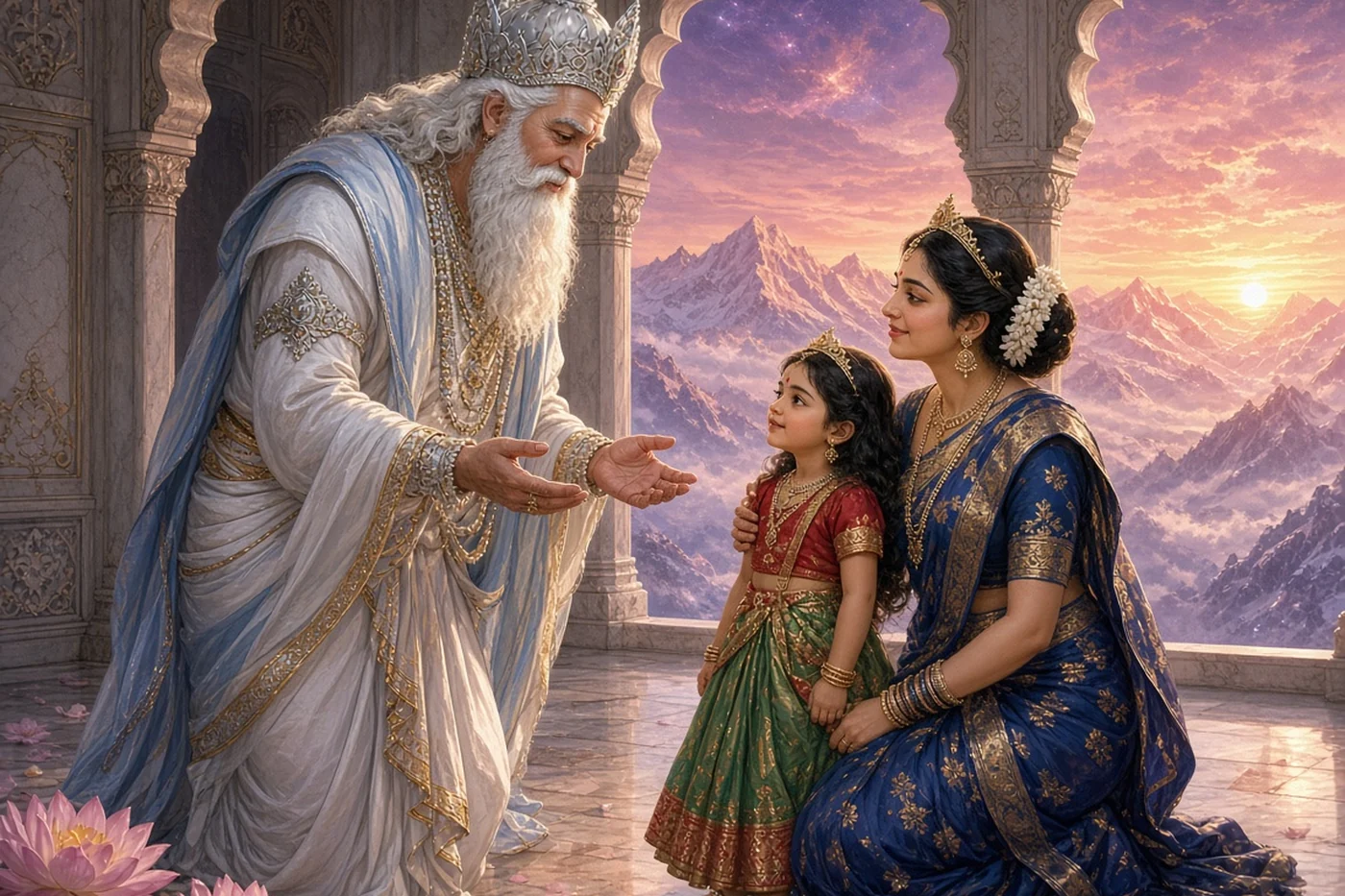
Himavat looked. The face was like the rising sun. She had matted hair, four faces, three eyes and eight arms, and the moon was her ornament. The king's mind shook. He put his head to the ground and joined his hands, and admitted he did not know who she was.
She told him. She was the highest power, resting in Maheshvara and no different from him, living in the self of every creature, the one who carries souls across the sea of birth and death. Then she gave him a new kind of sight, and showed him the form of her powers.
It shone like a crore of suns. Flames hung round it like garlands, like the fires at the end of the world. It had cruel teeth, a mass of matted hair, a crown and a mace, a conch, a discus and a trident. It was terrible and yet its face was calm and kind, and a hundred thousand moons adorned it. It stood inside the egg of the universe and outside it, with hands and faces turned every way.
The king was afraid and glad at the same time. He praised her with a thousand and eight names, and bowed to her as Kala, the time that ends all things, and then to her fair form as Bhavani. Then she told him to hear the secret of the unseen lord, to be calm and free of pride, and to take refuge in her highest form.