As the Devi Bhagavata tells it
Book 3, chapters 2 to 6 · Brahma remembers · 3 min read
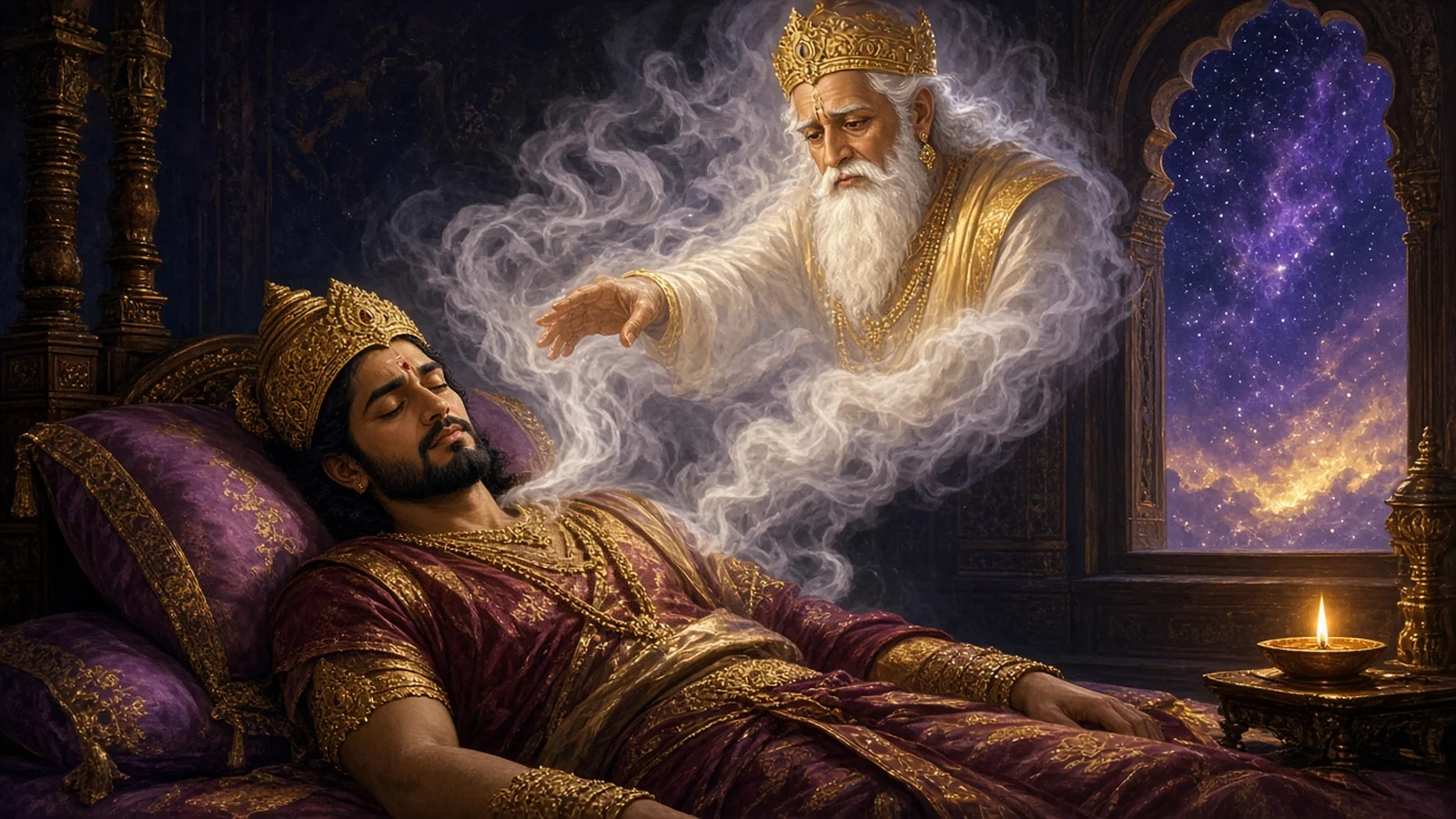
Narada once asked his father Brahma a plain question. Who made this world? Was it you, or Vishnu, or Shiva? Brahma was quiet for a while, and then he told a story about himself that did not flatter him.
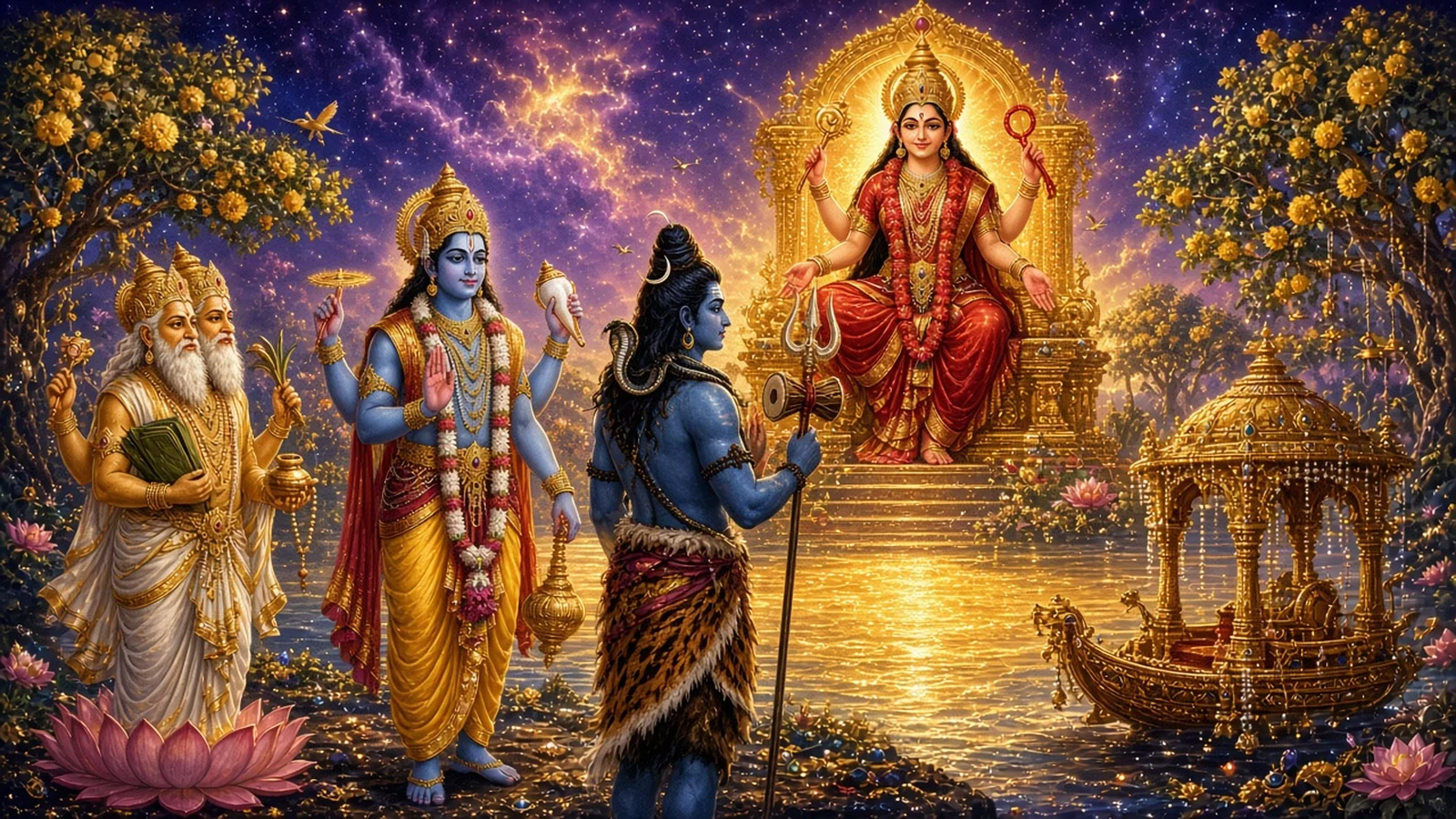
At the beginning there had been only water. Vishnu had woken from his long sleep and killed the two demons who came for Brahma, and Shiva had come to join them. The three gods stood together on the water, and above them, shining in the empty sky, they saw a woman.
"Why are you idle?" she said. "Brahma, make the world. Vishnu, keep it. Rudra, end it when its time comes."
"With what?" said Brahma. "There is no earth here. No elements, no senses, nothing to make anything from."
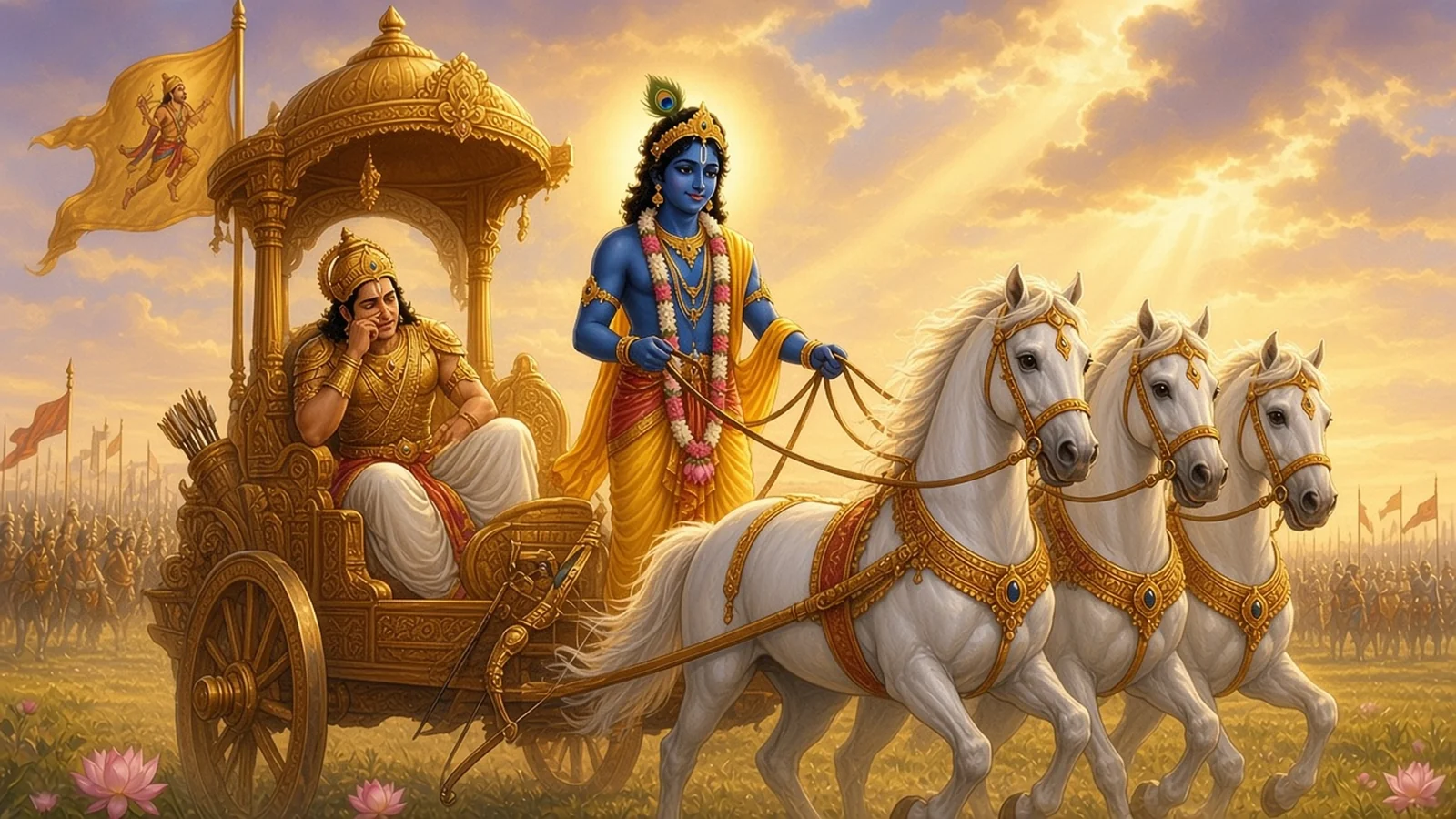
She smiled, and a car stood beside them, hung with pearls and gems and small ringing bells. "Get in," she said. "Do not be afraid."
They got in, and she lifted the car into the sky.
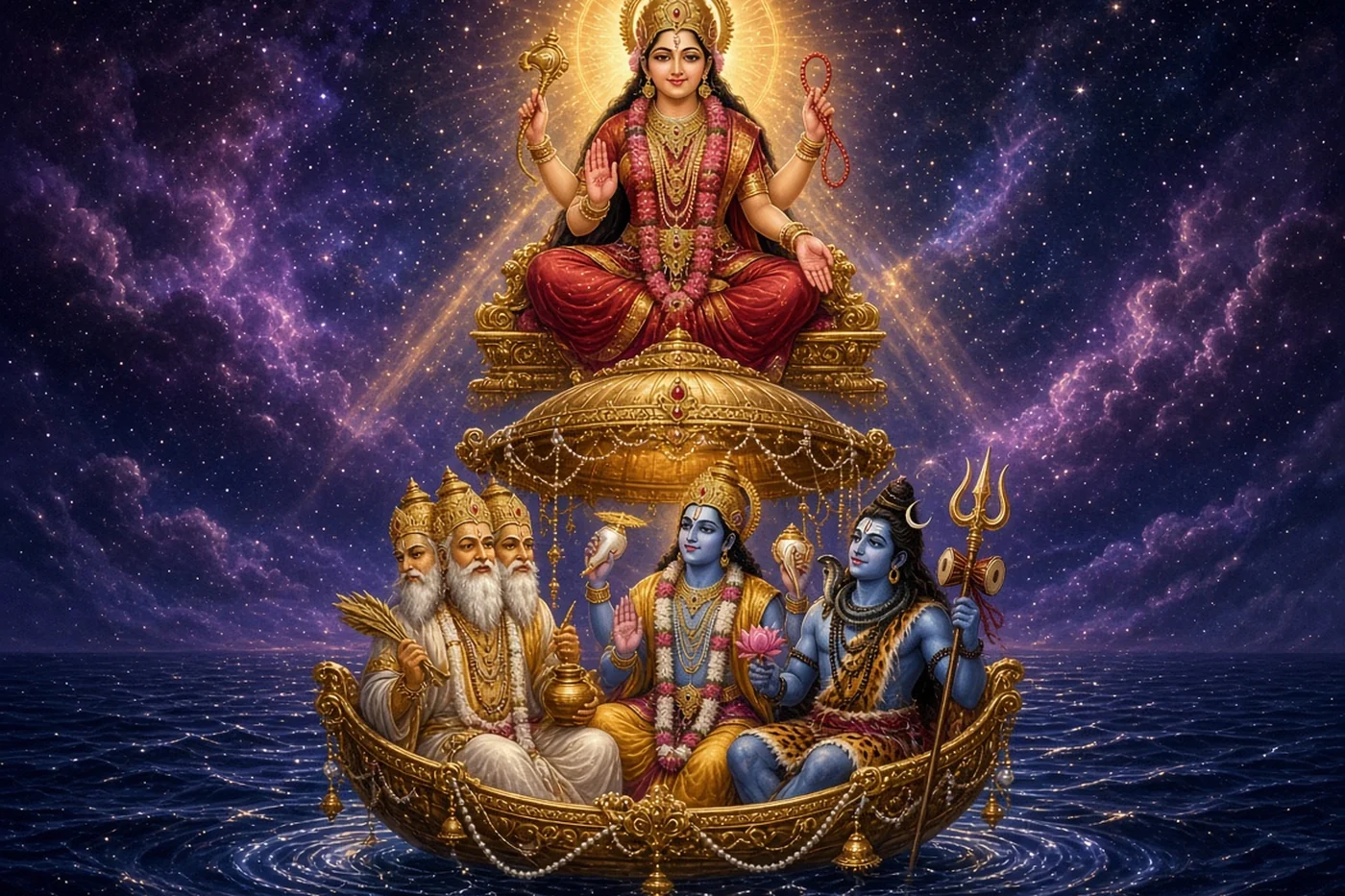
It came down first where the great water had ended, in a green land with cuckoos and fruit trees and rivers. They flew on to a heaven where Indra sat with his queen beside the wishing tree. Then they came to Brahma's own world, and there on Brahma's throne sat another Brahma, with the Vedas standing in his hall.
"Who is that?" Vishnu and Shiva asked.
"I do not know," said Brahma, and the words frightened him.
They came to Kailasa, and found another Shiva there, five-faced, riding his bull, with Ganesha and Kartikeya beside him. They came to Vaikuntha, and found another Vishnu on Garuda, with Lakshmi fanning him. Each god looked at his double and said nothing.
Then they crossed an ocean of nectar and came to an island of gems.
On a couch whose four legs were Brahma, Vishnu, Rudra and Ishvara, and whose top was Sadashiva, sat a woman dressed in red, with a noose and a goad in two hands, the other two granting boons and saying do not fear. The birds in her garden sang one syllable over and over: Hrim. As they watched, her four arms seemed to become a thousand, and her eyes and her feet a thousand.
Vishnu looked at her a long time.
"I know her," he said at last. "When I lay on a banyan leaf as a baby, at the end of an age, she was the one who rocked me and sang to me. She is our mother."
They went up to her gate. She smiled at them, and in that moment the three gods were three young women, dressed in jewels, standing among her maids.
At her feet they looked into the nail of her toe, and the whole universe was in it. They saw worlds and heavens, Brahma on his lotus, Vishnu asleep on his serpent, the two demons of the beginning, and the three of them.
"What are all these?" Brahma whispered.
A hundred years went by while they watched her. Each of them sang to her. Shiva said he would rather serve at her feet as a young woman than rule three worlds, and asked for her mantra of nine syllables, which he had once known and forgotten, and she gave it to him. Brahma confessed that he had thought himself the maker of the world.
"Tell me," he said, "are you a woman or a man?"
"I and the Supreme Being are always one," she said. "The difference you see is a mistake of the eye."
Then she gave Brahma Mahasaraswati, Vishnu Mahalakshmi and Shiva Mahakali, and sent the three away to do their work. They walked out of her gate as men again. They climbed into the car and looked back, and there was no island, no ocean of nectar and no Goddess. Only the car was left, and it carried them home to the dark water where it had all begun.
As the Saundarya Lahari sings it
South India · the hymn ascribed to Shankara · 1 min read
The Saundarya Lahari, the Wave of Beauty, is a hymn and not a story. Nobody travels in it and nobody becomes anyone else. But the poet knows the same island, and stands where the three gods stood.
In the middle of a sea of nectar, he sings, is an island of gems. Wish-giving trees stand round it, and a grove of kadamba. In the grove is a house made of the wishing jewel, and in the house a couch shaped like Shiva, and on it the Goddess. Only a few are lucky enough to worship her there.
He tells how the world is made. Brahma takes up one speck of dust from her lotus feet and builds all the worlds from it. The thousand-headed serpent carries that speck on his hoods, and it is heavy even for him. At the end, Shiva grinds it to powder and rubs it on his body as ash. Making, keeping and ending, all three are done with the dust of her feet.
He tells how the gods work. Brahma creates, Vishnu protects, Rudra destroys, Ishvara draws everything back into himself, and Sadashiva blesses them all. Each of them waits for one thing: a slight movement of her eyebrows.
He tells where they stand. The three gods born of her three qualities wait beside the jewelled stool under her feet, hands folded over their crowns. So whoever worships her feet has worshipped all three at once.
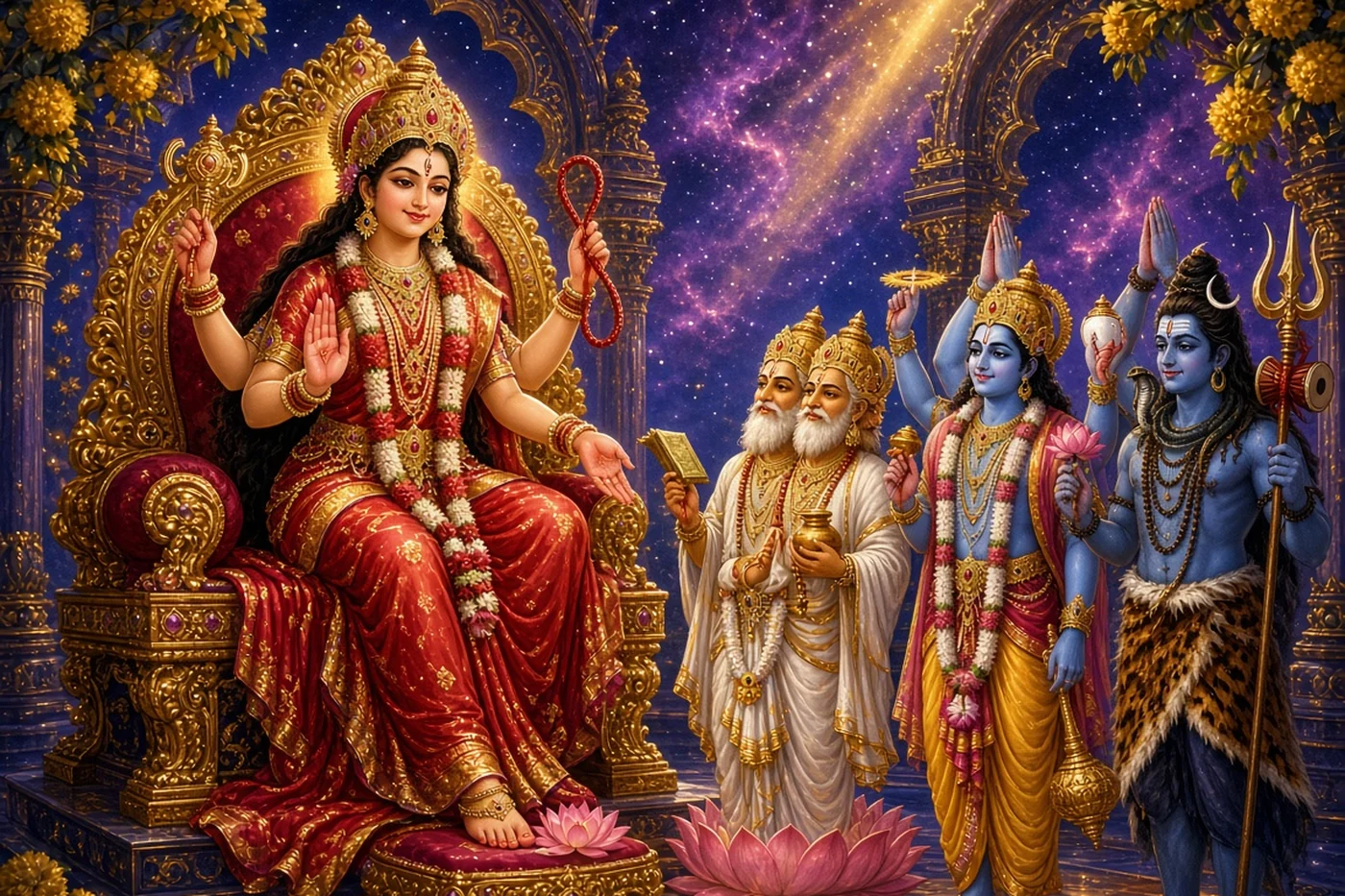
And he tells what her couch is made of. Brahma, Vishnu, Rudra and Ishvara are its four legs. Sadashiva, who is white, lies on it as its cover, and her colour falls on him until he glows red.
The poet asks no question and gets no answer. He does not need to be shown.