As the Bhagavata tells it
Bhagavata Purana 6.6, 6.18, 8.9 and 5.24 · 3 min read
The first sons of Diti were the two great Daityas, Hiranyakashipu and Hiranyaksha, and they had a sister. Her name was Simhika.
Simhika married a Danava, Viprachitti, one of the strongest of the many sons of Danu. She bore him a hundred and one sons. The eldest was Rahu. The hundred who came after him were called the Ketus.
So Rahu grew up in the greatest family of the Asuras. His mother's brother was Hiranyakashipu, the king who made war on Vishnu, and his cousins were Hiranyakashipu's four sons, one of whom was the boy Prahlada, who loved the very god his father hated.
Rahu did not take after his cousin. When the gods and the Asuras churned the ocean for the nectar of deathlessness, he slipped in among the gods in a god's disguise and drank, and the site tells what happened in Mohini and the Pot of Nectar. The Sun and the Moon saw through him. Vishnu's razor-edged discus took off his head.
The body had not touched the nectar, and it died. The head had, and it could not.
So there it was: a head without a body, which nothing in the three worlds could kill. Brahma, the grandfather of the worlds, looked at it and decided what was to be done.
"This head has tasted the drink of the gods," he said. "It will not die, so it must have a place. Let Rahu be counted among the planets."
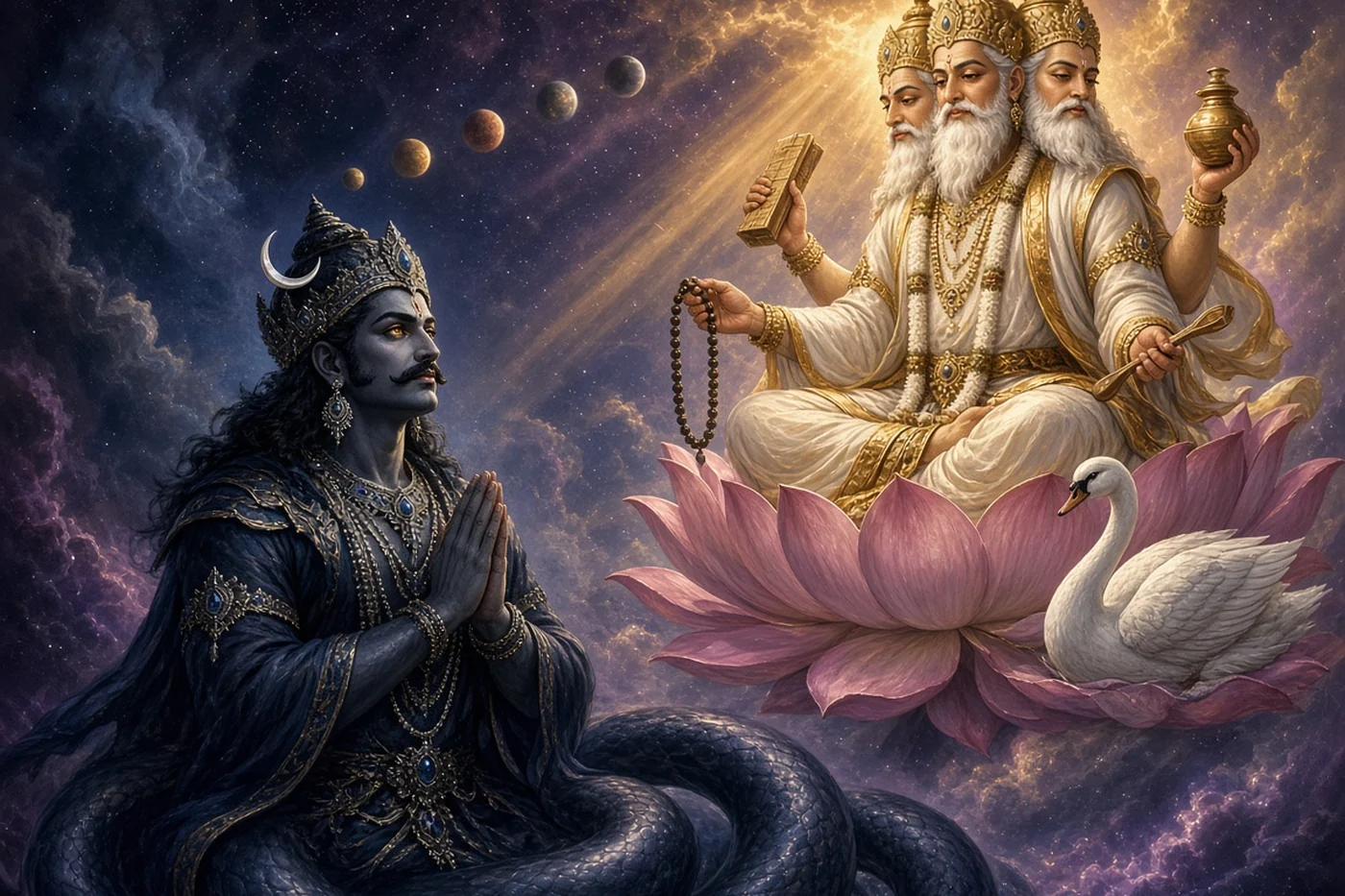
That is how the eldest son of Simhika came to stand in the sky. The Bhagavata says it plainly: he was the worst of the Asuras and had no right to a god's seat, and he held it only by the grace of the Lord.
His place is below the Sun, ten thousand yojanas down. The Bhagavata even gives his size. The Sun's globe is ten thousand yojanas across and the Moon's twenty thousand, but Rahu's is thirty thousand, the biggest of the three.
He did not forget who had given him away.
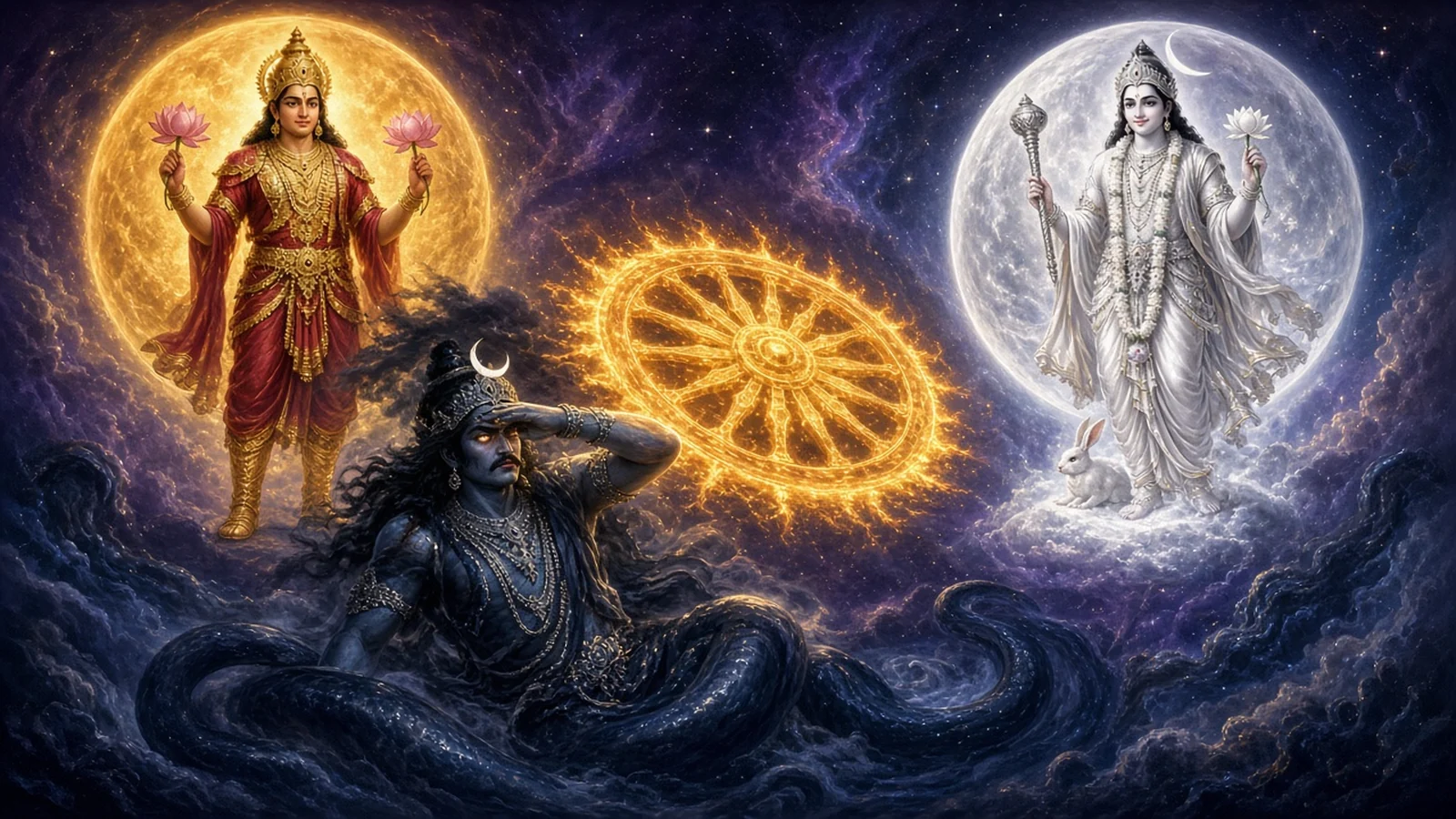
On the day of the dark moon, when the Moon stands close beside the Sun, and on the night of the full moon, when they face each other across the sky, Rahu rose and tried to cover their light.
The Sun and the Moon went to Vishnu.
"He comes at us again and again," they said. "At the new moon and at the full moon he rushes up from below and tries to swallow our light. Protect us."
"My discus will guard you," Vishnu said.
He sent the Sudarshana, the wheel that had cut through Rahu's neck. It went to the Sun and the Moon and turned beside them, blazing.
Rahu came up as always, mouth open. But the heat of the discus met him. It was more than he could bear, and he turned and fled.
He has never stopped trying. Each time the time comes round he rises toward the Sun or the Moon, and each time the wheel drives him back before he can keep them. For as long as he troubles them, the light goes dim, and that, the Bhagavata says, is what people call an eclipse.
As the Vishnu Purana and the Mahabharata count it
Vishnu Purana 1.21 and 2.12, Mahabharata, Adi Parva 65 · 2 min read
The Vishnu Purana sets out the same family and then surprises the reader. Viprachitti is there among the sons of Danu, and Simhika, the sister of Hiranyakashipu, is his wife. It names their sons one after another: Vyamsa, Shalya the strong, Nabha, Vatapi, Namuchi, Ilvala, Khasrima, Anjaka, Naraka, Kalanabha, the valiant Svarbhanu and the mighty Vaktrayodhi.
There is no Rahu in the list. The name that stands where he ought to be is Svarbhanu, the old Vedic name for the darkener of the Sun. The Purana's English translator, H. H. Wilson, noticed the gap in 1840 and wrote in a note that the text leaves out the two most famous sons of Simhika, Rahu the eldest and Ketu, whom the Bhagavata and the Vayu Purana both name. The Vayu adds that all the other brothers were killed by Parashurama.
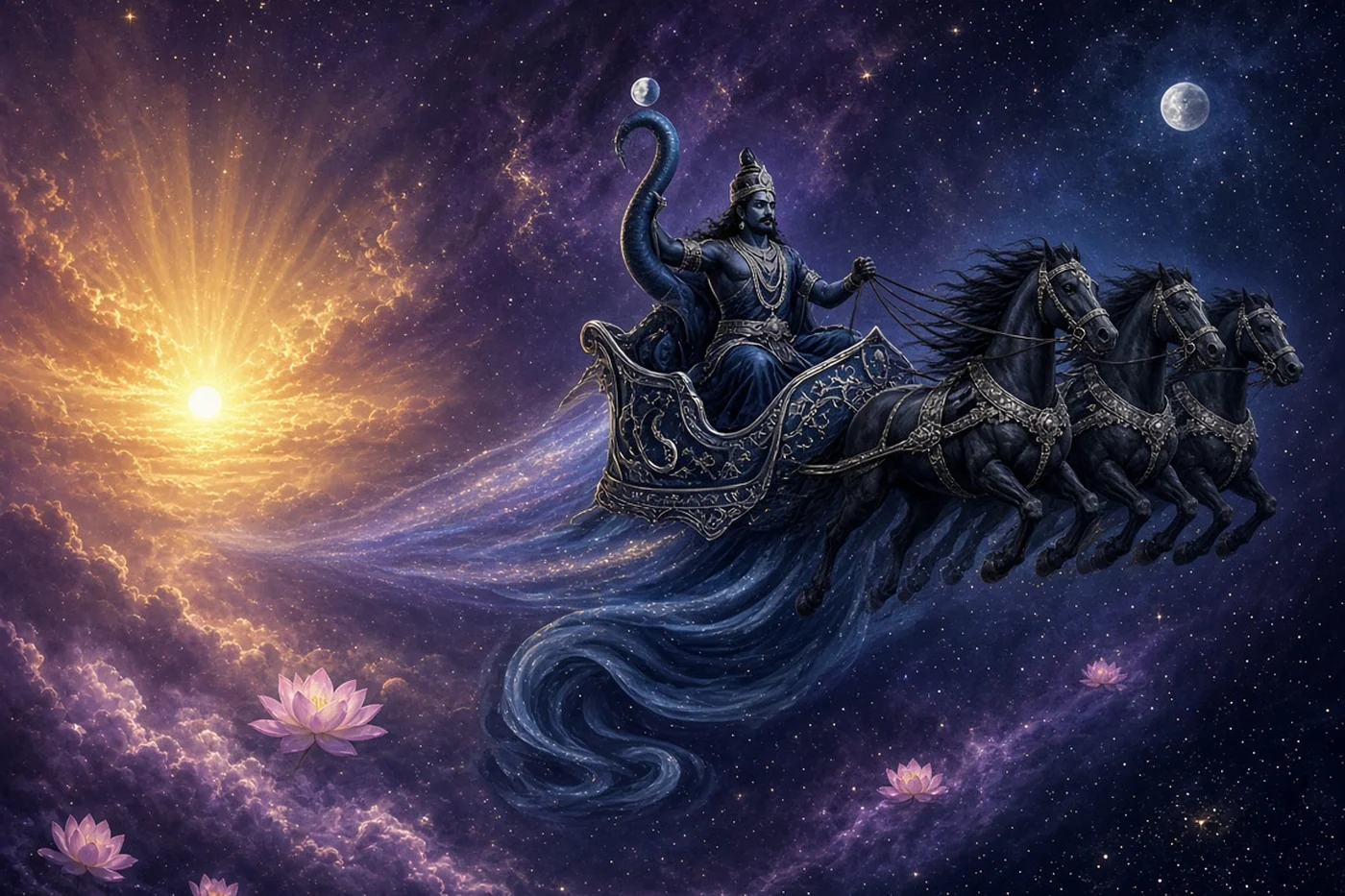
The same Purana gives Rahu something the Bhagavata does not, a chariot. Among the cars of the planets, his is the dusky one. Eight black horses draw it, harnessed once and never taken out of the traces. On the days of the nodes he drives it from the Sun to the Moon and back from the Moon to the Sun. Ketu's chariot has eight horses too, the dull red of lac, or of smoke from burning straw. Some other Puranas, Wilson adds, say that on those days Rahu takes up the round shadow of the earth.
The Mahabharata draws the family another way. In its count of the creatures, Simhika is one of the thirteen daughters of Daksha, the mothers of all the beings that sprang from the sage Kashyapa, and there is no Viprachitti beside her. She bears Rahu, whom the epic calls the persecutor of the Sun and the Moon, and three more sons whose names all speak of the Moon's ruin: Suchandra, Chandrahantri and Chandrapramardana.