Purana eraSmarta · The head that drank the nectar and could not die, son of Simhika, who chases the Sun and the Moon across the sky and swallows them in every eclipse
Rahu
Rahu is a head without a body. He was an Asura who slipped in among the gods at the churning of the ocean and drank the nectar of deathlessness before anyone noticed. The Sun and the Moon noticed.
Also calledSvarbhanuSaimhikeyaRahu Bhagavanthe north nodethe eclipse demon
In short
Who is Rahu?
The Asura who drank the nectar of deathlessness in a god's disguise and lost his head for it. The head could not die, and it became one of the nine planets, the north node of the Moon.
Why does Rahu swallow the Sun and the Moon?
Because they gave him away. At the churning of the ocean the Sun and the Moon pointed him out, and ever since he has gone after them at the new moon and the full moon. Each time he troubles them is an eclipse.
What is Rahu Kalam?
A stretch of about an hour and a half in every day that is held to belong to Rahu. People avoid beginning anything new in it, and temples such as Thirunageswaram choose it for his worship.
Are Rahu and Ketu the same demon?
In the usual telling they are the head and the body of one Asura, cut apart by Vishnu's discus. The Bhagavata counts them differently, as Rahu and his hundred brothers, the Ketus.
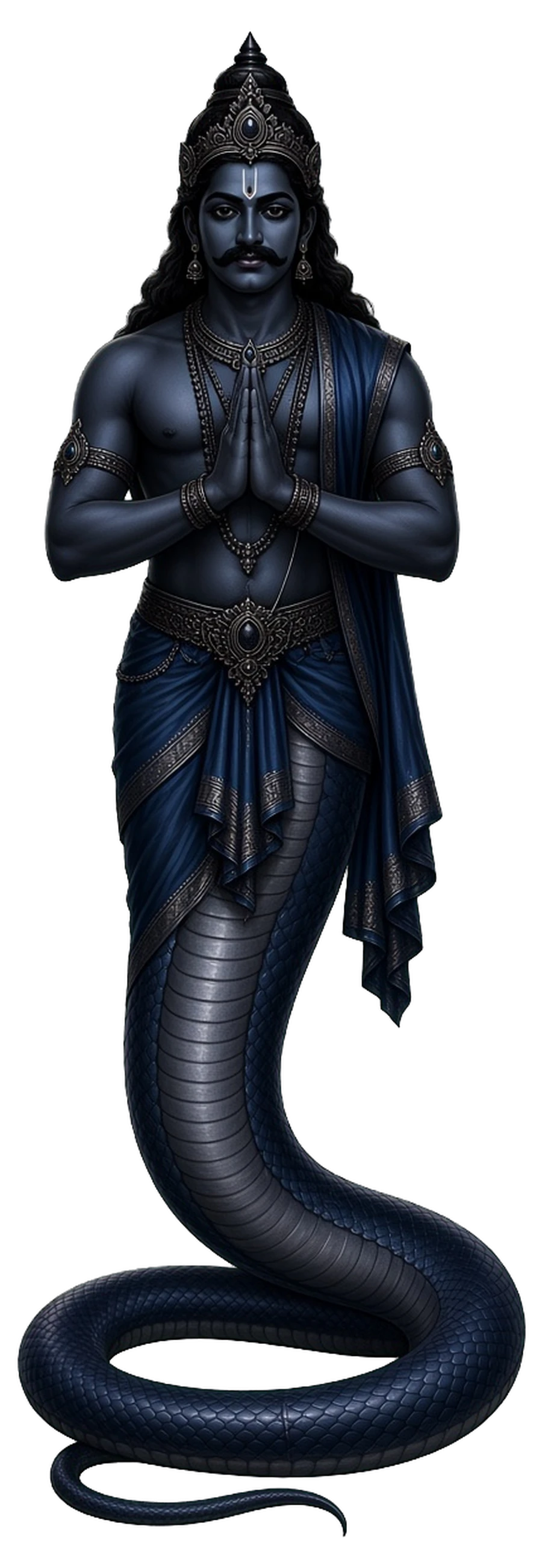
or a head rising from a serpent's coils; the hymn calls him the half-bodied one
ChariotA dusky car drawn by eight black horses, harnessed once and never unyoked
Who Rahu is
Rahu is a head without a body. He was an Asura who slipped in among the gods at the churning of the ocean and drank the nectar of deathlessness before anyone noticed. The Sun and the Moon noticed. They gave him away, and Vishnu's discus took off his head while the drink was still in his throat. The body died. The head had tasted the nectar, and it could not.
Brahma gave the immortal head a place among the planets, and from there Rahu has never stopped hunting the two who betrayed him. At the new moon and the full moon he rises to swallow the Sun or the Moon, and for as long as he holds them the light goes dim. That is an eclipse. Because he has no body, people say, they always come out again.
The site tells how it began in Mohini and the Pot of Nectar, and in The Day the Sun Went Dark, where the old Vedic darkener Svarbhanu and the epic's Rahu meet and the Sun's anger nearly burns the world. In Hanuman Leaps for the Sun, Rahu arrives for his eclipse and finds a baby monkey sitting on the Sun's chariot. The Head That Became a Planet tells his family and how the head came to its seat in the sky. The Face at Shiva's Door tells the day he carried a demon king's insolent message to Kailasa and was nearly eaten. The Milk That Turns Blue tells how he came to live in a forest near Kumbakonam.
He is the son of Simhika, and the hymn to the nine planets greets him by his mother's name:
Ardhakayam mahaviram chandraditya vimardanam, simhika garbha sambhutam tam rahum pranamamyaham: The half-bodied, the great warrior, who torments the Moon and the Sun, born of Simhika's womb, Rahu, I bow to you.
Rahu is feared the way Shani is feared. Where he stands in a person's chart, people expect deceit, delusion and obstacles, and the hour and a half of every day that belongs to him, Rahu Kalam, is kept free of new beginnings. But he can be gentle too. At Thirunageswaram he sits with his two wives in a human form, and devotees believe the milk poured over him there turns blue. At Srikalahasti the temple stays open in an eclipse so that he and Ketu can be worshipped at the very hour they are at work.
Before the Puranas
The Vedic roots of Rahu
The Vedas know the eclipse demon but not yet by Rahu's name. In Rigveda 5.40 the darkener of the Sun is Svarbhanu, an Asura who pierces the Sun with darkness until Indra breaks his magic and the priest Atri finds the Sun again with a prayer. The Taittiriya Samhita and the Shatapatha Brahmana tell the same eclipse with other rescuers. The name Rahu first appears in the later Vedic books: the Atharvaveda (19.9.10) asks the Adityas to be kind "with Rahu", and the Chandogya Upanishad (8.13) pictures the freed soul getting loose like the Moon from Rahu's mouth. Neither text tells his story.
The story comes in the Mahabharata. There Rahu is a Danava who drinks the nectar at the churning, is pointed out by the Sun and the Moon, and loses his head to Vishnu's discus; the head flies roaring into the sky and swallows them ever after. The epic also gives him a mother, Simhika, and calls him the persecutor of the Sun and the Moon. Later tradition joined the Vedic and the epic names and said that Svarbhanu had been Rahu all along.
The Puranas fill in the rest. The Bhagavata makes Simhika the sister of Hiranyakashipu and the wife of Viprachitti, gives Rahu a hundred brothers called the Ketus, and has Brahma accept the head as a planet; it measures his globe and sends Vishnu's discus to guard the two lights. The Vishnu Purana harnesses eight black horses to his chariot.
The astronomers took him over and changed him. In the sixth century Varahamihira's Brihat Samhita set out the popular views of Rahu, a head that tasted ambrosia, a black disc seen only at eclipses by Brahma's boon, a serpent cut in two, and then argued against them: a lunar eclipse is the Moon passing into the earth's shadow, and a solar eclipse is the Moon covering the Sun. In Indian astronomy Rahu became a point, the node where the Moon's path crosses the Sun's, and as that point he and Ketu still stand among the nine planets.