As the Harivamsha tells it
Harivamsha, Harivamsha Parva 25 · 3 min read
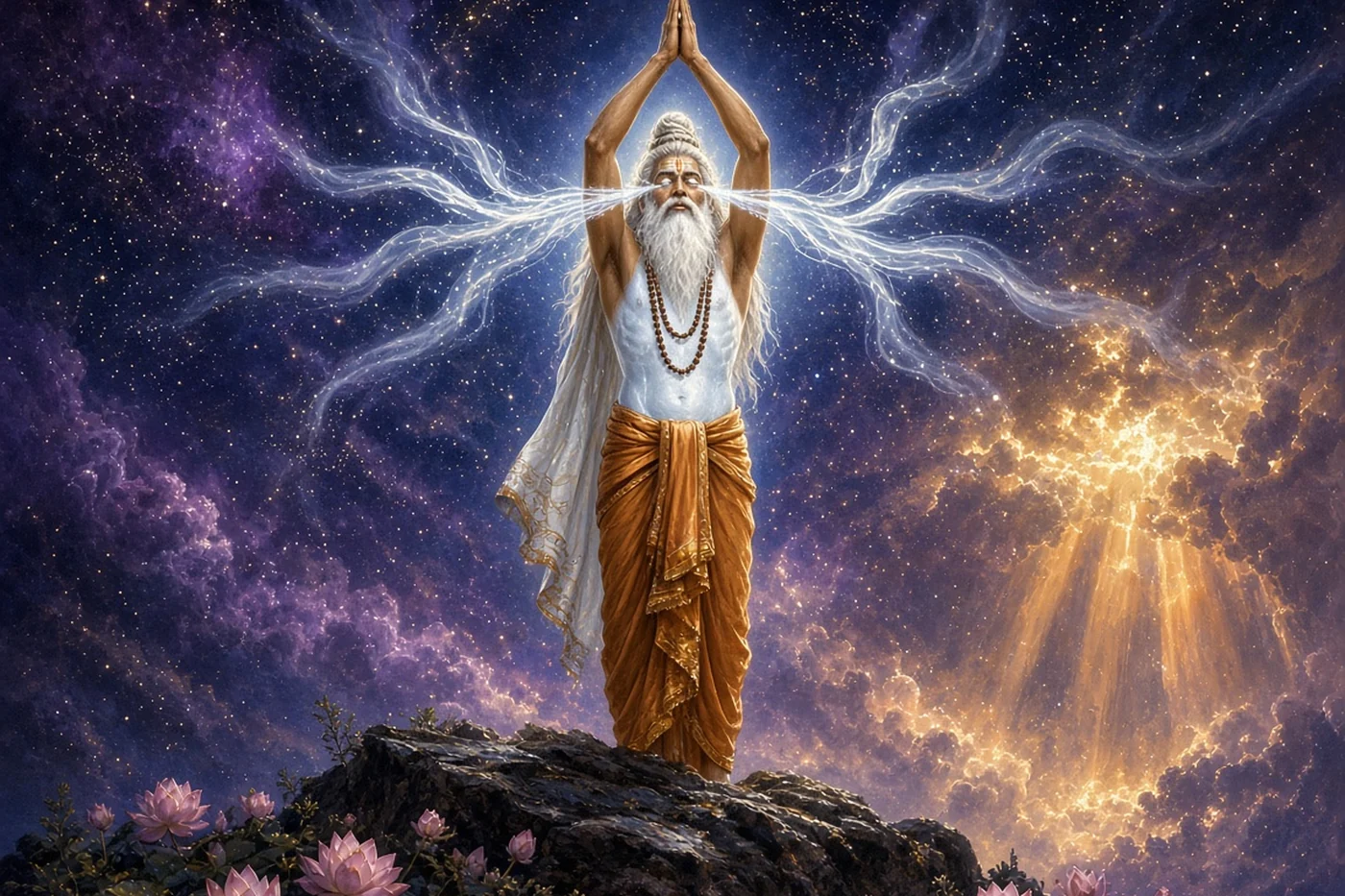
Atri was one of the sons Brahma made from his own mind, and he wanted children. He did not pray for them in words. He stood with his arms raised over his head and said nothing at all, and he went on standing like that for three thousand years of the gods.
Somewhere in those years his body began to change. A soft light came into it, cool and pale, the light of the moon. It grew until it spilled out of him and spread across the sky. Then the light found its way out through his eyes. Tears ran down the sage's face, and they did not stop at the ground. They flowed out into the ten directions, east and west, north and south, the corners between, and the regions above and below.
The ten directions are goddesses, and they took the light into themselves, each in her own way, as a mother carries a child. But it was too bright and too heavy for them, even all ten together.
"We cannot hold it," they cried. "It is slipping from us."
The shining child fell out of the directions and dropped toward the earth, and as it fell it lit up every quarter of the world at once.
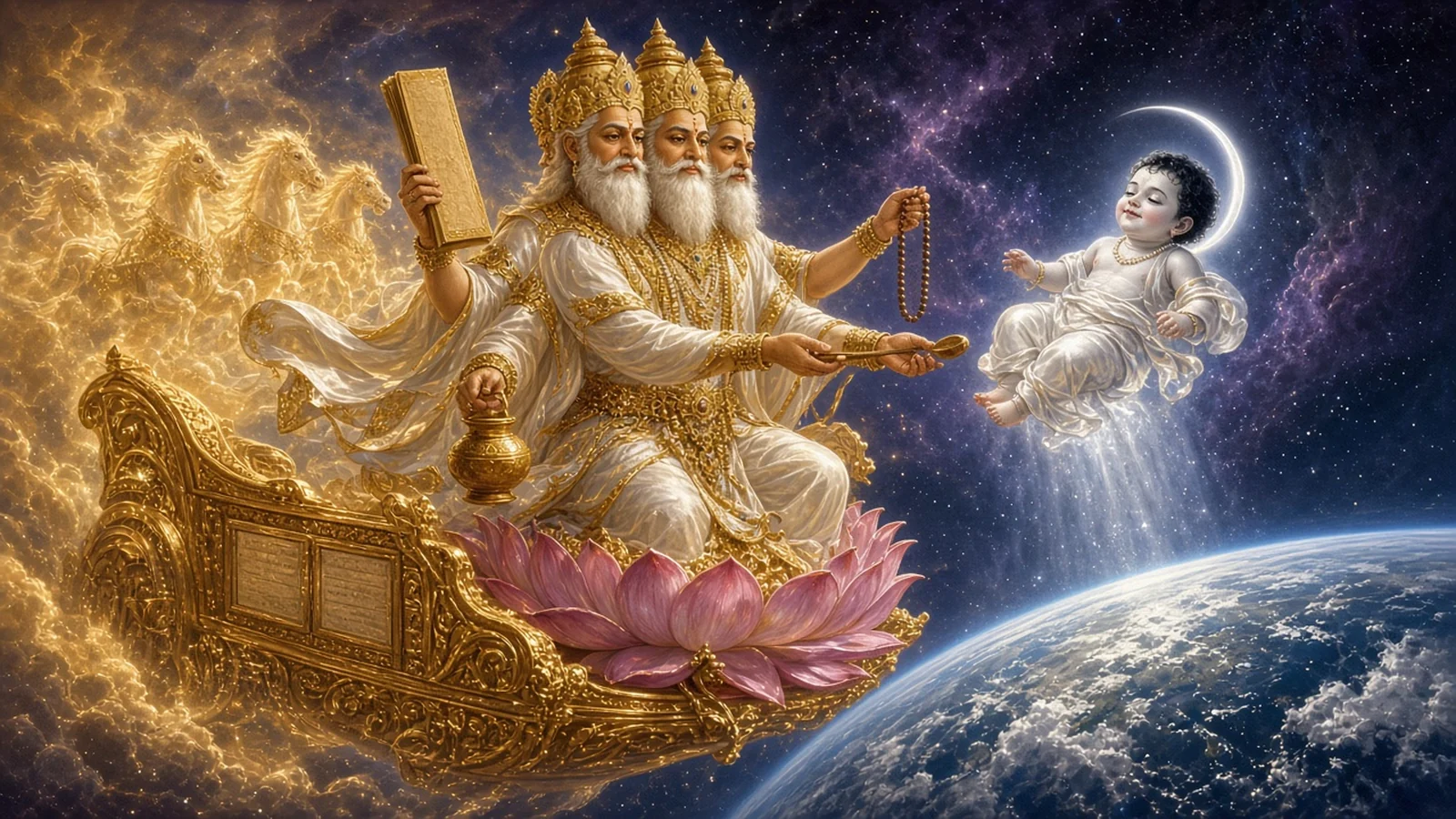
Brahma saw it falling. He came down at once in a chariot made of the Vedas, drawn by horses that were mantras, and he caught the Moon and lifted him up onto it.
"Come up, son of Atri," he said. "The worlds need you."
Then all heaven came out to see. The gods sang, and Brahma's seven mind-born sons sang. The sons of Angiras sang to him, and Bhrigu with his sons, in the verses of the Rigveda and the Yajurveda. With every hymn the Moon grew brighter, until his light gathered itself into a round in the sky and lit the three worlds.
"Drive," said Brahma, "and let the earth see you."
The Moon drove Brahma's chariot round the earth and its oceans, and round again, twenty-one times in all. As he went, light melted from the chariot and dripped down to the ground below. Wherever it fell, plants came up, and they glowed. Those are the plants that feed everyone: the gods and the ancestors, people and cattle, birds and snakes.
When his round was done, the Moon did not rest. He sat down to a penance of his own, and it lasted a thousand Padma years, a span the old books count in one of their largest numbers. When he rose from it, Brahma gave him a kingdom.
"You are king of the seeds and the plants," Brahma told him, "of the Brahmanas and of the waters."
Daksha gave him his twenty-seven daughters, the stars, to be his wives, and the young king held the Rajasuya, the great sacrifice of a crowned king, with Atri his father as one of the priests and Brahma himself as another. He gave away ten million cows that day and shone over all ten directions, the same ones that had once let him fall.
What came of that glory, and of the wives, is told in other stories.
As the churning tells it
Mahabharata, Adi Parva 18 · Vishnu Purana 1.9 · 2 min read
In the other story the Moon has no father at all. He comes out of the sea.
The gods and the Asuras wanted the nectar that would make them deathless, and they agreed to churn the ocean for it. They pulled up Mount Mandara for a churning stick, wound the great serpent Vasuki round it for a rope, and set the mountain on the back of the king of the tortoises. Then they pulled, the Asuras at the head and the gods at the tail, and the mountain turned.
The Mahabharata tells what the churning did to the sea. Trees on the mountain crashed into the water and caught fire, and Indra put the fire out with rain. Their gums and the juices of many herbs, with an essence of gold, ran into the sea. The water turned to milk, and from the milk, as the churning went on, came clarified butter. And the first thing that rose out of it was the Moon, calm, with a thousand rays.
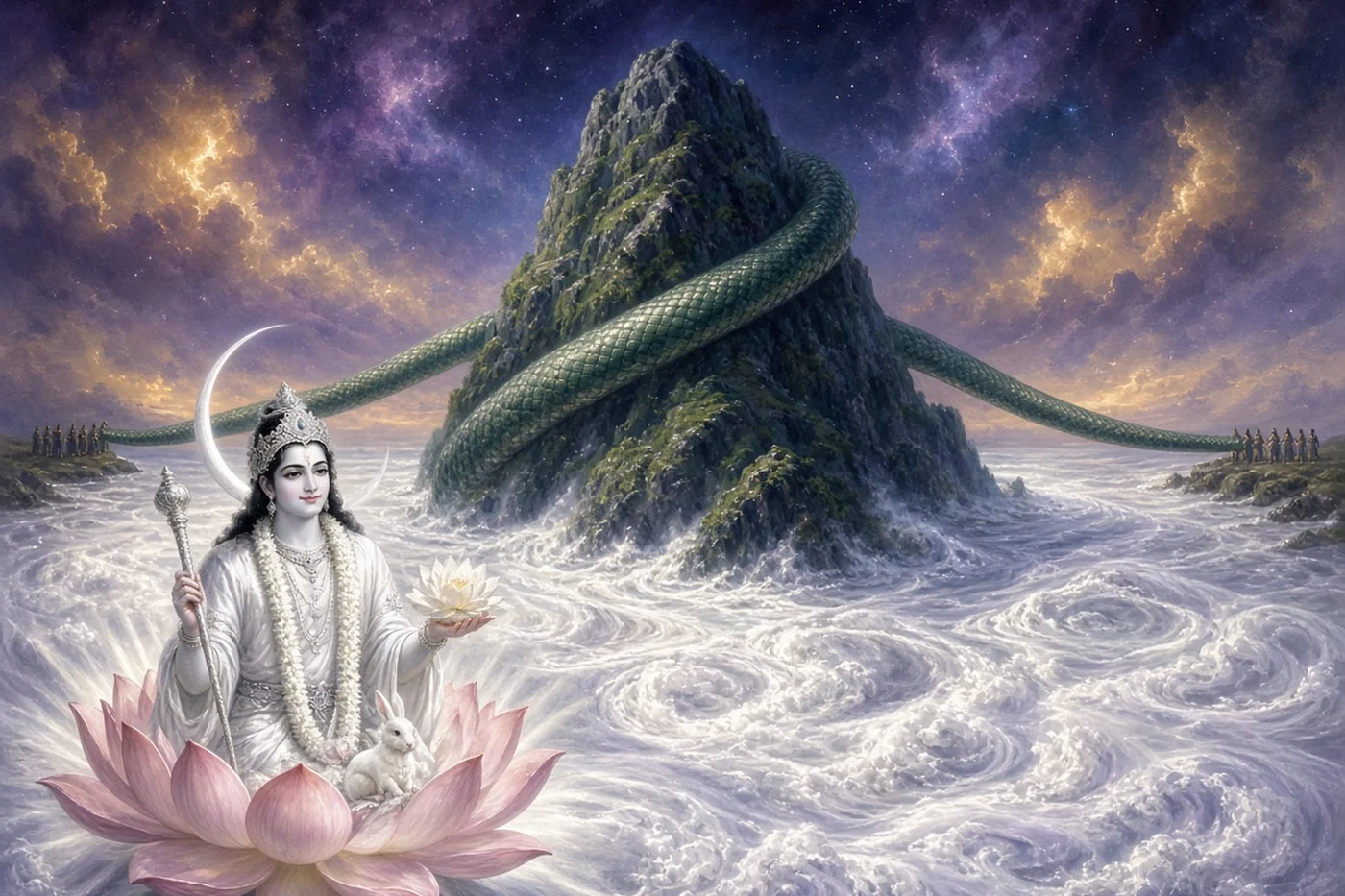
After him came Lakshmi in white, the white horse, the jewel Kaustubha for Narayana's breast, and at last Dhanvantari with the white pot of nectar. The epic does not say where the Moon went.
The Vishnu Purana churns the same sea after the sage Durvasa's curse, and its gifts come up in another order. First Surabhi, the cow of plenty, then Varuni, then the Parijata tree with its scent, then the heavenly dancers. After them the mild-rayed Moon rose out of the milk.
Maheshvara took him.
The Purana says nothing more than that, and in the next breath the serpents take the poison, Dhanvantari walks up with the nectar, and Sri rises on her lotus. But the hymn to the nine planets remembers both these things together when it greets the Moon: born of the ocean of milk, and the jewel in Shambhu's crown.