As the Shiva Purana tells it
Rudra Samhita, Sati Khanda 12 to 20 · Told across India · 3 min read
Brahma wanted Shiva married, and only one bride would do: the goddess herself, the power that was always Shiva's own. So he sent his son Daksha to ask her to be born.
Daksha went to the northern shore of the ocean of milk and prayed there for three thousand years of the gods. He lived on air, then on water, then on leaves. At last the goddess stood before him, as vast as the world.
"Choose a boon," she said.
"Be born as my daughter," said Daksha, "and become Shiva's wife. No one else can win him."
"I will," she said. "In every age of creation I will be born your daughter, and I will be his. But hear this. If you ever hold me in less respect, I will give up that body." Then she was gone, and Daksha went home happy.
She was born to Daksha's wife Virini in the tenth month, and Daksha knew at once whom he was holding. He named her Uma. She grew like the waxing moon. She played with the other girls, but every day she drew pictures of Shiva, and when she sang she was thinking of him.
One day Brahma came to the house with Narada and saw her.
"Child," he said, "win the lord of the universe for your husband."
She asked her mother's leave and began a year of vows at home, each month with its own day and its own offering. In Ashvina she offered rice cooked with jaggery. In Kartika she offered sweet cakes. On the full moon of Magha she kept awake all night and worshipped on a riverbank in wet clothes. In Phalguna she offered bilva leaves every three hours through the night, and in Jyeshtha she fasted for a month. When the vows were done she sat and thought of Shiva alone.
The gods came to see her penance. Then Brahma and Vishnu went up to Shiva.
"Marry," they said. "The world needs it."
"Marriage is a great bondage," said Shiva. "I am a yogi. But if I must, find me a woman who is a yogini when I sit in yoga and a loving wife when I love. She must never break my meditation. And she must never disbelieve what I tell her, or I will leave her."
"She is already waiting for you," said Brahma. "Daksha's daughter."
"So be it," said Shiva.
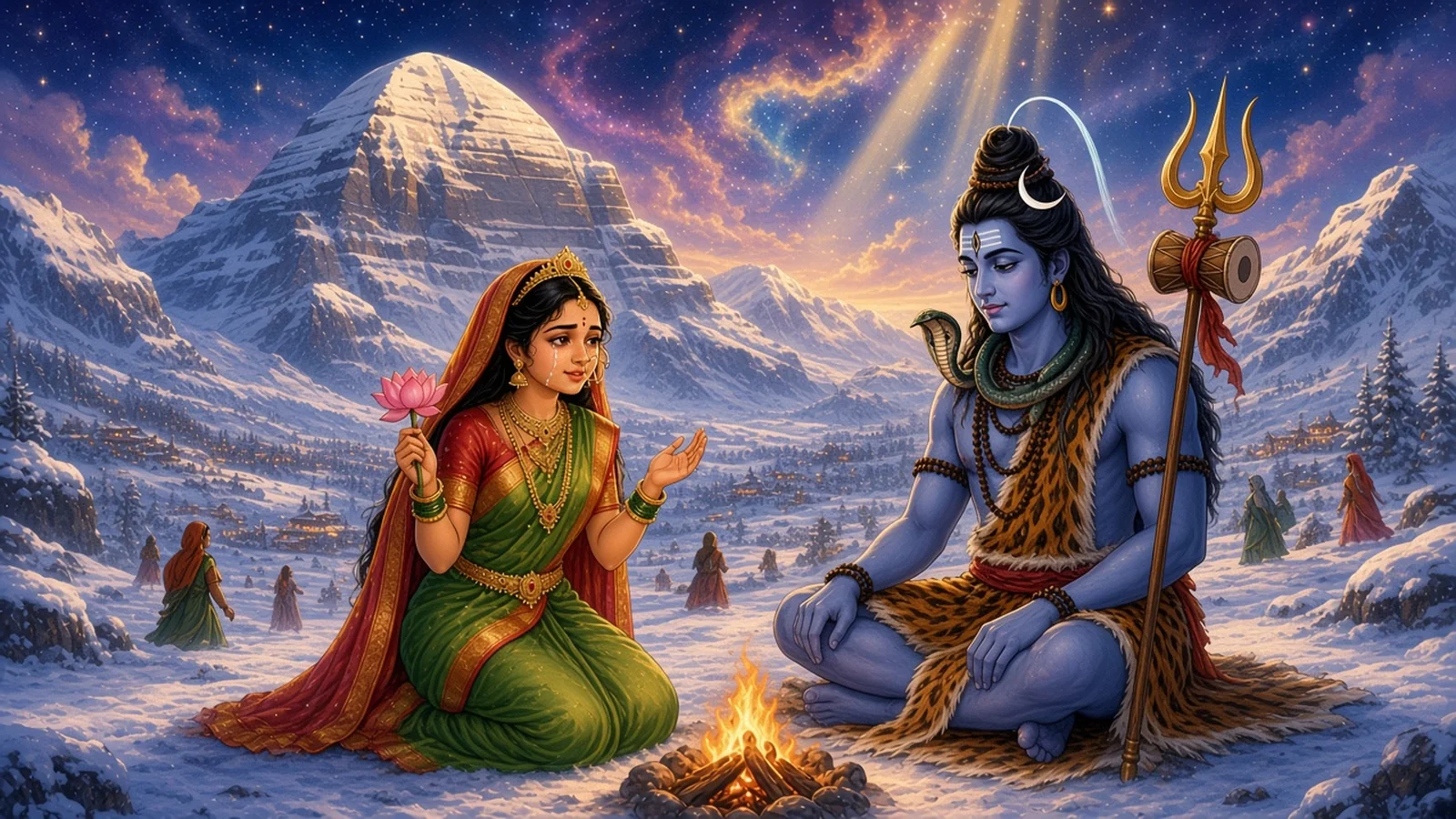
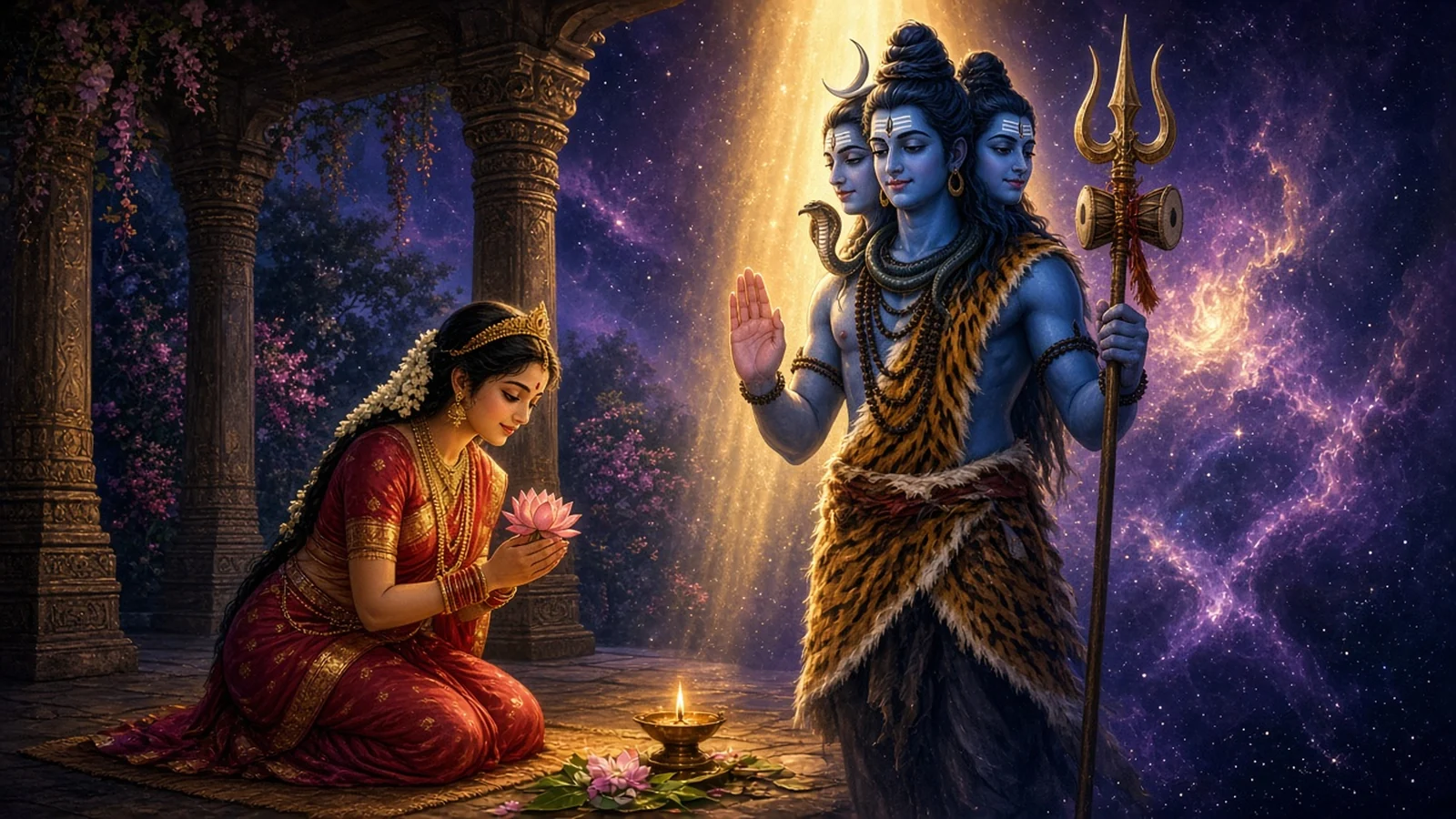
In Ashvina, on the ninth day, while Sati sat in meditation, Shiva stood before her with five faces and three eyes.
"Choose a boon," he said. "Whatever you wish."
She bent her head, too shy to speak. She began to ask, and before she could finish he said, "Be my wife."
For a while her joy had no words. Then she found her voice.
"Then marry me in front of my father," she said.
"So be it," said Shiva.
Brahma carried the word to Daksha, who was overjoyed, and brought his answer back. On the thirteenth day of the bright half of Chaitra, under the star Uttara Phalguni, Shiva rode to Daksha's house on his bull with the gods behind him. Daksha welcomed him humbly, and knelt before his own father Brahma to ask him to be the priest. Then he gave his daughter to Shiva, and Shiva took her hand.
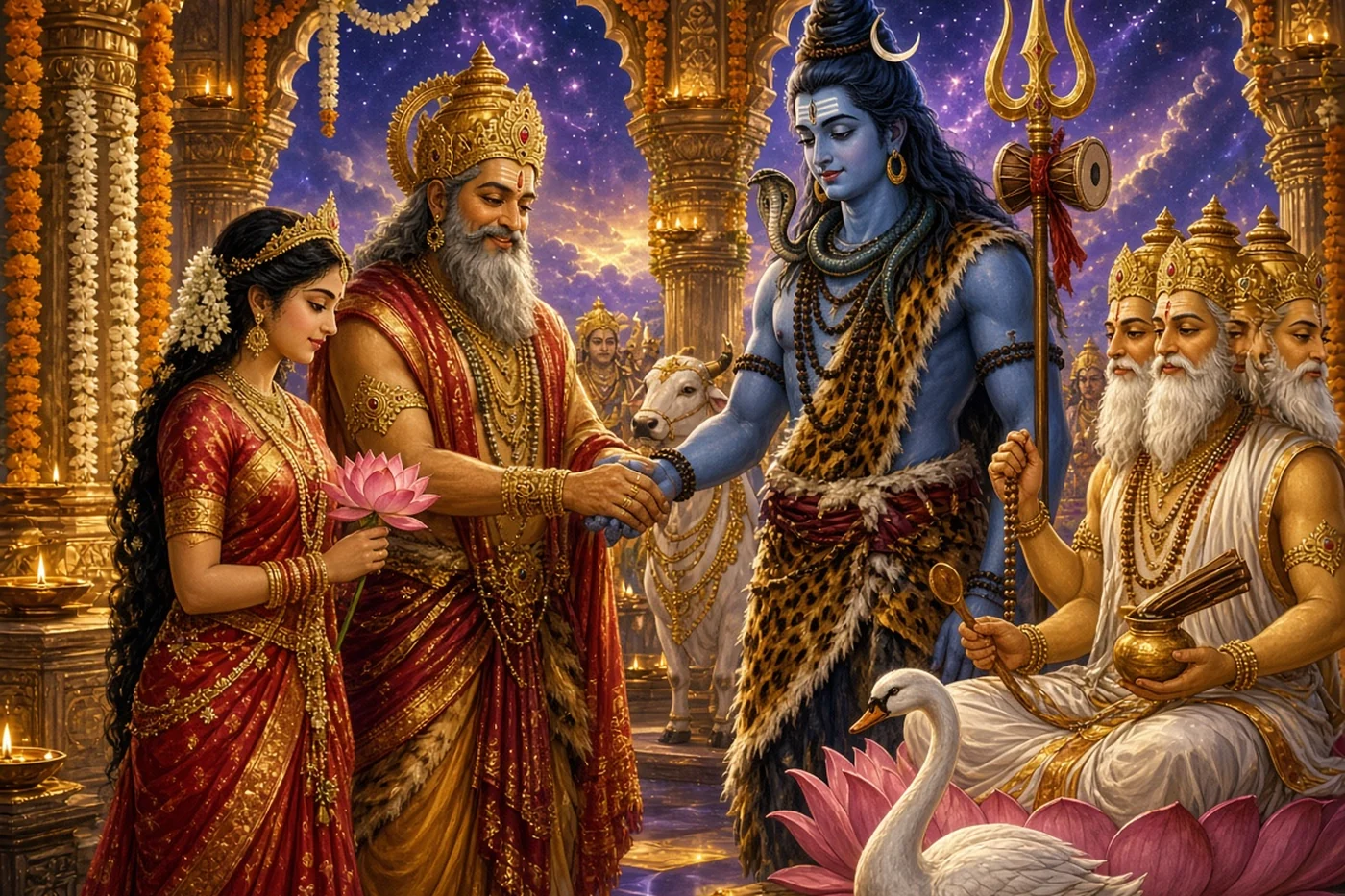
When the rites were done, Shiva lifted Sati onto the bull, and they rode away to the Himalaya, and at last to Kailash.
As the Devi Bhagavata tells it
Devi Bhagavata Purana 7.29 and 7.30 · the slopes of the Himalaya · 2 min read
The Devi Bhagavata begins her story with a quarrel in heaven. Shiva and Vishnu had beaten the demons, and they came home boasting to their wives, Gauri and Lakshmi. The goddesses laughed. Stung, the gods answered with insults, and the goddesses simply left them. They vanished.
At once the two great gods went dim. Their brightness drained away and they could no longer do their work. Brahma sat in meditation to learn why, and saw that the Supreme Goddess was angry. He took on their work himself for a time, and called his mind-born sons.
"Go and do penance," he told them. "Win her favour. The family she is born into will make the whole world pure."
Daksha and his brothers went into the forest on the slopes of the Himalaya and repeated the seed syllable of the great goddess for a hundred thousand years. Then she appeared, and they praised her as the one who lives in every body.
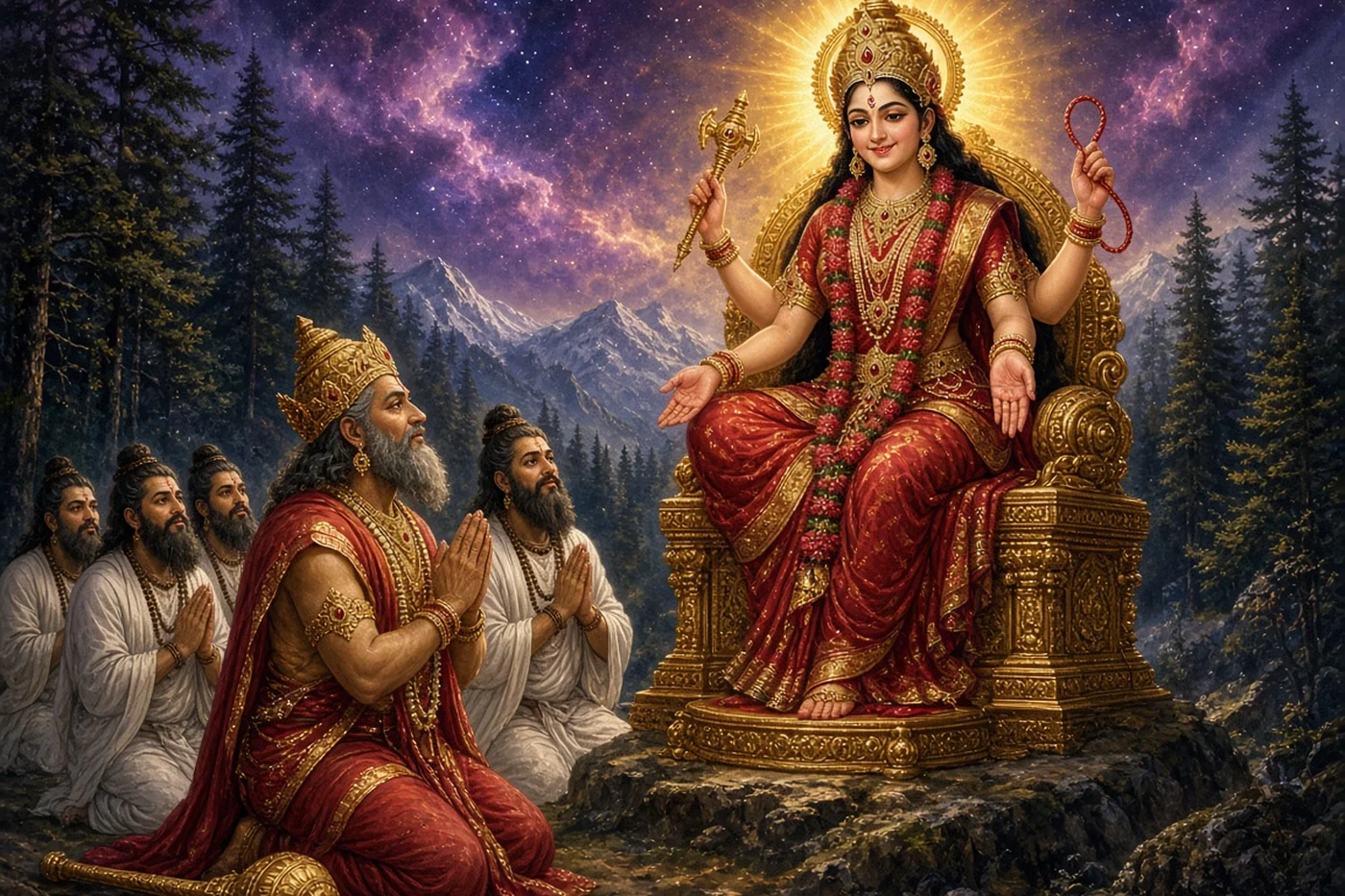
"Give Vishnu and Shiva back their power," they asked. "Let them have their goddesses again."
And Daksha asked one thing more: "Be born in my family."
"It was the insult to my goddesses that brought them to this," she said. "One of the two will be born in your house, Daksha. The other will be born in the ocean of milk. They will have them back."
So she was born in Daksha's house, and the three worlds were glad. Flowers fell from the sky, the drums of the gods sounded and the rivers flowed gladly. The sages named her Sati, because she was truth itself. When the time came, Daksha gave her to Mahadeva, whose power she had always been.
In this telling there is no year of vows and no shy meeting. The goddess comes back to Shiva because the world cannot run without the two of them together.