As a Pune courtyard keeps it
Maharashtra · Kartik shukla Dwadashi, the evening after Prabodhini Ekadashi · 3 min read
Mrunal's grandmother had eaten nothing since morning, and said it was nothing, because the women of the bride's house always fast on the wedding day.
"But you are not her mother," said Mrunal, who was ten. "Vimal kaku is."
"Vimal is giving her away. I am only doing the work. Hold this."
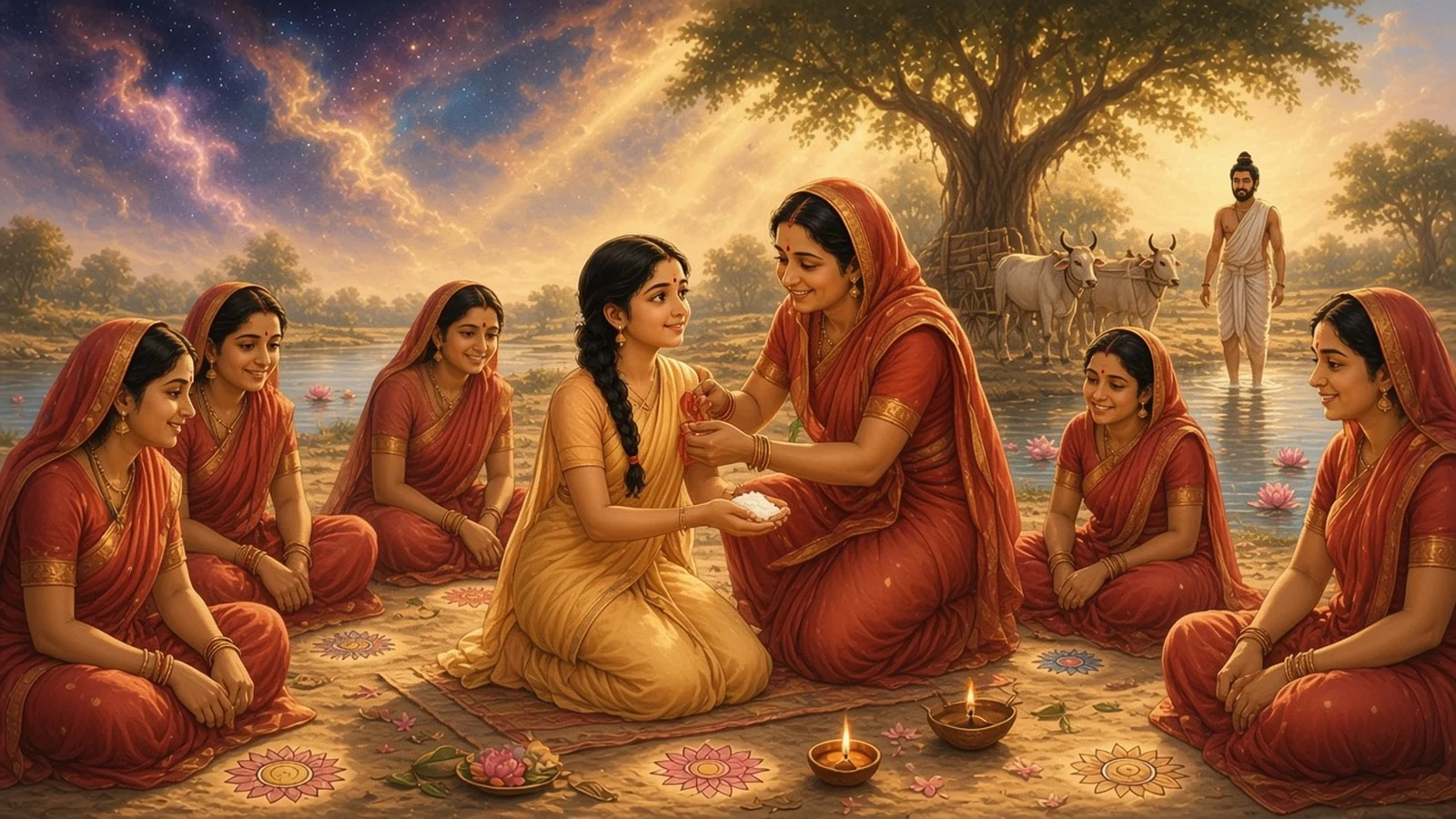
The tulsi grew in the middle of the old wada's courtyard, in a square brick stand as high as Mrunal's waist, and by four o'clock four sugarcanes stood round it like the poles of a wedding canopy, their leaves tied together overhead. Aaji had washed the stand at dawn and drawn a rangoli at its foot. Now she dressed the bride: a small green sari wrapped round the pot, glass bangles, turmeric and kumkum on the stems, a black-bead mangalsutra no longer than a finger. Last she pinned on a face cut from paper, with a bindi and a nose-ring, and the shrub was suddenly somebody.
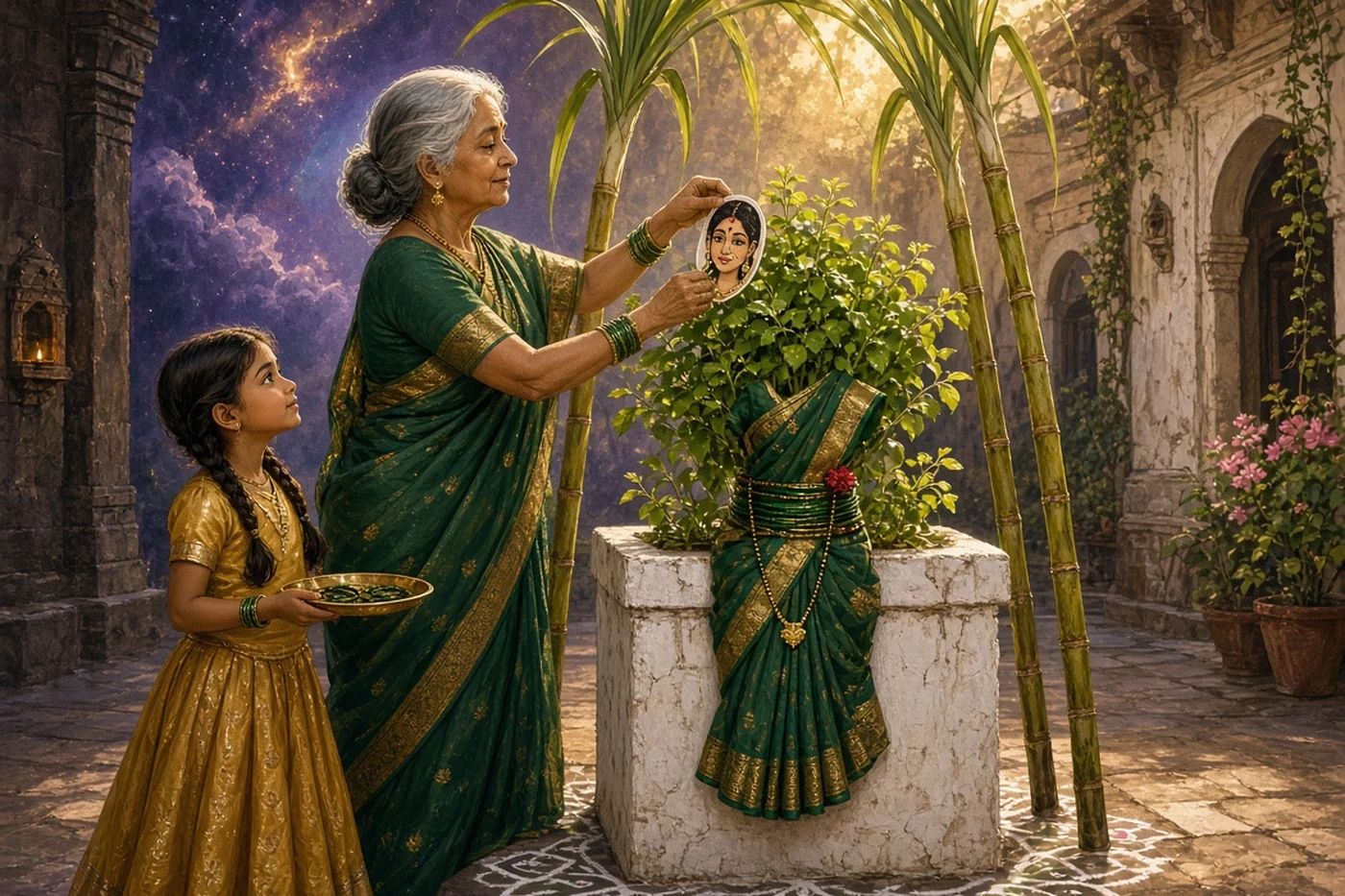
"She looks shy," said Mrunal.
"Brides do."
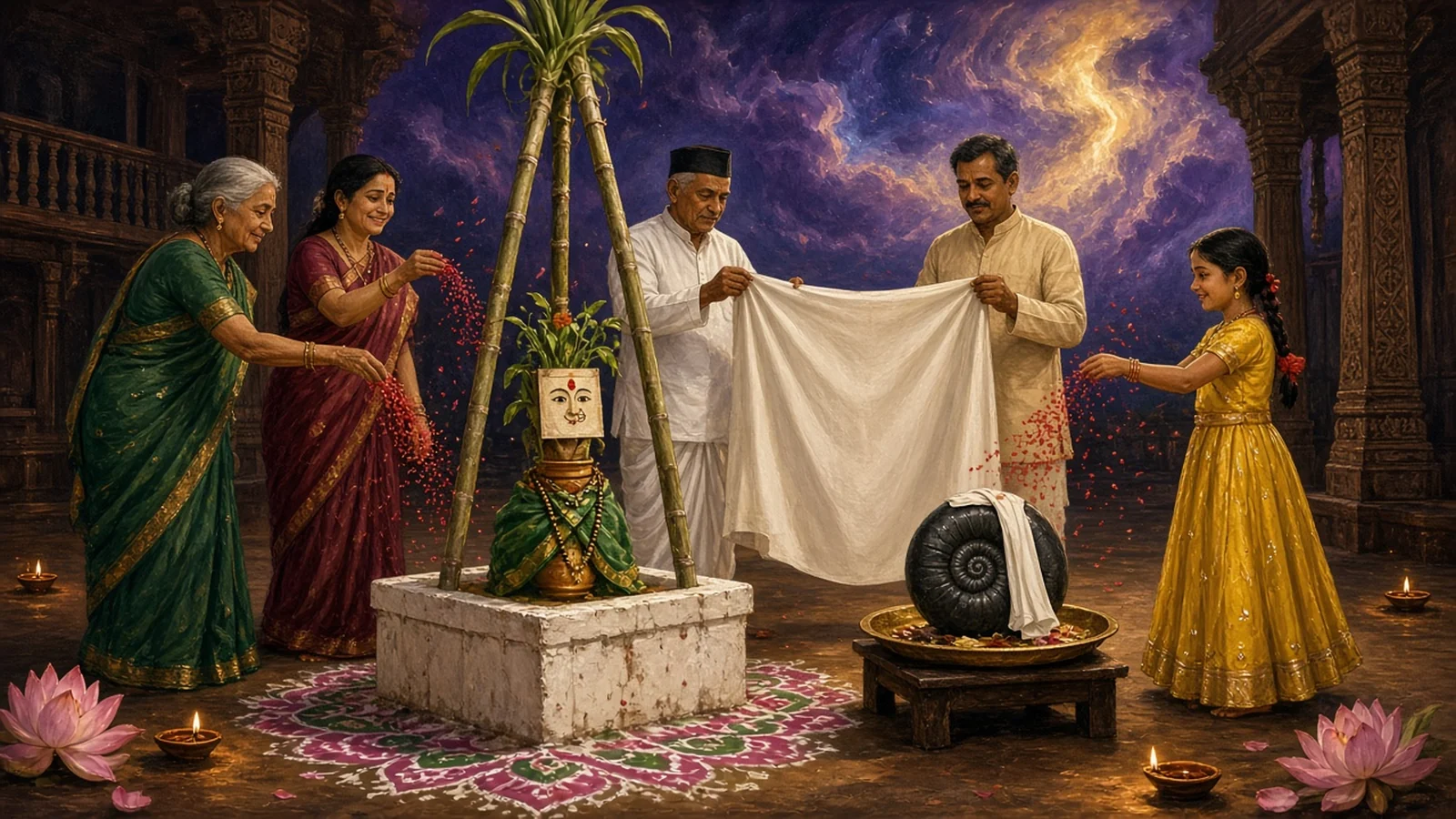
At dusk Ajoba came out of the shrine room carrying something folded in yellow silk and unwrapped it on a brass plate under the canopy. It was a black stone, round as an egg, with a coil like a shell on one side. He dabbed sandal paste on it, laid a strip of white cloth over it for a dhoti and a loop of thread for a sacred thread.
"That is Vishnu?"
"From the Gandaki, four generations ago," said Ajoba. "He has slept since Ashadha. Yesterday the whole country woke him, and the first thing he does on waking is get married."
"Why does he marry a plant?"
"There is a story of a woman called Vrinda and a promise he owed her. I will tell it on another night. Tonight we are busy."
Next door's Vimal kaku and Shrikant kaka came over dressed for their own daughter's wedding. They had no daughter. In thirty years of marriage they had no children at all, and so every Kartik they gave the courtyard's tulsi away, and the elders said the merit of giving a daughter in marriage was theirs. Vimal kaku held the pot steady while Aaji wound a cotton thread round bride and groom together.
Then Ajoba and Shrikant kaka held up a white cloth between the plant and the stone, the antarpat, so that neither could see the other. Everyone was given a pinch of rice reddened with kumkum. Aaji began the first of the eight wedding verses, the mangalashtak, calling on Ganesha and the rivers to bless the pair, and the whole courtyard came in on the last line.
"Shubh mangal savadhan!"
The rice flew at the cloth. Eight verses, eight showers. On the last the cloth came down and the bride and groom were looking at each other, and everybody clapped, and two boys in the lane set off a string of crackers.
"Aaji," said Mrunal while the plates were filled, "why is she in every courtyard, and why does every offering to him need her leaf?"
"The Padma Purana says Brahma lives in her root, Vishnu in her stem and Shiva in her new shoot, and that no want and no quarrel stays where she grows. The Devi Bhagavata calls her Pushpasara, the best of flowers. He can be given a hundred flowers and be pleased with none of them, unless she is there."
The prasad was puffed rice mixed with pieces of sugarcane, green tamarind, amla and coconut. Ajoba held up a stick of cane. "The groom's best man. And the tamarind is the bride's friend."
Vimal kaku was crying a little, as mothers of the bride do. Aaji put an arm round her.
"Now your niece's wedding can be fixed," she said. "The tulsi is married. The season is open."
As the temples and the Kartik vow keep it
Saurashtra, Udupi, the Telugu country and Vrindavan · Prabodhini Ekadashi to the full moon of Kartik · 2 min read
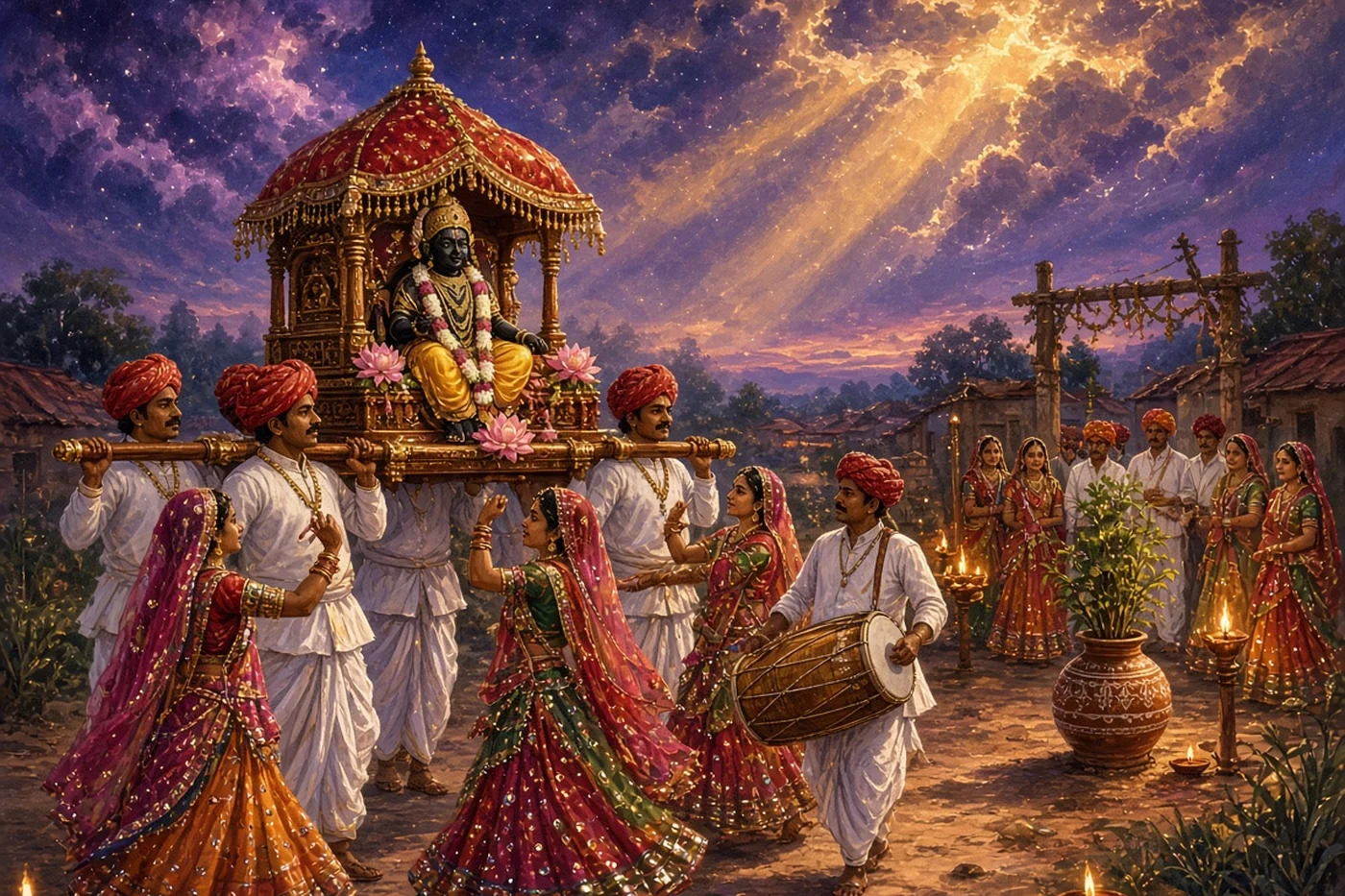
In two Rama temples of Saurashtra the wedding is between two villages. The temple of the bride sends a formal invitation to the temple of the groom, and on Prabodhini Ekadashi the groom's side sets out with the image of Vishnu they call Lalji in a palanquin, singing and dancing, a proper barat. The bride's village meets it at the boundary. The tulsi has been planted in a clay pot for the occasion, and couples who hope for a child ask to be the ones who give her away. Bhajans go on all night, and in the morning Lalji goes home with his bride.
In the Telugu country the day is Ksheerabdhi Dwadashi and the rite is Tulasi Kalyanam. The groom there is a branch of the amla tree, set into the tulsi stand beside her, and the bride is worshipped with the sixteen offerings. Karnataka keeps it as Tulasi Habba on Utthana Dwadashi, and at Udupi the Krishna Matha opens its Laksha Deepotsava that day, the festival of a lakh of lamps, which lights the town from then until the Kartik full moon.
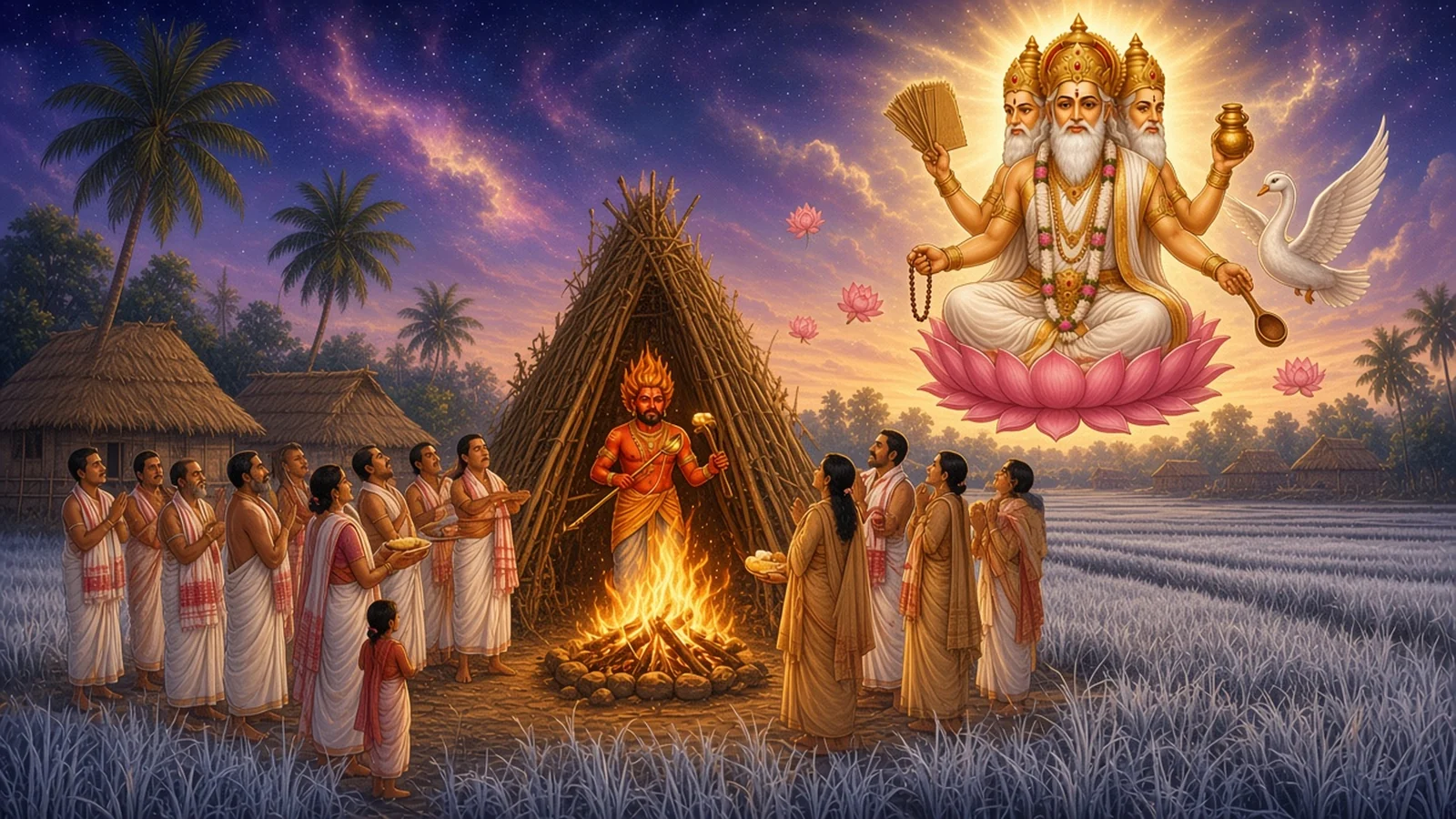
In Vrindavan the head priest of the Radharaman temple, Padmanabha Goswami, has set down the rite as his line keeps it. A fire pit is dug under a canopy and a water pot of good omen set beside it. A golden Narayana and a silver Tulasi are installed, with a shaligram, and four learned men stand for Brahma, the teacher, the seer and the priest. The two cloths are knotted, bracelets are tied on the wrists, and the host and his family walk four times round the tulsi carrying the stone while the women blow conches and sing.
The month frames it. The Padma Purana's Kartik vow ends on the fourteenth with a canopy of flowers raised over the tulsi, Jaya and Vijaya painted as its doorkeepers, a golden Vishnu worshipped there and a night kept awake with songs, and on the full moon Vishnu and Tulsi are worshipped together and thirty Brahmin couples fed. The Devi Bhagavata says Tulsi was born on that full moon and that Vishnu himself first worshipped her then. Through the whole month lamps are lit for Vishnu as Damodara every evening, and in many villages the Kartik sky lamp, raised at dusk for Lakshmi, Narayana and the ancestors, stands on the tulsi platform.