As Valmiki's Uttara Kanda tells it
Uttara Kanda 13 to 15 · Lanka and the slopes of Kailasa · 3 min read
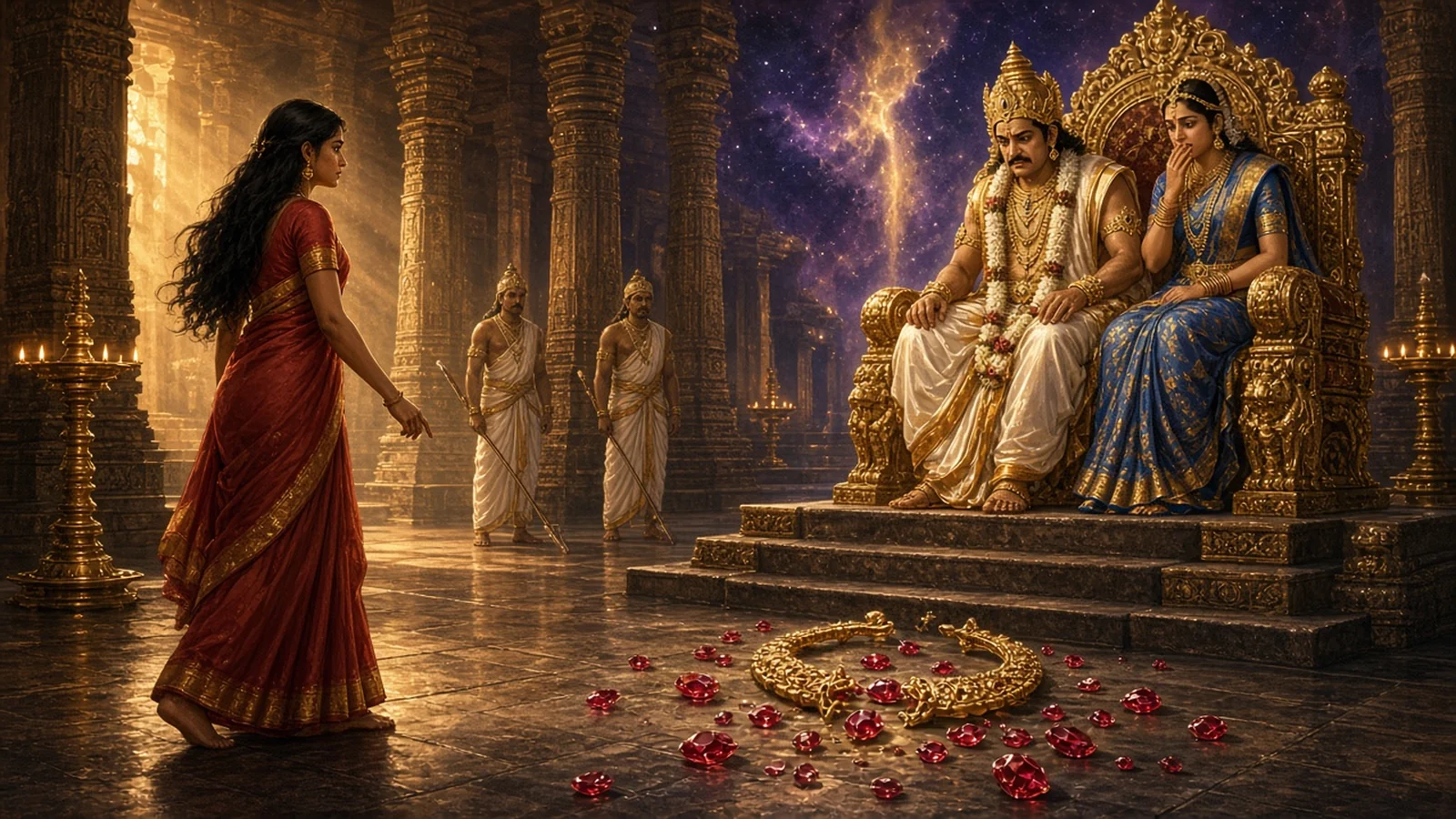
When Kumbhakarna sank into his long sleep, nobody was left to hold Ravana back. He went through the three worlds like a storm, wrecking the gardens of the gods, churning up rivers, tearing up trees and breaking hills, and troubling the sages at their fires.
The news reached Kubera in the north. Ravana was his younger half-brother, and the good name of their family was his to keep as much as Ravana's. He chose a messenger and sent him to Lanka.
Vibhishana met the man at the gate, asked kindly after Kubera, and brought him into the hall where Ravana lay at his ease.
"Your brother says this," the messenger began. "Brothers should behave alike. Leave this road and come back to the right one. I have seen the Nandana garden laid waste and heard what is done to the sages, and the gods are already meeting about you. I have overlooked a great deal. But when a young man goes wrong, his own people must tell him so.
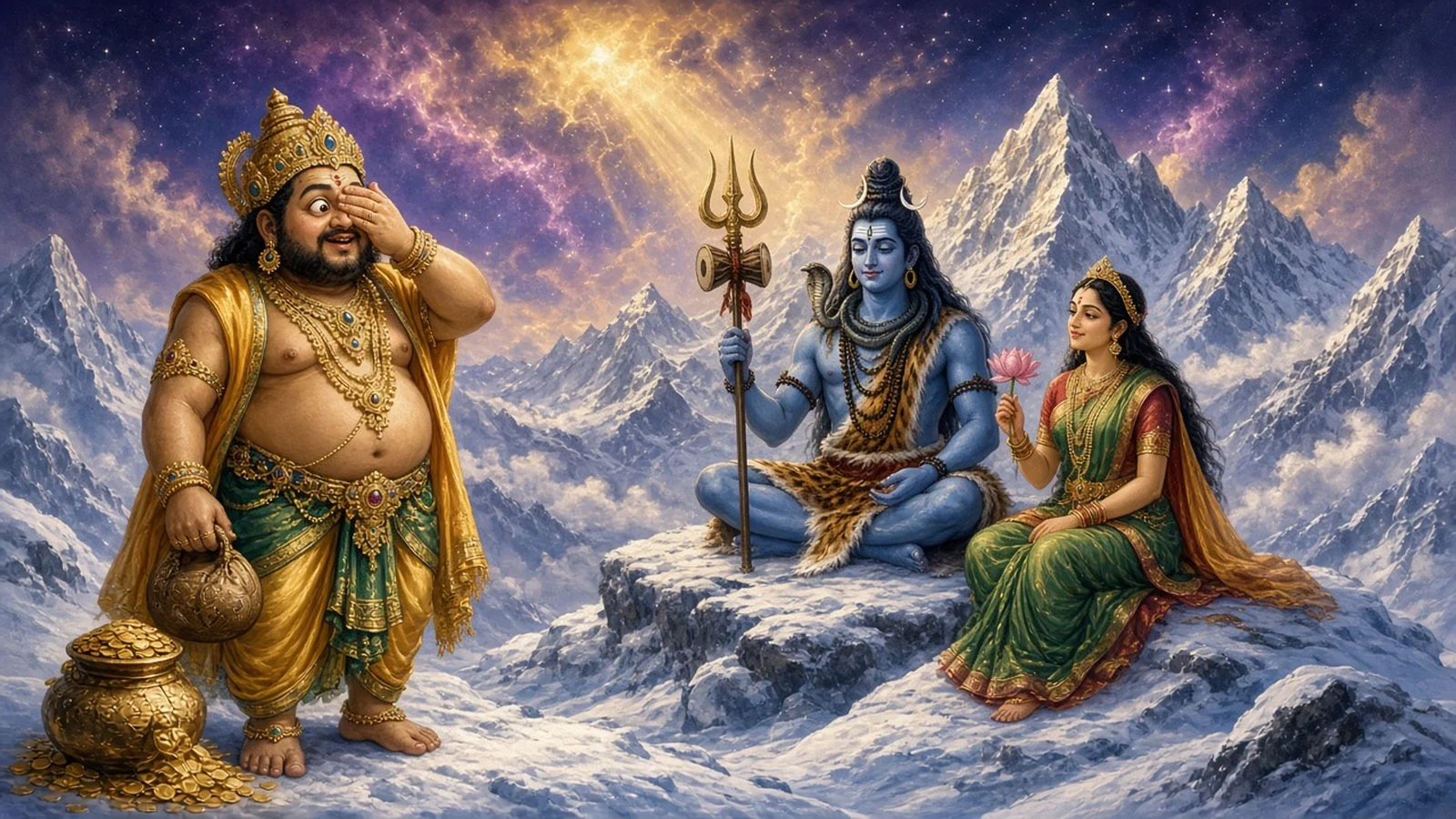
"Hear what happened to me. I went up to a high plateau of Himavat to keep my vows and please Mahadeva, and there I saw him with the goddess Uma. My left eye fell on her, and I wondered who she might be. That was all. By her own power she burned that eye, and it went yellow and dim, as if dust had blown into it.
"I went to another slope of the mountain and kept silence for eight hundred years. At the end of it Shiva came to me, pleased. 'Your vow is done,' he said. 'Be my friend. Since the goddess has turned your eye yellow, you will be Ekakshipingala, the one with the yellow eye.' I came home Shankara's friend and found the news of you waiting. Stop, brother, before you shame our whole line."
Ravana's eyes had gone red while he listened, and his fists were clenched.
"You are no true messenger," he said, "and the one who sent you is no friend of mine. Am I to sit here and be told about his friendship with Shiva? I have spared him only because he is my elder brother. Now I will take the three worlds, and on his account I will send all four guardians of the world to Yama."
He drew his sword and killed the messenger where he stood. Then he mounted his chariot and set out for the north.
He took six ministers with him, Mahodara, Prahasta, Marica, Shuka, Sarana and Dhumraksha, over rivers and mountains and forests, until he reached Kailasa. The yakshas ran to warn Kubera, and Kubera sent them out to fight. They fought bravely, but the rakshasas cut through them, and the survivors threw down their weapons and hid in the rivers and caves.
Kubera called his captain.
"Manibhadra," he said, "kill him."
Manibhadra came with four thousand yakshas and struck Dhumraksha senseless. Then Ravana met him and hit his crown so hard that it slipped to one side, and from that day Manibhadra has been called Parshvamauli, the one whose crown is askew. He fell back.
So Kubera came himself, mace in hand.
"I warned you," he said, "and you would not listen. A man who does wrong and knows it is drinking poison with his eyes open. You will reap what you have sown. I will not argue with you again."
Ravana's ministers fled. Ravana stayed. Kubera's mace struck his head and did not move him, and the two brothers fought for a long time, fire weapon against water weapon, while Ravana became a tiger, a boar, a cloud, a mountain and the sea. At last he brought a huge mace down on Kubera's head, and the lord of wealth fell like an ashoka tree with its roots cut. Padma and his companions lifted him and carried him through the air to the Nandana garden.
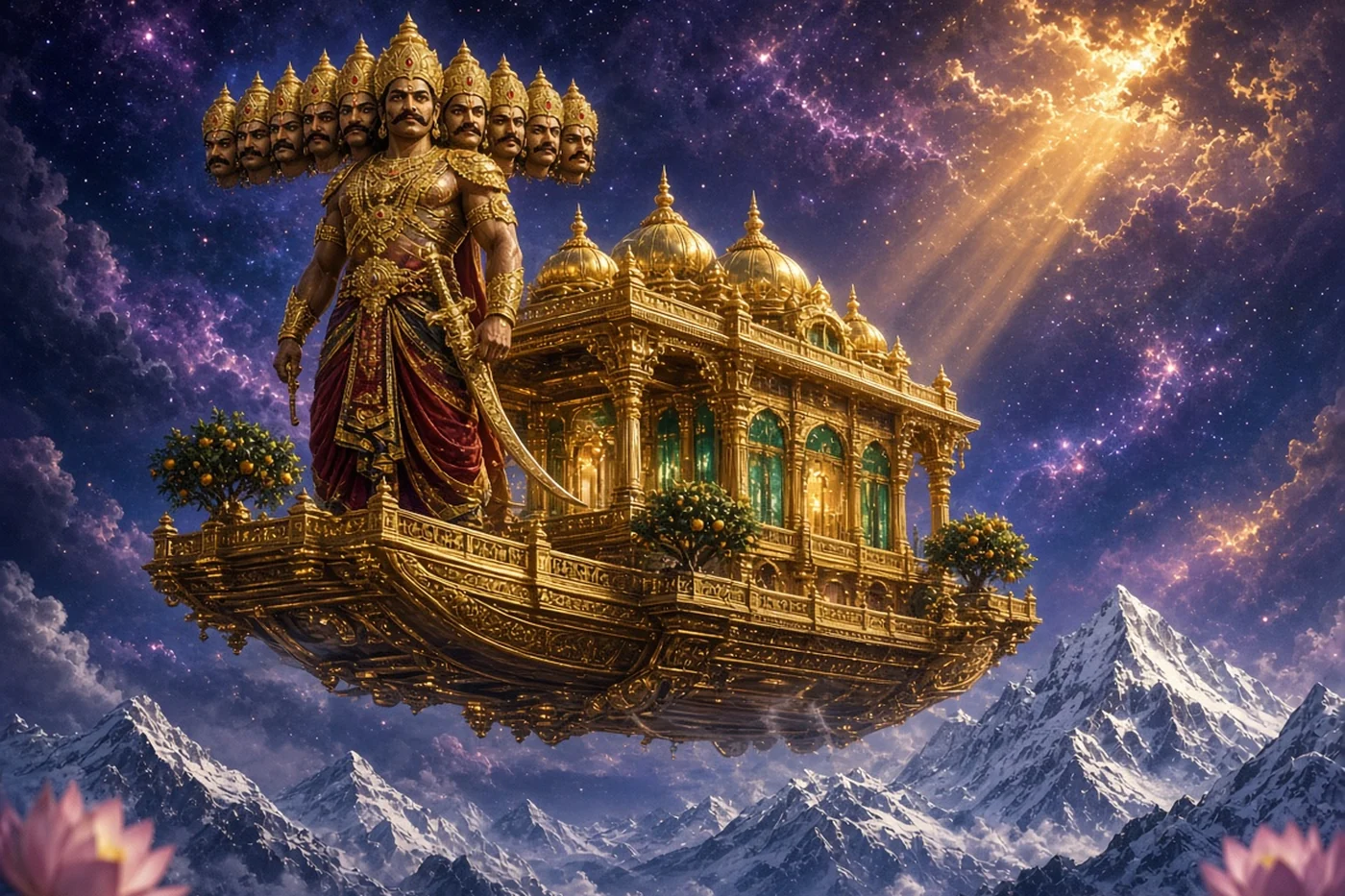
Ravana took the Pushpaka, with its golden pillars, its emerald doors and its trees that fruit in every season, and rode it away from Kailasa as if the three worlds were already his. Where it stopped is told in Ravana Lifts Kailash.
As the Shiva Purana tells it
Rudra Samhita, Srishti Khanda 19 · Kashi · 2 min read
In the Shiva Purana the glance comes at the end of a long road, which began with a thief who brightened a temple lamp (The Thief Who Trimmed the Lamp). In his last birth he was Shrida, a son of Yajnadatta, and the merit of those lamps drew him to Kashi.
There he set up a linga and worshipped it, saying the mantras of the eleven Rudras and offering good thoughts in place of flowers. He kept at it for two hundred thousand years, until he was skin over bone.
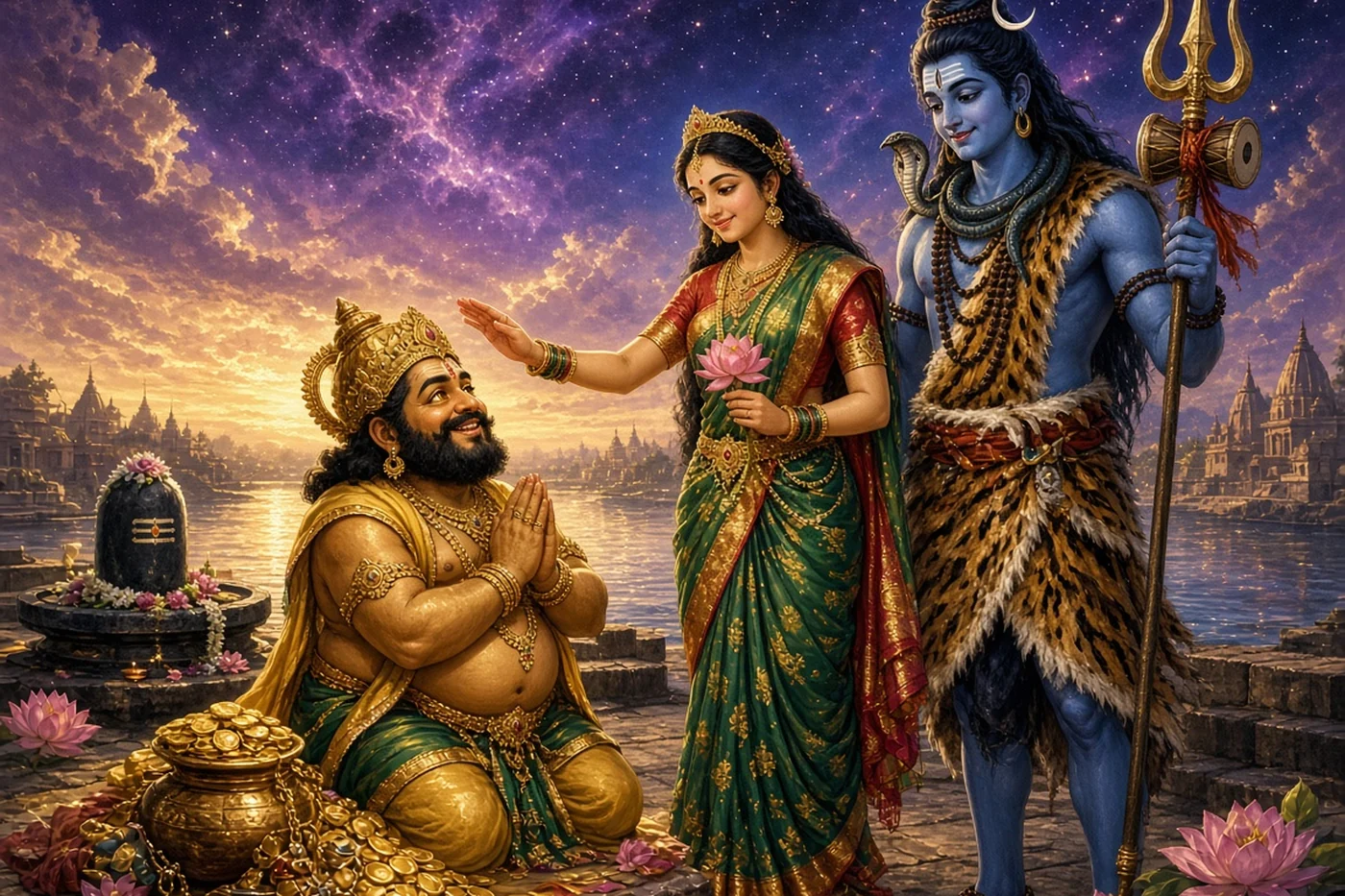
Then Vishveshvara, the lord of Kashi, stood before him with Uma at his side.
"Ask for a boon," said Shiva.
Shrida opened his eyes. The light was too much, and he shut them again.
"Lord," he said, "give my eyes the strength to look at your feet. I want nothing more."
Shiva touched him with his palm, and he could see. The first thing he saw was Uma, and he could not stop looking. Her beauty, her husband's love, her good fortune: he kept crying out at all of it, and there was envy in the look. His left eye burst.
Uma turned to Shiva.
"Why does this ascetic keep staring at me?" she asked. "Why does he go on about my beauty and my luck? Is he jealous of me?"
Shiva laughed.
"He is your son, goddess," he said. "He is praising you. There is no malice in him."
To Shrida he said, "You will be lord of treasures and of the guhyakas, king of the yakshas and kinnaras, chief of the punyajanas, and the giver of wealth to all. My friendship with you will last for ever, and I will live near you."
Uma blessed him then: may his devotion to Shiva never fail. And she named him twice. Because his left eye had burst, he would be Ekapinga, the one with a yellow mark where an eye had been. Because he had looked at her with envy, he would be Kubera, the ill-formed one.
He ruled from Alaka, the city Vishvakarma built, and Shiva made his home on Kailasa, close beside it.