As Braj tells it: the counting in the kitchen
Braj · the day before Annakut · 3 min read
The kitchen had been going since before light. There was kheer cooling in a brass pot, a tray of laddus, a pan of kadhi, puris stacked under a cloth, and the grandmother was counting on her fingers with her lips moving.
"Thirty-one," she said. "Thirty-two with the chutney. Meera, write it down."
Her granddaughter wrote it down. "Dadi, why does it have to be fifty-six? Why not fifty, or sixty? Fifty-six is a terrible number to cook."
"Because that is how many he was owed."
The girl waited. The grandmother put the ladle down.
"When Krishna was small, in Nanda's house, Yashoda fed him eight times a day. Eight. Butter in the morning, then milk, then rice, then something sweet, then whatever he cried for, all day long, the way you feed a child who is always running. He never missed one."
"And then?"
"And then the rain came. The year the cowherds fed the hill instead of Indra, and Indra sent the clouds to drown them. The boy picked up Govardhan and held it over everybody, the whole of Vraja, the cows and the carts and the old people and the babies. He stood there for seven days. Seven days and seven nights, and all that time he did not eat a mouthful. He did not drink. He did not sit down. The Bhagavata says it in one line: he forgot hunger and thirst."
Meera thought about seven days without food and then about missing one meal.
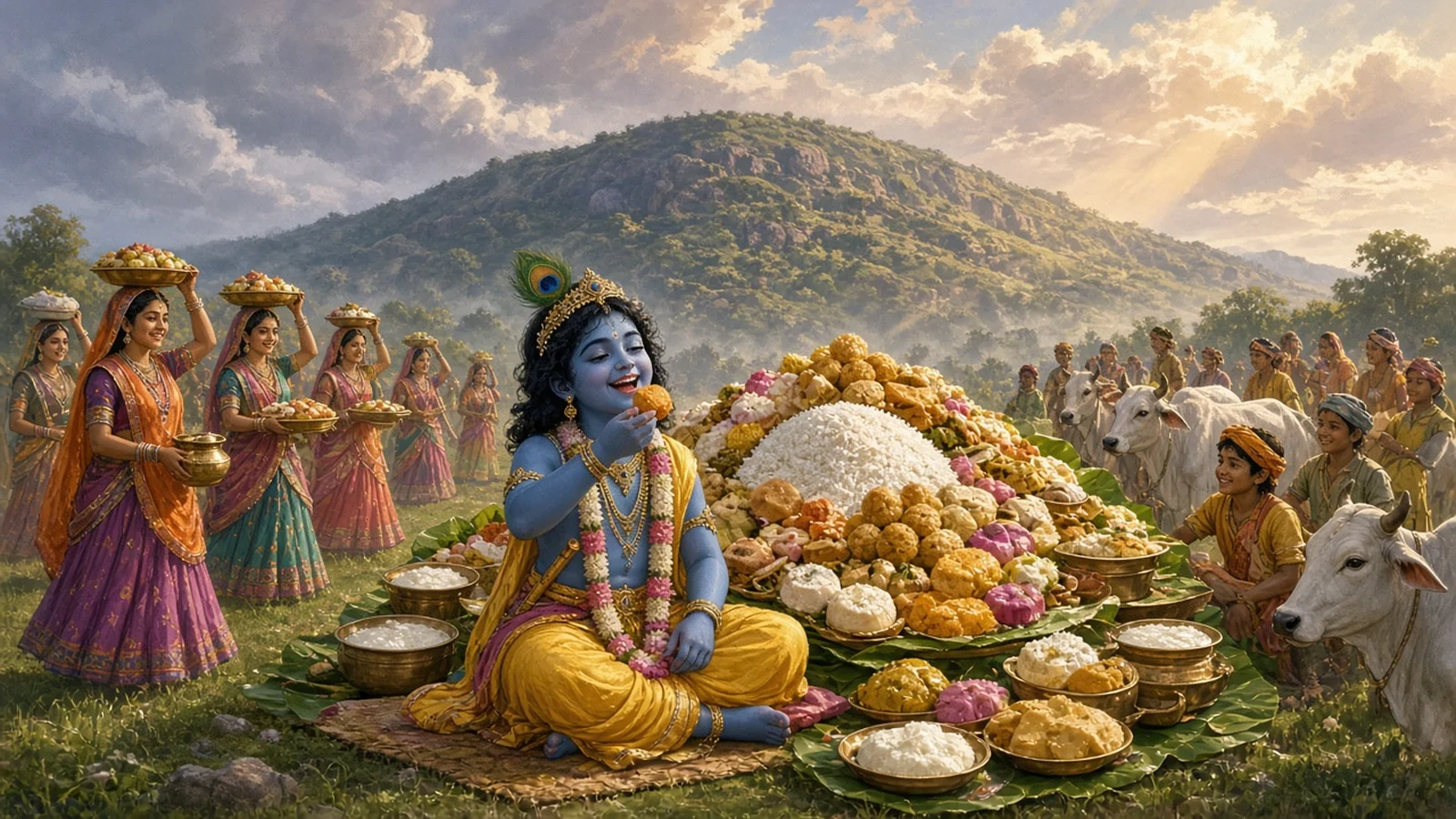
"When the clouds went away and he put the hill back, the women of Vraja looked at each other. One of them said what all of them were thinking. 'Eight meals a day. Seven days. He has gone without fifty-six meals.' And another said, 'Then he shall have them. All at once.'"
"All fifty-six?"
"All fifty-six, child, every house cooking something different, carried to the foot of the hill and heaped up until it was a hill itself. He sat down and ate, and that is the Annakut, the mountain of food, and that is why the count is fifty-six and not fifty or sixty. Now stir that before it catches."
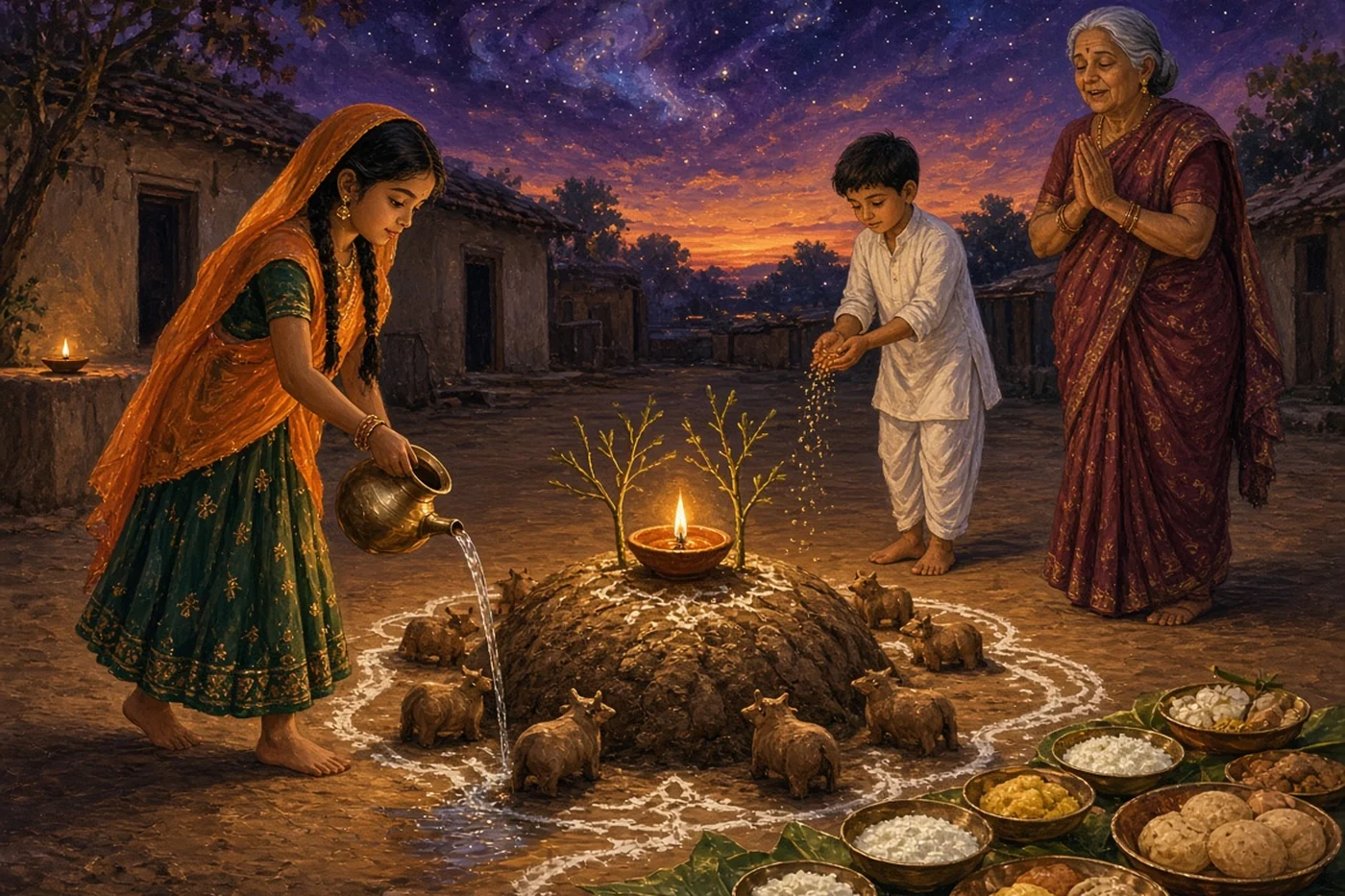
By afternoon the courtyard had its own Govardhan. The grandmother had shaped it out of cow dung that morning, a long low mound with a bowl pressed into the middle for a lamp, twigs stuck in for trees, little dung cows along its flanks, and a picture of the boy propped at the top. Meera had drawn the path round it in rice flour.
The dishes went in front of it in an order the grandmother would not let anyone change.
"Milk first. Butter and sugar, curd, ghee, cream, nearest to him. Then the sweets made of gram flour. Then the salt things, the puris and the kachoris and the papad. Then everything else. And the cardamom last of all, because that is what a guest is given when he has finished eating."
"And the rice?"
"The rice is the hill. It goes in the middle, heaped up, and the rest of the food climbs it."
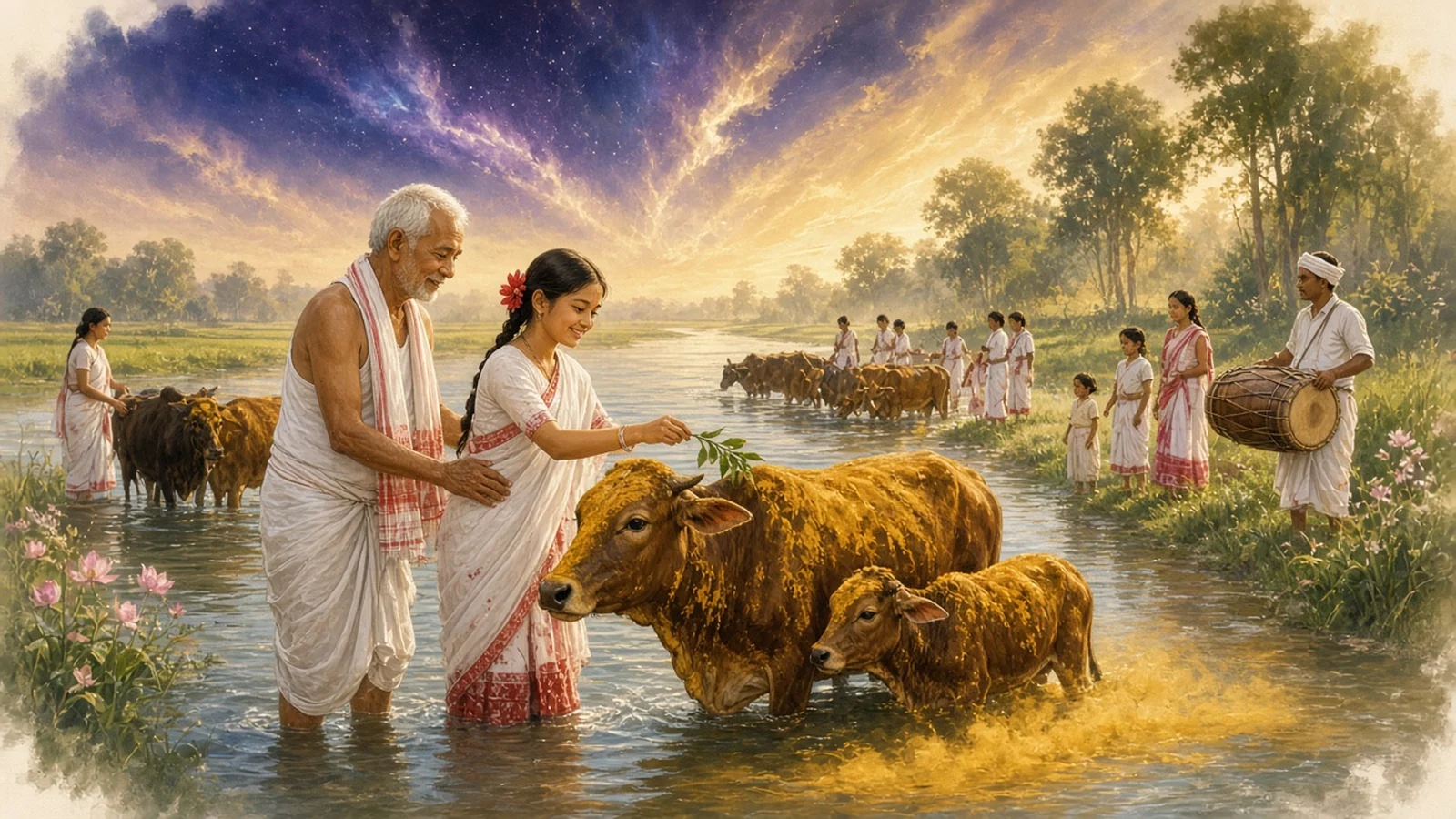
When the lamp was lit they walked round the dung hill seven times, Meera in front with the brass pot tipping a thread of water onto the ground, her brother behind scattering barley, the grandmother singing the Govardhan song that nobody had taught her either. Then they went out to the cowshed, where the cows had been washed and their horns rubbed with ghee and painted, and fed them jaggery and rice from their hands.
Up the road, the grandmother said, at Jatipura, the same fifty-six were being set down in front of the face in the rock, and the whole village had been pouring milk on it since dawn. At the big temple in Vrindavan the hill of sweets and rice and halva in the courtyard was taller than a man. It was the same meal everywhere. It had been waiting a long time to be eaten.
"Fifty-six," said Meera, counting the plates.
"Fifty-six," said her grandmother. "And not one of them is for us until he has had his."
As Nathdwara keeps it: the loot of the mountain
Nathdwara, Rajasthan · the Pushtimarg Annakut · 3 min read
At Nathdwara the god is a child of the house, and the house is turned upside down for him on the day after Diwali. On every other day Shrinathji is seen eight times between waking and sleep. On this day there are only two darshans, the one at dawn, and the Annakut, late at night.
The afternoon belongs to the hill and the cows. In the Govardhan Puja Chowk a small Govardhan is built of cow dung, and set into a hollow in its side is a stone brought from the real hill in Braj, so that the god's mountain is present in person. One of the Goswamis, the priests who descend from Vallabhacharya, bathes it with water poured from a conch sheathed in gold, and offers it incense, a lamp, food and betel.
Then the cows come in. The temple keeps thousands; a hundred or so are brought up to the haveli for the day, painted, hung with peacock feathers, anklets on their feet, bellowing and pulling at their herdsmen while the crowd watches from the roofs. One cow is Nandini, whose line the temple traces to Nanda's own herd. She is worshipped first, and when the puja is done she is let loose to walk into the dung hill and break it down, which is the hill accepting what has been given.
Inside, meanwhile, the kitchens have cooked more than two tonnes of rice.
It is built up in front of the image into a mountain, the rice itself standing for Govardhan, a great round sweet set on its peak and four more at its corners, for Vishnu and his four arms. Round it the inner rooms disappear under food, dish after dish, until there is nowhere to step. Then the doors close.
They open again towards eight at night. By then the queue winds back through three courtyards and takes the better part of two hours, and iron gratings stand between the people and the food.
Among the people are the Bhils, the hill tribes of Mewar, who have come in from the villages for this. The moment the curtain goes up they go for the rice. They scoop it into heavy pots and knot it into great scarves, pass it back over their heads, climb the gratings for more, and carry it out of the haveli and home. Nobody stops them. The railings went up after people were crushed, but the loot itself is the rite, and the sect says it is as old as the first Annakut, when Krishna in the shape of the hill put out hand after hand and ate everything the cowherds had brought.
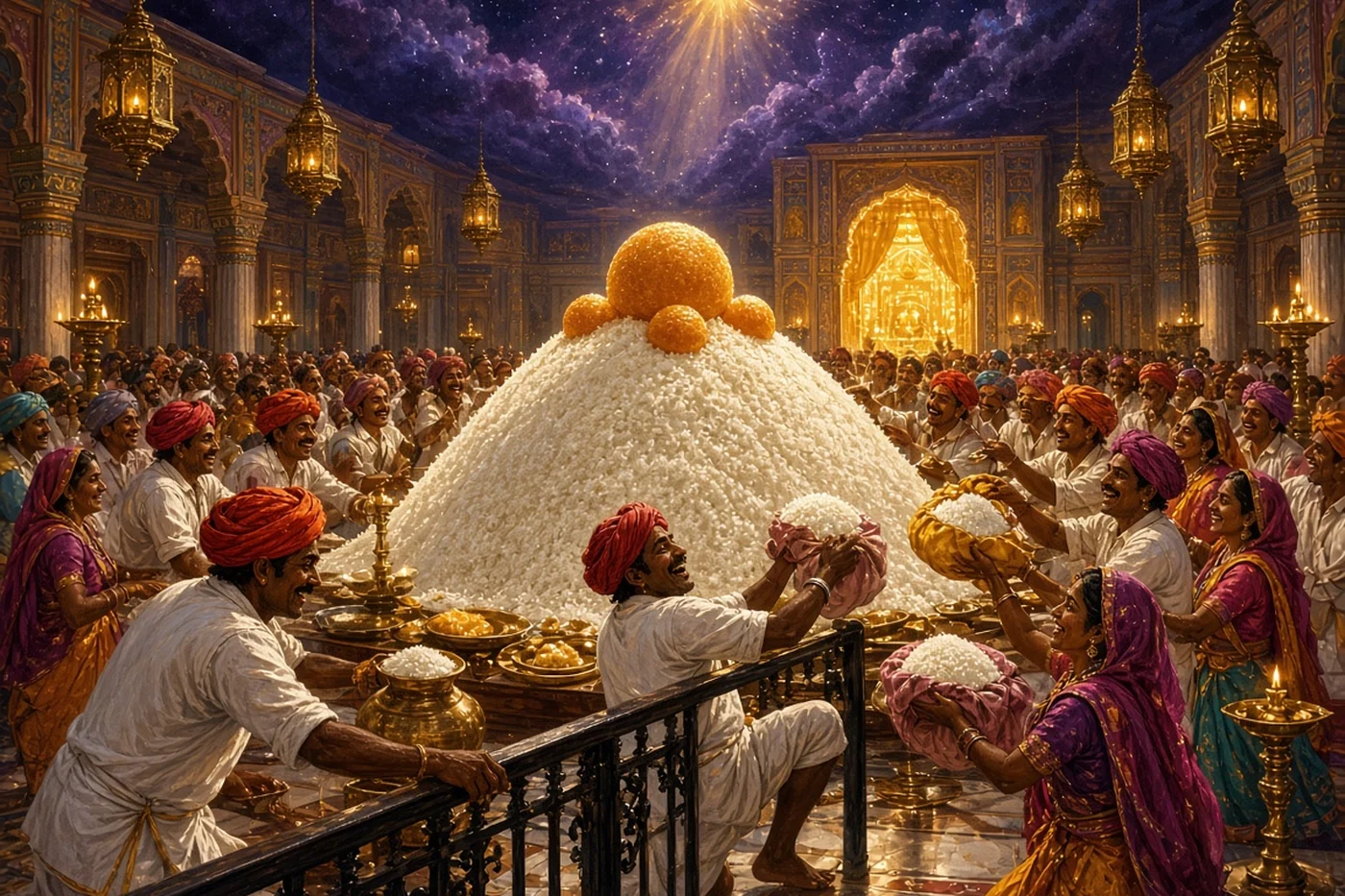
A painting from Nathdwara in the British Museum, some two hundred and fifty years old, shows the god with his arm raised and the mountain of food before him, and the note on it says what the painters knew: afterwards the food goes to the Bhils.
Nathdwara tells the fifty-six story too, but in its telling one woman did the cooking. Yashoda made all fifty-six herself, the sect says, to feed her son when he came out from under the hill.