As the Padma Purana and Pushkar tell it
Padma Purana, Srishti Khanda 15 · Pushkar, Rajasthan · 3 min read
Brahma sat on Meru and could not decide where to hold his sacrifice.
"Kashi," he said to himself, and set it aside. "Prayaga. Naimisha." Each was holy, and each already belonged to someone. He wanted a place that was nobody's yet, the first tirtha, made for this one rite and for him.
So he came down to the earth and walked until he found a forest so pleasant that he stopped. The trees felt him there and spoke.
"Stay with us," they said. "Do not pass through."
"Ask for something, then, if I am to stay."
"Let us never grow old. Let us carry flowers and fruit in every season. Let us take any shape we please."
"You have it," said Brahma, and he stayed among them for a thousand years.
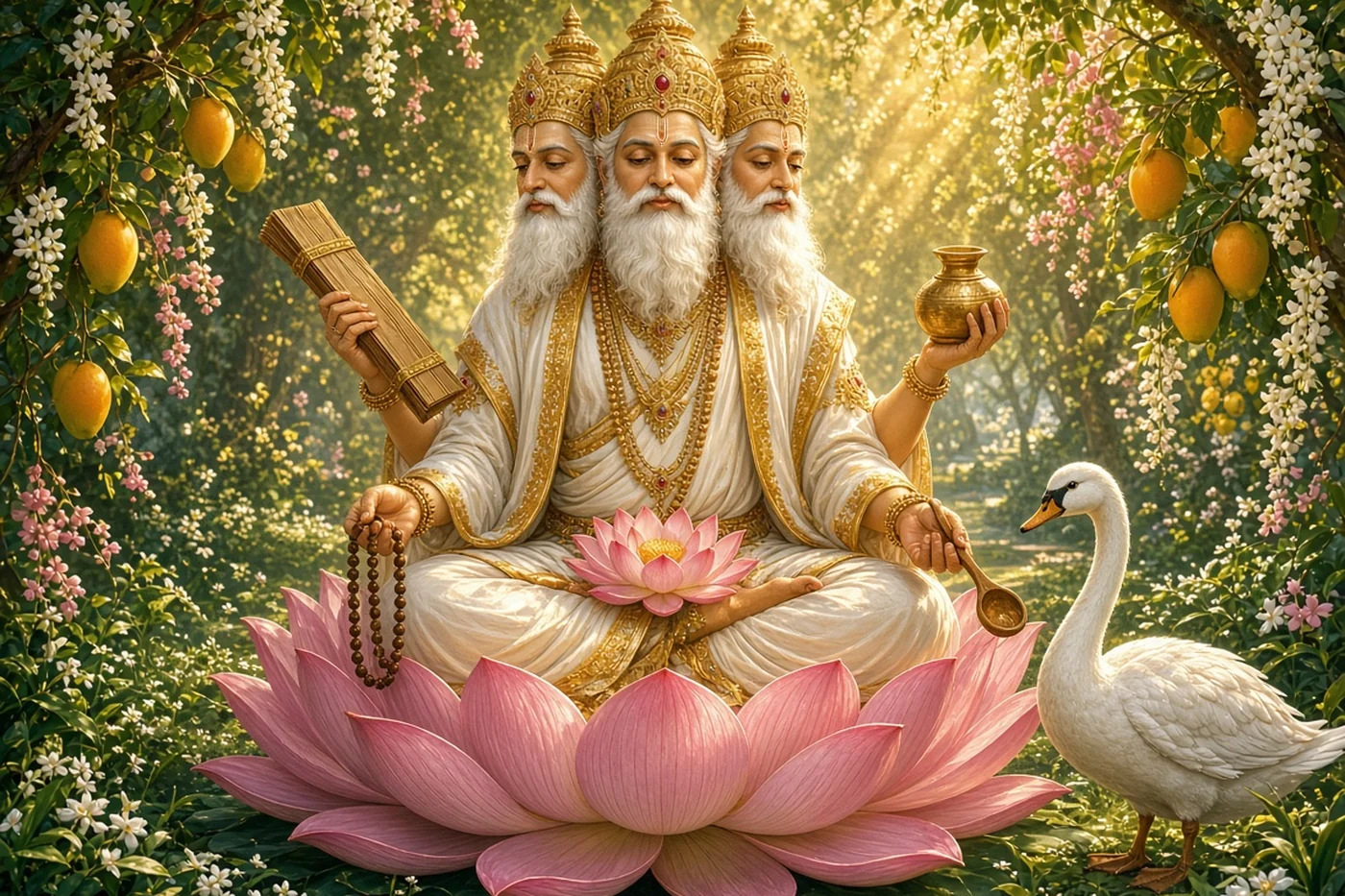
He had a lotus in his hand all that while, as he always has. One day it slipped from his fingers and fell.
The earth shook. The oceans heaved out of their beds, the mountains swayed, and in all three worlds the living things cried out, because nobody knew what had struck. The gods ran to Vishnu.
"What was that?"
"A demon called Vajranabha," said Vishnu. "He kills children. He has been lying hidden in the world below, waiting for his hour to come up and fall on you. The hour has passed. The lotus came down on the place where he lay."
Brahma looked at his empty hand. "Then this is the place," he said. "Where my lotus fell, let the ground be called Pushkara, and let it be holy for as long as the earth stands."
He made three sacred spots there, one after another: the first his own, the middle one Vishnu's, the last Rudra's. Then he called Brihaspati, the teacher of the gods, to be the guru of the rite, had the gods initiated, and began the sacrifice. The Purana says he has never really left. Whoever bathes at Pushkar with the Apohishtha verses on his lips is washed clean of the night's sins, and whoever sees Brahma there at noon is washed of the day's. A single day spent at Pushkar, it says, is worth twelve years in the first age of the world.
That is the book. Pushkar tells it with a little more blood and a little more water.
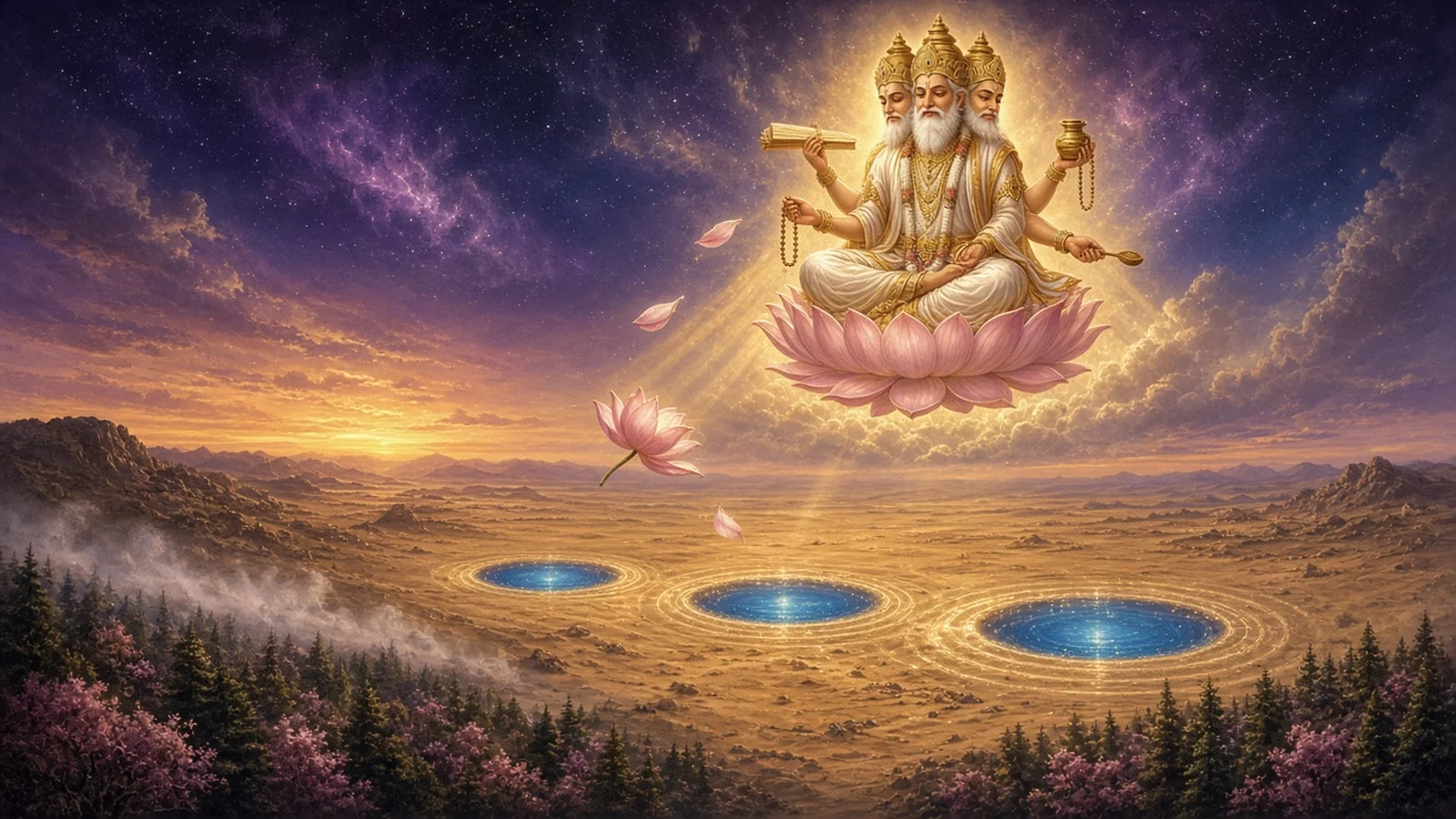
In the town's telling Brahma was not resting under the trees. He was hunting. Vajranabha had been tormenting his children, and the Creator went after him with the flower, the nearest thing to a weapon he owns, and struck him down with it. The lotus broke, and its petals came down in three places in the sand, and where each petal touched the ground water rose. The eldest lake is the one the town stands on, Jyeshtha Pushkar; the middle and the youngest lie a little way off, each with its own shrine. The town's name, the guides will tell you, is pushpa and kar, the flower and the hand it fell from.
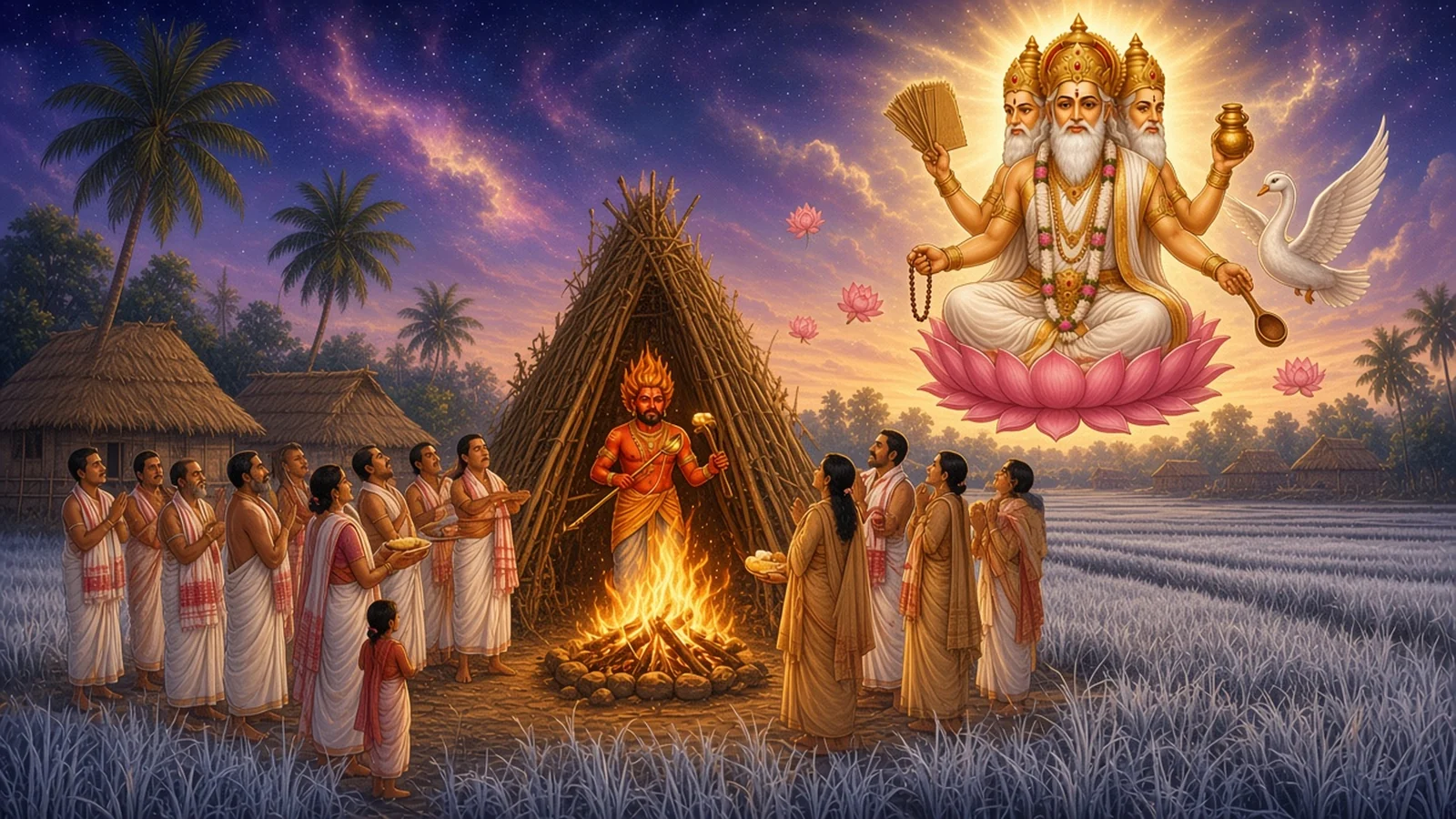
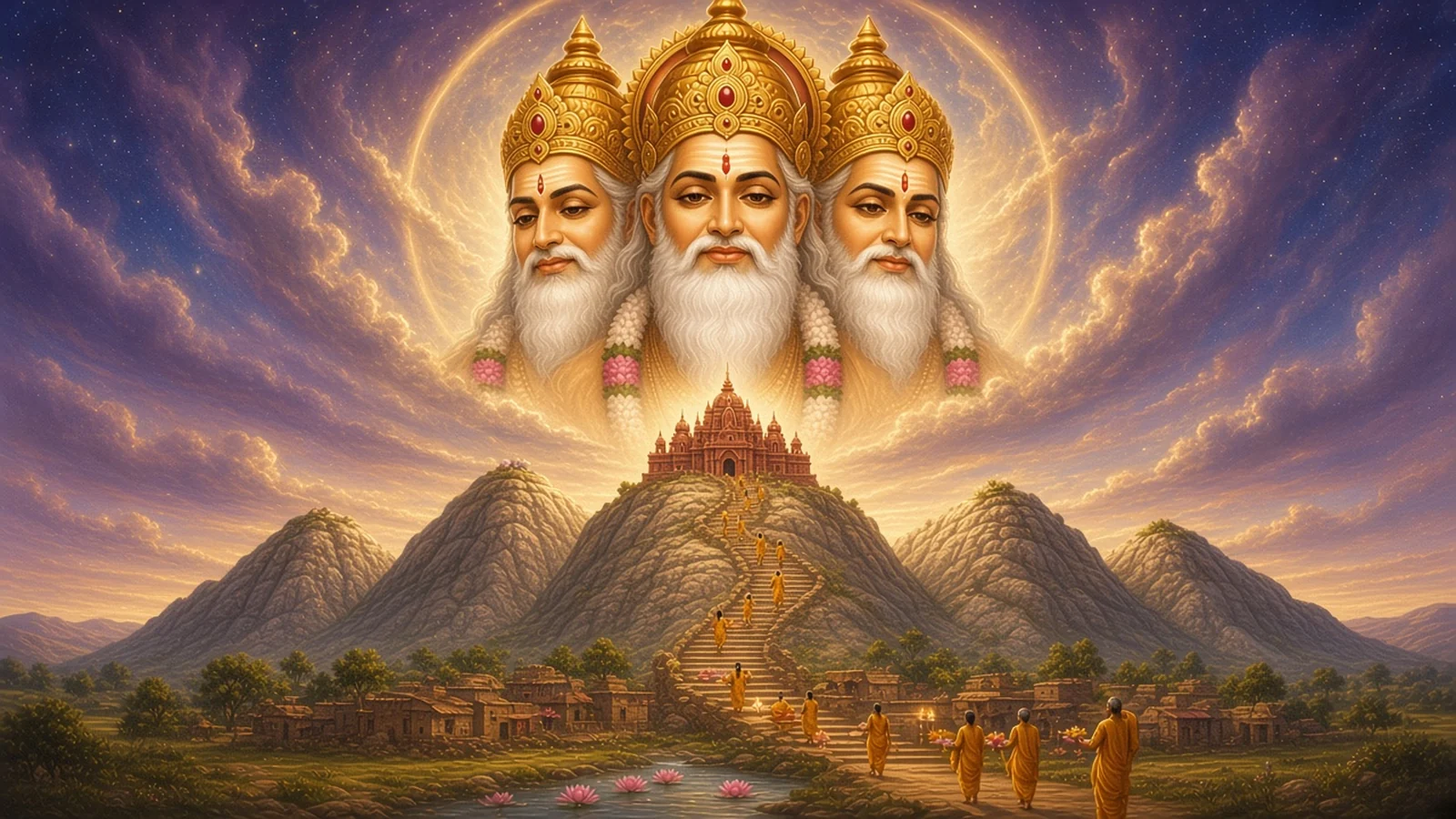
Then Brahma chose the eldest lake for his fire and raised four hills round it to keep the demons out, Ratnagiri to the south, Nilgiri to the north, Sanchoora to the west and Suryagiri where the sun rises. What happened at that fire, how his wife came late to it and what she said when she arrived, is told in The Wife Who Came Late. It is the reason, the town says, that this is the one great temple of Brahma and there is hardly another.
Her hill is Ratnagiri. His temple stands below it, with a red spire and a goose over the gate.
As the fair keeps it today
Pushkar, Rajasthan · the Kartik mela · 2 min read
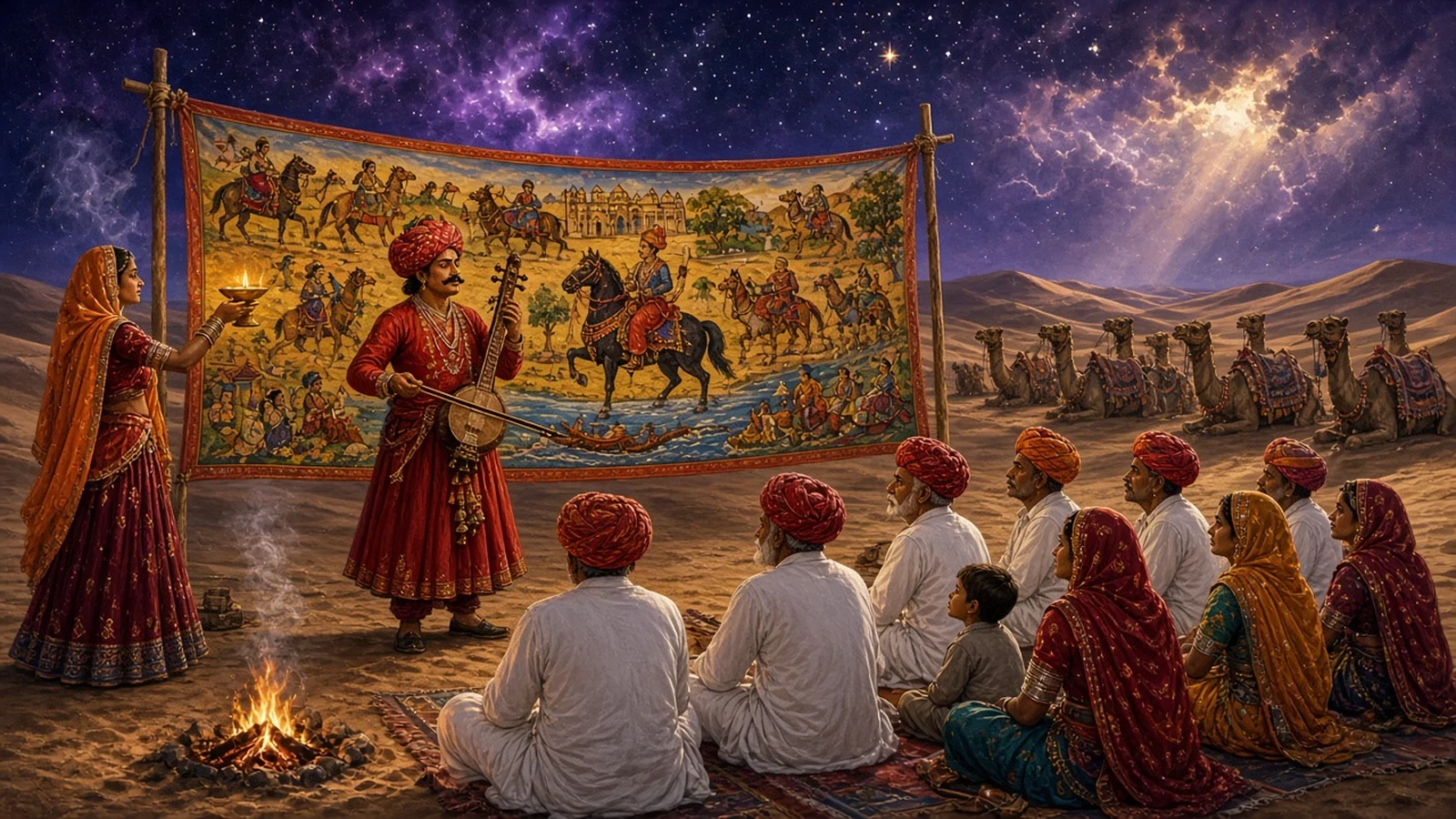
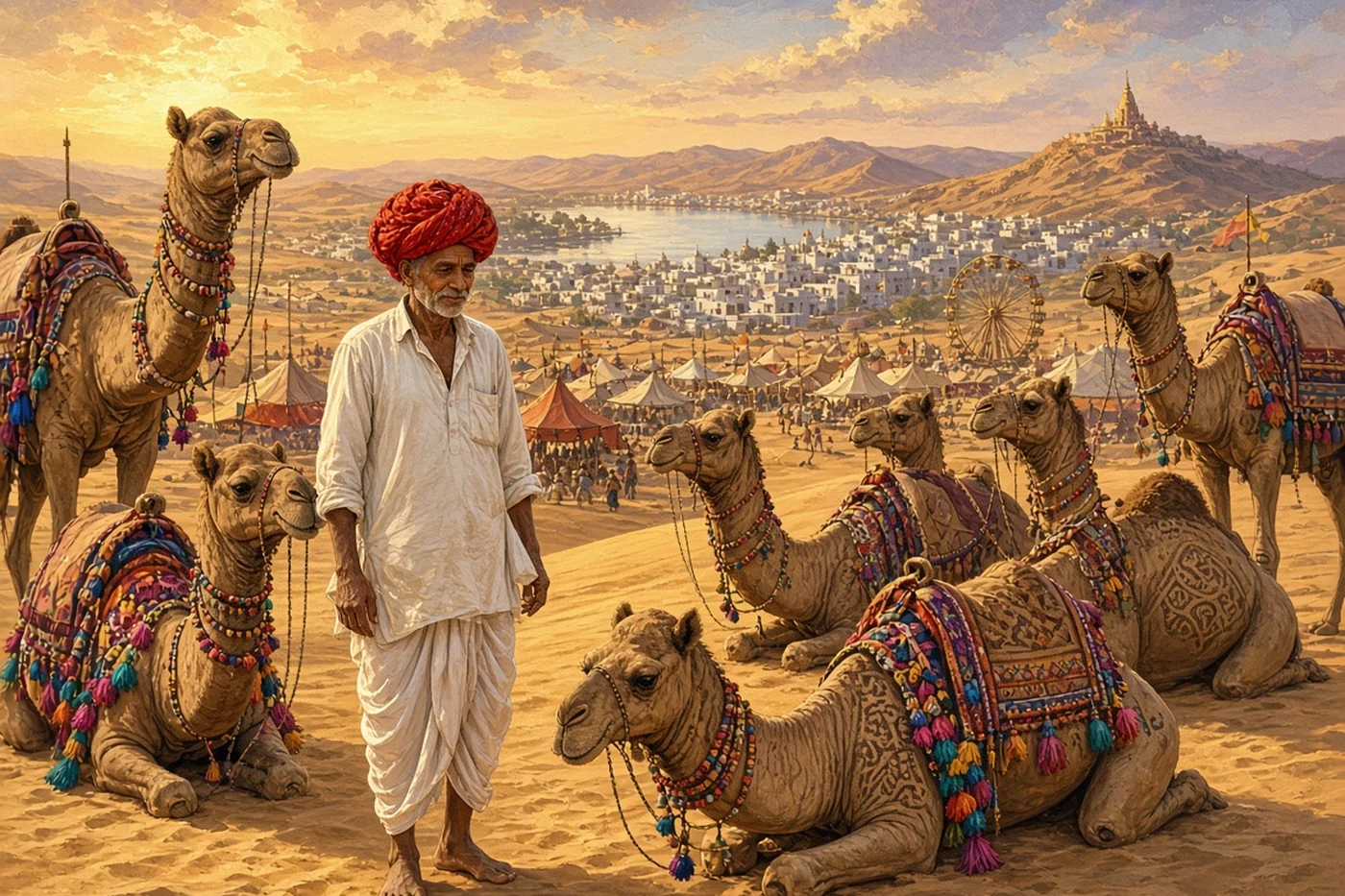
Ratan brought his camels in from Nagaur eight days before the full moon, as his father had, and pitched camp on the dunes west of the town where the mela ground is.
The fair begins with the month of Kartik and ends on its full moon, and the trading comes first. For days the sand is covered with camels, horses, cattle, sheep and goats, the camels clipped in patterns and hung with tassels and bells, the horses walked up and down for buyers. Then, from the eleventh day of the bright fortnight, the pilgrims arrive and the fair becomes a festival, with the last five days the fullest.
"Who wins the tug of war?" a boy from Delhi asked him, watching the rope laid out between a team of foreigners and a team of Pushkar men.
"We do," said Ratan. "Every year. They are bigger. We are used to pulling camels."
By day there are the camel races and the camel beauty contest, the matka phod, the turban tying, the longest moustache, the bridal competition, and a football match between the Pushkar club and a side of tourists; the hot-air balloons that go up over the dunes are the one thing with a ticket. The stalls sell silver, bangles and printed cloth, and the ferris wheels turn till late.
But the fair is Brahma's. At dusk the pilgrims go down to the lake, where the priests say the evening prayers at the Varah Ghat and small oil lamps are set on the water and drift out among the reflections. On the night of the full moon the whole town stays awake.
Before sunrise Ratan's wife took the children down the steps. There are fifty-two ghats round the lake, and every one was full.
"Hold your breath and go under," she said. "Once for yourself and once for your grandmother."
The pilgrims say that a dip here on Kartik Purnima is worth centuries of sacrifice, and that it clears the skin and the sins together. Afterwards they walked the round of the three lakes, about sixteen kilometres, and came back to the Brahma temple, where a householder may not enter the sanctum: the offering is handed to the sanyasi priest and carried in. After Brahma, Gayatri; and the fit ones climbed Ratnagiri to the temple of Savitri, who sits up there, the temple people say, still annoyed.
How many come, nobody agrees: two lakh people and twenty-five thousand camels by one count, five or six lakh by another, and fewer camels every year than the old men remember. In 2009 the lake itself failed and the pilgrims bathed in concrete tanks filled from tube wells. In 2025 the fair ran from 30 October to 5 November, and in 2026 its full moon is 24 November.