As a dindi walks it
Maharashtra · from Alandi to Pandharpur in the month of Ashadha · 3 min read
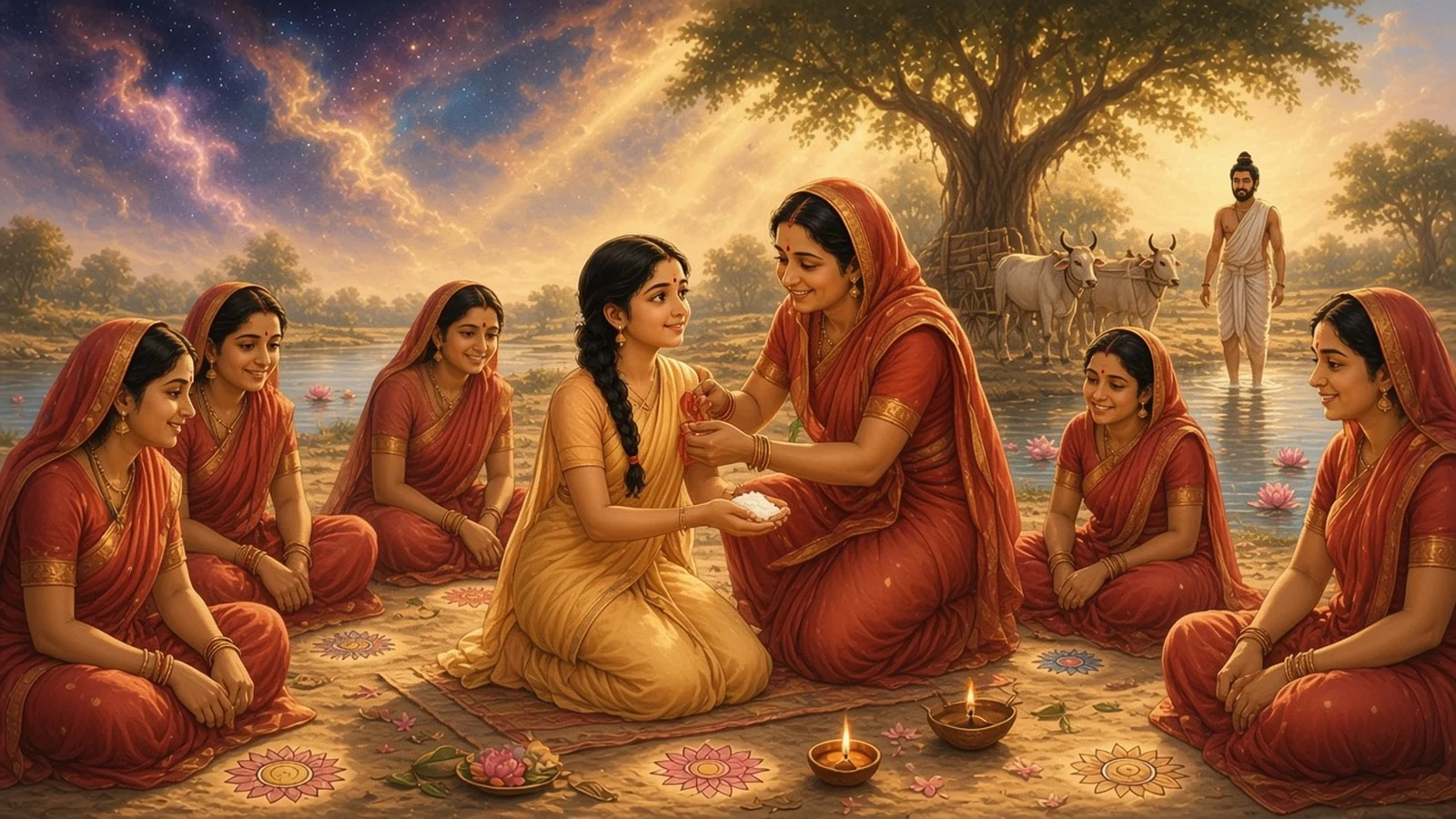
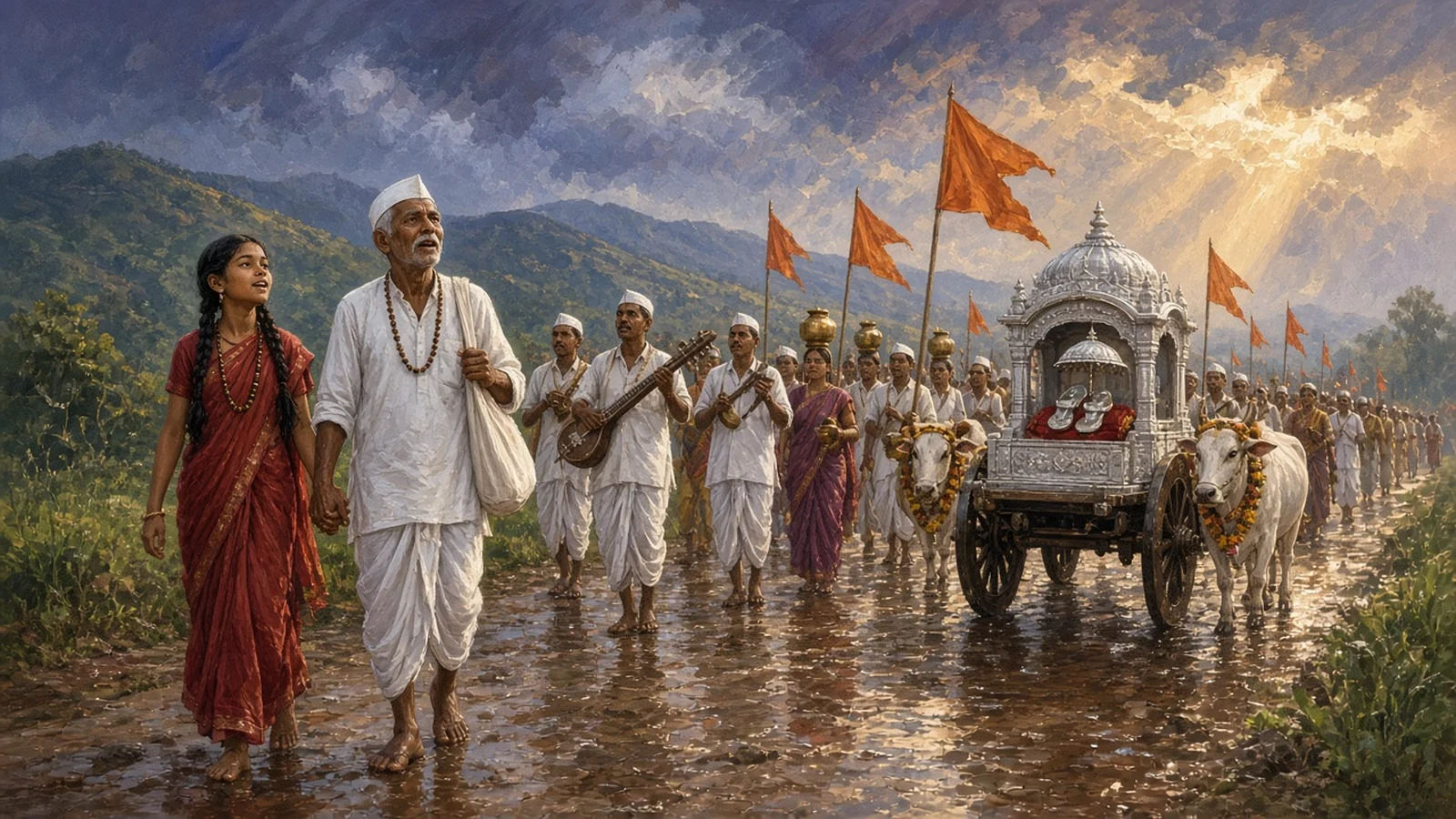
Sakhu was eleven and had never slept anywhere but her own village, and now she was going to walk to God.
"Two hundred and fifty kilometres," her grandfather said, tying the tulsi beads round her neck. "Eighteen days. If your feet hurt, you sing louder. That is the whole secret."
Tanaji had made the walk forty-one times. Their dindi, sixty people from a village near Phaltan, had a number, a place in the line and a veena-player who began every abhang. They reached Alandi the day before the palanquin left and stood in the rain outside the temple where Dnyaneshwar had gone down into his samadhi seven hundred years ago and not come out.
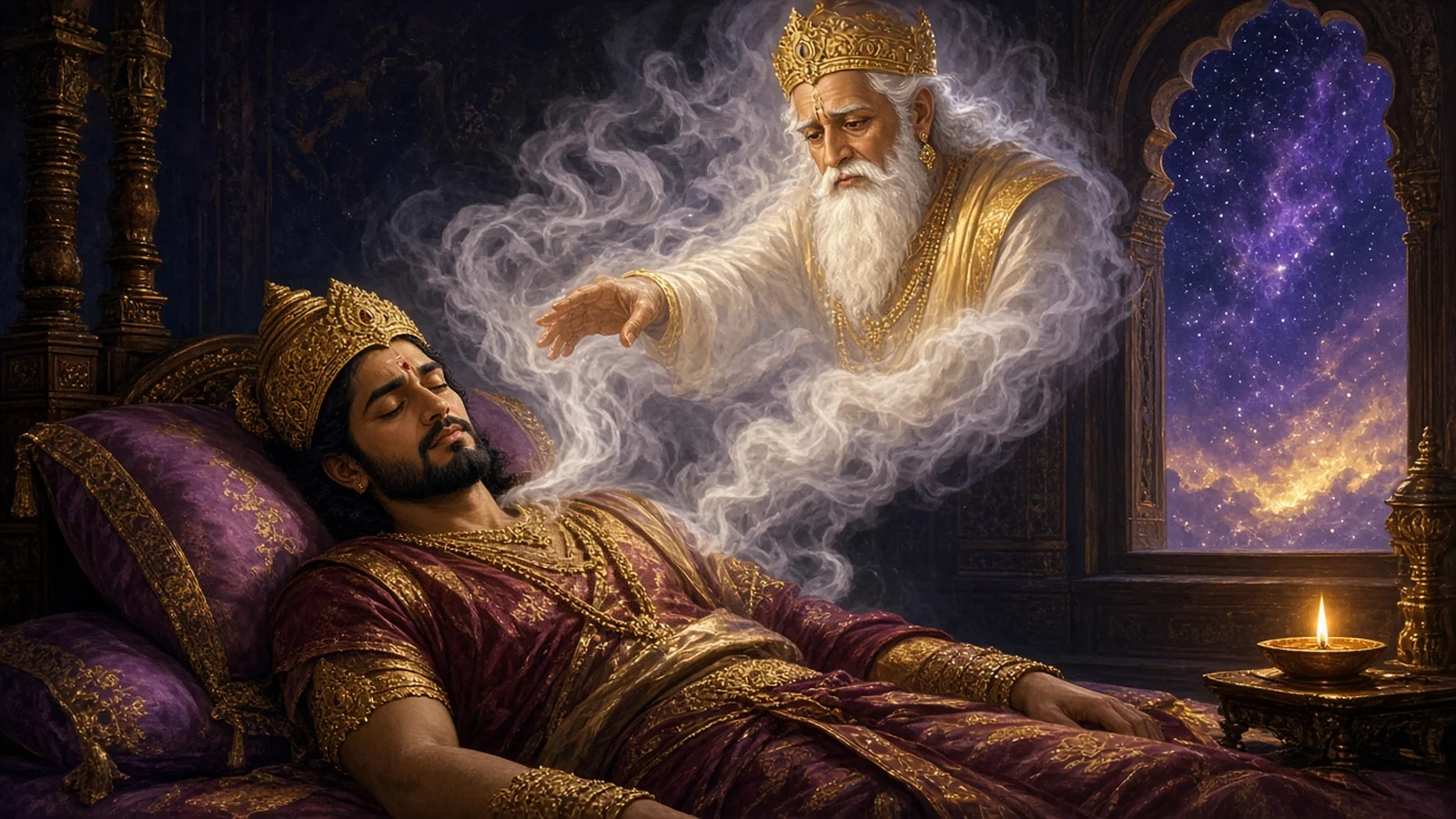
"He was twenty-one," Tanaji told her. "He wrote the Gita in Marathi so that people like us could read it, then shut himself in a cell under this temple. That was 1296. His sandals are in there. We are taking them to Pandharpur to see Vitthal, because he cannot go himself."
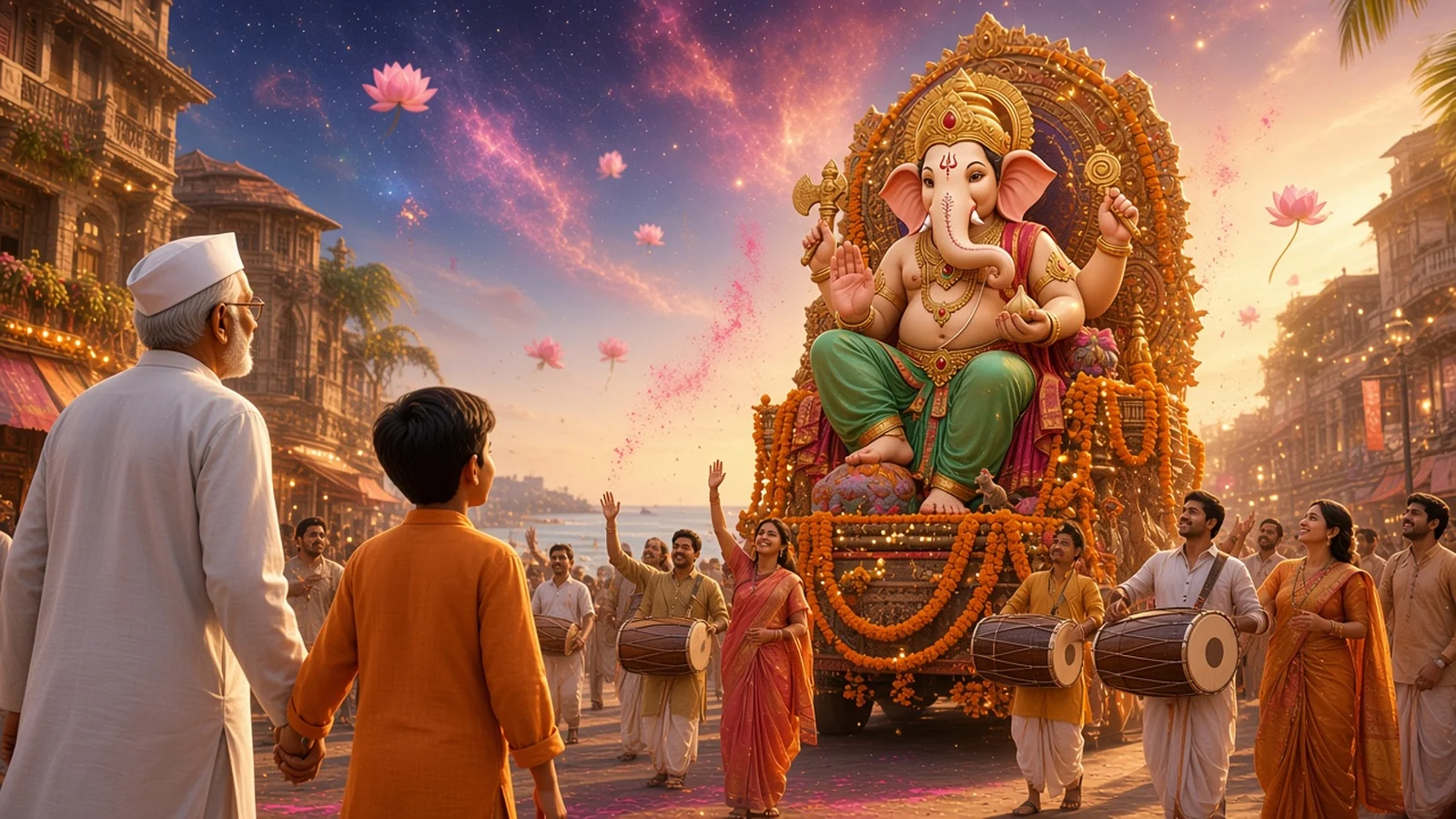
The sandals came out at dusk in a silver palanquin on a bullock cart, and the sound that went up from the town was not a cheer. It was two names, shouted by a hundred thousand people. Gyanba Tukaram. Gyanba Tukaram. Sakhu found that she was shouting it too.
Then they walked.
Into Pune, where strangers fed them for two days. Up the ghat to Saswad, to Jejuri under Khandoba's hill, and down into the Nira at Lonand, where everyone bathed and the sandals were bathed too. Each morning a horn blew three times: wake, line up, go. Each night they slept in a school or a field, and sang Tukaram first.
"Who was Tukaram?" Sakhu asked on the fourth night.
"A shopkeeper from Dehu," said Lakshmibai, who had carried a brass tulsi pot on her head for a hundred kilometres. "A bad shopkeeper. He gave the stock away. He wrote four thousand songs to Vitthal, and when the Brahmins threw his notebooks in the river, the river gave them back dry. His sandals are walking too, on the other road."
"And who started all this walking?"
"Everyone and no one. Namdev was singing of Pandharpur in Dnyaneshwar's own day. Tukaram's son Narayan first carried the sandals, both saints' together, in 1685. Then Haibatrao Baba, a nobleman from Satara who had served at the Scindias' court, gave Dnyaneshwar a palanquin of his own, and a horse, and the dindis, and the ringan. The Varkaris say 1832. He is buried under the first step at Alandi. You stepped over him."
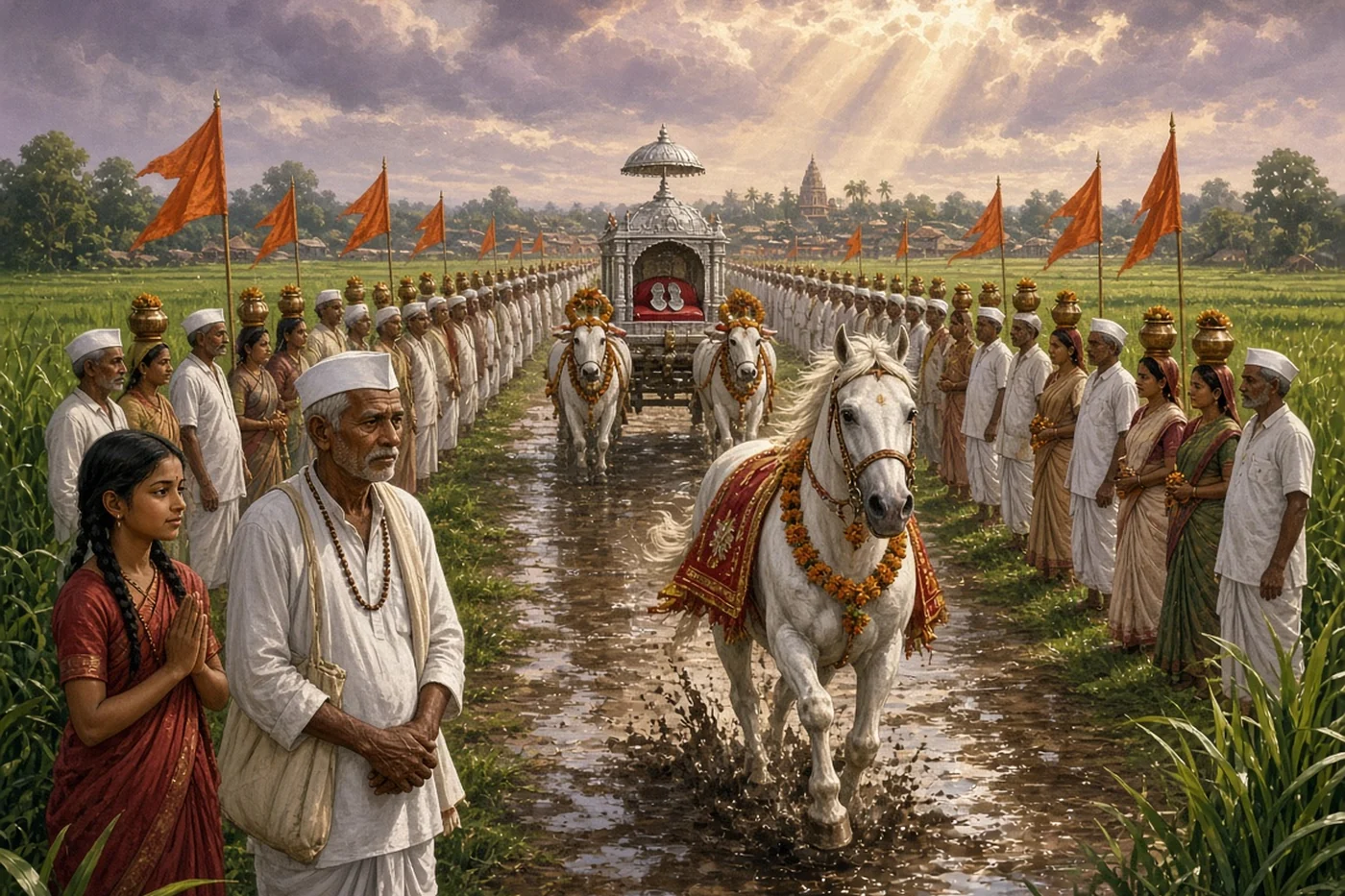
The ringan came on the ninth day, in a field at Chandoba's Limb outside Taradgaon. The dindis formed two walls a kilometre long, the palanquin stood between them, and a riderless horse was led to the far end. The saint himself rides it, the Varkaris say. The horn blew and it ran down the lane between the walls with the wet earth flying, and when it had passed, the walls broke, and ten thousand people knelt to scoop up the mud and rub it on their foreheads. Sakhu got a handful. She kept it in a knot of her sari for a year.
On the eighteenth day they came down to Wakhari and found the other road already there: Tukaram's palanquin from Dehu, Eknath's from Paithan, hundreds of them in one enormous camp. Nobody slept. Before first light a loudspeaker said that the Chief Minister had done the puja at the god's feet with a farmer and his wife beside him, and the camp roared.
They walked into Pandharpur at sunrise and down to the Chandrabhaga, the Bhima widened into a slow brown lake, and bathed with a lakh of other people. Then Tanaji looked at the queue for the temple and sat down on the ghat steps.
"Twelve hours to touch his feet," he said. "I have touched them forty-one times. You go."
"I am not going without you."
So they sat on the steps and looked up over the roofs at the temple's spire, which is all that most Varkaris see of Vitthal in the end, and Sakhu understood that her grandfather did not mind at all.
As the Varkari path and the historians give it
Maharashtra · the Varkari sampradaya, seven centuries of it · 2 min read
The walkers call themselves Varkaris, people of the vari, the regular coming and going, and the historians agree with them that the going is old. Inscriptions at Pandharpur speak of Ekadashi pilgrimages to the town in the eleventh century; a shrine to Vithoba is recorded there in 1189, and a Hoysala king gave a village for the temple's upkeep in 1237. The saints came after the god.
Dnyaneshwar, a Brahmin boy whose family had been cast out, wrote his Marathi Gita about 1290 and took samadhi at Alandi in 1296. Namdev the tailor sang of Pandharpur in the same generation. Chokhamela the Mahar was not allowed through the temple door and sang from outside it; his tomb is at the gate now, and every pilgrim passes it. Janabai was Namdev's maidservant, Gora a potter, Savata a gardener, Sena a barber, Kanhopatra a dancing girl, Sheikh Muhammad a Muslim. Eknath, a Brahmin of Paithan, revived the path in the sixteenth century, and Tukaram, a grocer of Dehu, carried it everywhere in the seventeenth, in some four thousand abhangs that the Varkaris still know by heart.
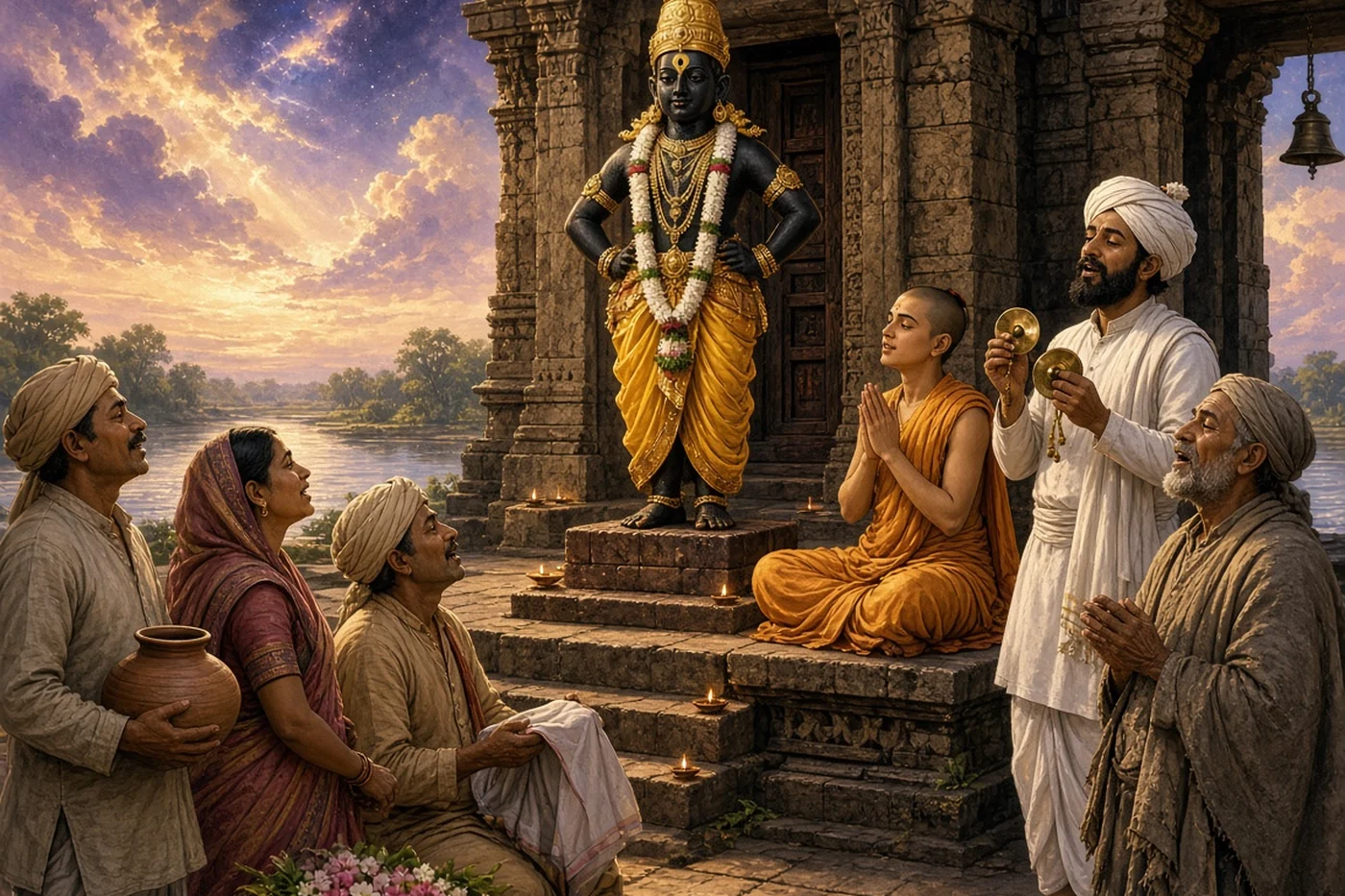
That list is the point. The scholars of the path, from G. A. Deleury and Eleanor Zelliot to R. C. Dhere, whose study of Vitthal Anne Feldhaus translated, describe a devotion that admitted every caste and both sexes to the same god, the same songs and the same road, and put no priest between the walker and Vitthal. On the Wari the Varkaris bow to one another and call each other Mauli, mother, which is also Dnyaneshwar's name. Dhere adds that Vitthal himself was probably a herders' god before he was Krishna, and Richard Eaton puts that pastoral worship as early as the sixth century.
The procession as it looks today is younger than the devotion. Tukaram's youngest son Narayan began carrying the saints' sandals to Pandharpur in 1685. In the early nineteenth century Haibatrao Baba Arphalkar, a nobleman of Satara district and a former soldier who had served the Scindias, reorganised the walk like a military march: a timetable, numbered dindis, the horse, the ringan, a separate palanquin for Dnyaneshwar. The Varkaris give the year as 1832; the encyclopaedias say the 1820s. D. B. Mokashi's Palkhi, a Marathi account of walking it that Philip Engblom put into English, is the classic description, and Dilip Chitre's Says Tuka did the same for the grocer's songs.
The numbers today: about forty registered palanquins, more than two hundred dindis on each of the two main roads, each of a hundred to five hundred people, something like 250 kilometres walked in about three weeks, and a million people in Pandharpur on the day, where the Chief Minister of Maharashtra performs the government's puja before dawn with a Varkari couple chosen for the honour. In 2026 the queue for the god's feet was more than twenty-five kilometres long. The Varkaris do it again, on a smaller scale, in Kartik, Magh and Chaitra.