As Vrindavan keeps Hariyali Teej
Braj · the Banke Bihari temple · 3 min read
The queue began before the sky did.
At five in the morning the lane outside the Banke Bihari temple was already full, umbrellas touching, and the rain that had been falling on Vrindavan since the night before ran off them in strings. A grandmother from Mathura had her grandson by the wrist.
"Hold my hand and do not let go, whatever happens. Today the whole of Braj is in this lane."
"Why today, Dadi?"
"Because today he swings. One day in the year. The rest of the year the swing is put away."
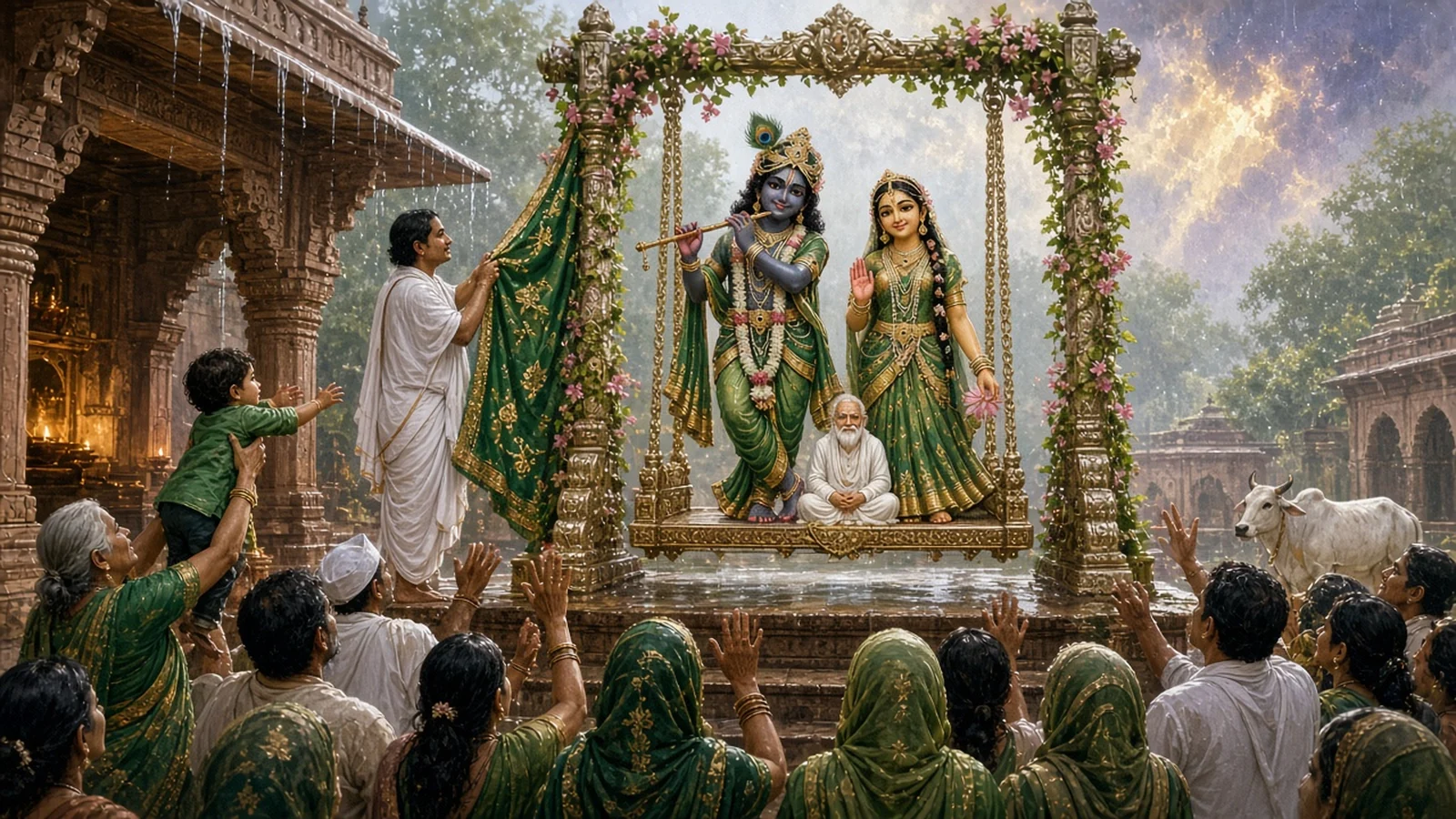
They had been getting it ready since the new moon, she told him. On Hariyali Amavasya, two weeks before, the temple had built the last of the season's flower houses, the phool banglas that had cooled the god every hot afternoon, and the same evening the men had begun on the swing. It stood now on a platform outside the jagmohan, in the open court, where the sanctum's curtain could not hide it. Gold and silver, she said. People say twenty kilos of gold went into it and a hundred of silver, and that it took five years to make, from the war to Independence. The temple itself only says it is grand, and golden, and comes out once.
At six the doors opened, early, because the lane could not hold any more people. The crowd went in like water.
Inside, the boy saw nothing for a long time except backs. Then his grandmother lifted him, and there it was.
The swing was taller than a man and bright as a lamp, and in it, in green, sat Banke Bihari, bent at the neck and the waist and the knee the way he always stands, with Priyaji beside him and old Swami Haridas, who found him in the Nidhivan grove, at their feet. The green was for the monsoon. Everything in Vrindavan was green that day, the dress on every image in every temple, the saris in the lane, the leaves tied to the swing.
"Bihari!" the crowd shouted. "Banke Bihari!"
A priest drew the curtain across. A groan went through the hall. A minute later he drew it back, and the shout went up again.
"Why does he keep closing it?" the boy said.
"Because if you look at him too long he will come home with you," his grandmother said. "That is what they say here. He is a child, this one. No bells in his temple, no early aarti, nothing to wake him. If a devotee stares too long he forgets himself and follows, and then the temple is empty. So the curtain."
The boy stared as hard as he could, to test it.
Outside, in the rain, she bought him ghevar, the round honeycomb of fried batter that is the sweet of this day, and a twist of pheny, because those are what the temple feeds the god on his swing.
"Is it only here he swings?"
"No. From today every temple in Braj hangs a swing. Radha Raman, Radha Vallabh, Dwarkadhish in Mathura, the ISKCON temple at Raman Reti, all of them. It goes on till the full moon, and some say to Janmashtami. Our people call it Jhulan."
"What is it for?"
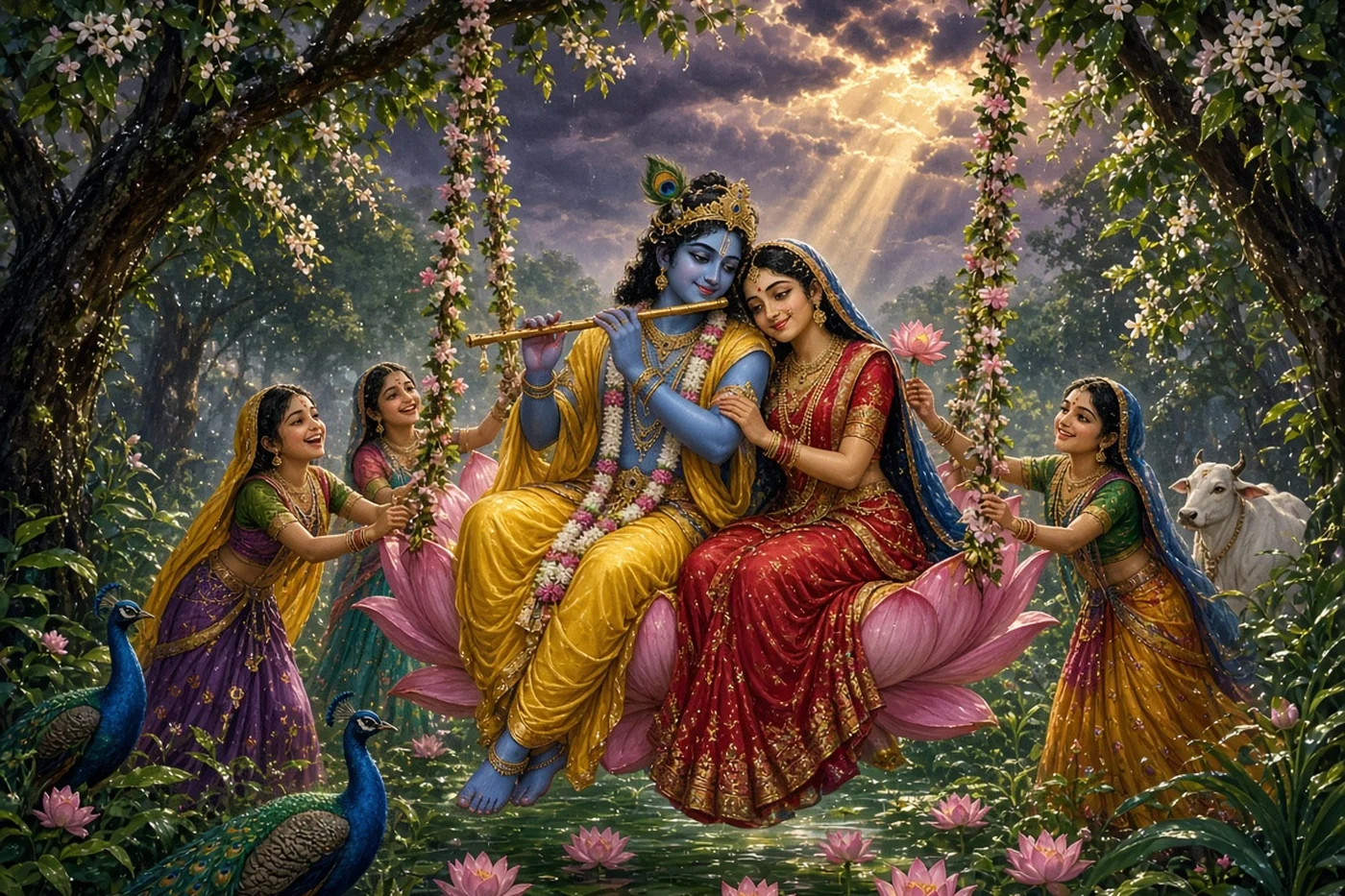
"For the rains," she said. "When the rains come, Radha and Krishna go to the groves and swing. The book one of the Goswamis' line wrote says the girls of Braj hang a swing shaped like a lotus between two bakul trees near Lalita's pond, and push it, and push it harder, until Radha is frightened and forgets to be shy and holds on to him. That is why they push. The whole of Shravana is that one afternoon."
She wiped the rain off the boy's face.
"And it is Teej," she added. "Parvati's day. In the towns the women are on swings too, in green, with mehndi on their hands, at their mothers' houses. Everyone swings today. Even him."
As Jaipur carries out Teej Mata
Rajasthan · the City Palace to the Chaugan · 2 min read
In Jaipur the swing is a palanquin and the god who rides it is the goddess.
On the afternoon of Hariyali Teej the walled city shuts its traffic and opens its terraces. Under the arcades of Tripolia Bazaar a sweet-seller had been frying ghevar in a wide iron pan since the week before, thin rings of batter poured into hot ghee until they set into a lace disc, then soaked in syrup and heaped with rabri.
"Today and tomorrow," he told a girl who had come with her father. "Chhoti Teej and the day after. Then the pan goes back on the shelf till Gangaur."
"Where is she now?"
"Inside." He pointed with his ladle at the palace wall. "In the Zanani Deorhi, the women's gate. The ladies of the palace do her puja in there where nobody sees. Then she comes out of Tripolia, which only the royal family may use, and down this street, and all of us see her."
The girl's father had bought her a lehariya dupatta that morning, the tie-dyed stripes that ripple like water and that Jaipur wears on this one day. Her hands were still brown from the mehndi of Sinjara, the day before, when the basket had come from her mother's house for her married sister: bangles, henna, a box of ghevar, a lehariya sari.
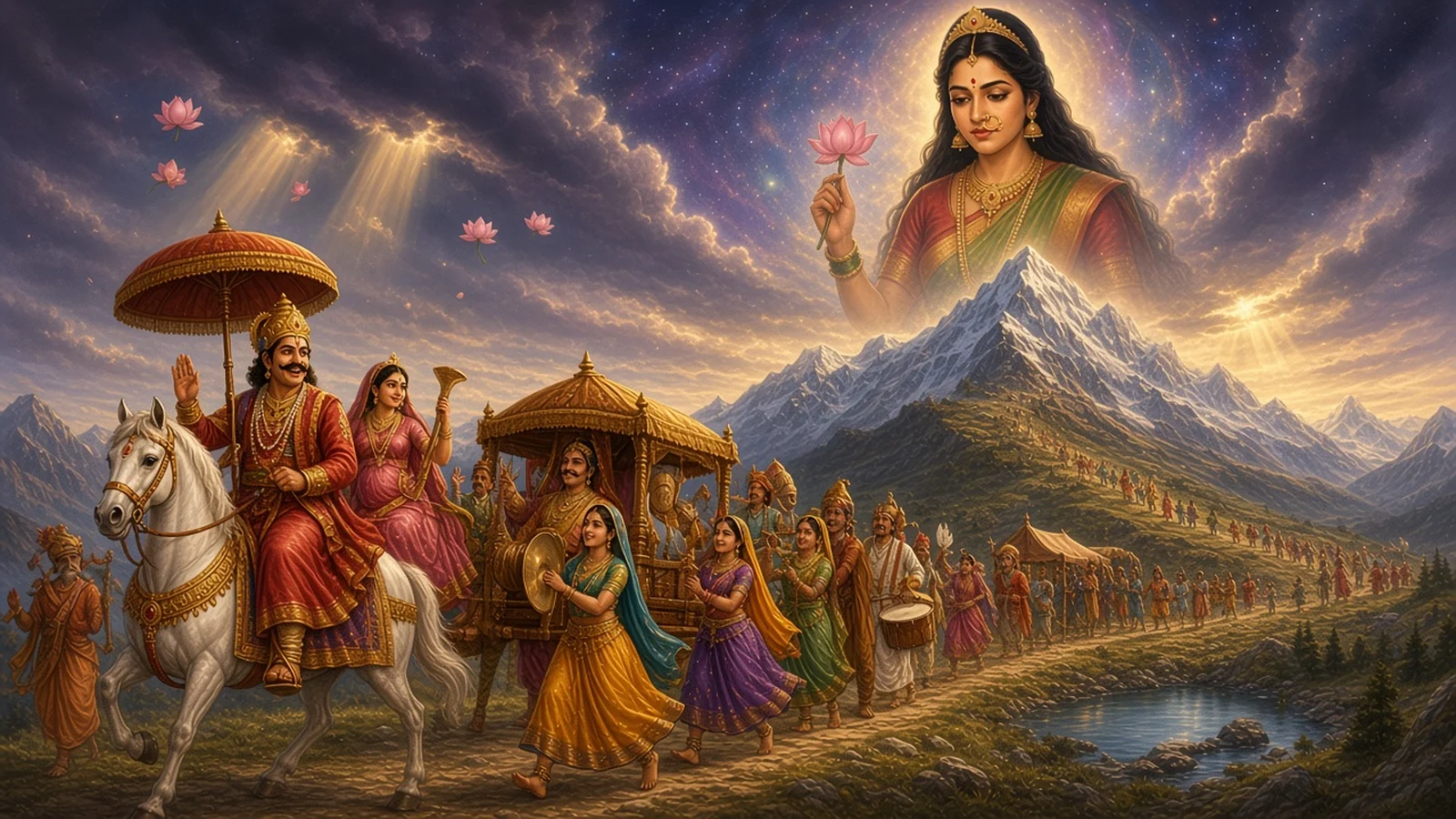
At five the drums began.
First came eleven tall poles with pennants, the standards of Gogaji, carried by men of the Valmiki community. Then the dancers: men riding cloth horses in lehariya skirts, snake charmers blowing their pipes, a man breathing fire. Bullock carts. A mock camel corps with a small brass cannon on a cart; the Jaipur state kept a real one once, the girl's father said, and it fought in two world wars. An elephant walked slowly past under the five-coloured flag of old Jeypore.
Then the band, and behind the band, under a canopy, in a palanquin hung with flowers and gold cloth, Teej Mata herself, Parvati on the day she leaves her father's house for her husband's. A line of women constables walked on each side of her holding a thick rope, and the men who led her wore white achkans and red turbans.
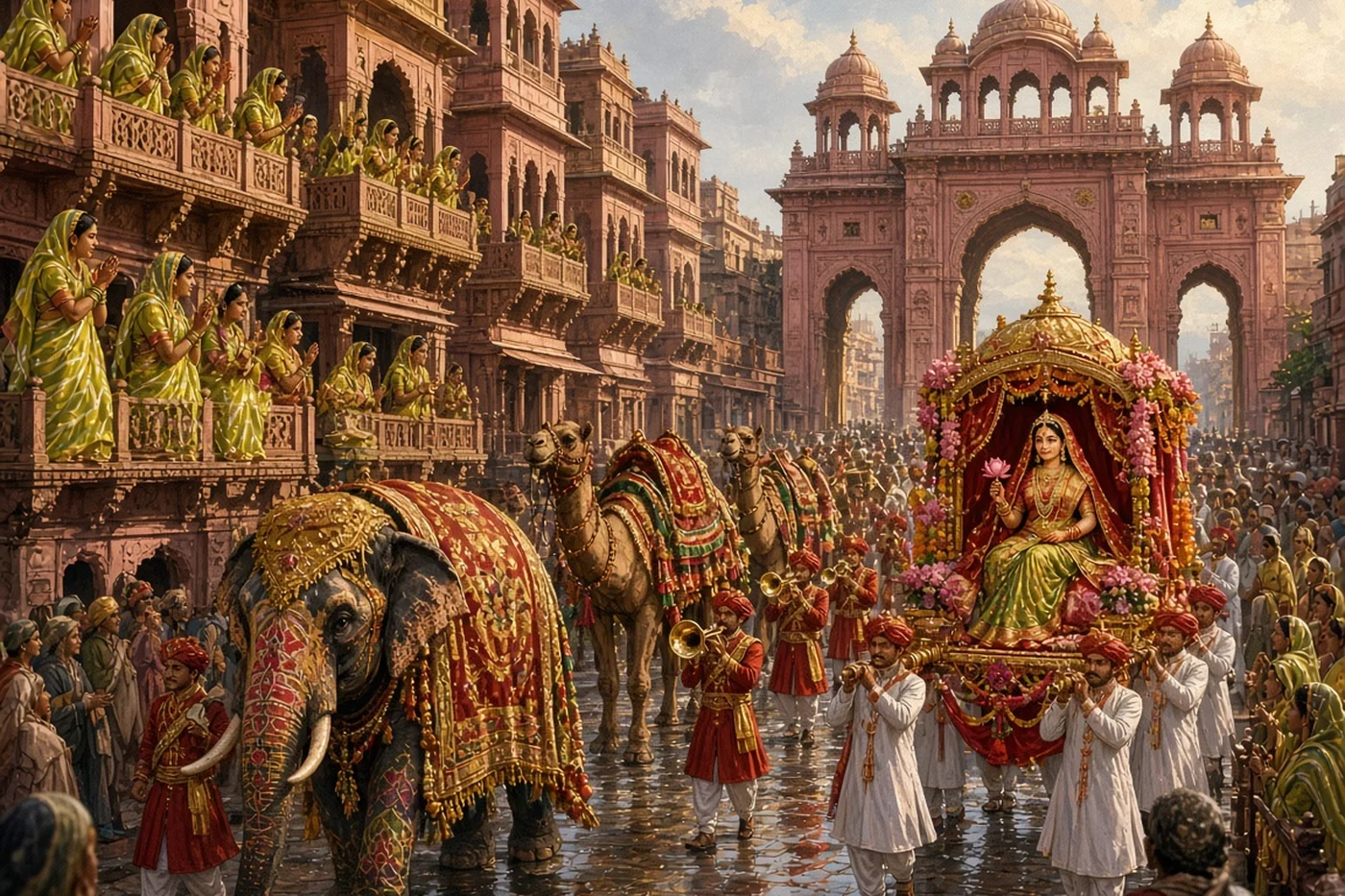
"Why is she covered?" the girl asked. "Gangaur is open."
"Because this is the day she goes to Shiva. A bride is covered."
The whole thing took twenty minutes to pass, and then the street filled behind it and followed her to Chhoti Chaupar, down Gangauri Bazaar, to the Chaugan.
Nobody in the street could say who began it. The old men say it is as old as the city, and that before Independence she went from Sirehdyodi to the Badi Chaupar instead. Bundi, down the road, says the real Teej Mata was gold and that its raja carried her off from the Jaipur procession long ago, and that Jaipur has walked a stand-in ever since. Jaipur does not say so.