As Braj and the Gaudiyas tell it
Arita, below Govardhan · the Bhagavata's bull, and the night after · 3 min read
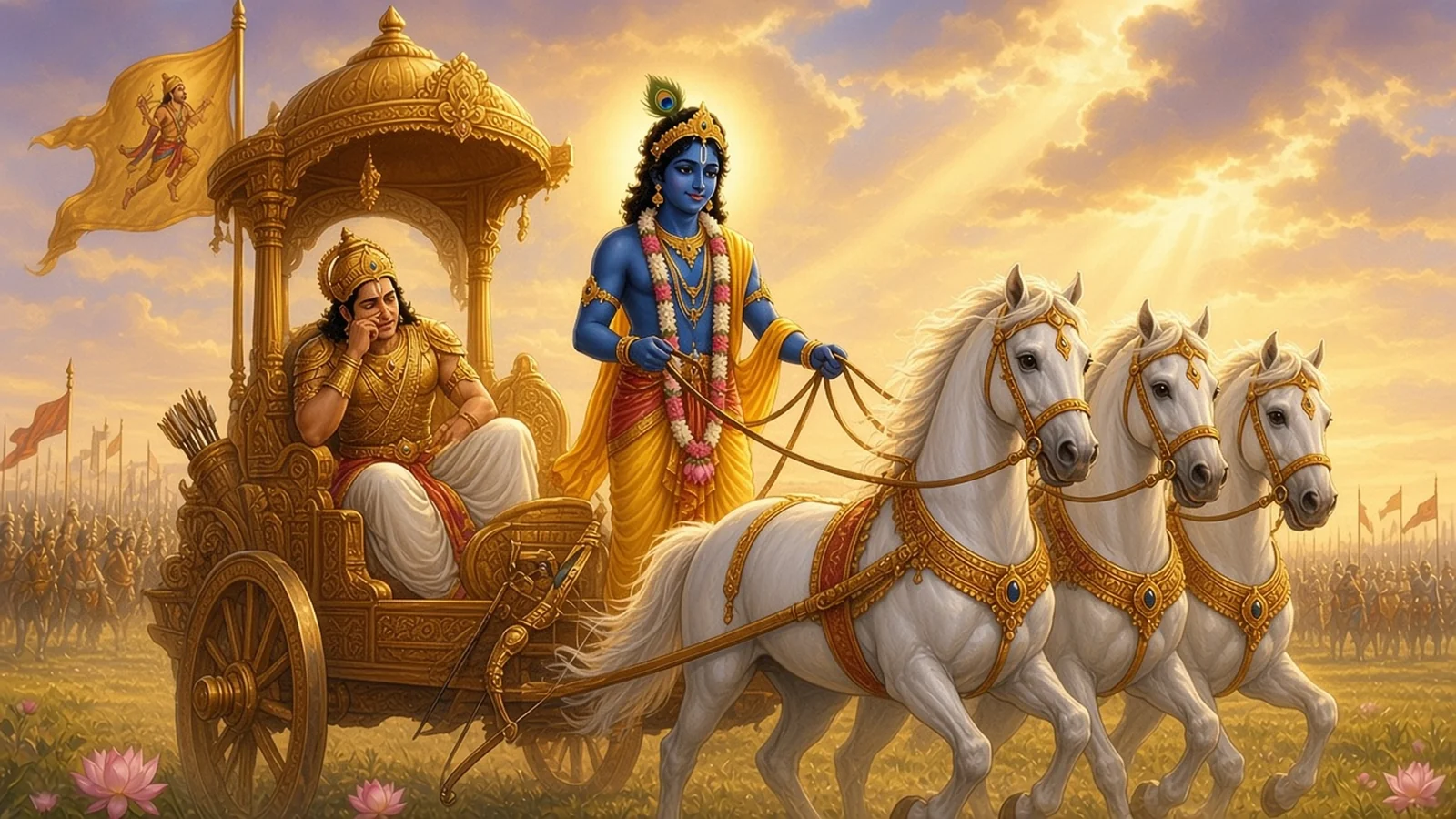
The bull came into Vraja in the afternoon, when the cows were out. It was not a bull. It was Arishta, a demon Kamsa had sent, but he had taken a bull's body, and such a body: a hump like a hill with the clouds sitting on it, horns like spears, hooves that split the ground as he walked. He bellowed, and the sound went through the village like a blow. He gouged the banks of the ponds with his horns, the cows ran, the women who were carrying lost their children in fright, and the herd boys ran to Krishna.
"Don't be afraid," said Krishna. Then, to the bull: "Fool. You frighten cows and children. I am here."
He slapped his arms, and the bull lowered its head and came at him like a thunderbolt. Krishna caught it by the horns and threw it back eighteen paces, the way one elephant shoves another. The bull got up, sweating and blowing, and came again. Krishna took the horns a second time, put it down with his foot and wrung it like a wet cloth, and then he tore one horn out of its head and beat it with its own horn until it lay still. The gods threw flowers. The village, which is called Arita, breathed again.
That is the Bhagavata's part. Braj tells the rest.
That night Krishna went looking for Radha, and she stepped back from him.
"Do not touch me," she said.
"What have I done?"
"You killed a bull."
"I killed a demon."
"You killed a bull," said Radha, and the gopis round her nodded. "A bull is the cow's own family. Whoever kills one has killed a cow, and whoever kills a cow has to wash. We will not go anywhere with you until you are clean."
Krishna looked at her face and saw that she was serious, or had decided to be. "Then tell me how."
"Bathe in every holy river in the world," said Radha. "All of them. Then come back."
He laughed. He struck his heel into the ground where he stood, and the earth opened into a pit, and he called, and from every direction the rivers came, Ganga and Yamuna and Saraswati, Narmada, Godavari, Kaveri, in the shapes of women, and one after another they stepped into the pit and became water. It was full before the gopis had finished gasping. Krishna bathed in it, came out, and shook the water from his hair.
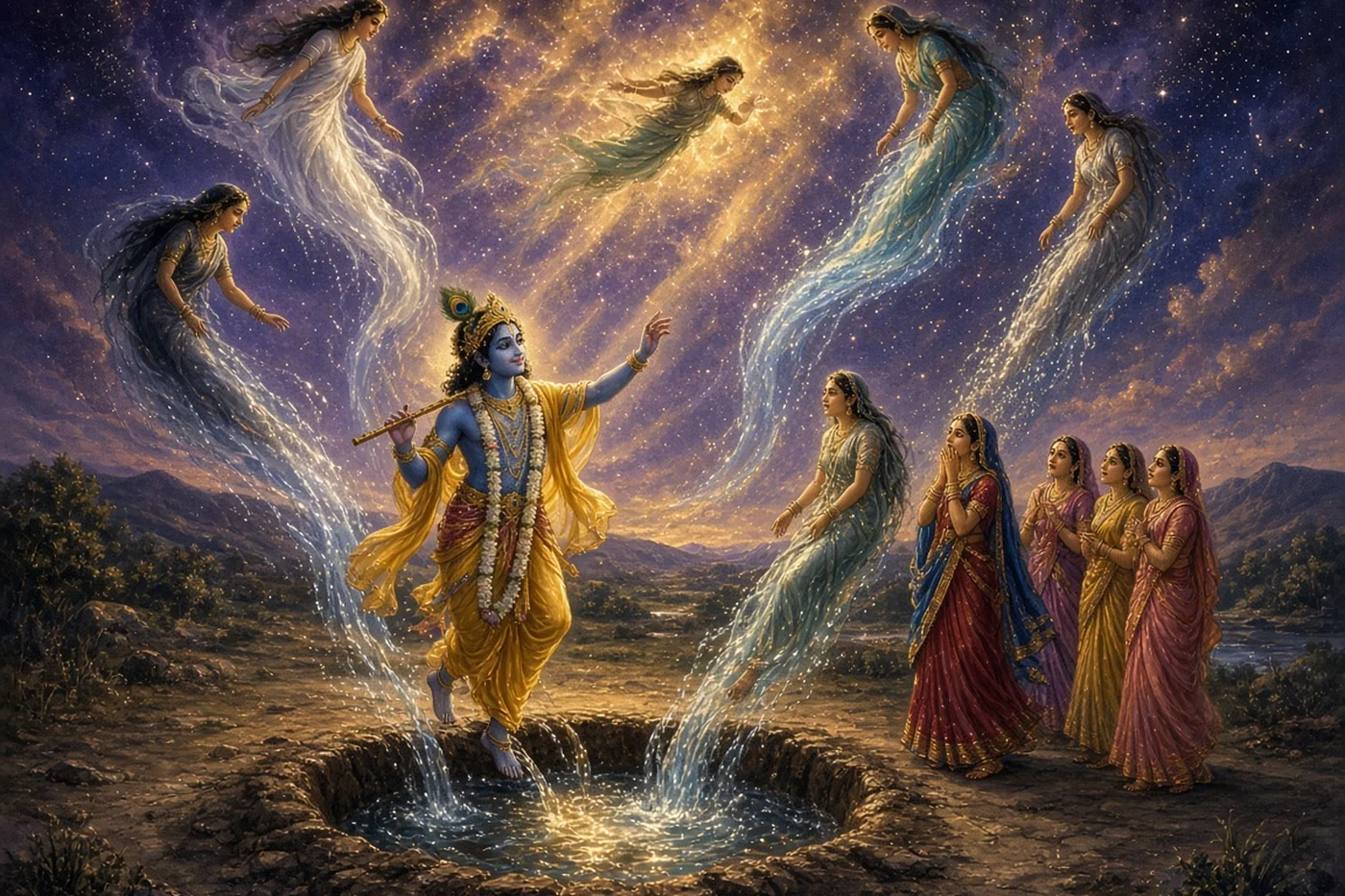
"There," he said. "Every holy river in one pool. Mine. Is there a finer pond anywhere in Braj?"
That was a mistake.
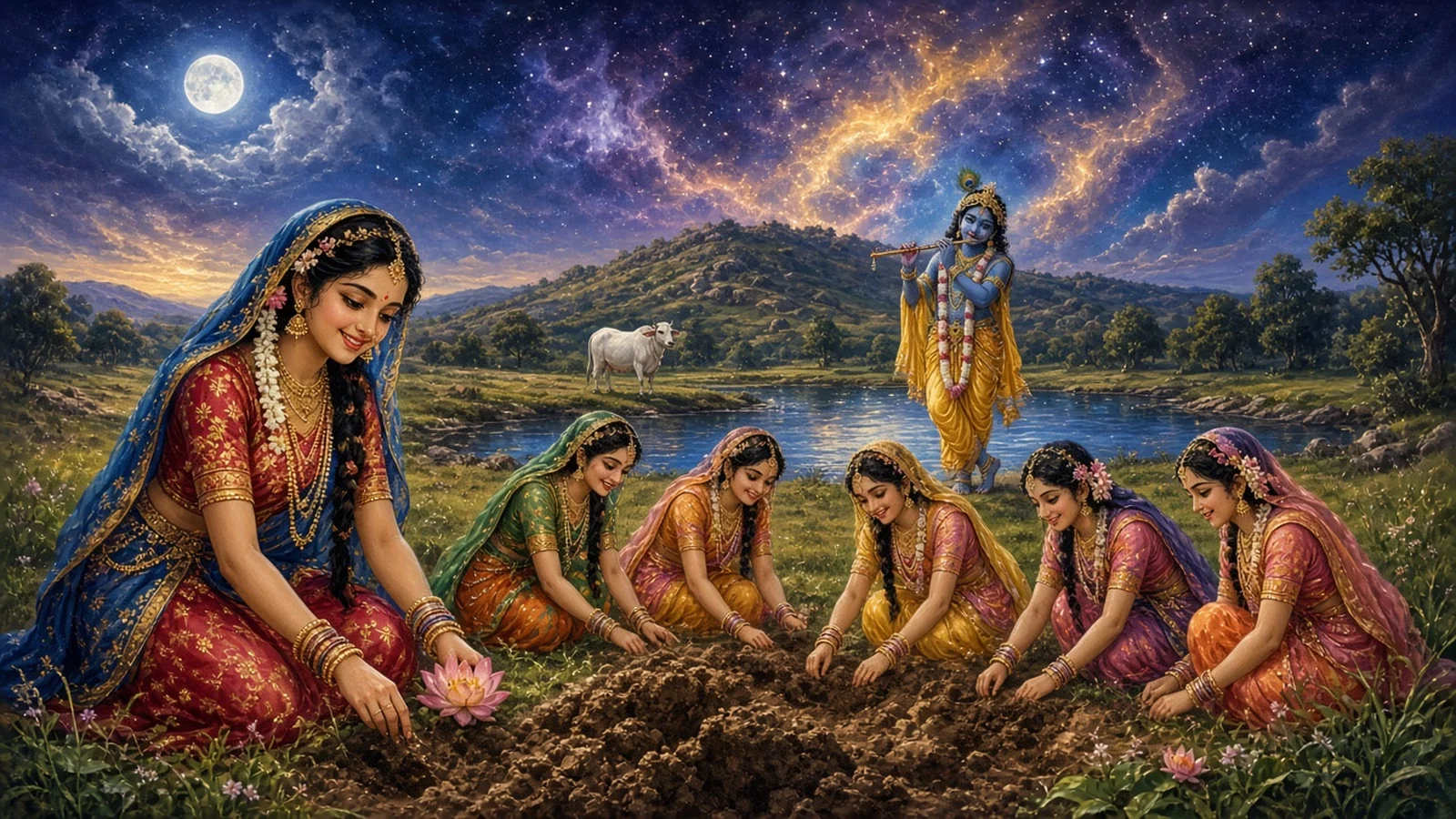
"We shall see," said Radha. She slid the bangles off her wrists, went to the ground on the far side of his pool and began to dig with them, and every gopi did the same, bangles scraping at the hard earth of Arita until a second pit lay beside the first. It was dry.
"Take water from mine," said Krishna.
"From the pond of a bull-killer? No." Radha sent the girls to Manasi Ganga, the lake on Govardhan, with clay pots, and they made a line from the lake to the pit and passed the pots from hand to hand, and the pit did not fill, and they did not stop.
Krishna could not bear to watch for long. He made a sign to the rivers, and the rivers rose out of his pool in their own forms and came and stood before Radha with their hands folded.
"Let us in," they said. "We have filled his. Let us fill yours. It is we who will be honoured by it."
Radha looked at them a while, and then she nodded. A channel opened between the two pits, and the water of Shyam Kund ran across into hers and rose to the brim, and that was Radha Kund.
It was midnight, Braj says, on the eighth night of the dark fortnight of Kartika. Krishna stood on the bank between the two ponds. "This one," he said, "is as dear to me as you are. Whoever bathes in it will have the love you have."
As the kund's later story is told: lost, found, and the midnight bath
Radha Kund, Mathura district · the Chaitanya Charitamrita, and the night of Ahoi Ashtami · 3 min read
After Krishna left Braj the two ponds went back into the ground, as if they had never been, and for a very long time nobody knew where they were.
Around 1515 a sannyasi from Bengal came walking through Braj asking for them. He was Chaitanya, whom his followers would call Krishna and Radha in one body, and at the village of Arita he asked the people where Radha Kund was.
"We have never heard of it," they said. The brahmin who had come with him from Mathura had not heard of it either.
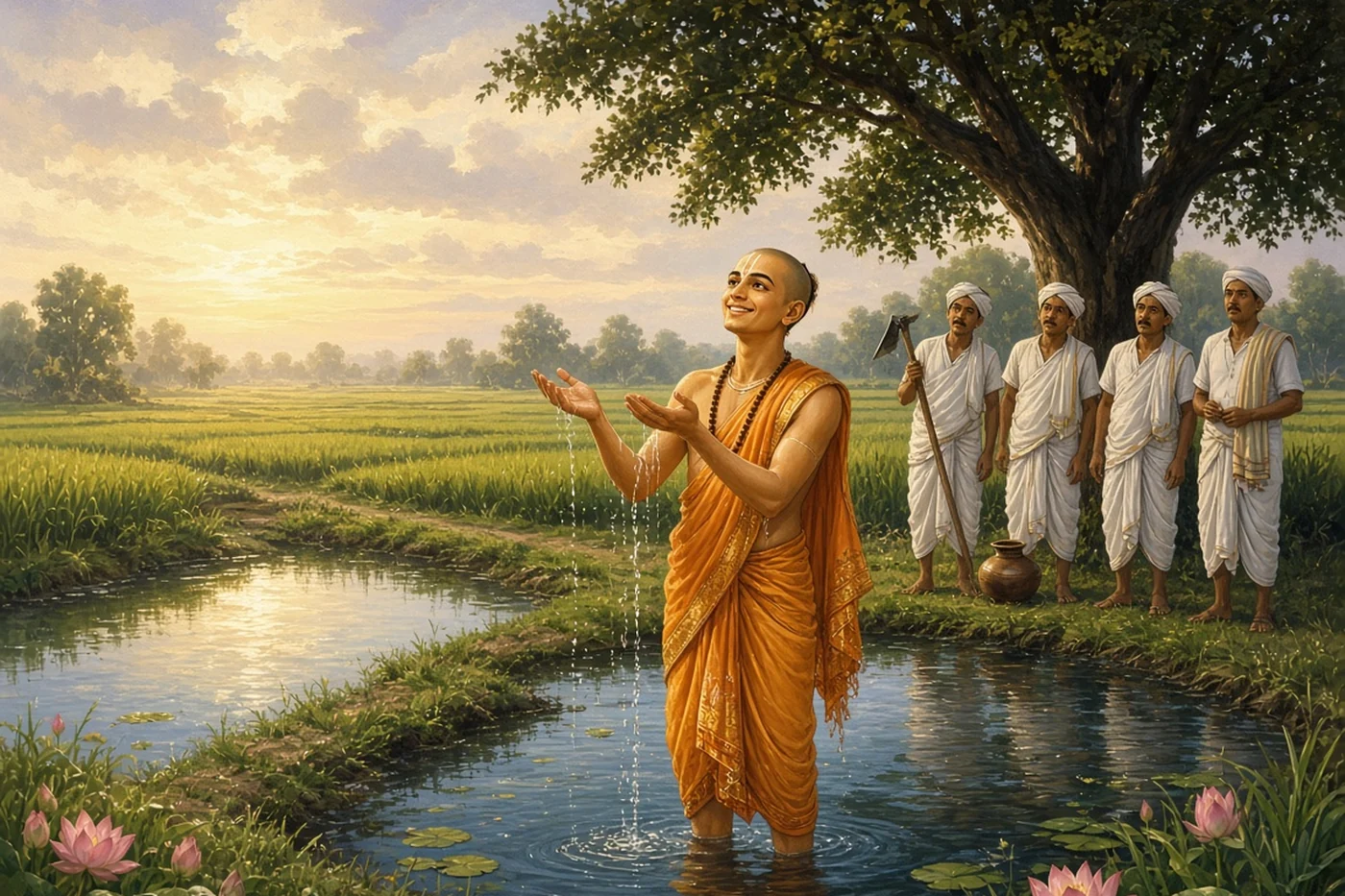
Chaitanya went out into the fields and sat under a tamal tree, and from there he saw two shallow ponds in the paddy, the kind every field in Braj has, with a little water in each. He got up, went to them, and knew them. He bathed in both, with the farmers watching a holy man wash in their field water, and he spoke to the pond itself, saying it was as dear to Krishna as Radha was and that one bath in it gave her love. Then he danced on the bank, rubbed its mud on his forehead for a tilak, and carried some of the mud away with him. One Gaudiya account says the villagers had called the two ponds the fair one and the dark one.
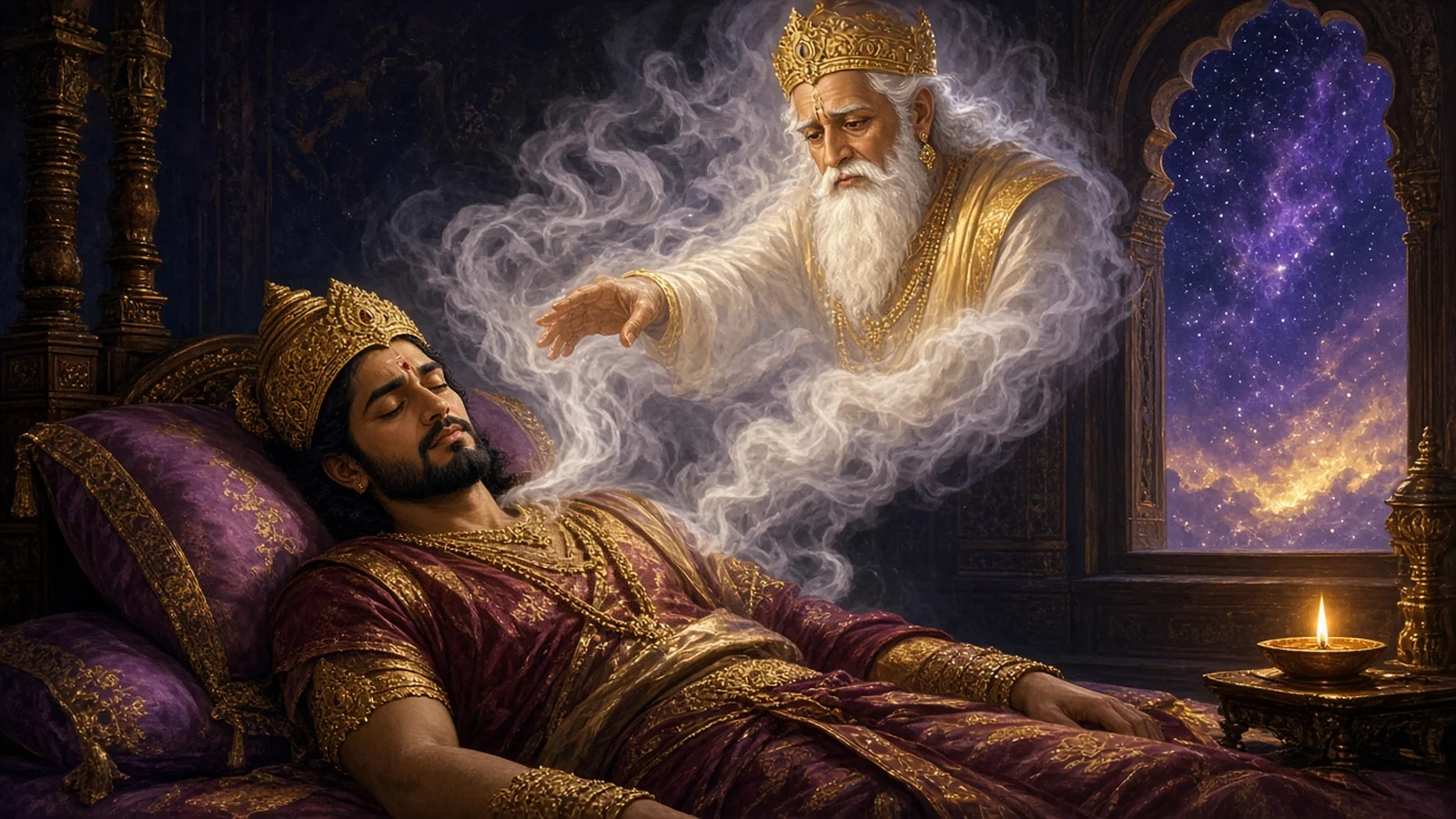
The men he sent to Vrindavan, Rupa and Sanatana, and after them Raghunatha dasa, settled the matter. Raghunatha dasa lived on the bank and would not touch money, so the digging waited until, the story says, a rich merchant on his way to Badrinath dreamed that the god told him to turn round and dig Radha Kund instead. While Shyam Kund was being cut square, Raghunatha dasa dreamed of five trees on its edge that were the five Pandavas sitting in meditation, and the trees were left standing, which is why Shyam Kund is not square to this day.
Rupa Goswami wrote the kund's rank into his eleven verses of instruction: Mathura is higher than heaven, the forest of Vrindavan higher than Mathura, Govardhan higher than the forest, and Radha Kund, at the foot of Govardhan, highest of all, because it is as dear to Krishna as Radha; one bath in it, he says, awakens the love the gopis had.
That is why the night is kept as it is. On Bahulashtami, the eighth of dark Kartika, the Gaudiyas keep the kund's appearance day, and the great bath begins at midnight, the hour the two ponds came up, and goes on until nearly dawn.
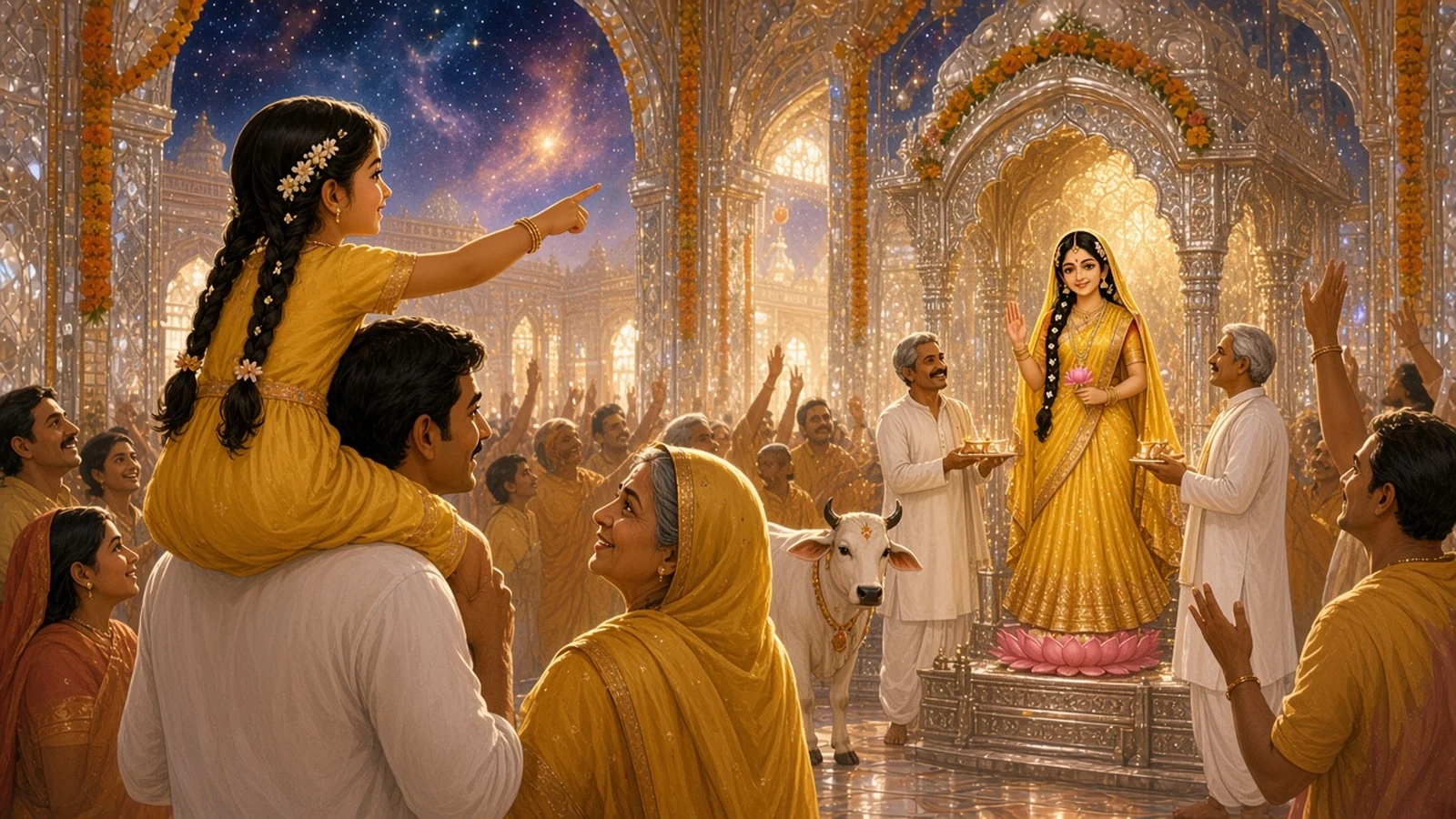
For the rest of the north the same night is Ahoi Ashtami, the mothers' fast for their children, and the couples who have no child come to Radha Kund for it. They stand in the water together, each pair with a white pumpkin wrapped in red cloth, and ask Radha for a child; lamps are set afloat at dusk before the bath, and the couples whose prayer was answered come back a year later to say so. More than a lakh people were in the water on that one night in 2021.