As the Bhagavata tells it
Vrindavan, by the Yamuna · Bhagavata Purana 10.29 to 10.33 · 4 min read
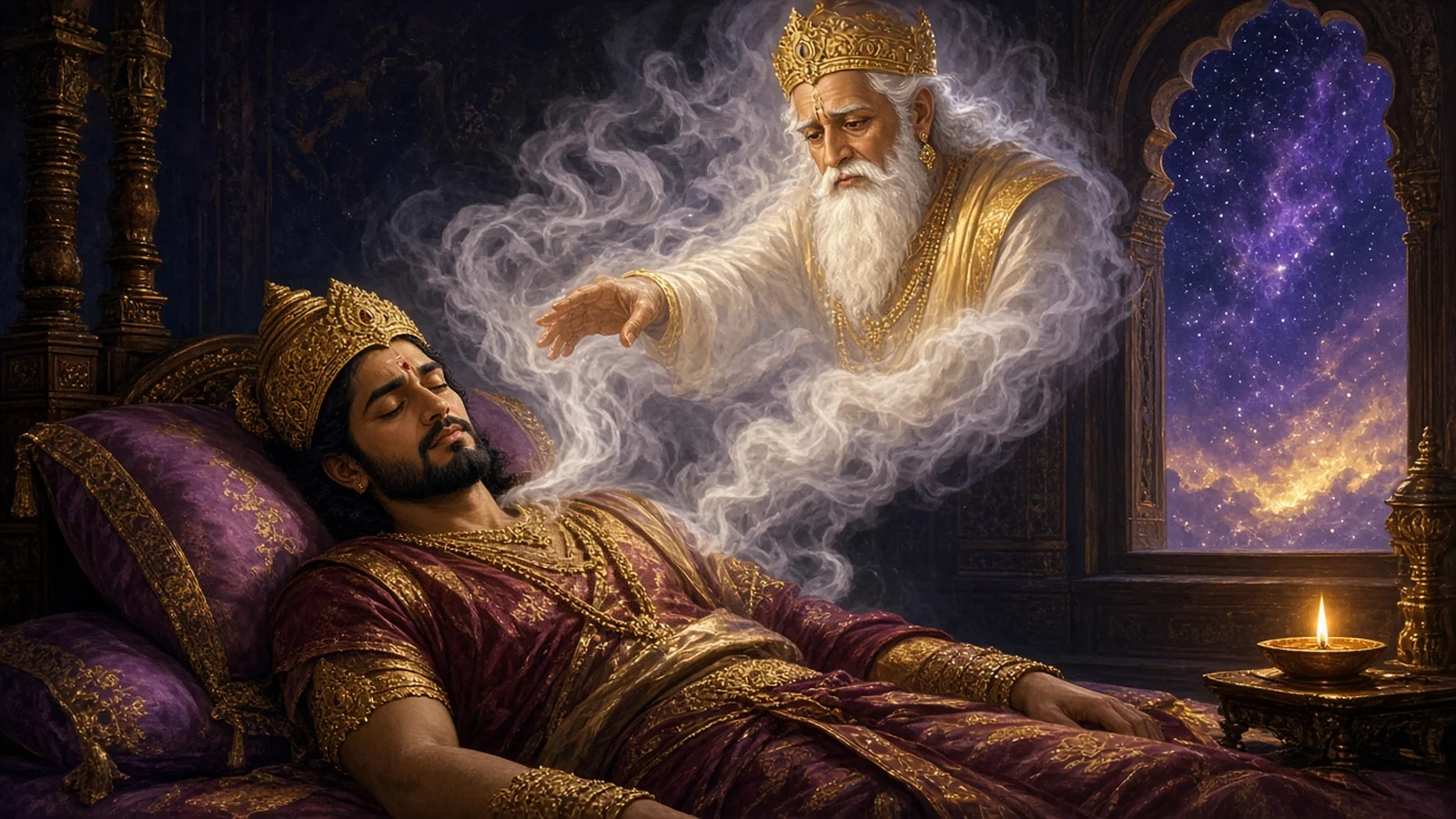
The rains were over and the nights of autumn had come, when the jasmine opens and the air turns cool. One evening the full moon rose red over the forest, the lilies opened to it and the wood turned to silver, and Krishna put the flute to his lips and played.
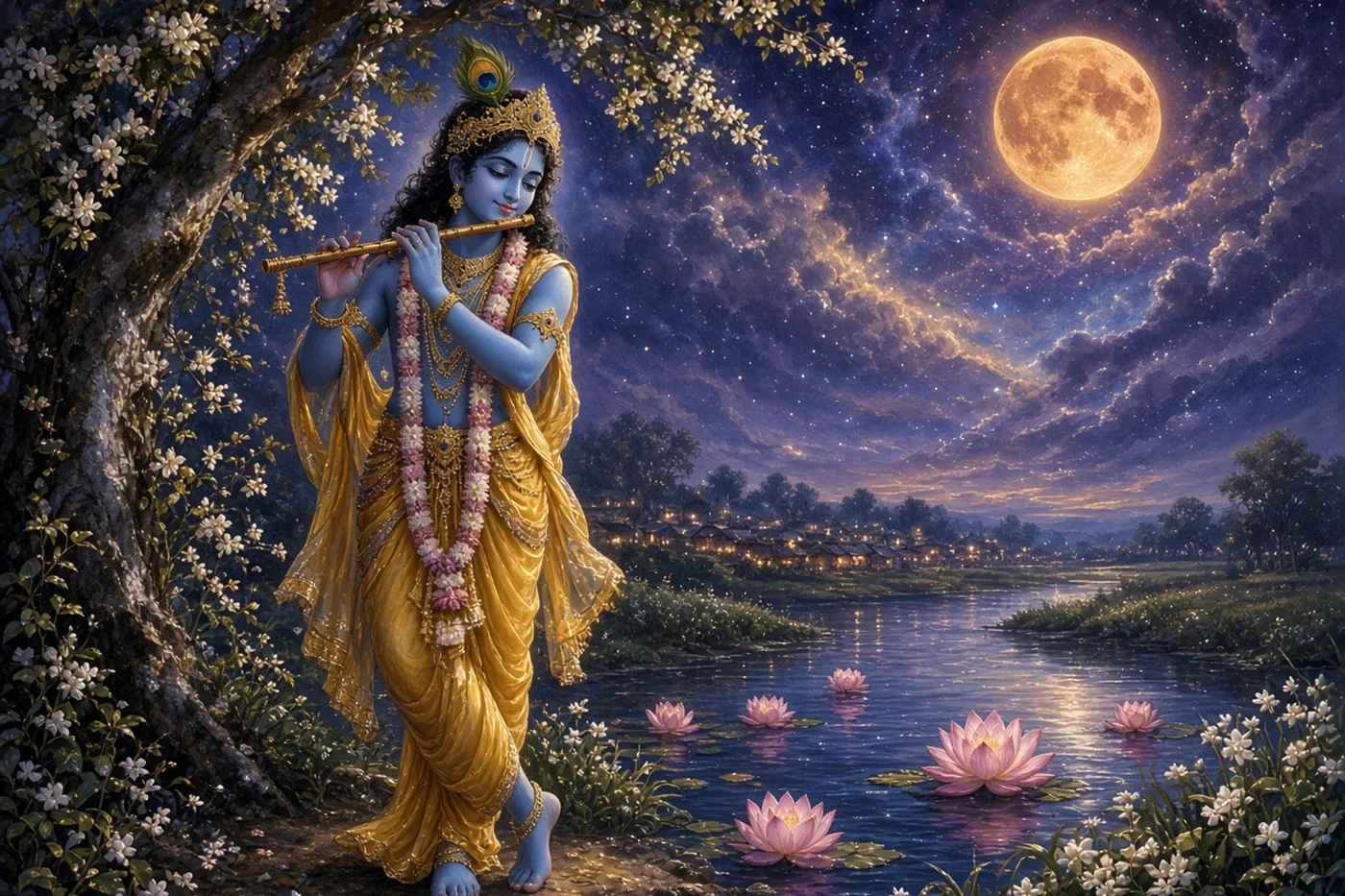
In Vrindavan the sound went into every house. One woman left the milk on the fire. One set down the child at her breast. One ran out half dressed with her ornaments on the wrong way round, and none of them told the others. Husbands and brothers called after them. They did not turn.
They found him by the river. He looked at them as though he could not think why they had come.
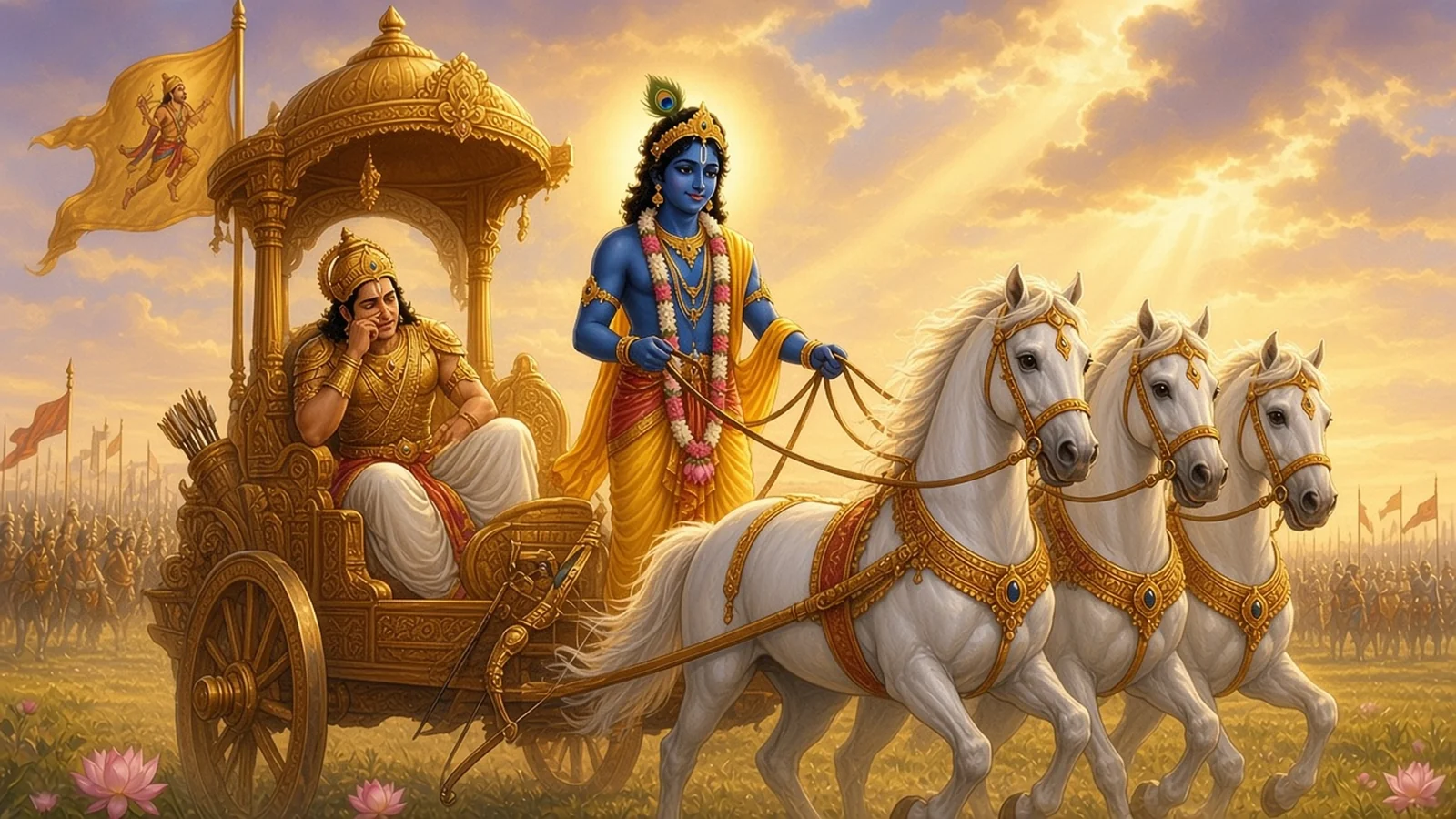
"Welcome," he said. "What can I do for you? Is something wrong in Vraja? The night is dark and there are wild animals in the forest, and your mothers and husbands will be looking for you. Go home."
The women stood still.
"You have seen the forest in the moonlight," he went on. "That is enough. Go back and look after your children and your calves. A woman's place is her house. Hear about me, think about me, and you will be nearer to me than you are standing here."
They did not move. Their tears cut lines through the kajal on their cheeks and wet the dust at their feet. At last one of them spoke.
"Do not say that, Govinda. We have left everything to come to you. You are the self inside every self. Who is a nearer husband than that? Our feet will not go back. Send us away and we will burn, and it will be your doing."
Then he smiled, the text says, and let them stay.
He took them down to the soft sand of the Yamuna and sang with them, and walked among them like the moon among stars. Each woman began to think herself the most fortunate on earth. Each one thought he was hers alone. And as their pride grew, he was gone.
They looked everywhere. They asked the trees. "Ashvattha, have you seen him? Tulasi, you are the one he loves, which way did he go?" They began to act him out to each other, one lifting a hill on her hand, one playing a flute of air, weeping and laughing at once.
Then they found his footprints in the moonlight, and beside them a woman's. He had taken one of them away alone. The prints stopped where the grass grew rough, so he had carried her, and further on they found her sitting by herself.
"I was proud," she said. "I asked him to carry me. He said, climb on my shoulder, and he was gone."
They searched as far as the moonlight reached, then went back to the riverbank and sat and sang to him. Come back. Your smile, your feet that stood on the serpent's hoods, your flute. A moment without you is an age.
He came, in a yellow cloth with a garland and a smile, and every one of them stood up at once, as if life had returned to her body. They were angry and glad together.
"Some people love only those who love them," one said. "Some love everyone. Some love nobody. Which are you?"
"I went so that you would think of nothing else," he said. "You have given up everything for me. I could not repay you in a lifetime of Brahma. Let your own love be the payment."
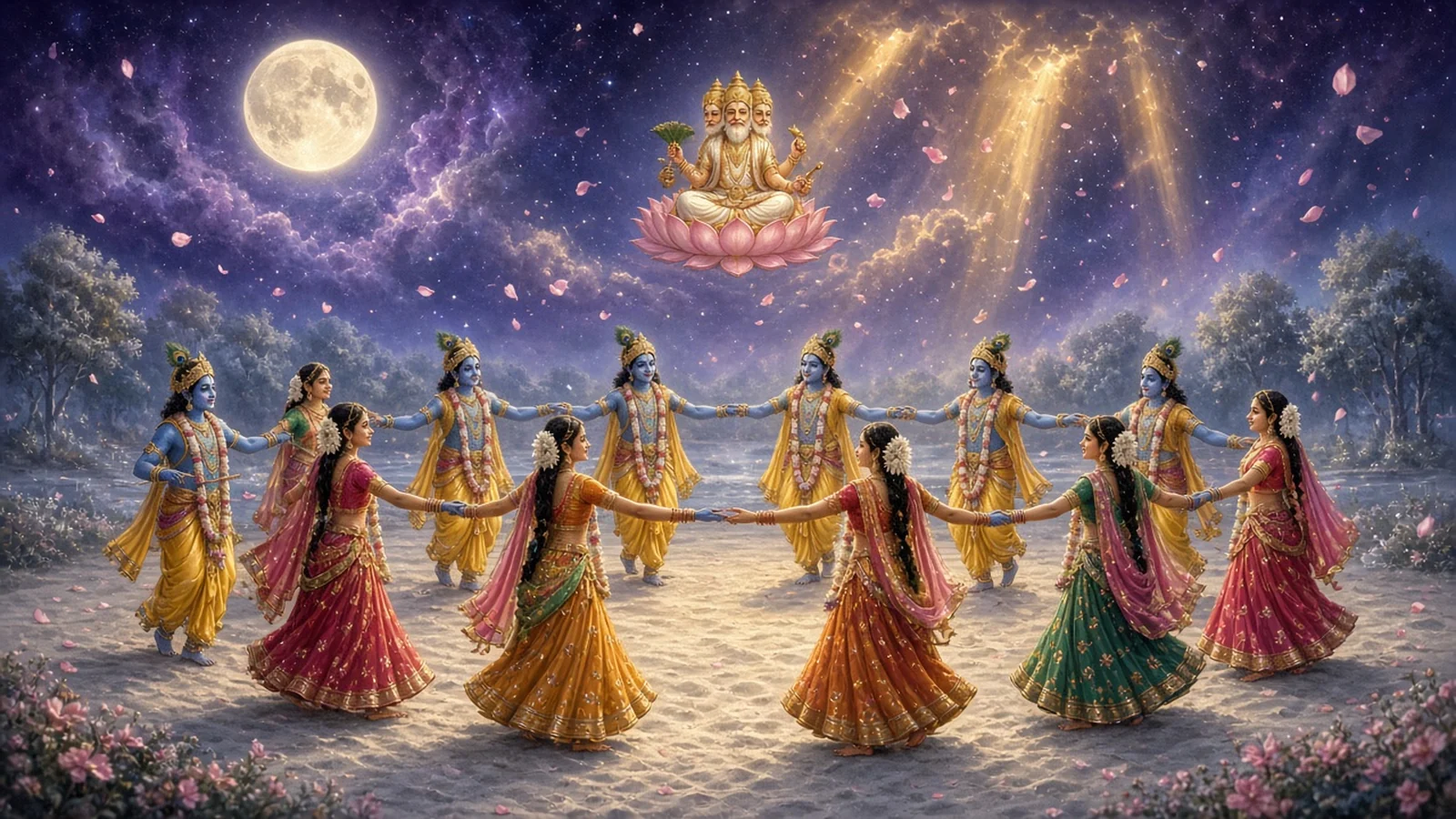
Then the dance began. The women stood in a ring with their arms linked, and between every two of them stood a Krishna with an arm round each neck, so that each one believed he was beside her alone. Drums sounded in the sky and flowers fell. The gods came with their wives to watch, and the moon and the stars stood still. They danced until their hair came down and their garlands broke, and when they were tired he wiped their faces with his hand and led them into the river.
The sages say that night was not one night. It had the length of a night of Brahma, and when its dawn came at last he sent them home, and their husbands had never missed them.
As Braj keeps the night
Vrindavan and Braj · Sharad Purnima, the Raas Purnima · 2 min read
In Vrindavan the full moon of Ashvin is Raas Purnima, and the town says the dance happened here, at Vamshivat, the banyan by the river where the flute was heard, and that it happens again every year.
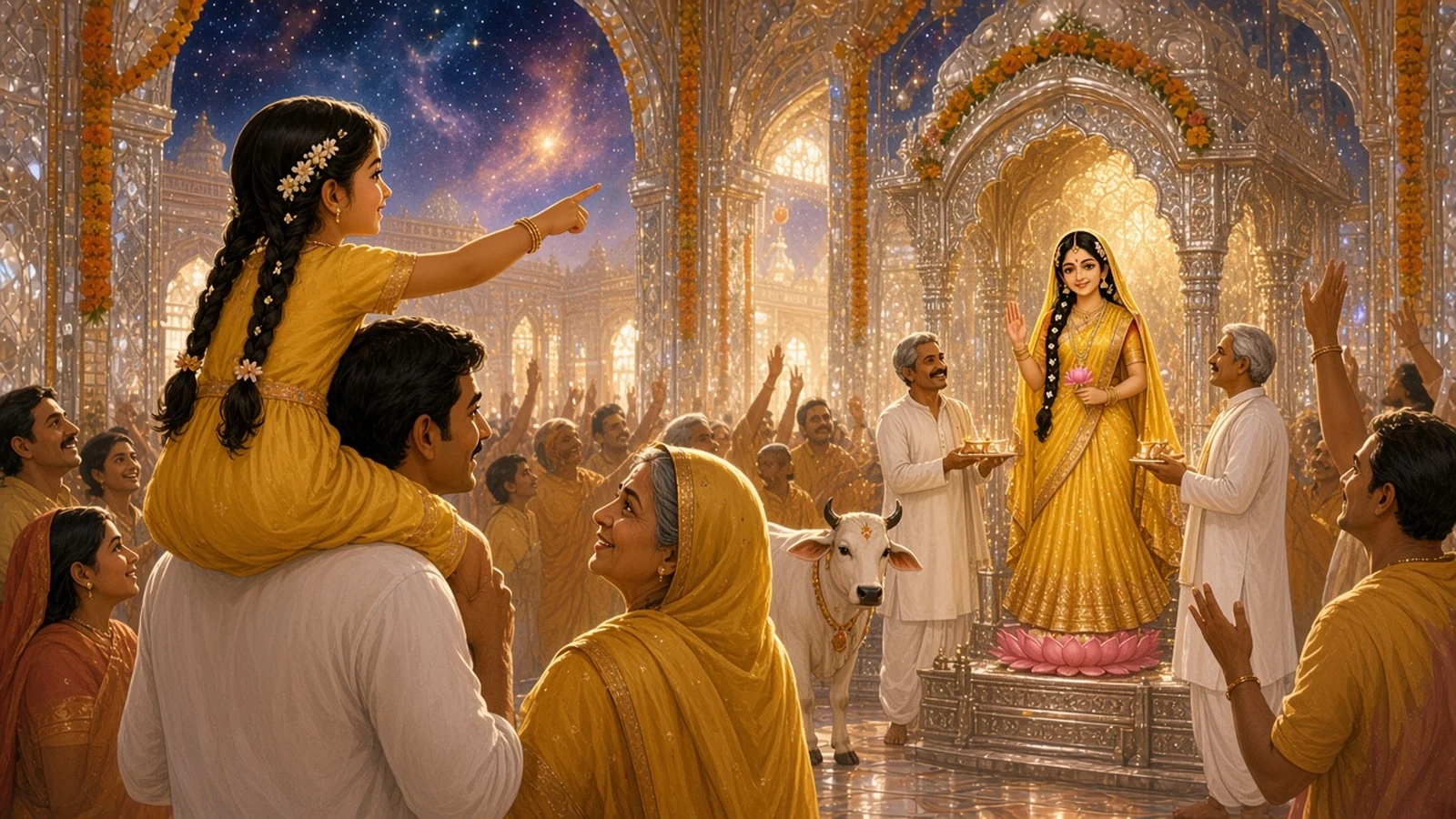
On the afternoon of the full moon the hall before Banke Bihari's sanctum is turned into a forest. Branches of flowering trees are tied along the walls, plantains and bushes fill the courtyard, and a small hut of silver stands in the middle for a throne. The god is dressed in white from head to foot, moon white, as every deity in Vrindavan's temples is dressed that night, and he wears a tall crown unlike his usual one, the crown the Raas Lila stage troupes later copied. And he holds his flute. On every other day of the year it lies on the throne beside him. On this one night it is at his lips.
The image faces east, where the moon comes up. When it is high, the shutters over the courtyard grille are opened so that its light can fall into the temple, and the darshan does not end until the moonlight has crossed the floor and touched the feet of Banke Bihari. The people say the moon takes its blessing from those feet and gives it back through its rays. Then they go home to the kheer they set out in the open at dusk, and towards midnight they eat it.
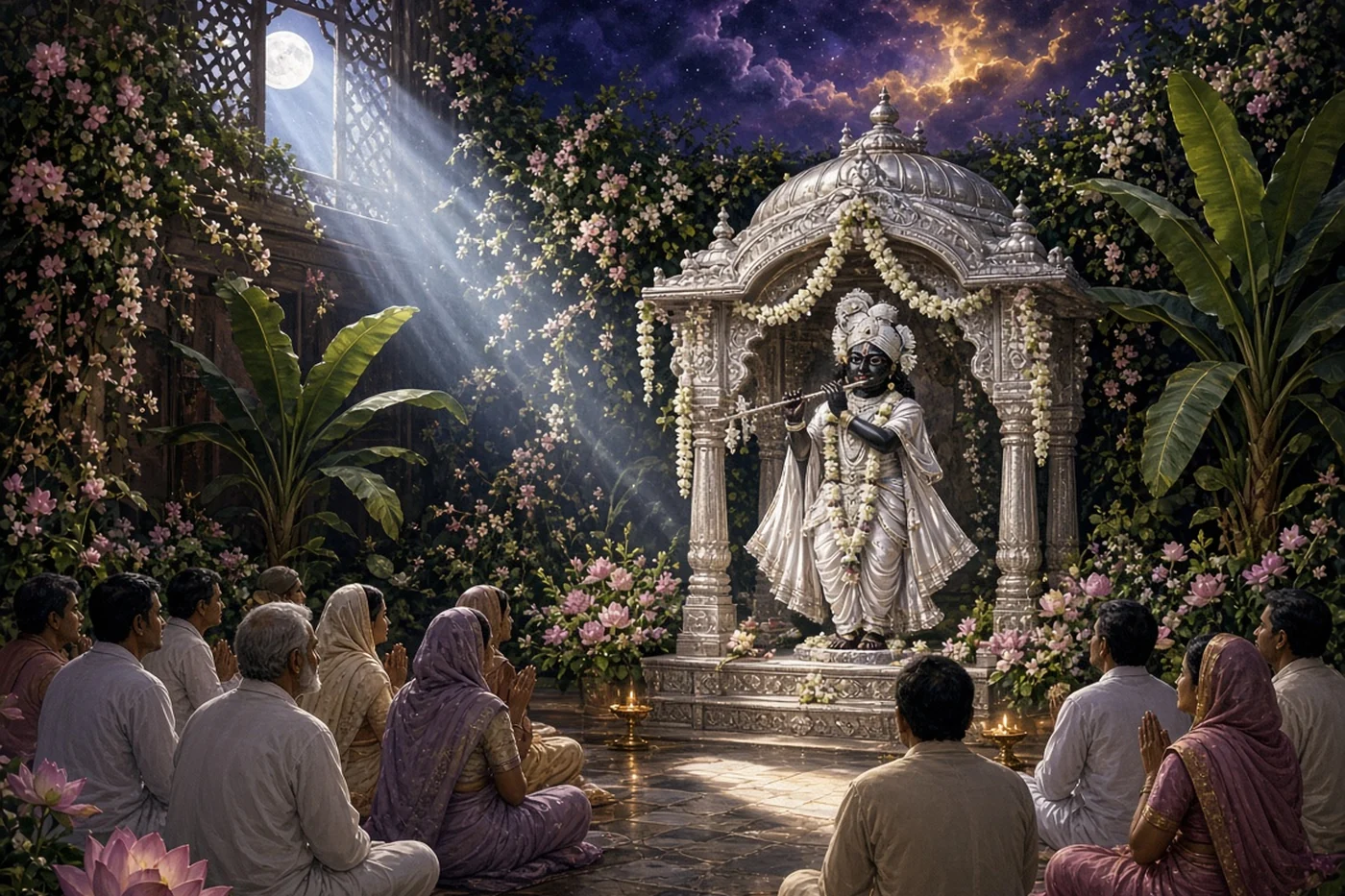
Across the town the Raas is played. The Raas Lila troupes of Braj, who have acted the dance since the saints of the Nimbarka line began it at Vamshivat in the fifteenth century, put a boy Krishna and a girl Radha in the middle of the ring, and the singers sing the old acharyas' songs of the night. At the Gopeshwar Mahadev temple the priests tell how Shiva himself longed to see the dance, came dressed as a woman of Vraja, and is worshipped there to this day as the Lord of the Gopis.
The woman the Bhagavata does not name has a name here. In the twelfth century Jayadeva of Odisha wrote the Gita Govinda, twenty-four songs in which Krishna dances with the cowherd girls in the spring woods, Radha burns with jealousy and longing, a friend carries their messages, and he comes back to her at last. It was sung every night before Jagannath at Puri and spread across the country, and from it the devotional movements of the north made Radha a goddess. In Braj she stands at Krishna's left in every temple, the town greets itself with her name, and on Raas Purnima nobody doubts who the gopi in the moonlit forest was.