As the commentators tell it
Malpe beach and Udupi, Karnataka · 3 min read
Madhva went down to the sea before dawn to bathe, as he did on many mornings. The shore lay about three miles from Udupi, and the walk was long enough for a hymn.
That morning he did not only recite. He made new verses as he walked, short songs to Krishna that could be sung by a crowd, and they came faster than he could say them. By the time he reached the sand he had five chapters. He had a feeling, Padmanabhachar's life of him says, that Krishna himself was on his way to Udupi that day.
He sat down on the sand to pray. When he opened his eyes there was a ship out on the water in trouble.
It was a merchant ship from Dwarka, heavy with goods, and the storm had taken it out of the sailors' hands. It drifted, swung round and stuck fast on a sandbank. It would not go forward and it would not come in. The crew were shouting from the deck.
"Help us! She is aground!"
Madhva stood up, took the cloth from his shoulder and waved it towards the ship.
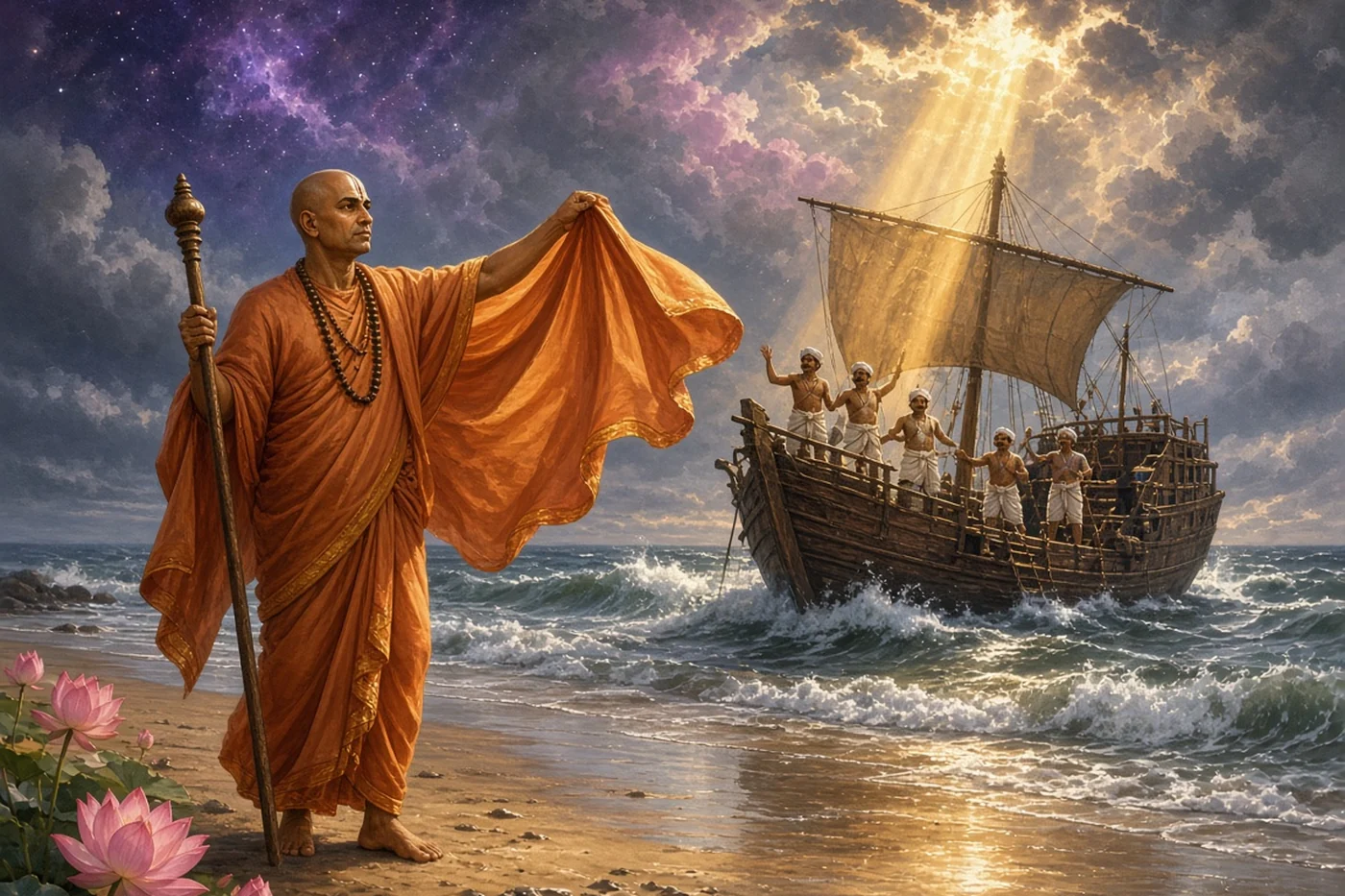
The ship lifted off the sand. It came in through the waves as if someone were pulling it by a rope, and it reached the shore safely, and everyone on the beach cheered.
The captain came up the sand and bowed to the monk.
"You have given us our lives and our cargo," he said. "Take whatever you want from her. Name it."
"I want none of your goods," said Madhva. "You have some lumps of gopichandana in your hold. Give me a few of those. That is enough."
Gopichandana is the pale yellow clay of Dwarka that Vaishnavas use to draw the marks on their foreheads. The sailors brought the lumps up gladly, and one of them was far bigger and heavier than the rest.
"Carry that one carefully," said Madhva. "Bring it to the matha."
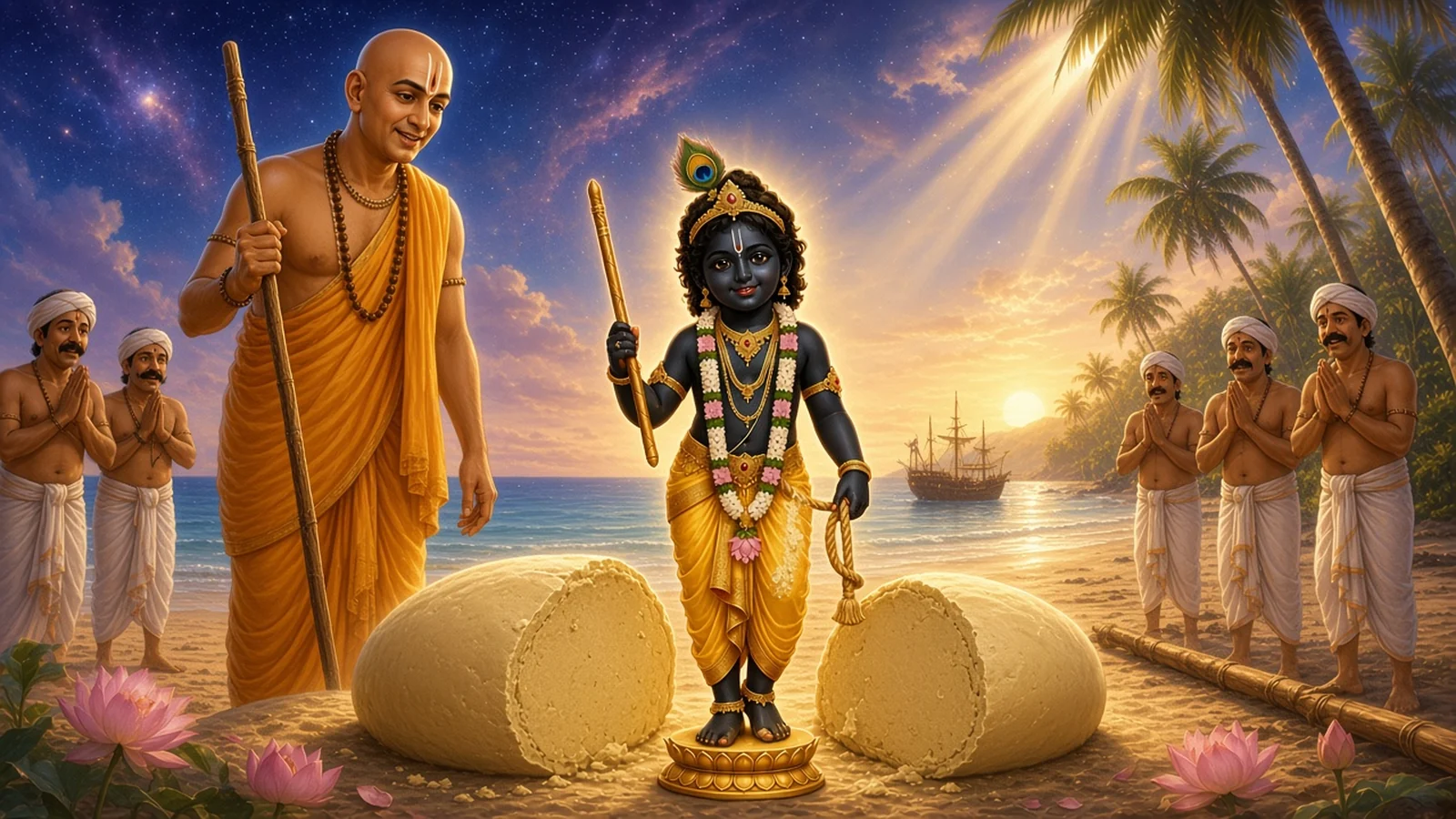
They set off for Udupi with it. They had gone only a furlong or two when the big lump split in two.
Inside it stood a small figure of the child Krishna. In one hand he held a churning rod, and in the other the rope that turns it.
Madhva stood and looked at him and could not move. Then the songs began again, and now he sang them straight to the child's face. By evening all twelve chapters of the Dvadasha Stotra were done.
The place where the clay broke is called Vadabhandeshwara, and there is a temple to Balarama there now.
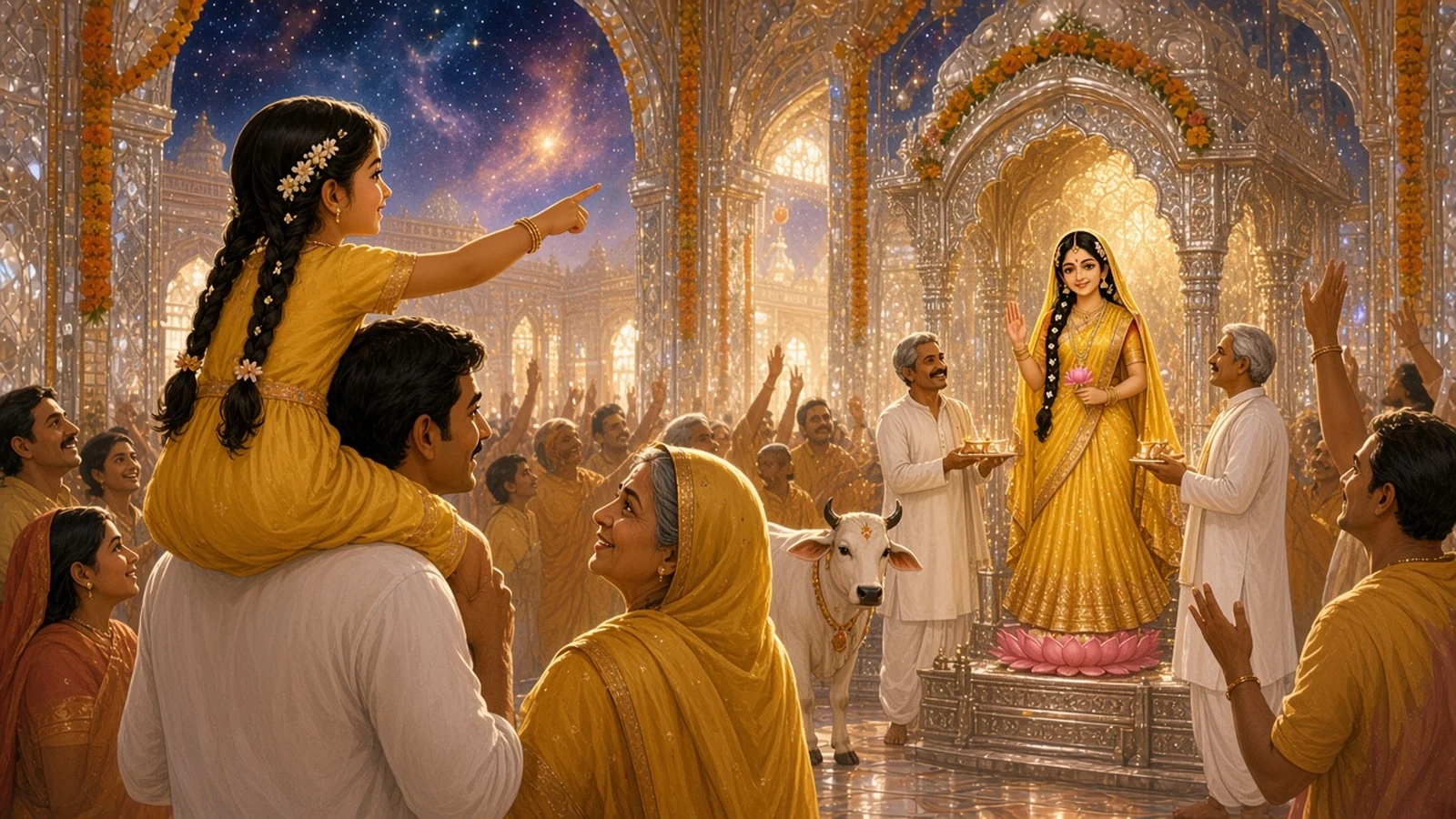
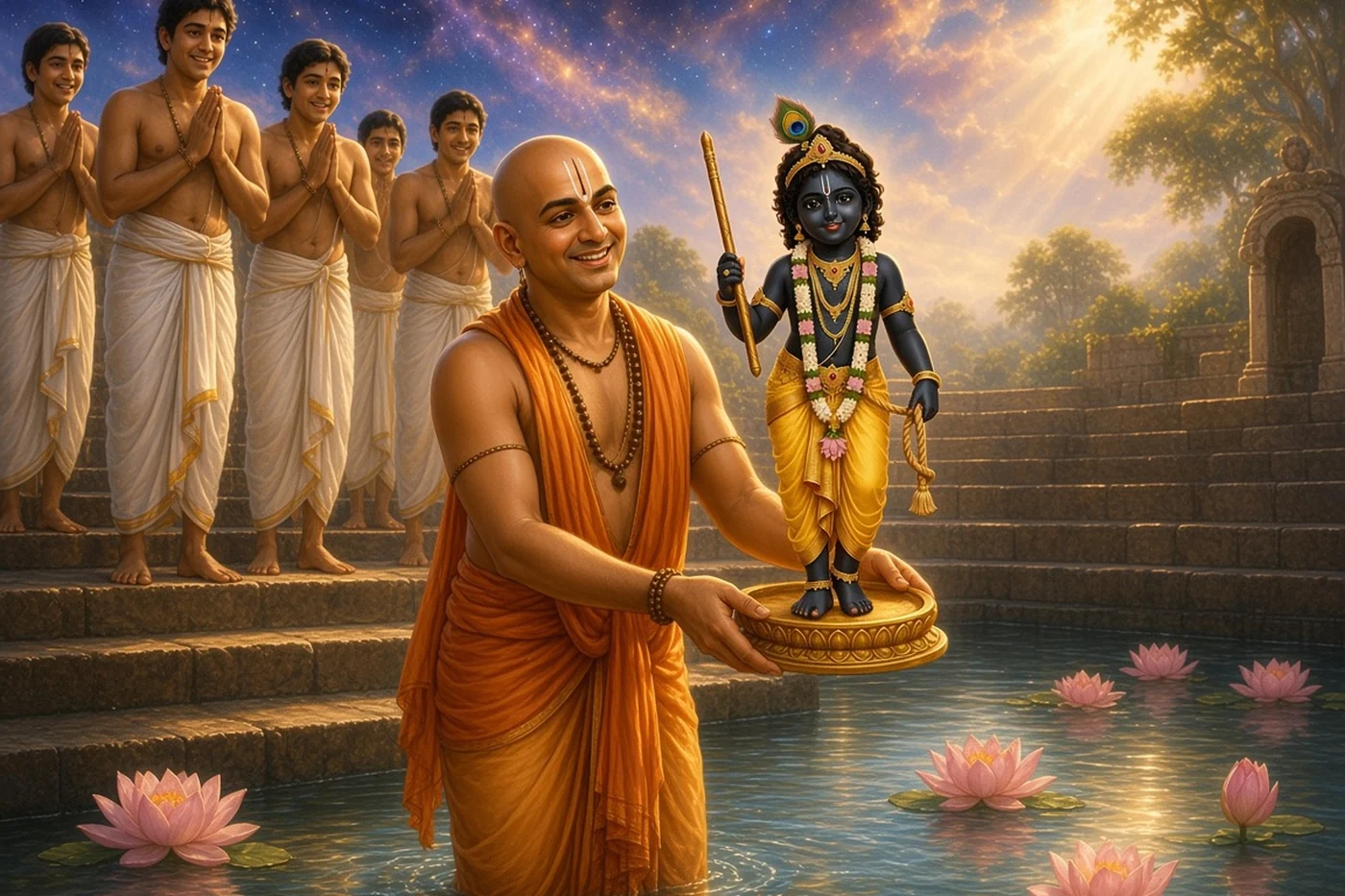
They carried the child into Udupi and washed the last of the clay off him in the tank that is called Madhva Sarovara. The crowd that gathered said light was coming off the image. Then Madhva told his men to take the god into the matha.
They tried, and could not move him. More men came to help. Thirty strong men pulled together, and the little figure stayed where it was as if it had grown into the ground.
"Leave him," said Madhva. "He wants me to carry him."
He lifted the child in both arms and carried him in, and set him up in a small, plain shrine. He wanted no towers for him. Instead he wrote down how the child was to be served, every hour of the day, and did the first worship himself. The child has been served that way ever since.
As the Sumadhva Vijaya sings it
Canto 9, verses 40 to 43 · Udupi · 2 min read
Narayana Panditacharya, the son of one of Madhva's own disciples, told Madhva's life in the fourteenth century as a long Sanskrit poem in sixteen cantos. In its ninth canto the image of Krishna comes to Udupi in four verses, and there is no ship in them at all.
Madhva had come home from Badari in the Himalaya with his commentary on the Brahma Sutras. At Udupi he went first to bow before the god of the old temple, Anantasana. Then he sat down with his own teacher, Achyutapreksha, and went through the new commentary with him until the old man gave up his doubts and took it for his own.
Then, the poem says, Madhva felt pity for good people everywhere and wished to keep them from harm, and so he resolved to set up an image of Krishna in Rajatapithapura, the city of the silver seat, which is Udupi.
Three or four of his disciples brought the image. They washed it, and laid it in water for a time, as the rules for a new image require. The poem calls the god in it the dearest of the cowherd women and the lord of Lakshmi, and it gives him a lovely face and a gentle smile.
When the day of installing came, thirty strong young men went into the water to lift the image out. They could not stir it. The god was present in it now, the poem explains, and Madhva had touched it, and it had grown too heavy for any of them.
Madhva went in and lifted it alone, without the least effort, and carried it up into the shrine and installed it there.
The poet later boiled his whole poem down to thirty-two verses for people who could not recite all sixteen cantos. In that short version, the Anu Madhva Vijaya, the image gets half a line: the Krishna that thirty young men could not shake, which Madhva brought in as easily as if he were playing. Where the image came from, neither poem says.