As Puri keeps it
Puri · Hera Panchami at the Gundicha temple, Niladri Bije at the Lion Gate · 3 min read
On the second day of the bright half of Ashadha, Jagannath went out of his temple with his brother and his sister, climbed onto a chariot, and was pulled up the Grand Road to the Gundicha temple by a crowd counted in lakhs. He did not tell his wife.
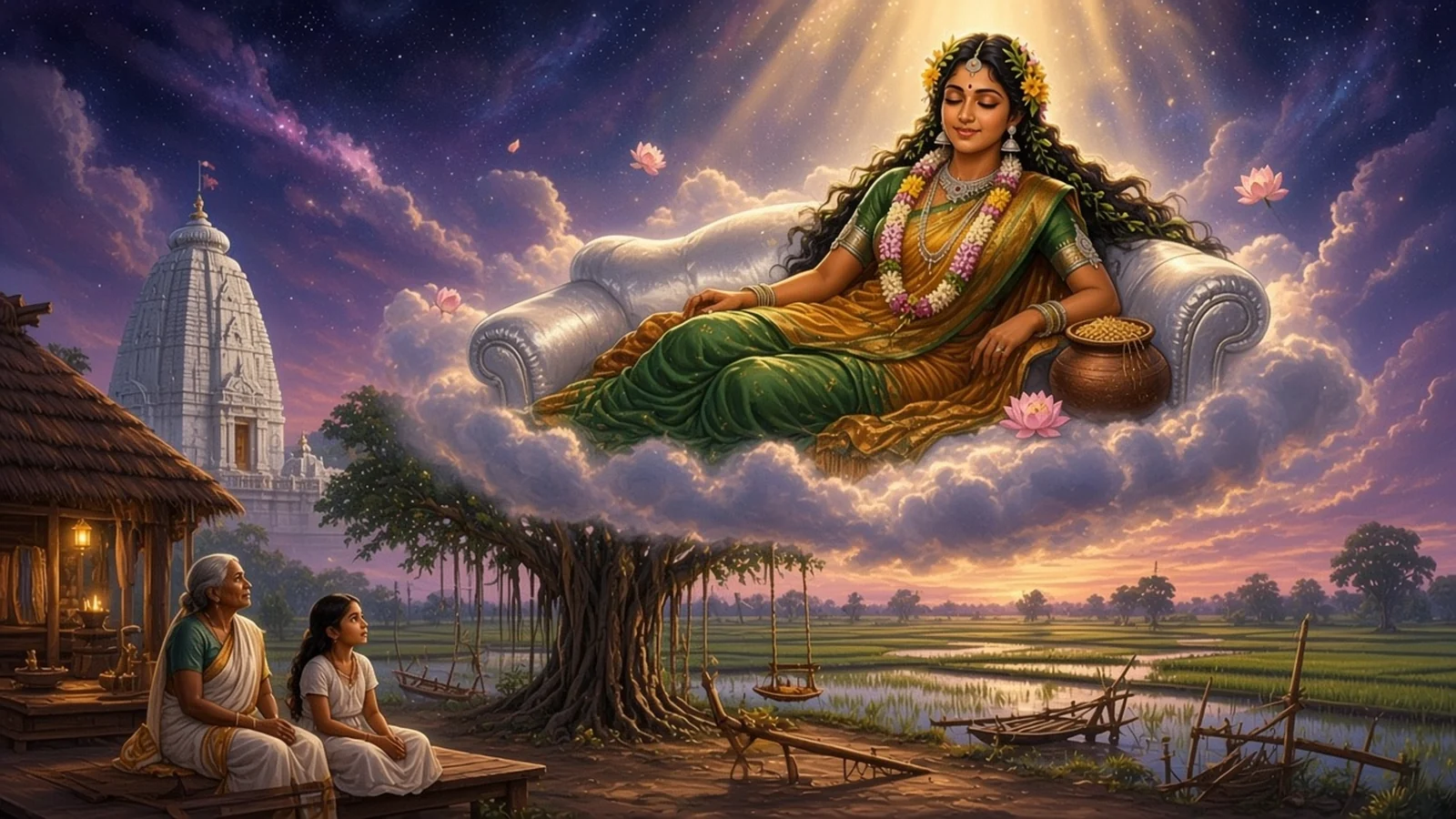
Lakshmi found out the way wives do. The temple went quiet, the kitchen fires went low, and the servitors who should have been at her shrine were three kilometres up the road.
"He has gone to his aunt's house," one of them told her. "With Balabhadra and Subhadra. For a week."
"For a week. And I am to sit here."
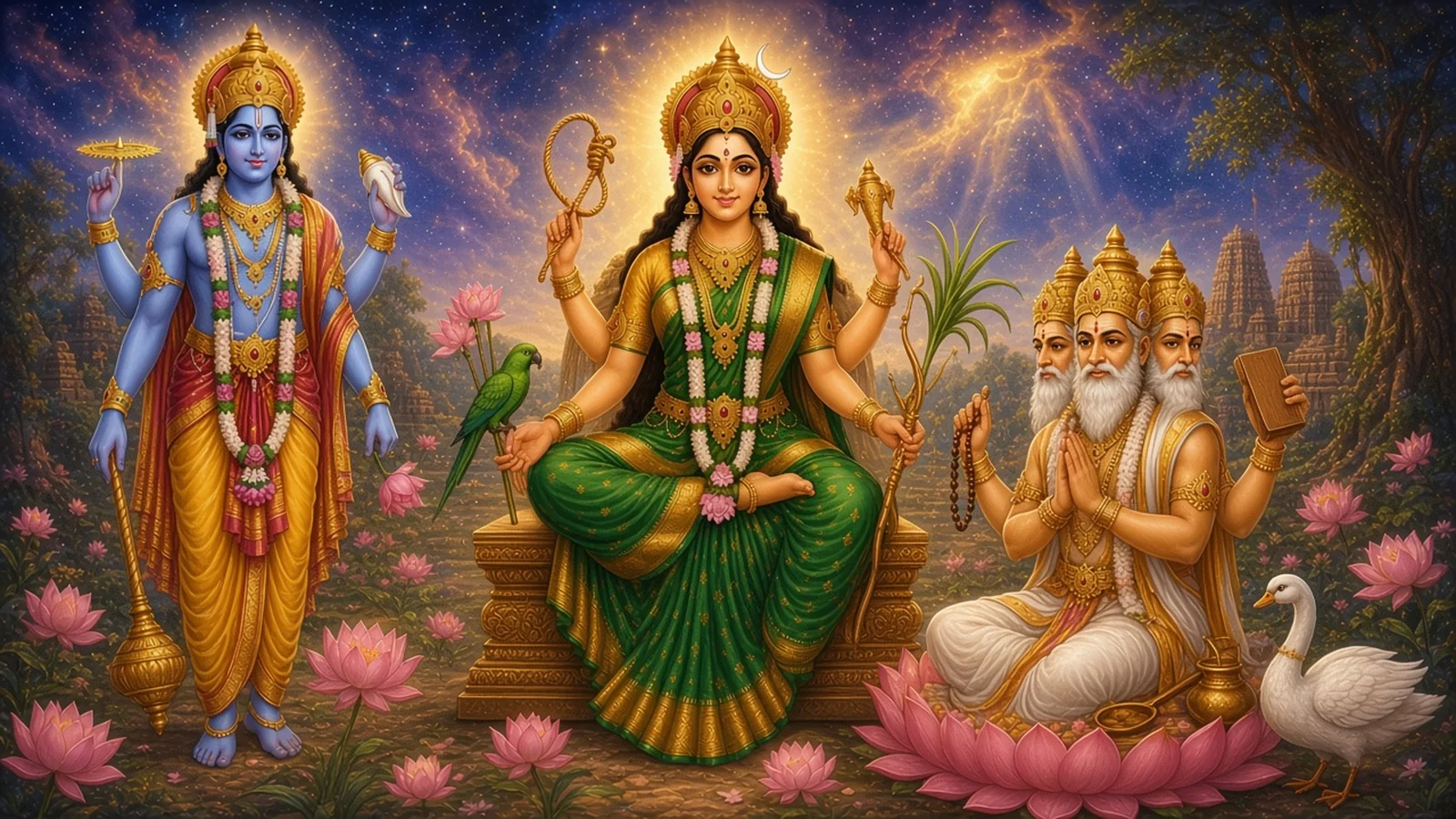
She went to Vimala first, the goddess of the temple's own ground, who sees everything inside its walls. The temple's lore says Vimala gave her a packet of mohachurna, a powder that draws a husband back, and told her to go and look at him.
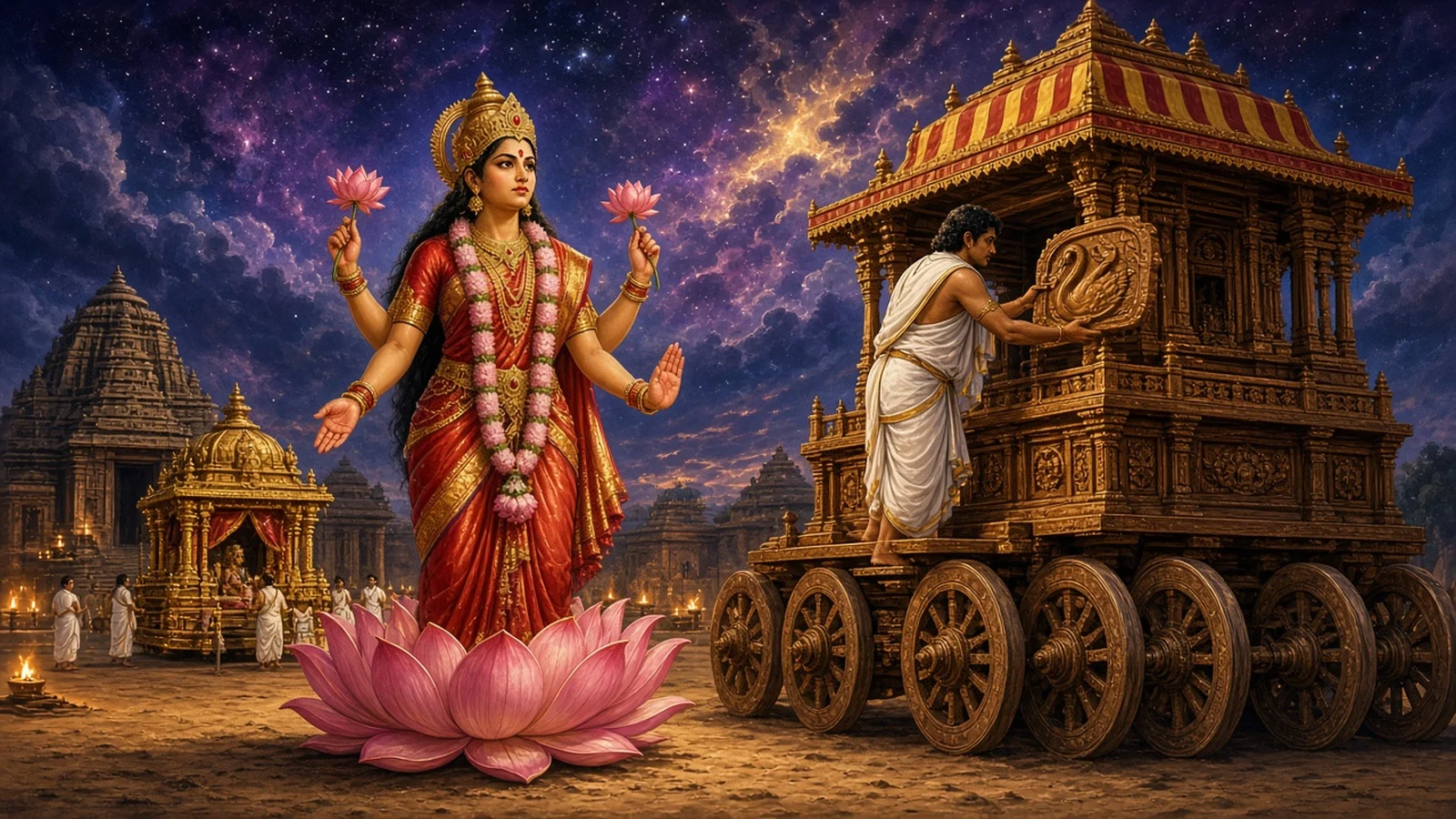
Hera means to see. On the fifth evening, after her bath and her dressing and the lamps, Lakshmi in her golden form was lifted into a palanquin and carried out of the Lion Gate and along the Grand Road, her own servitors round her, past crowds who had come to watch a wife go after her husband.
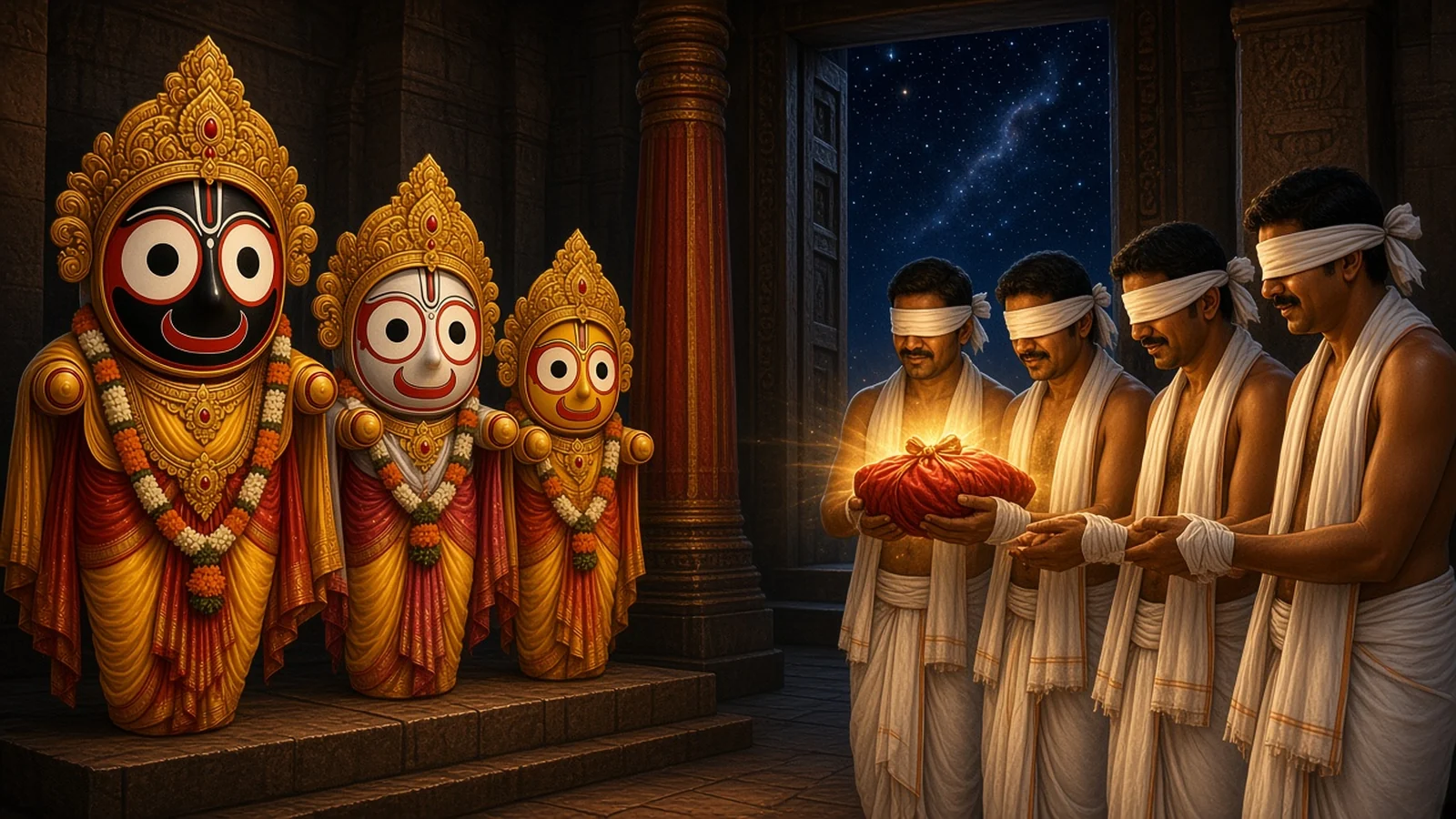
At the sands before the Gundicha temple they set her down. Jagannath's people came out to receive her as a guest, with curd and betel and the waving of the chamara. She was carried up to the Jaya Vijaya door of the hall, and a servitor of the Pati Mahapatra family came out with a garland in his hands.
"The Lord sends you this," he said. "The garland of his consent. He will come home."
"When?"
"In his own time, Mother."
Then the doors were shut in her face.
She did not raise her voice. She looked at the three chariots standing empty on the sand, and at the tallest of them, Nandighosha, red and yellow on sixteen wheels, and said to the attendant beside her, "Break something."
He climbed up and broke a piece from the chariot's side, the carved hamsa board, so that when the Lord came out in the morning he would see it.
Then she would not go back the way she had come, with music, past the people. She slipped out by the Nakachana gate on the far side, waited behind a tamarind tree until the road was dark, and went home through a back lane that is still called Hera Gohri Sahi, the lane of her return, with no procession at all.
The next morning the chariots were turned to face south, towards home. On the tenth day the three came back down the Grand Road, stopping at the aunt's temple halfway for a baked rice cake, and the king swept their chariots again. On the eleventh they sat on the chariots at the gate in gold, with golden hands and golden feet. On the twelfth a sweet drink of milk and cheese and banana was held to their lips in clay pots, and the pots were smashed on the road for the spirits.
On the thirteenth night they were carried in one by one. Balabhadra went in. Subhadra went in. The pillar Sudarshana went in. When Jagannath came to the Jaya Vijaya door, it was shut.
The women who speak for Lakshmi spoke from inside. "He went without a word. Twelve days. Let him stand there."
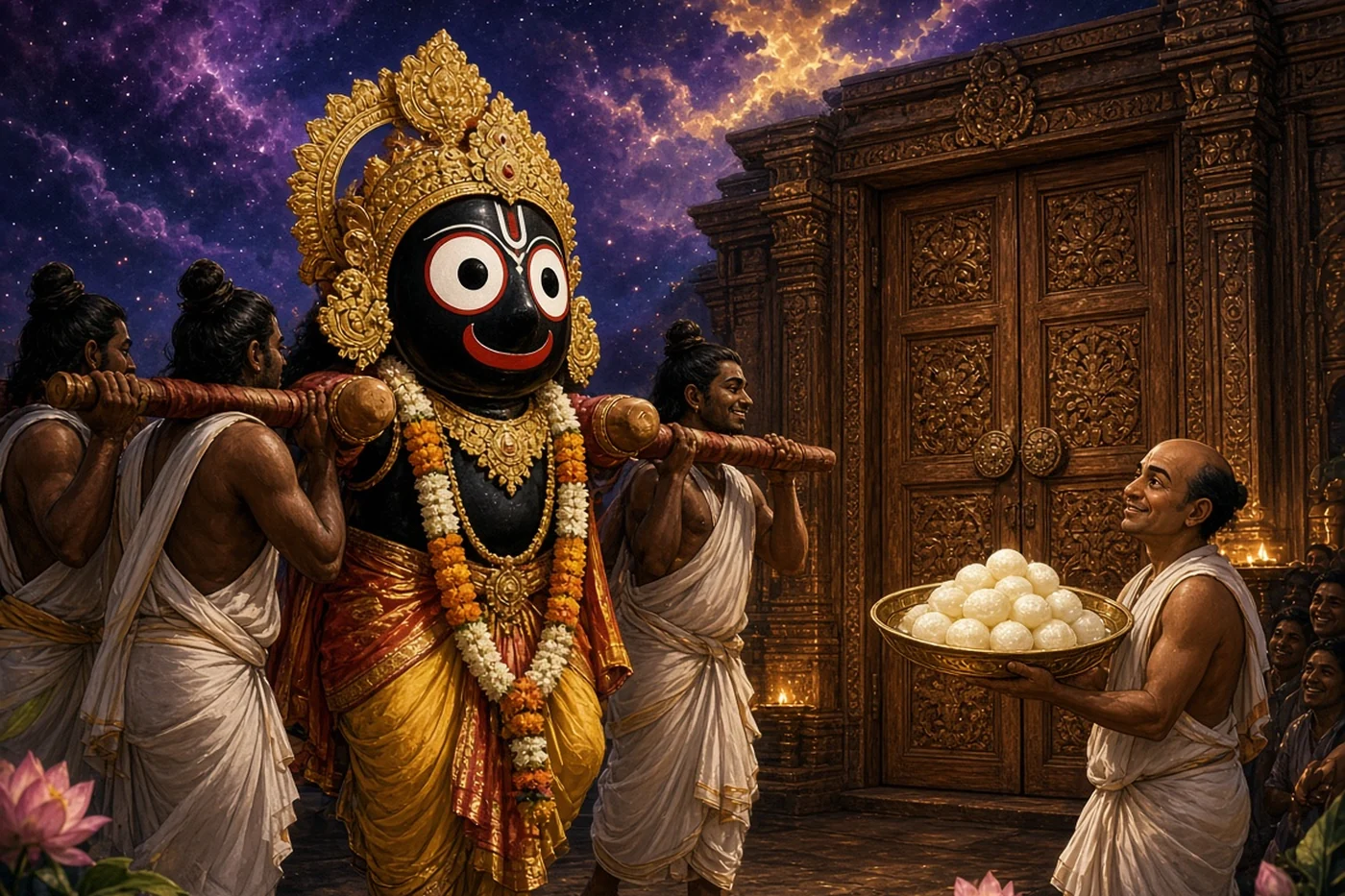
The Daitas who carry Jagannath spoke from outside. "He is the Lord of the Universe, and he is at his own door."
"Then let him knock like anybody else."
It went back and forth, as it goes every year, until the servitors of the inner rooms came forward with a dish of rasagolas, white balls of cheese in syrup, and offered them to the goddess in the Lord's name. The door opened. He went in and sat down beside her, and only then did he climb back onto the jewelled throne. Odisha has kept that night as Rasagola Dibasa since 2015.
As the Gaudiya Vaishnavas read it
Bengal and Puri · Chaitanya Charitamrita, Madhya 14 · 2 min read
Krishnadasa Kaviraja, who wrote the life of Chaitanya in Bengali, saw the fifth day through Chaitanya's eyes, and in his book it is not a sulk. It is a war.
King Prataparudra had told his minister Kashi Mishra to make that year's Hera Panchami grander than any before: every printed cloth, every bell and umbrella and yak-tail fan from the storehouses, musicians, dancers, and twice the food. Chaitanya and his companions sat in the garden by the Gundicha temple to watch.
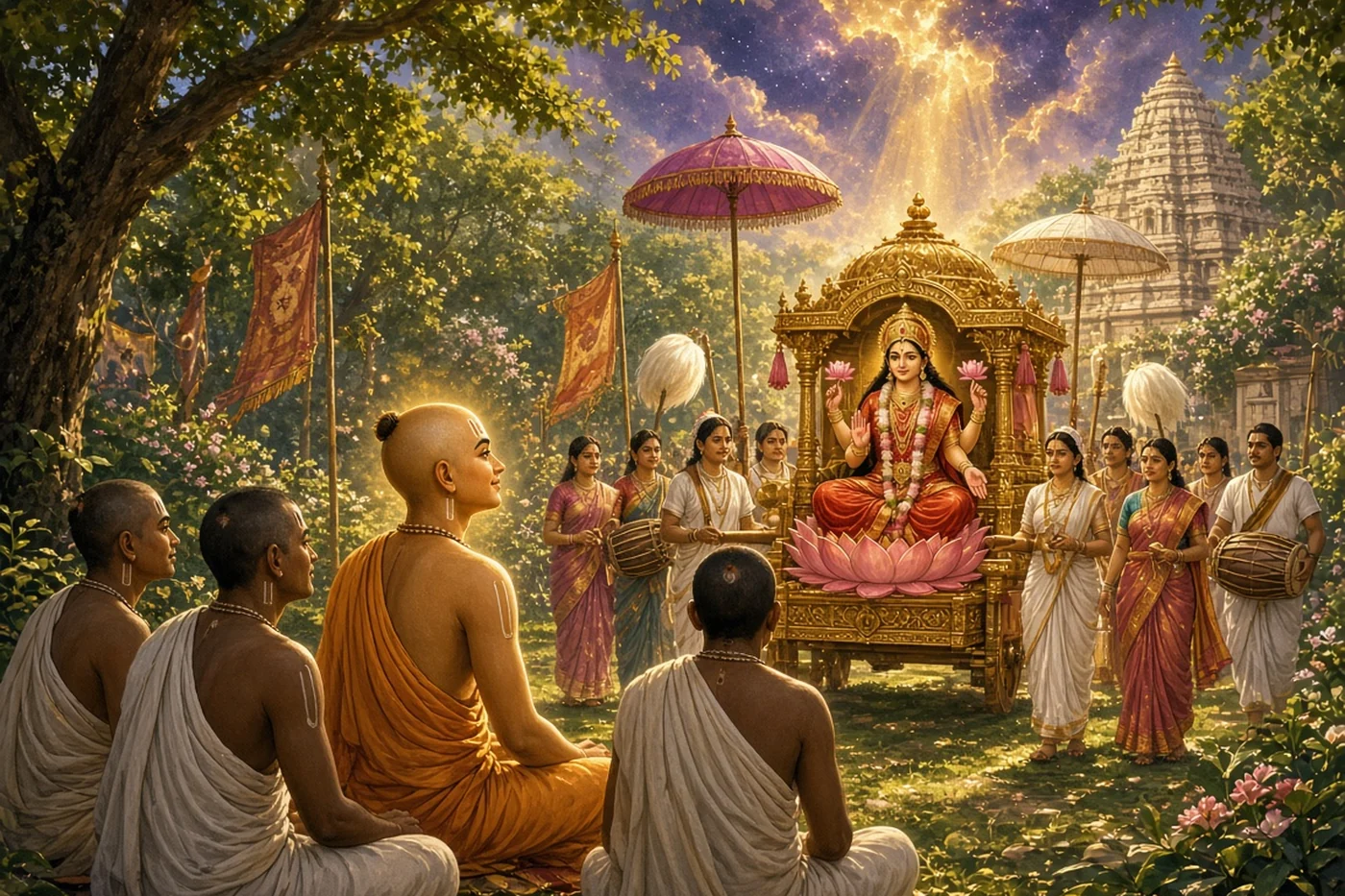
Before the goddess came, Chaitanya asked the question the day asks. "The Lord has every opulence in his own house, as he had in Dvaraka. Why does he come each year to these gardens, and why does he leave the goddess of fortune behind?"
Svarupa Damodara answered him. "Because these gardens are Vrindavan, and Lakshmi has no entry there. In Vrindavan the cowherd girls are his only companions. Nobody else can draw his mind."
Then Lakshmi arrived on a golden palanquin, with her maidservants and her musicians and her whole household, in a splendour Krishnadasa says nobody could describe. Her maids went straight for Jagannath's chief servants. They seized them, bound their hands, dragged them before the goddess and made them fall at her feet, and beat them and mocked them like thieves caught with the goods. Chaitanya's friends hid their smiles behind their hands.
"I have never heard of pride like this," said Svarupa. "Satyabhama was proud. The cowherd girls are proud. But the goddess of fortune goes to war against her own husband."
Shrivasa, who loved a joke, took up the maids' part. "Where is this master of yours, this expert in everything, who leaves a treasury like hers to go and pick flowers in Radha's garden? Bring him here. Bring him to Lakshmi."
The maids beat the chariot with sticks, he said, as if the chariot were to blame. And the servants of the Lord folded their hands and promised that they would bring him back to her the next day. She let herself be calmed, and went home to her quarters.
The Gaudiya commentary adds the piece Puri leaves unsaid: that when the Lord left for the festival he promised Lakshmi he would be back the next day, and that she waited two or three days before her patience gave out.
Then Shrivasa stopped joking and Svarupa answered him in earnest. All the wealth of Lakshmi, he said, all of Dvaraka and all of Vaikuntha, is a drop beside Vrindavan, where the trees give whatever is wished for, the cows give without end and the ground is made of jewels, and the cowherd girls outrank the goddess of fortune. Chaitanya heard it and was lost in the mood of Radha, and the chanting went on until nobody could stand.