As the Narada Pancharatra tells it
Kailash · chapter 13, as the Pitambara Peeth printed it at Datia · 2 min read
Brahma told this story, and the book that keeps it says it stands in the thirteenth chapter of the Narada Pancharatra.
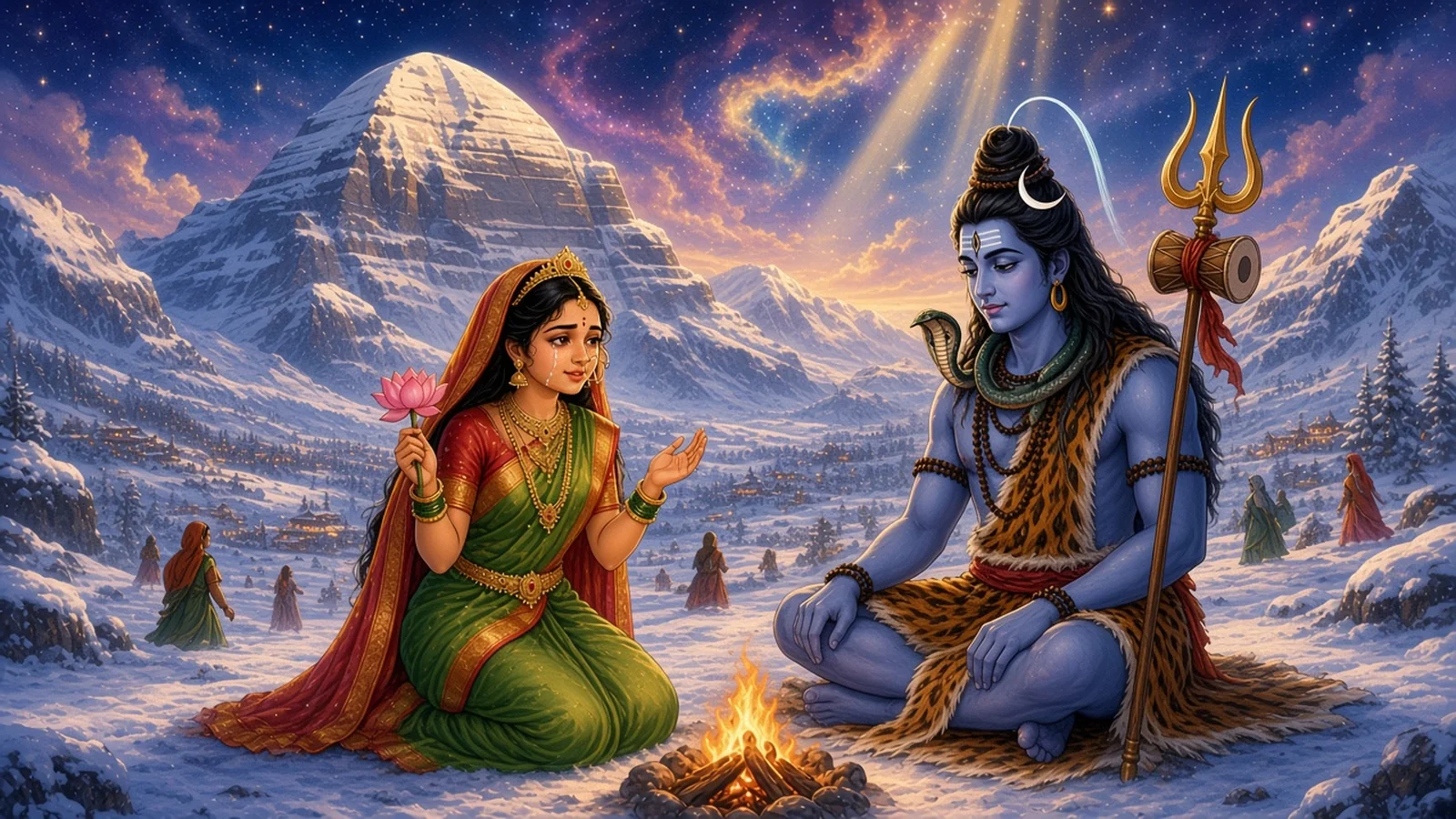
Once Shiva was living on a peak of Kailash, and Girija, the daughter of the mountain, sat in his lap. She was hungry. It was not the small hunger that comes before a meal. It was the kind that hurts.
"I am in pain with hunger," she said. "Give me something to eat, whatever is fitting."
"Wait a moment," said Shiva gently. "All will be well with you. In a moment I will give you food."
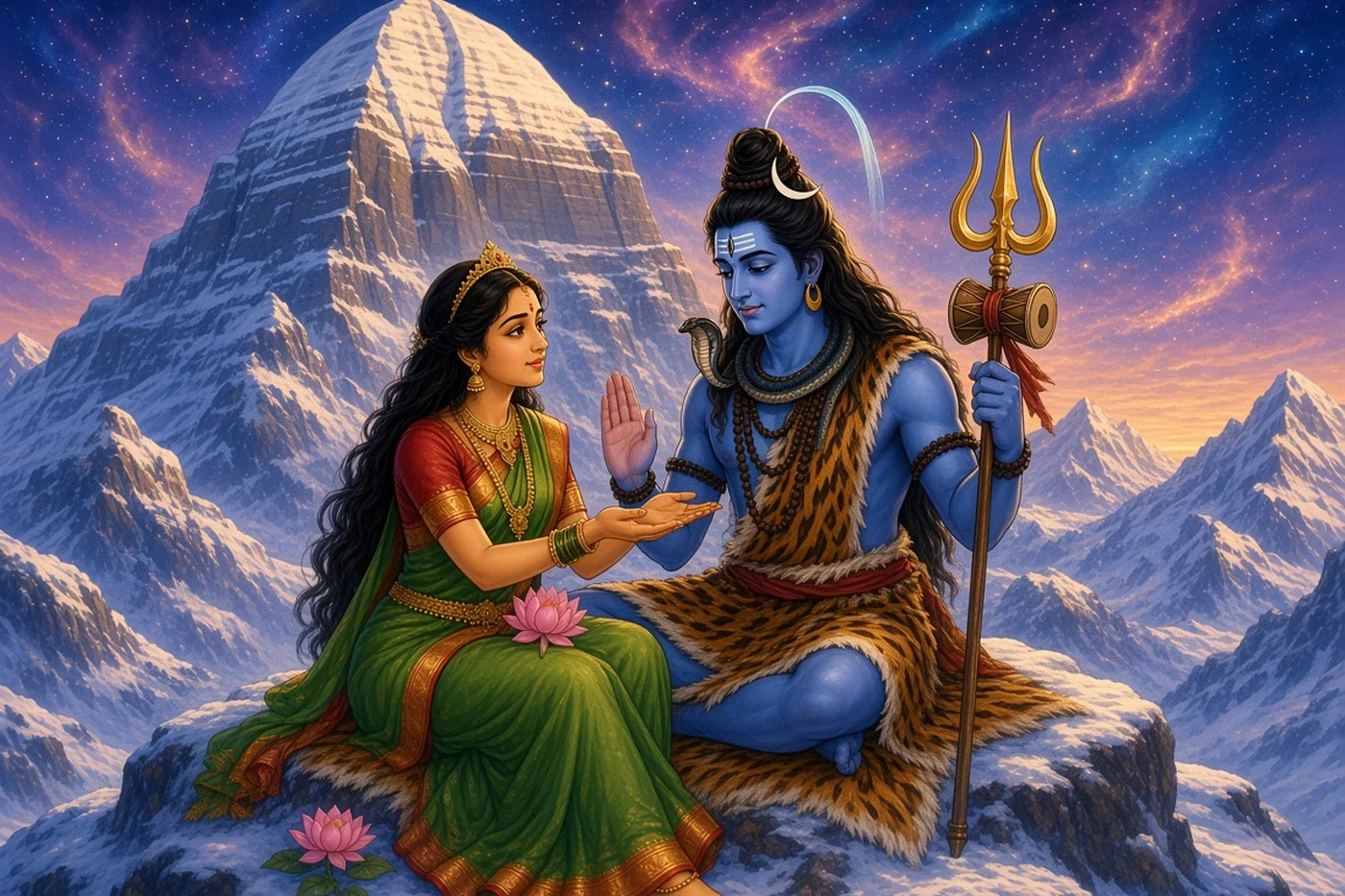
Then he fell silent, and said nothing more.
The moment passed, and no food came. The pain grew.
"Give me something to eat, Mahadeva," she said. "I am starving, lord of the world. I cannot hold off any longer. It hurts, Maheshvara."
The book calls Shiva a treasure of mercy, and he heard his beloved's words. But his answer was the same.
"Wait a moment," he said. "I will give you whatever you wish to eat."
So she waited again. And again nothing came.
"Give me food, master of the world," she said, for the third time. "I cannot wait."
Then she took hold of her husband and put him into her mouth.
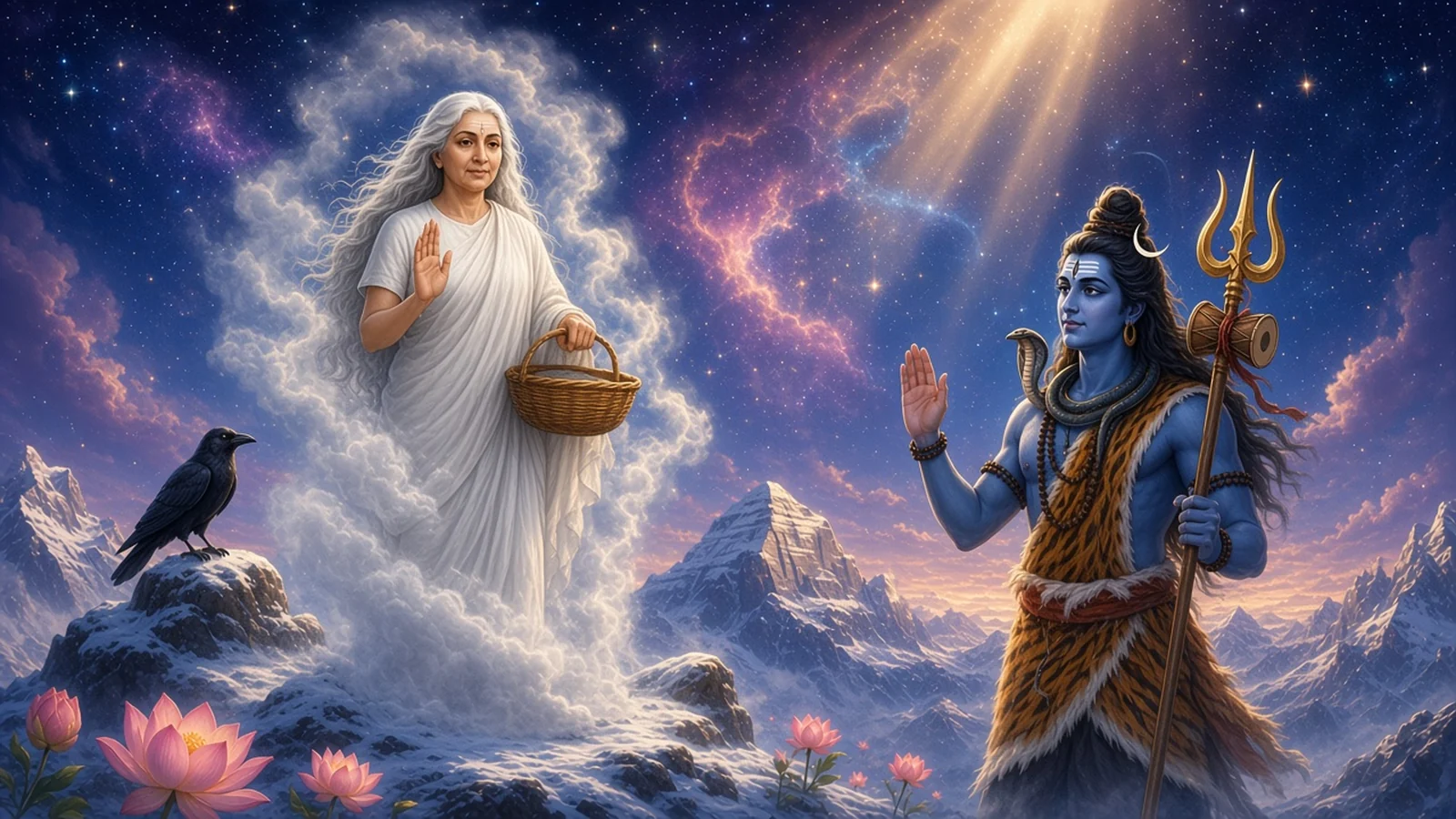
In an instant smoke began to rise from her body. It came thick and grey, a great cloud of it, until the goddess was wrapped in smoke from head to foot.
Then Shiva came out again. He took a body once more by his own power of illusion, and stood before her, and spoke.
"Listen, lovely one," he said. "Look with the eye of knowledge, and see. There is no man anywhere except me. And there is no woman anywhere except you."
She looked, and he went on.
"You have taken your husband into yourself. So you are a widow, faithful one. Put away the conch-shell bangles. Put away the red powder in your parting. Lay aside every mark of a wife whose husband lives."
Then he named what she had become.
"This highest thought of yours will be famous as Bagalamukhi. And because your body was filled with smoke, you will be remembered as Dhumavati."
"These are two more of your forms," he said, "two vidyas that bring their worshippers success, just as fierce Tara is your form, and Kali, who was once Sati, and Bhuvaneshvari, Tripura Bhairavi and Chhinnamasta. So are you in all of them, highest goddess."
So, says the book, Dhumavati came into the world: out of hunger that could not be put off, and a husband who kept saying wait.
The Pitambara Peeth at Datia printed this story in Sanskrit in 1978, in a small book on four of the ten goddesses. That was the year its swami gave Dhumavati a temple of her own on the hill, beside the goddess in yellow, Bagalamukhi, who is born in the same moment in this telling.
As the Pranatoshini Tantra tells it
the Himalaya · as David Kinsley gives it from a Bengali study of the tantras · 1 min read
In the Pranatoshini Tantra, a large compendium of tantric lore, the hungry wife is Sati, Daksha's daughter. She and Shiva are living together in the Himalaya. The scholar David Kinsley gives the story from Upendra Kumar Das's Bengali book on Shakta practice, which quotes the tantra.
Sati grows hungry, terribly hungry, and asks Shiva for food.
He does not tell her to wait. He refuses.
"Then I shall simply have to eat you," she says.
And she does. She swallows Shiva whole.
From inside her, Shiva pleads to be let out, and at last she gives him up again. But as soon as he is free he turns on her. He curses her, and the curse is a shape: from now on she must wear the form of a widow, the goddess Dhumavati.
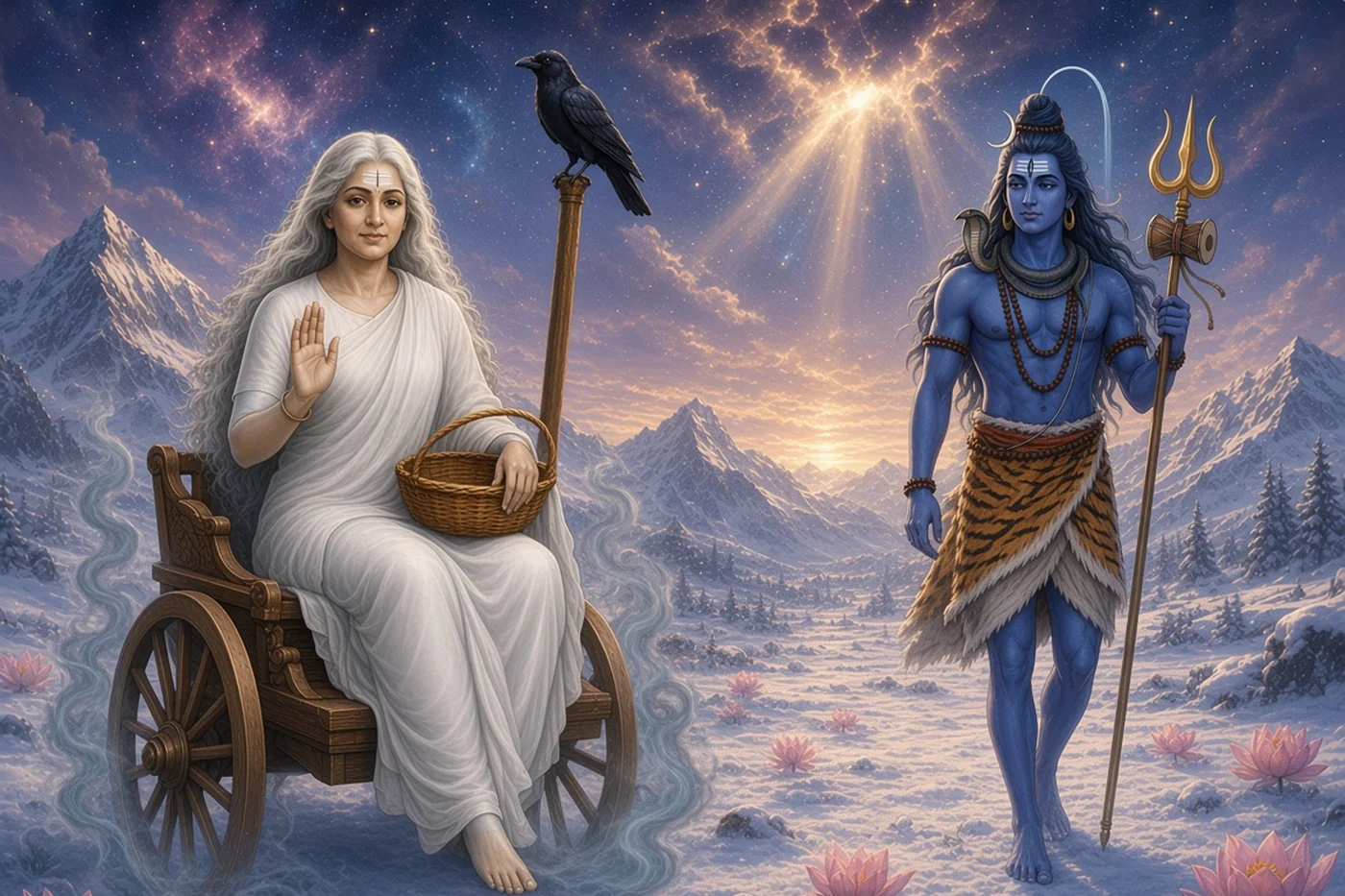
The almanac site Drik Panchang tells this same telling as the story behind Dhumavati Jayanti, the eighth day of the bright half of Jyeshtha. It adds that once she had given him back, Shiva rejected her.
Kinsley found something odd in it, and said so. By swallowing her husband the goddess has made herself a widow by her own act, without asking anyone. Yet in this telling she does not take the widow's form until Shiva's curse gives it to her. He also notes how the story echoes the birth of the ten Mahavidyas, when Sati, crossed by Shiva, grows angry and fills every direction. Here too the goddess is refused, and she answers by taking Shiva himself.