As the Bhagavata tells it
Bhagavata Purana 10.57 · Dwaraka, Hastinapura and Mithila · 3 min read
Word came to Dwaraka that the Pandavas and their mother had burned to death in a house of lac. Krishna knew better. Still, a death in the family is a death in the family, and he went with Balarama to Hastinapura to sit with the Kurus in their grief.
He was hardly out of the city when two Yadava lords, Akrura and Kritavarma, went to see a third, Satadhanva.
"Satrajit promised us his daughter," they said, "and then he gave her to Krishna. Why should he keep that jewel too? Let him go the way his brother went. Take the Syamantaka."
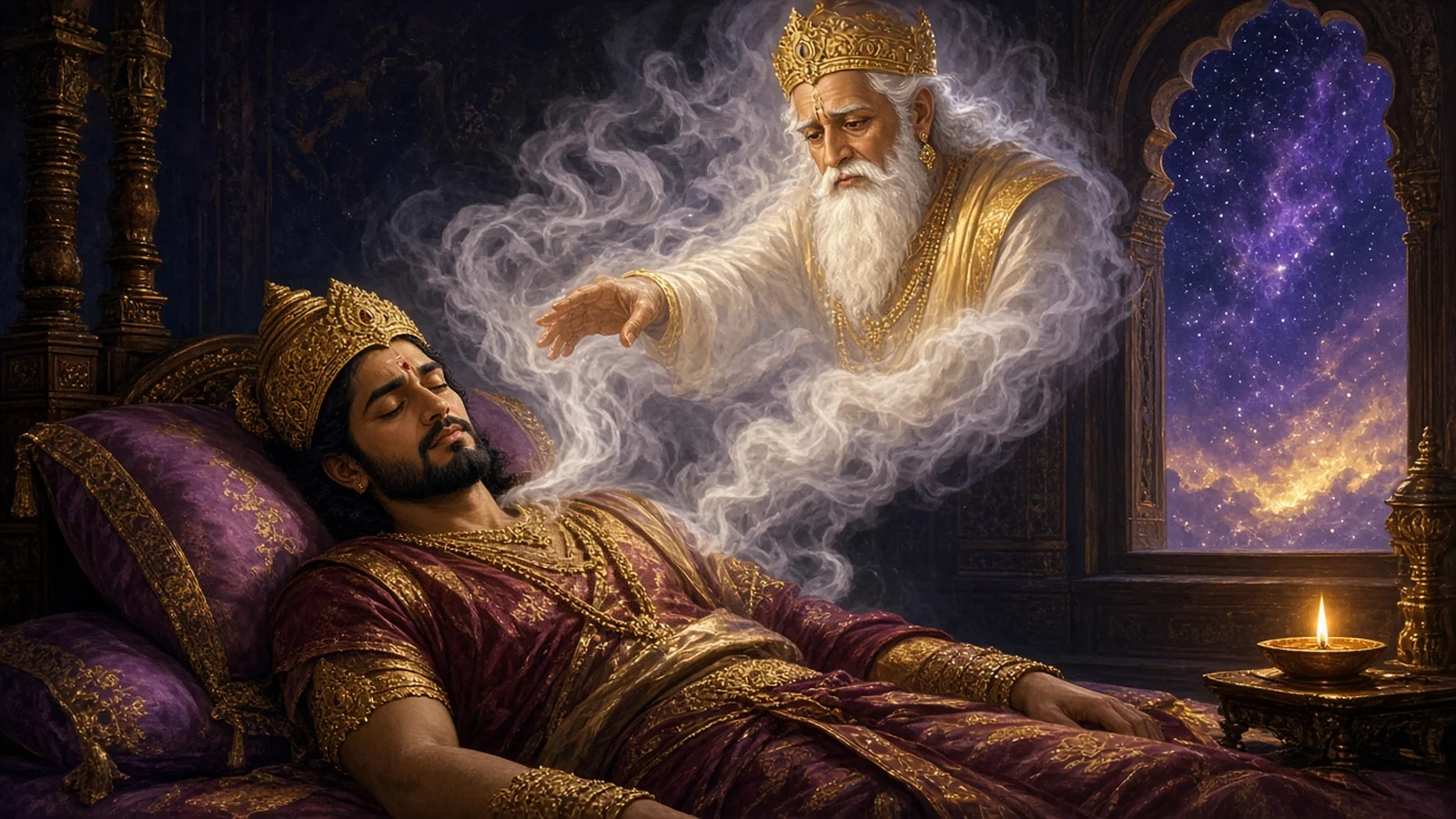
Satadhanva let himself be talked round. That night he went into Satrajit's house, killed him as he slept and came out with the jewel, while the women of the house wailed behind him.
Satyabhama found her father dead.
"Father," she cried, "they have killed me too," and she fell senseless beside him.
When she came to herself she did not wait for anyone. She had the body laid in a great vat of oil, so that it would keep until the rites could be done, and she set out herself for Hastinapura.
She found Krishna among the Kurus.
"My father is dead," she said. "Satadhanva killed him in his bed and took the jewel."
He knew already, the Bhagavata says. Still he and Balarama wept with her as men weep, and he brought her home at once, meaning to have the killer's head and the jewel back.
Satadhanva heard that Krishna had come home, and ran to Kritavarma.
"Help me," he said.
"Against those two?" said Kritavarma. "Think what became of Kamsa. Think how often Jarasandha came against them and went home beaten. No."
He ran to Akrura. Akrura would not fight the boy who had lifted a mountain at seven years old. So Satadhanva left the jewel with Akrura and rode for his life on a horse that could cover a hundred yojanas.
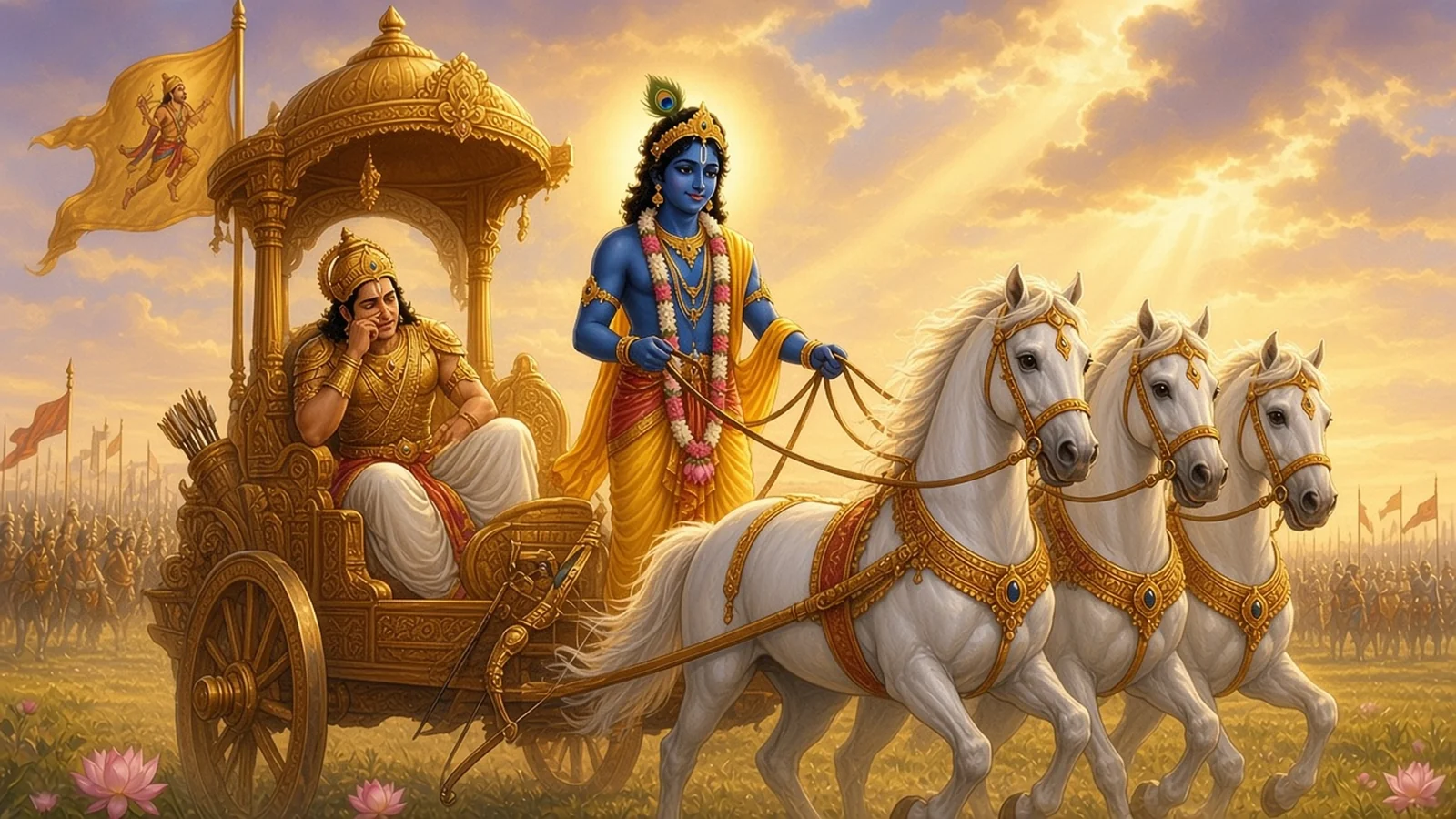
Krishna and Balarama went after him in the chariot that flew the Garuda banner. In a garden outside Mithila the horse collapsed under him. Satadhanva ran on, and Krishna jumped down and ran after him on foot, and cut off his head with the discus. Then he searched the dead man's clothes. There was no jewel.
"We have killed him for nothing," he told Balarama.
"Then he left it with someone," said Balarama. "Go home and find out who. I am going into Mithila. Its king is a friend of mine."
The king of Videha came out to meet him, and Balarama stayed in Mithila for years. Duryodhana came there to learn the mace from him.
Krishna went home and told Satyabhama that her father's killer was dead and the jewel not found, and he told her gently. Then he did her father's funeral rites with all the family.
Akrura and Kritavarma heard that Satadhanva was dead and fled from Dwaraka. Once Akrura had gone, hard times came: sickness, bad omens, trouble of body and mind. The elders remembered that rain had followed Akrura's father wherever he went, and said the city needed Akrura back. Krishna sent for him and received him with honour.
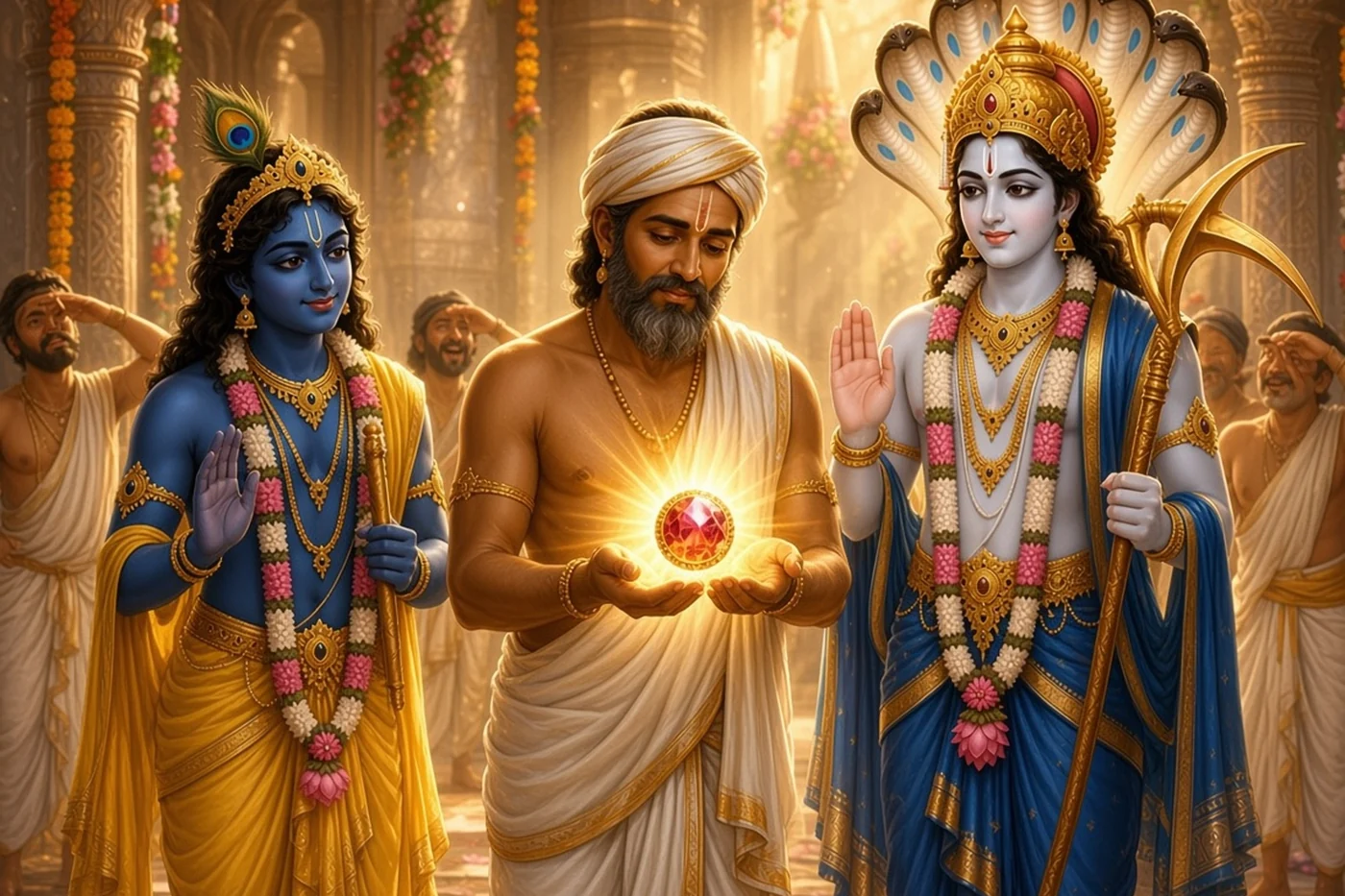
"We have always known the jewel is with you," Krishna said, kindly. "Keep it. Only show it once, so that my brother believes me."
Akrura, ashamed, took it out of his cloth, and the hall lit up as if the sun had come in. Krishna showed it to all his kin and gave it back to Akrura.
As for Satrajit's estate, Krishna ruled that it should go to his daughter's sons. They would make his offerings and pay his debts. So Satyabhama's boys became her father's heirs, and the jewel he had died for stayed with the man who had kept it hidden.
As the Vishnu Purana tells it
Vishnu Purana 4.13 · Varanavata, Mithila and Dwaraka · 2 min read
The Vishnu Purana sends Krishna to Varanavata, where the house of lac burned, to calm Duryodhana. Three men had wanted to marry Satyabhama: Akrura, Kritavarman and Satadhanwan. The first two urged the third on and promised to stand by him, and he killed the sleeping Satrajit and took the gem.
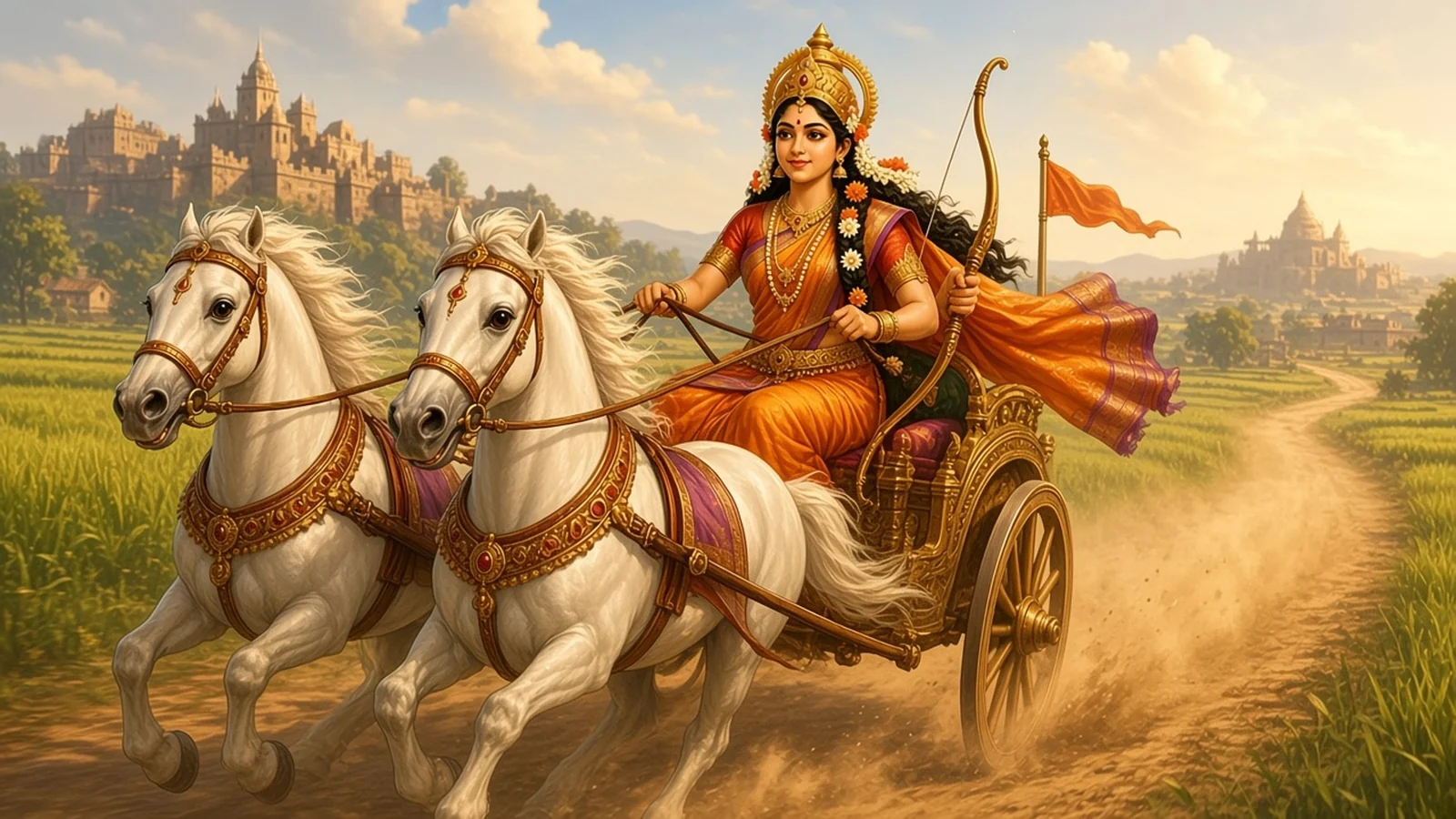
Satyabhama heard it, mounted her chariot and drove to Varanavata in a fury. She told her husband what had been done and begged him to avenge her father at once. The text says Krishna was always calm within, but his eyes flashed. "I will not take this from such a man," he told her.
At Dwaraka he went straight to Balarama. "A lion killed Prasena, and now Satadhanwan has killed Satrajit," he said. "With both of them gone, the jewel is ours by right. Get in the chariot."
Kritavarman refused Satadhanwan. Akrura would not fight, but agreed to hide the jewel. Satadhanwan fled on a mare that ran a hundred yojanas a day, and in the land of Mithila she fell dead. The ground was bad there, so Krishna left Balarama with the chariot, ran two kos on foot, threw the discus and took the killer's head. He found nothing on him.
This time Balarama did not believe him. "Shame on you, so greedy for wealth," he said. "You are no brother of mine. I am done with Dwaraka and all our house." He went to Videha, where Janaka took him in and Duryodhana learned the mace from him. After three years Ugrasena and the elders persuaded him that Krishna did not have the jewel, and brought him home.
Akrura, meanwhile, spent the jewel's gold on sacrifices for fifty-two years, and the land knew no famine. When at last Krishna made him show it at a festival, two people stood up to claim it. Balarama said it was his and Krishna's together, as they had agreed. Satyabhama said it was hers, because it had been her father's.
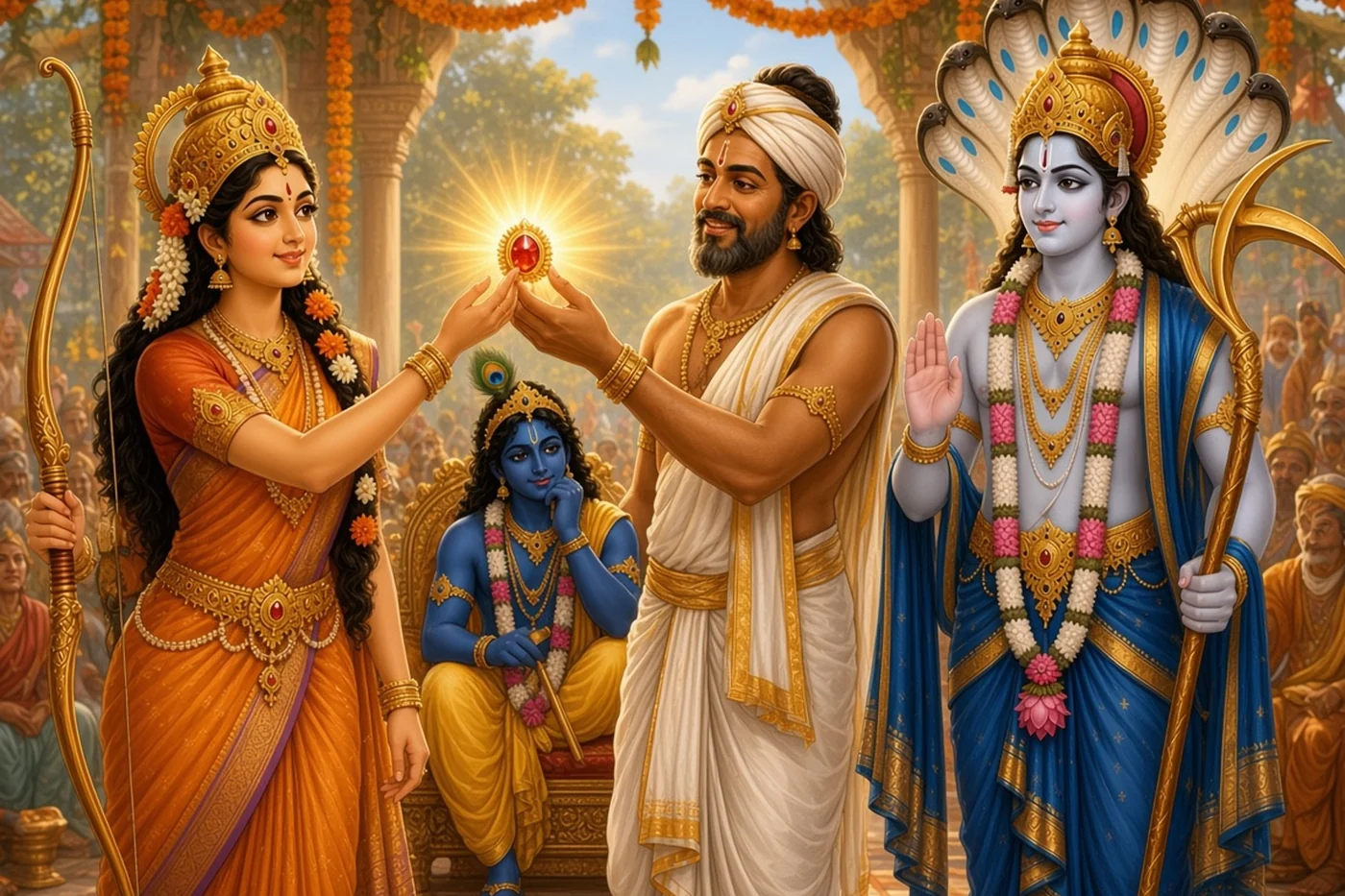
Krishna said he felt like an ox caught between the two wheels of a cart. The jewel, he said, must be kept by someone who lives in perfect self-restraint. He was not that man, with all his wives; Balarama loved wine too well; and Satyabhama was not likely to accept such a rule. So it went to Akrura, who wore it openly from then on.